Reining in Israel
IN SPITE of American presence, the G-8 statement on the Middle East appears relatively well balanced. First, it calls for “an end to Israeli military operations”. This goes against the American view, reiterated by Secretary of State Condoleezza Rice, that a ceasefire will not address the underlying issue of the “threat to Israel”. Second, without blaming either Hezbollah or Hamas by name, the G-8 leaders, gathered in St Petersburg, demanded on Sunday that the “extremist elements” stop shelling Israeli territory. America would have preferred a one-sided condemnation of Hezbollah and Hamas for a crisis that began with the massacre of Palestinian picnickers on a Gaza beach last month. The statement also has not blamed Syria and Iran by name for supporting Hamas and Hezbollah. Instead, the G-8 communiqué has asked “those that support” the extremist elements to stop doing so. It has also called for the release of the captured Israeli soldiers as well as of the Palestinian ministers and legislators kidnapped by Israel. The idea behind the statement is to “create conditions for a cessation of violence that will be sustainable”. The communiqué reflects the moderating influence of France, Germany and Russia when it calls on Israel to halt its operation in Gaza and for an end to attacks on the Jewish state.
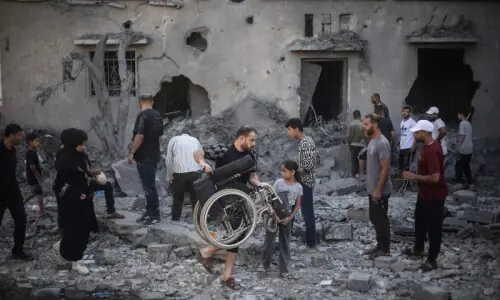
One can clearly see the difference between the US and the European Union on the issue. The US is opposed to a ceasefire, for a cessation of hostilities will not help Israel achieve its aim, which is to destroy as much of Hezbollah’s military capability and its Lebanese infrastructure as possible. President George Bush’s stand conforms to the standard US policy on the Middle East when he said Israel had “every right to defend itself”. He did not call for a ceasefire but merely asked Israel “to be mindful of the consequences”. This is in sharp contrast to EU foreign policy chief Javier Solana’s views. Shortly before leaving Brussels for talks with Lebanese Prime Minister Fuad Siniora, he said his first task was to secure a ceasefire. Russia and the EU too believe that Israel’s use of force was “disproportionate”. Millions have seen television images of the havoc wrought by Israeli firepower, which has killed more civilians than Hezbollah guerillas, whose destruction is Israel’s avowed aim. Prime Minister Ehud Olmert war-ned of “far-reaching consequences” because Hezbollah’s rockets are now reaching deeper into Israel. On Sunday, Hezbollah rockets killed eight Israelis in Haifa. On his part, Hezbollah chief Hassan Nassrullah has vowed defiance, saying that its missiles and his fighters were “in their full strength and power”.
It now remains to be seen how things will go at the UN, which has been asked by the G-8 leaders to consider ensuring “a security/monitoring presence” in Lebanon. Last week, the US vetoed a watered-down resolution in the Security Council calling for the Palestinians to release the Israeli PoWs and asking Tel Aviv to halt its operations in Gaza. The UN may approve of a monitoring force, but, if the past is any pointer, this will not ensure peace in the region. The real issue is Israeli hubris and America’s unqualified support to it. In spite of the military impotence of Arab states, resistance to Israel will continue in one form or another, so long as Israel is in control of the West Bank (and of Gaza every now and then). Without an Israeli withdrawal from occupied territories, peace in the Middle East will remain a mirage.
Formation of tribal jirga
SUNDAY’S announcement that a grand inter-tribal jirga will become functional later this week is a significant step towards restoring peace to North Waziristan through dialogue rather than confrontation. The 45-member jirga will include major stakeholders from all seven tribal agencies but its precise composition and mandate remain unclear. Government officials in the NWFP, however, maintain that the tribal council will have the authority to “negotiate and settle matters” with militants. The jirga’s formation is the latest in a series of moves by the NWFP governor, who appears to be more in tune with tribal sensibilities than his predecessor, to open a backchannel line of communication with pro-Taliban elements. This comes in the wake of a conditional ceasefire announced by militants on June 25, an offer that was subsequently endorsed by the Taliban who, through a July 8 decree, asked sympathisers to “stop fighting Pakistan”. North Waziristan has been relatively calm in the aftermath of these developments and it is believed that conditions in the agency are now conducive to substantive talks.
While tribal chiefs can play an important role as intermediaries, their influence over the militants is minimal at best. The authority of the maliks has waned in recent years, and it is the pro-Taliban clerics and their militias who now call the shots in the volatile parts of Fata. Given this shift in the traditional balance of power, pragmatism suggests that the jirga should, in addition to the maliks, include clerics who are respected by the militants. There is, however, a danger that the government’s willingness to talk may be interpreted as a sign of weakness. As such, it is critical that no compromise is made in two key areas. One, foreign militants must either leave the country or be handed over to the authorities. Two, the writ of the state cannot be open to negotiation and the law enforcement must be in accordance with the demands of peace and stability. Once calm returns to the area, it is imperative that the government follows up on promises of investment and infrastructure development. A lasting peace in Waziristan can only be achieved through job creation and poverty alleviation.
When legislators break the law
IT becomes a matter of considerable concern when legislators decide to take the law into their own hands. Regrettably, Friday’s incident in which an MNA representing a Karachi-based party angrily refused to hand over the firearm he was carrying in his hand luggage to security officials at Islamabad airport is not the first of its kind. Last year, the son of Law Minister Wasi Zafar thrashed a fellow passenger at Karachi airport in the presence of his father who himself is reported to be prone to temper tantrums that have resulted in violence on more than one occasion. What also comes to mind is an incident in January where Minister for Religious Affairs Aamir Liaquat’s car was stopped by the police during a traffic campaign against tinted glass. Not only was the minister, who was driving in a car with tinted glass windows, let off, the campaign itself was suspended the following day. Similarly, in Friday’s incident, the chief security official at the airport apologised to the errant MNA and transferred the official who had forbidden the parliamentarian to carry arms in a restricted area to another section of the airport.
Besides breeding a culture of discrimination where legislators and other high-ups are given preferential treatment over common citizens, and are not held accountable for breaching the rules, all this is also demoralising for those who are supposed to enforce the law. There is growing public resentment against the unchecked perpetuation of the VIP culture and an equal sense of helplessness among police and other security officials who are obstructed from carrying out their responsibilities in an even-handed manner. Interference of this sort by politicians and others with clout cannot be allowed. The law applies in equal measure to all and attempts to violate it should be strictly dealt with, no matter how influential a person the transgressor might be.
Asia’s changing strategic scenario
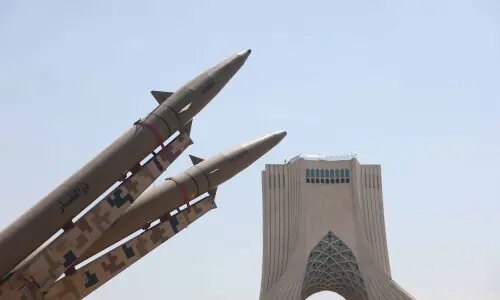
THE recent testing of seven missiles by North Korea and the varying reactions of the major powers to this event have once again highlighted the tensions which have been building up in Northeast Asia and the strategic realignment which is taking place in Asia. These developments have important implications not only for regional and global peace and stability but also for Pakistan’s security.
It is, therefore, critically important for us to study the changing strategic scenario in Asia so that our foreign policy avoids the dangers which are lurking ahead and is able to take advantage of the opportunities which wait for us.
There is by now a general consensus among security thinkers that the momentous developments taking place on the Asian continent in the form of the rise of China and India, the expanding strategic alliance between the US and Japan, Russia’s increasing tendency to reassert its power and influence in Central Asia to check the US military presence in the region, and the growing competition between the US and the major Asian powers to secure the continent’s vast energy resources would radically transform the Asian strategic scene in the coming years.
While the tectonic strategic shifts taking place in Asia will inevitably produce profound and far-reaching consequences, it remains to be seen whether this transformation will come about peacefully and smoothly or whether it is accompanied by major upheavals which have characterised the major power shifts among the great powers in the past. The answer to this will determine whether the 21st century is going to be a century of peace and progress or whether it will be marked by major conflicts and a cold war as was the case in the 20th century.
The phenomenal rise of China will prove to be the most important development of the 21st century and result in the redrawing of the security map in Asia. If current trends are maintained, China will emerge as the largest economy in the world in PPP (Purchasing Power Parity) terms and the second largest in dollar terms by the year 2020. There would be inevitably a corresponding expansion in China’s power and influence both at the regional and global levels.
The US, which currently enjoys global supremacy and would like to protect the status quo, is trying to counter the expansion of China’s influence by strengthening its alliance with Japan, building up India as a counterweight to China on the latter’s southern periphery, developing relations with the Asean member states, maintaining military ties with Taiwan, and strengthening its military presence in the Asia Pacific region.
The US in its drive to contain China is exploiting historical tensions in Sino-Japanese relations the territorial disputes in the East China Sea, the Taiwan issue and Japan’s worries about China’s rapid growth as well as the apprehensions of some Asean member states regarding China’s future policies, particularly those relating to territorial disputes in the South China Sea.
According to all indications, China’s supreme national objective remains its economic development to which all other national objectives have been subordinated. Since peace is an essential requirement for development, China’s foreign policy will continue to aim at avoiding a major armed conflict in the foreseeable future unless such a conflict is forced upon it through, for instance, the mishandling of the Taiwan issue.
Russia, which has been on the retreat since the end of the Cold War, is increasingly showing signs of impatience in the face of the expansion of Nato on its western borders, the US military presence in Central Asia, and the reliance on unilateralism by the Bush administration in the handling of foreign affairs. Russia, therefore, has its own reasons for developing strategic partnership with China.
It is, therefore not surprising that China and Russia have been gravitating towards each other to safeguard their essential security and economic interests. These developments also provide the rationale for last year’s Sino-Russian declaration that opposed the US policy of unilateralism. They called upon the US, from the forum of the Shanghai Cooperation Organisation, to close its military bases in Central Asia.
The enormous oil and gas resources of Central Asia provide an important motivation for the new Great Game being played in the region by the US, Russia and China and some major regional countries. However, Central Asia’s oil and gas reserves fall far short of those of the Persian Gulf region. In fact, the proven oil and gas reserves of the whole of Central Asia are far less than those of Iran alone. Therefore, the energy resources of Central Asia do not fully explain the intensity of the competition for influence in the region between the US on the one side and China and Russia on the other.
The US declaration of March 2005 to help India become a “major world power in the 21st century” and the US-India defence and nuclear deals of June and July last year are part and parcel of the new security architecture for Asia that Washington is in the process of designing.
Whereas Pakistan is seen by the US both as an asset and a problem in combating extremism and terrorism, Washington’s fast developing strategic relationship with New Delhi, which is qualitatively wider in scope and deeper in significance than the one with Islamabad, does not brook such limitations. That was the main reason why both President Bush and Secretary of State Condoleezza Rice during the visit in March this year ruled out a nuclear deal with Pakistan on the lines of the Indo-US nuclear deal.
India, however, is too big and important a country to place all its eggs in the US basket. It has a very important strategic relationship with Russia which remains strong particularly in the military field since Moscow is its biggest arms supplier. India is also engaged in the process of developing trade and economic relations with China which, in New Delhi’s view, might provide the additional benefit of neutralising to some extent Pakistan’s influence in China. Their bilateral trade is expected to reach the target of $20 billion by 2008.
Thus, as a Japanese scholar put it at a recent conference of security experts from the Asia Pacific region in South Korea which I had the opportunity to attend, two opposing camps consisting of the US and Japan on the one hand, and China and Russia on the other may be emerging in Asia although some contrary events occasionally blur this line of division. It goes to the credit of Indian diplomacy that New Delhi is in the enviable position of being wooed simultaneously by the US, Russia and China.
It wasn’t surprising, therefore, that there were fundamental differences between the reactions of the various major powers to the recent missile tests by North Korea. Whereas Japan, the US, Britain and France condemned the missile tests and called for UN Security Council sanctions against North Korea, the reaction of China and Russia was relatively milder. The latter two expressed their concern over the tests but opposed the imposition of sanctions on North Korea. Beijing emphasised that China and North Korea remained friendly neighbours and called for diplomacy to defuse tensions.
In an apparent reaction to North Korea’s missile development programme, Japan signed an agreement with the US last month to develop a joint missile defence system. Seoul, after the North Korea missile tests, shelved further food aid to Pyongyang but decided to go ahead with ministerial talks with it from July 11-14 in Busan.
This is the strategic reality within which Pakistan has to carefully navigate so as to safeguard its security and economic interests. As far as Pakistan’s external policies are concerned, the need of the hour is to evolve a coherent regional policy whose basis should be a strong strategic relationship with China. In addition, Pakistan should develop ties of friendship and cooperation with Iran, Afghanistan, the Central Asian Republics and Russia.
As for India, we should avoid the extremes of confrontation and capitulation. While we should continue to work for defusing tensions in Pakistan-India relations and promoting mutually beneficial cooperation, we should preserve our separate cultural identity which was the raison d’etre for Pakistan and avoid falling in the trap of such proposals as a South Asia Economic Union which ultimately would rob us of our economic independence. Our failure to do so would undermine the rationale for the existence of Pakistan as an independent country.
We need to pay greater attention than has been the case so far to the developments in Northeast Asia which directly affect the security of several of our friends. It is inevitable that in one way or the other, these developments will have repercussions for our security and economic well-being. We, therefore, need to pursue a carefully balanced policy in regard to the evolving situation in the region to safeguard our national interests.
Our policy should not only take into account our close friendly relations with China, the US, Japan and South Korea but also contribute to the strengthening of peace and stability in the region by encouraging the use of diplomacy rather than coercion to find negotiated solutions to regional problems through such initiatives as the six-party talks on North Korea’s nuclear programme.
The writer is a former ambassador. E-mail: javid_husain@yahoo.com