0
0

Jamal Abro: stylist with a purpose
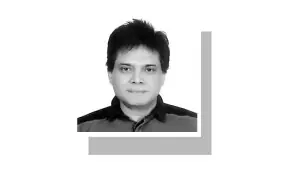
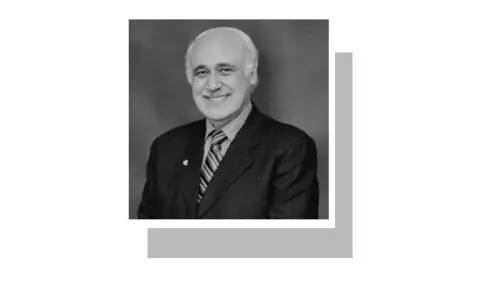
With the death of short story writer Jamal Abro on Wednesday night, Sindhi literature has lost a man of great style in fiction, a committed preacher of social justice and an upholder of truth.
Jamal Abro was born in a farming family of the Sangi village, Dadu district, on May 24, 1924. His father, Ali Khan Abro, was also a writer and poet. The system into which Jamal Abro was born was such that even a primary school did not exist in his village and he had to walk a long, thorny way to Mangwani, followed by secondary schools at Larkana and the Noor Mohammed High School in Hyderabad.
He was among the few students from Sindh who had their matriculation conducted by the Bombay University in 1941 as at that time the Sindh government had no arrangements of its own. This was followed by further education at the D. J. College, Karachi. He abandoned engineering to take up law, which he was to practise later.
The freedom movement and other political developments in the subcontinent influenced his thinking to a great extent, especially the Bengal famine (1943-44). Greatly moved by the misery, he went to Bengal to take part in relief work. On his return, he took up law practice first in Larkana and then in Karachi.
During this entire period, he came across a number of writers, poets, intellectuals and political activists - an interaction that persuaded him to start writing and exposing the social injustices meted out to the simple-hearted people of Sindh. He became one of the founding fathers of the Sindhi Adabi Sangat.
Jamal Abro took to short story writing in 1952 to reflect his concern over man-made injustices. He used his writings to express the realities of life in contrast to the popular use of unfamiliar similes and alien metaphors.
He observed his society deeply, its miseries camouflaged as traditions and tribal customs. He knew the greed, class conflicts and instruments of exploitation that plagued society.
Peerani, Seendh, Badtameez, Shah jo Phar, Munhun Karo, Kahamisay jo Kot, Pishoo Pasha, Badmaashi, Laari, Meharbaani, etc., are some of the stories that lent a new dimension to the diction and interpretation of the Sindhi short story.
Technically, Abro did not confine himself to stereotype characters. He combined the difficult narrative mode with a rich imagination to lend life to ordinary characters.
Pishoo Pasha, Badmaashi, Munhun Karo and Shah jo Phar reflect that expressiveness. His works now form part of the graduation syllabus in various universities. In 1949, Abro joined the judiciary.
He became secretary of the Sindh Assembly in 1972 from where he retired and devoted himself to reading and wrote very little after that. During the last years of his life, he studied mysticism. This led him to the concept of universal love.
Institution without rules
Divisional Public School and College Dera Ghazi Khan has been running without proper service rules and regulations since its establishment. It was set up in 1984 as a primary school.
It became a high school in 1992 and was upgraded to college level in 1994. The main campus with an area of 80 kanals has three sections: nursery wing, junior wing and senior girls wing. There is a separate campus for boys spread over 10 acres.
The overall control of the institution is with the president of a board of governors who is the district coordination officer. Last year, he abolished kinship facility without properly consulting the BoG and parents of students. He also increased admission fee of technology college which irked the students but the DCO did not acknowledge their protest.
Earlier the bureaucracy took interest in the DPSC for the education of their children, but when other A-class private schools were established it lost interest in the betterment of the institution.
The institution has been in a crisis since long. There are rival groups among the teaching staff who remain engaged in trying to get into the good books of the president of the school who has powers of appointment and dismissal. That is why the institution could not obtain the services of a learned and skilled principal on a permanent basis.
The board of governors comprises 14 members, seven private and six official. Some of them have no experience of education and some members are running their private academies. The board of governors was constituted on the direction of district Nazim and district coordination officer.
It should be reconstituted to make it more representative. For example, the president of the Chamber of Commerce, Dera Ghazi Khan, president District Bar DGK, district president Pakistan Medical Association, president Dera Press Club can be inducted in it. Representatives of parents can also be included.
Upwards of a hundred children of the teaching staff are getting free education in this institution while other students paying heavy fees are without the facility of kinship. Kinship facility should be restored while the teaching staff should pay half the fee for each child.
It is strange that without any proper legal provision two posts of vice-principal have been created. The abolishment of these posts is necessary to create a balance in the income and expenditure of the institution.
As many as 80 teachers are providing education to at least 2,400 students. The salaries of teachers vary from Rs2,500 to 3,500. There is no regular increment because service rules do not exist.
The monthly income of the institution is Rs1.4 million while Rs1.1 million are spent on salaries of a total of 132 employees and Rs0.1 million are spent on day-to-day expenditure. Last year, the president of the BoG increased the tuition fee twice.
Principal Tariq Munir told Dawn that earlier different accounts were not segregated, but now he had established separate accounts for each financial head. He suggested that all educational wings should be steered by the rotary panel which would be responsible for all activity and performance of the wing.
He told that the private members of the Board of Governors should be representatives of important walks of life. The principal told that the Board of Governors never met regularly.
He assured that a master plan regarding the documented performance of staff and expansion of DPSC building would be accomplished in 2005 if the authority concerned took interest.