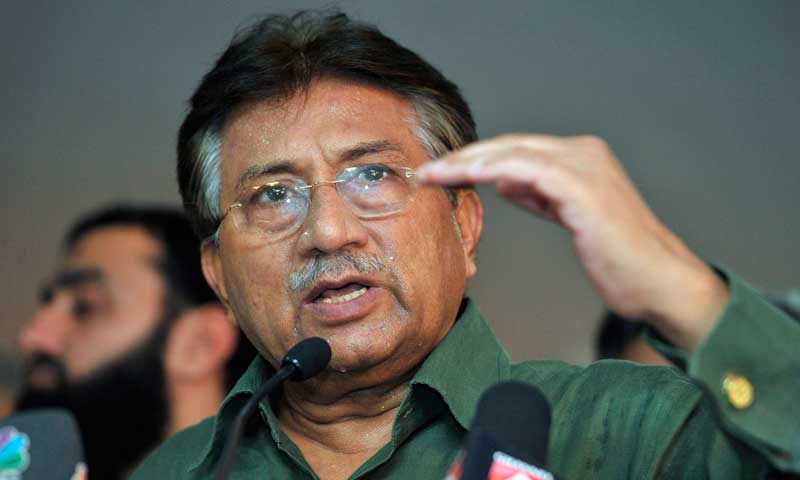


ISLAMABAD: The government will try former military ruler General Pervez Musharraf for treason for imposing emergency rule in 2007, Interior Minister Chaudhry Nisar Ali Khan said Sunday.
“Following the judgement of the Supreme Court and a report submitted by an inquiry committee, it has been decided to start proceedings against General Pervez Musharraf (for treason) under Article 6 of the Constitution,” Khan told a press conference televised live.
“It is happening for the first time in the history of Pakistan and the decision has been taken in the national interest,” Khan said.
The minister said the Supreme Court's Chief Justice would Monday receive a letter from the government requesting the setting-up of a tribunal of three high court judges to start proceedings against Musharraf for treason.
The government would also announce a special prosecutor on Monday.
Musharraf is already facing four major criminal cases dating back to his 1999-2008 rule, including one related to the assassination of former prime minister Benazir Bhutto in 2007.
Last week he asked a court to let him leave the country to visit his sick mother in Dubai. The court was expected to rule on the application on Monday.
There have been rumours in recent months that a deal would be reached for Musharraf to leave Pakistan without going through with his trials.
Khan said that three thrice-elected Prime Minister Nawaz Sharif's government had come to power five months ago and it had never demonstrated any “revengeful” gesture towards General Musharraf.
Musharraf overthrew the Sharif government in a bloodless military coup in October 1999, but a year later the Supreme Court validated the take over.
In November 2007 Musharraf imposed emergency rule, suspending the constitution and parliament and sacking top judges who declared his actions unconstitutional and illegal.
Musharraf technically became a free man this month when an Islamabad district court granted him bail over a deadly raid on a radical mosque in the capital in 2007.
His return to Pakistan in March was far from the triumphant occasion he had hoped for.
He was barred from contesting the general election, which was won convincingly by Prime Minister Nawaz Sharif, the man he ousted from power in 1999, and was hit with a series of criminal cases dating back to his rule.
Apart from the mosque raid, he faces charges over Bhutto's murder at an election rally in 2007, the death of a Baluch rebel leader in 2006 and the detention of judges in 2007.
He was put under house arrest in April, an unprecedented move against a former army chief in a country where the military holds huge power.