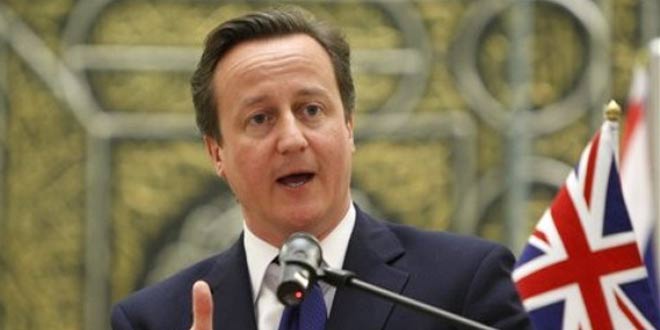

LONDON: Prime Minister David Cameron's plans for an imminent military strike on Syria were thrown into disarray on Thursday after a protest by lawmakers warning him to heed the “lessons of Iraq”.
The prime minister was forced into an awkward position on Wednesday in the UK Parliament when members from the opposition Labour party and lawmakers in his own Conservative party said they wanted more evidence before voting for military action.
It was unclear how Britain’s internal political hesitancy regarding the strike would affect the plans of United States and France for an imminent strike.
The government published an opinion from one of its top advisers on Thursday, showing that it was legally entitled to attack Syria given the current circumstances.
It further stated that should the UN Security Council block action, Britain was still be permitted under international law to “alleviate the scale of humanitarian catastrophe in Syria”.
The intelligence dossier accompanying the publication stated that there was no doubt that chemical weapons had been used in the poison gas attack that killed hundreds last week.
However, the memory of the Iraq war effectively diluted support for the prime minister back home with regards to the proposed strike in Syria.
Almost a decade ago, Britain had helped the United States (US) to invade Iraq after asserting – wrongly, as it later turned out – that dictator Saddam Hussein possessed weapons of mass destruction.
The country, already involved in war in Afghanistan, lost 179 troops in eight years of war after Iraq descended into savage sectarian conflict.
“We have got to learn from the lessons of Iraq. The people remember the mistakes that were made in Iraq and I am not willing to make those mistakes again,” said Ed Miliband, the Labour party's current leader.
Conservative officials were furious at the delay, accusing Miliband of opportunism.
“Ed Miliband is playing politics when he should be thinking about the national interest and global security,” said one Conservative official.
He alleged that Miliband kept changing his position for political advantage, and did not have global interest at heart.
PUBLIC OPPOSITION
The potent memory, of Iraq, however, is reflected not only in party politics, but also in public opinion surveys.
YouGov, an international internet-based market research firm founded in the UK, published a poll on Thursday showing growing public opposition to the proposed strike in Syria.
According to the results, only 22 per cent of the British public favour the missile strike, while 51 per cent of the people oppose the proposition.
Opponents said Britain has neither the money nor the evidence to justify further military action in the Middle East.
“We do not have a great track record of intervention, there is no appetite for it in the country or in the House of Commons,” said Andrew Bridgen, a lawmaker from the Conservative party who opposes immediate military action.
As a part of a two-party coalition government, Cameron’s domestic authority looks dented.
The prime minister’s rhetoric in parliament on Tuesday indicated his confidence of gaining support for the proposed strike on Syria, yet the tone changed on Wednesday when dozens of lawmakers questioned the evidence of chemical weapons.
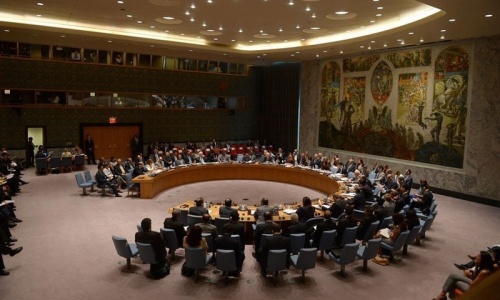
Hours of negotiation between the prime minister’s political managers and opposition leaders, Cameron’s office agreed to wait for United Nations Security Council decision regarding the findings from the chemical weapons inspectors before Britain responded militarily.
The parliament will vote on Thursday on a government motion cautioning President Bashar al-Assad and authorising military action in principle only.
It will need to vote again to authorise any direct military action.
Britain is to send six RAF Typhoon air-to-air interceptor jets to its Akrotiri base in Cyprus on Thursday, the Ministry of Defence said. Cyprus is just 200 km away.