
WASHINGTON: President Barack Obama said Wednesday he had not yet signed off on a plan to strike Syria, but action appeared likely after Washington abandoned the hunt for a last-minute UN mandate.
Political uproar in London, meanwhile, cast doubt on whether Britain will join American military action to punish President Bashar al-Assad's regime for a chemical weapons attack, should the response take place before next week.
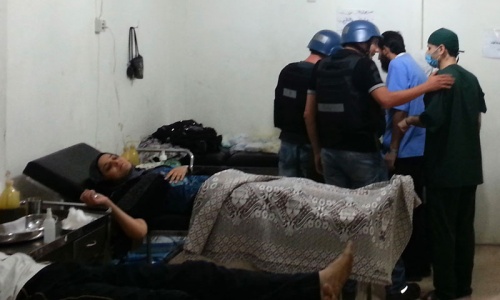
And a team of UN inspectors pressed on with its hazardous work in Damascus, testing victims of the alleged poison gas attack, which killed hundreds of people last week and threatens to draw reluctant Western states into a vicious civil war.
Obama, who has warned that the use of chemical weapons in Syria would cross a US “red line,” said Washington had definitively concluded that the Assad regime was to blame for last week's attack.
A senior White House official told AFP that the administration will brief senior US lawmakers on Thursday about classified intelligence about the chemical attack.
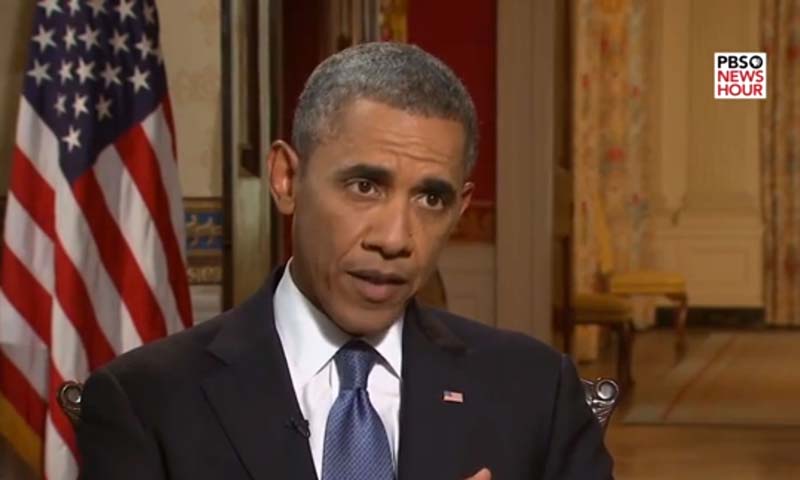
Asked how close he was to ordering a US strike, expected to start with cruise missile raids, Obama told PBS NewsHour: “I have not made a decision.”
But he warned that US action would be designed to send a “shot across the bow” to convince Syria it had “better not do it again.”
He admitted that the limited strikes envisioned by the White House would not stop the killing of civilians in Syria but said he had decided that getting involved in a civil war that has already killed 100,000 people would not help the situation.
The US leader, who wants to seal a legacy of ending foreign wars, not getting into new ones, argued that it was vital to send a clear message not just to Syria, but around the world.
“We do have to make sure that when countries break international norms on weapons like chemical weapons that could threaten us, that they are held accountable.”
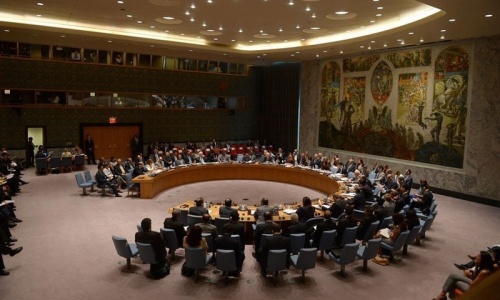
Earlier, Washington bluntly signaled that a UN Security Council resolution proposed by Britain that could have given a legal basis for an assault was going nowhere, owing to Russian opposition.
“We see no avenue forward, given continued Russian opposition to any meaningful Council action on Syria,” State Department deputy spokeswoman Marie Harf said.
“We cannot be held up in responding by Russia's continued intransigence at the United Nations, and quite frankly the situation is so serious that it demands a response,” Harf said.
British Prime Minister David Cameron was meanwhile slowed by a parliamentary revolt and was forced to pledge he would not order military action until the report by UN inspectors has been published.
Cameron plans to put his case to lawmakers on Thursday, but with a majority in doubt on the issue a second vote, possibly early next week, will now have to take place before British forces can join the fray.
White House officials would not immediately say whether Washington would wait for Britain before launching any military action.
Syria's nervous neighbors meanwhile stepped up their preparations for conflict as a strike appeared imminent.
Israel authorized a partial call-up of army reservists, Turkey said its forces were on heightened “vigilance,” and New York oil hit the highest level -- $112.24 per barrel -- for more than two years.
“The region is like a gunpowder depot,” Iran's Supreme Leader Ayatollah Ali Khamenei warned in a condemnation of the West's reported military plans.
The United Nations says its inspection team needs two more days to finish their work. But it has given no deadline for reporting on whether chemical weapons have been used.
The inspectors went to the Ghouta district east of Damascus on Wednesday to collect blood, urine and hair samples from victims of the August 21 attack.
The United States, Britain and France blame Assad's forces for the attack using chemical weapons, which are banned under an international convention.
The Syrian government has blamed the attack on “terrorist” rebels. Its UN ambassador, Bashar Jaafari, said Wednesday that Syrian soldiers had been gassed in three new incidents near Damascus since last week.
Russia, which has vetoed three UN Security Council resolutions aiming to increase pressure on Assad, has maintained its support for his government.
But it also evacuated more than 100 people from the Syrian city of Latakia on Wednesday.
Russia's Foreign Minister Sergei Lavrov told Britain's Foreign Secretary William Hague that the international community must wait for the UN inquiry to be completed before taking any further steps, the Russian Foreign Ministry said.
In another conversation with UN Syria envoy Lakhdar Brahimi, Lavrov said Western military strikes against Assad would destabilize the entire Middle East.
The Syrian government has meanwhile defiantly shrugged off the growing military threat.