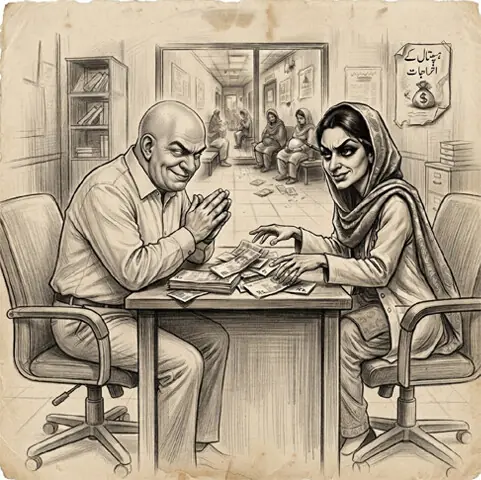
I WOULD like to highlight the psychology and social history of the satirical comments doing the rounds in the media and on cellphones about President-elect Mamnoon Hussain’s links to the cloth and food business community of Burnes Road, Karachi.These satirical comments emerged in the minds of the government servant class and take us back to the 1857 War of Independence when the British Raj eliminated land entitlements of the aristocracy.
The landed aristocracy, especially Muslims, found themselves to be penniless, as they not only lost their entitlements but their regular earnings from their land holdings also disappeared. They found themselves with no marketable skills or knowledge. Their Persian skills became worthless overnight, as the official business started being transacted in English (recall the famous saying ‘Farsi seekho, baicho tael’).Culturally, the aristocracy, especially Muslims, had looked down upon craftsmen and tradesmen as ‘kammi’ (menial jobs) and avoided trades and crafts that required working with hands. They used the terms related to crafts pejoratively and disparagingly: jolahay (artisan), taeli (oil seller), kumhar (potter), qasai (meat seller), baniya (shopkeeper), halwai (maker of sweets), mazaray (field hand), etc.
I can still recall the echo of the intended contempt in these words uttered by old and long-gone family elders in the early 1970s.
Hence, Muslims effectively shut themselves out of businesses related to these crafts. Therefore, aristocrats had no option but to go for English studies at new schools and colleges so that they could eventually become government ‘servants’.
Those who did not take to the new mode of education towards the government route and also shut themselves out from trades and crafts went hungry.
In short, we saw during the late 19th century the start of a mad rush towards the secure job of the British India government servant, and it is continuing even after partition.
However, the love for security and official residences still reigns supreme among the officials living in Islamabad. To hide their cognitive dissonance, they resort to satire and jokes on the working class and those who wanted political and financial autonomy.
Jokes denigrating Afghan tribesmen were a mechanism to subdue and humiliate them as they could not be tamed by the British. The community led its life independently. In fact, it still does.
There are also settled business communities like Memons and Chiniotis who are enterprising and create their own business space, using the trading system for their liberation. They are the real risk-takers. They have also been made the butt of jokes. Unfortunately, many unsuspecting from among us relate to these jokes without realising how they were designed to malign our psyche and mentality.
If today, even after more than 65 years it is not time to get out of this slave mentality that disparages entrepreneurial risk taking, then when would it be? Unless we begin to take our destiny in our own hands and stop denigrating craftsmanship, things would never change.
However, the change is visible and is coming. We now see people looking favourably at crafts and businesses. For example, we now see in Pakistan upscale and trendy businesses keeping names such as ‘Darzi’ and ‘Kaarigar’ for boutiques, ‘Mochi’ for shoe shops and ‘Halwai’ for sweet sellers.
This financial autonomy is bound to lead to political autonomy.
PROF (Dr) IRFAN HYDER
Institute of Business Management
Karachi