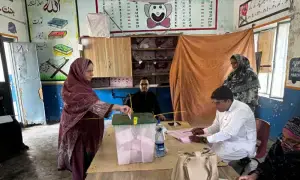
The gender divide is systematic in Pakistan’s electoral system. Not only that women were barred from voting or contesting in parts of Pakistan, they were not even registered as voters in many other parts. In fact, Pakistan counted 11 million fewer women registered voters than men in the recent elections.
The statistics provided by Election Commission of Pakistan (ECP) paint a gloomy picture of the gender divide, which is more pronounced in some parts of Pakistan. In Khyber Pakhtunkhwa (KP), only one in three voters was a woman. The highest share of women voters was observed for Islamabad and the Federal Territories where women represented 46 per cent of all voters.

Pakistan’s electoral system allows for reserved seats for women to address the gender bias in electoral outcomes. While the motivation behind the move for reserved seats is commendable, the outcome hardly meets the intent. In fact, the reserved seats have rested more power in the hands of a handful of men who appoint their favourite women to the legislature. It would have helped if the women alone elected the women candidates for the reserved seats instead of the richest and the most influential half a dozen Pakistani men.
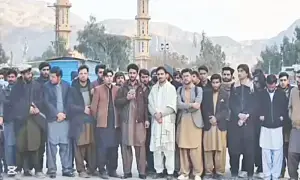
In some parts of Khyber Pakhtunkhwa, where the share of women registered voters was already the lowest in Pakistan, political parties agreed not to allow women to vote in the elections. This is one of those odd moments of consensus in Pakistan where consensus on political matters is not only rare, but almost non-existent.
The Associated Press recently reported that in the 2008 elections, 564 polling districts recorded zero votes cast by women. This was partly a result of an understanding reached between political parties to deny women the right to vote. Similar agreements were revealed in the 2013 elections where candidates in Upper and Lower Dir, to name a few, agreed to bar women from voting in the provincial assembly elections.
Why Islamists oppose women enfranchise?
While Islamic injunctions may not prevent women from participating in the political process, Islamists certainly do. There is an obvious correlation between the degree of religiosity at a place and the women’s ability to vote in Pakistan. For instance, the religious dogma is most prevalent in FATA, Khyber Pakthunkhwa, and Balochistan. These are also the places where women voting rights are the least prevalent. In Dir, where political parties agreed to prevent women from voting, Jamaat-i-Islami’s candidates have regularly emerged victorious. Other political parties that flaunt religion to forward their political cause have also used religion or tradition to disenfranchise women.
Jamaat-i-Islami and other similar religo-political outfits take their cues from Saudi Arabia where women’s political rights are almost non-existent. The right to rule and lead is reserved exclusively for the male offspring in the Royal family. Women, in fact, are forbidden even from driving. The religiously-oriented political parties in Pakistan have not explicitly stated their misogynist ideals in their manifestos. However, since their inspiration comes from Saudi Arabia, and given an opportunity they routinely deny women the right to vote, it takes not much imagination to visualise the kind of regressive future religious parties envision for Pakistan.
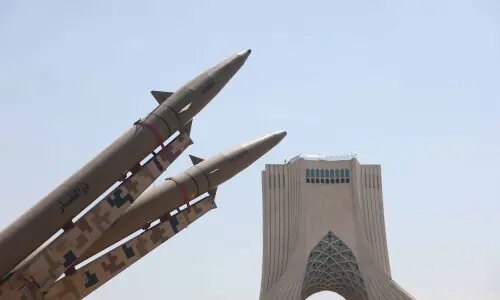
In the neighbouring Iran the situation is not much better. Iranian mullahs in the Guardian Council have concluded that while a woman can be the mother, wife, and sister of a President, she however cannot be the president. The mullahs have thus denied the right to contest the presidential elections to 30-odd women who wanted to participate in the elections scheduled for mid-June. The mullahs believe that the Iranian constitution allows only men (reejal) to hold the President’s office.
Are seculars any better in Pakistan?
It is true to a large extent that secular parties in Pakistan (whose political ideology is not necessarily defined by religious doctrines) do not oppose women from participating in the electoral process, they however seldom act to enfranchise the disadvantaged lot. Consider Imran Khan’s Pakistan Tehreek-i-Insaf (PTI) who had the opportunity to nominate two women to the National Assembly against the reserved seats for women in Punjab. PTI’s choices, however, appear to favour the privileged. One of the PTI’s nominee is a resident of Islamabad’s elitist sector, E-7, and the other is the Lahore-based president of PTI’s women wing.
While the Mullahs in Dir restricted women’s participation in the elections altogether, the supposedly enlightened ones did not fare much better as they rewarded power, fame, and wealth instead of promoting women from the struggling classes in Pakistan.