Our war, our business
PRESIDENT Pervez Musharraf’s advice to those on the other side of the Durand Line to put more emphasis on the political approach to tackle the insurgency in Afghanistan holds equally good for Islamabad. Speaking at the Royal United Service Institute in London on Friday the president made two suggestions in respect of the performance of the International Security Assistance Force: its strength should be increased and there should be a greater emphasis on a political approach. The president’s statement coincided with Britain’s refusal to accept Mr Hamid Karzai’s charge that Helmand was lost to the Taliban because he accepted British and American advice to change the governor. The controversy serves to underline the hazards of listening to foreign advice on one’s domestic problems. “I made the mistake of listening to them,” Mr Karzai said at Davos. On his part, President Musharraf said his government had tried the political approach but failed — a reference to the deal with the militants in September 2006.
The ‘confessions’ made by the two presidents, who are battling an insurgency that has common roots, is of particular importance to Pakistan because of the unceasing talk of America’s military intervention in Fata. On Thursday at a Pentagon news briefing Defence Secretary Robert Gates offered to ‘partner with them’ if Islamabad wanted joint operations. He added, though, that Pakistan was a sovereign country and the US would not conduct any combat operations in the country without Islamabad’s permission. The president correctly told his audience that the common man would see any intrusion by foreign forces into the country as an attack on Pakistan, though he added that his government would welcome training for its troops, besides intelligence sharing, but not “criticisms and insinuations.”
Ignoring how Mr Karzai suffered because he listened to others, history tells us foreign advice in any country’s internal affairs is usually flawed. Foreign powers have their own perception of a given issue, they have their own interests to advance, they may have a secret agenda which they would not like to share with the host government, and their reading of the ground realities may be totally superficial. In Fata’s case, as the president pointed out, fighting a guerilla war in the Pakistani mountains would be entirely different from the kind of anti-Taliban operations going on in Afghanistan. The president must listen to the people of Pakistan and do that which he has advised those in Afghanistan to do — put more reliance on political steps to follow the military operations. This country has suffered enough. The president’s claim that the Taliban have been defeated in Swat appears premature. It is quite possible that the army has the upper hand at the moment, but we do not know whether the militants have been wiped out. Fighting the Taliban in Pakistan is our business, and, instead of accepting unsolicited advice, the government would do well to develop a national consensus on the war on terror to deal with the threat that militants pose to our way of life.
Cost-effective education
GIVEN the cumbersome procedure adopted by the relevant government departments when releasing budgeted funds for recurring and development expenses, it is not surprising that many projects — notably in education — have suffered due to the non-availability of timely funds. Hence it was not surprising that the Senate Standing Committee on Education felt it necessary the other day to call for the speedy release of funds to facilitate proper utilisation to ensure improvement in the standard of education in the country. One hopes that this appeal will prompt our finance managers to remove the bottlenecks which slow down the process of flow of funds. This flaw in our governance has often resulted in the lopsided implementation of policies — education included — which are otherwise sensible, feasible and in the national interest.
While the importance of this should not be underestimated, there is also an urgent need to take an objective view of how the funds earmarked for the education sector are being spent. There was a time when the major complaint against governments was their close-fistedness vis-à-vis the social sectors. Mercifully this approach has changed somewhat — at least in respect of education — thanks to the generosity of foreign donors. Although education spending in Pakistan is still low compared to other countries, one feels that the focus now needs to shift towards monitoring the use of these funds. The financial audit that is mandatory does not speak much about the feasibility, suitability and relevance of a project. It also fails to detect the misappropriation that takes place when leakages are cleverly glossed over by doctoring figures on paper. Small wonder, with funds flooding in and not very effective inspection on the ground, the education sector has become notorious for corruption. It is ironical that at a time when one cannot complain as before of financial constraints, education in Pakistan has not registered the improvement in quality and quantity one would have expected. This only goes to reinforce the need for a performance audit of all projects.
The fact is that the policymakers while responding commendably to the demand for greater funds for the education sector forgot to work concurrently to increase its capacity. As a result the education sector lacks the capability of making optimal use of the extra finances that it has begun to receive. The White Paper prepared by the National Education Policy Review Team in 2006 while identifying this weakness had stressed the importance of capacity building in the following two years. Needless to say this was not done. This has led to a lot of funds going down the drain or to line the pockets of unscrupulous elements.
Not so idyllic for pizzas
EATING pizza on a remote, picturesque island may sound romantic. But if the venue is a traffic island, amidst a sea of vehicles, pizza lovers may not find the environment so exciting. What is more worrying is that a traffic island is basically designed to facilitate a better flow of traffic. Hence the report that a pizza outlet of a famous food chain is to be located on a triangular island in a crowded crossing in Karachi’s middle class locality of North Nazimabad can only cause dismay. What is more disturbing is that the town municipal administration is said to have given permission for this venture. Even more worrying is the news that the town nazim intends to invite other food chains as well to open their outlets on the island as part of his beautification scheme for the area. The multinationals will pay a huge sum as rent for what they view as a coveted and prime location.
The contradiction in the civic authorities’ approach is intriguing. At a time when the city government is engaged in carrying out huge projects like flyovers, underpasses and widening of roads throughout the city at a cost of billions of rupees ostensibly to ease the flow of traffic, the town nazim is moving in the opposite direction. It is certain that his ‘innovative’ scheme will create traffic jams and will run counter to the defined objective of his bosses. Needless to stress, traffic islands are there to help streamline traffic and not to serve the financial interest of a town administrator. It is not clear whether the KBCA’s formal permission has been obtained for the outlet which may hamper any future widening of the road. Experience shows that such structures once erected refuse to come down as their owners leave no stone unturned to find ways and means to stay on, including relief from courts.
Time for an economic U-turn
WHILE the political failure of the Musharraf regime is now being accepted widely in the country, the claim for its survival and perpetuation is being staked on its dubious economic achievements during the past eight years.
Ironically, while the political U-turn that Musharraf took seven years ago, may be difficult to reverse, the time for an economic U-turn the country has avoided for so long may now have come.
My esteemed friend and former colleague, Professor Aly Ercelan, who has made an admirable transition from the academia to social activism, not unlike that of his more renowned Vanderbilt contemporary, Nobel laureate Yunus, without giving up his forte of rigorous analysis, has forcefully exposed (Dawn, Jan 19.) the thin veneer of ‘success’ that has been achieved in recent years (as epitomised by the ice-cream-pizza-hamburger consumerism, the bank-credit financed automobile explosion and the LBOD-Chashma-Tarbela-Gwadar mega project development strategy) and its impact on the poor.
The atta crisis is just the tip of the iceberg which has resulted in our titanic economic failures. As the economic shipwreck hovers on the horizon, the embattled crew is busy arranging the deckchairs to assure the passengers that it is nothing but a passing turbulence in the sea. What is really surprising is that the regime and its supporters not only continue to be in denial about the looming disaster, but that the president has made it a prerequisite for future governments to adhere to the continuity of policies that have been its genesis.
The general (retd)-president has embarked on an eight-day largely self-imposed, politically-motivated European tour, including Davos and London, to underline his key role as the guarantor of the flawed western agenda of globalisation in Pakistan. He would try to convince the Davos crowd that, without him, Pakistan will not only become a political, but also an economic disaster. A major aim of the trip is stated to be ‘image-building’ and there are no prizes for guessing whose image is at risk.
With the Bush administration already having given him the assurance that his services will continue to be needed in the war on terror, he hopes to somehow extricate himself from the external and political pressures mounting on him to give up the reins of government to ensure credible elections. Whether this gratuitous foreign tour in the midst of a critical period of extreme uncertainty and insecurity in the country, is based on false bravado or complacency, the future alone will tell.
Although Pakistan’s economic development since the Ayub years had been based on elitist and inegalitarian foundations, there was some moderation in them during the ‘democratic interregnum’ of 1972-77 and 1988-99, forced by the need to adopt populist policies in an electoral democracy. That desirable course was reversed and pushed back by the now-retired Gen Musharraf towards the Ayub era of the 1960s, which for all its faults had at least a modicum of economic rationale behind its development strategy, and failed largely because of its inability to get a majority of the population living a thousand miles away from the centre, into the loop of a virtuous circle of growth.
The Musharraf years have been bereft of any economic vision, other than the regime’s focus on reviving the economy through the largesse received from the US and other western countries in lieu of services rendered during the war on terror and the distribution of the benefits of the windfall among the regime’s political allies. The underlying socio-economic philosophy of the Musharraf-Shaukat Aziz era was callous towards the poor and obliging towards the privileged.
A fundamental tenet of this tunnel vision has been the almost total withdrawal of the state from its economic and social responsibility, including the provisioning of essential commodities and utilities, as succinctly pointed out by Ercelan. However, the distinctly militarist character of the regime so conspicuous in its political agenda has been equally transparent in its economic programmes.
While profitable public enterprises, such as Pakistan Steel Mills and Pakistan Telecommunications Corporation have been cheaply privatised after being run down by the meddling of the government in their functioning, the military-run commercial enterprises were continually strengthened and kept out of the pale of privatisation.
Luxurious housing complexes, including farm houses and shopping malls, have been developed around major metropolises by the defence housing authority through the acquisition of land from small farmers and transfer of the acquired land at below market prices to military personnel. The military also gave a shot in the arm to feudalism by evicting farmers on its land.
On the other hand, no serious attempt was made to provide affordable housing to the poorer sections of the population, the cost of which along with that of transport, constitutes an increasingly high proportion of their budgets, making it impossible for them to cope with the rising prices of food and fuel.
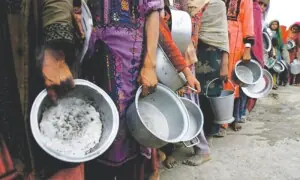
While the poor stand in long queues outside under-stocked and poorly-managed utility stores (which fail to cater to those who can’t afford to buy 20kg bags), the well-heeled and privileged buy their provisions from defence canteens and department stores, providing fuel to the fire of disgust, anger and violence.
Along with the military, the foreign aid and loan dispensing agencies have encouraged the privatisation of social services, especially education and health. Poverty alleviation programmes, allegedly ‘home-grown’, were meant mainly as a sop to insistent donors and were bureaucratically-run, with minimal impact on poverty reduction.
A major problem with the assessment of the economic performance of the Musharraf years has been the credibility of the data used for measuring economic growth and poverty alleviation. Despite repeated calls by economic experts for creating an autonomous statistical commission to ensure the quality and reliability of economic data, the government has continued to doctor the data to suit its political ends.
The tall claim of economic resurgence, made on the basis of high foreign exchange reserves and high GDP growth rates is now under serious doubt, as the macro-economic situation (on which the recent quarterly report of the State Bank has raised alarm bells and that poverty reduction and social indicators and the shortfalls in MDG targets indicate) has been rapidly deteriorating in the past few years.
If US foreign aid and foreign direct investment, which have provided artificial respiration to the economy, also react adversely to the worsening perception about the Musharraf regime, worse could follow.
Before it becomes too late, the doctrine of continuity of economic policies should be buried, along with kindred doctrines of necessity, indispensability and unity of command, which were forced down gullible brains in the last eight years or more. The time for taking roads not treaded for fear of upsetting the status quo has come.
The writer is the author of “The Unravelling of the 9/11 U-Turn”.
syed.naseem@aya.yale.edu
OTHER VOICES - Indian Press
Partnership of equals
A GREATER role for India in the global arena would be of much advantage to the developed world: this was the message that the British prime minister, Mr Gordon Brown intended to send across during his two-day visit to India. And this could be achieved by engaging India as an equal partner. Mr Brown strongly advocate(ed) the case of India for a permanent seat in the UN Security Council by calling it “an idea whose time has come”…
…The issue of a permanent seat for India in the UN Security Council has been lingering over the years. If at all Mr Brown is sincere in his approach towards India and really believes that India and Britain are ‘equal partners’, this is the right time for him to support this issue at the right forum and also impress upon other nations having veto powers to confer this status on India. It is also a fact that the UNSC in the present world scenario needs additional members to sustain and enhance its power. Significantly, India has also shown to the world its leadership quality.
…It is significant that Mr Brown’s delegation was packed with business delegates. It is also significant that trade between India and the UK has been growing at a pace of 20 per cent every year... India has also emerged as the second-largest investor in Britain, with investments of over $1.9 billion in the last year alone. It is the growing importance of India that made Mr Brown announce his plan to invest £825 million in health and education projects over the next three years… — (Jan 24)
Ailing health sector
A UNICEF State of the World’s Children report reveals disturbing trends regarding the health of Indian children. The dismal…figures on mortality of Indian children, contributing to 21 per cent of the total deaths in the world, have exposed the poor planning of the country’s health sector and the vulnerability of its children. The report points out that 5,700 infants die on a daily basis…The report…lays bare the fact that many of the health problems arise out of deprivation and poverty…
The neglect is massive. This is marked by the absence of basic necessities that can provide for healthy human existence, as well as by the substandard delivery of public health institutions. Either people rely on quacks or visit hospitals and primary health centres where doctors are not available. Even in major hospitals, doctors often play truant, and equipment for basic medical tests is lying defunct…
Both in terms of planning and spending, the health sector remains eternally neglected... Coupled with this is the absence of an adequate monitoring mechanism… Thirdly, the proportion of health-related problems in the country, as is revealed by the UN report, is too high for the kind of meagre investment that goes into the health sector. Leading Indian economist and Nobel laureate, Amartya Sen, too, has for long been advocating that India’s progress depends upon focusing on the health sector… Unfortunately, his words have fallen on deaf ears… — (Jan 25)
| © DAWN Group of Newspapers, 2008 |