A gruesome end
“EIGHTY per cent of the operation,” to quote an army spokesman, had been completed to expel the terrorists from the Lal Masjid when these lines were written, and Abdul Rashid Ghazi had been killed, though resistance from hard-core militants was still going on, with the death toll in the vicinity of 150. While no tears will be shed over the death of the well-armed militants gathered around him by Ghazi, our hearts go out to the families of those innocent men, women and children who were killed during Tuesday’s operation or in the fighting earlier. The responsibility for the death of the innocents and the trauma of those who have survived rests with the extremists who held hostage those whom they had lured into the mosque for giving them lessons in Islam. Instead, in a most perfidious way and in a way that behoves perhaps hardened criminals, they used men and women as a human shield to save themselves. That was the reason why the late-night talks which had aroused hopes for a peaceful solution failed. The government’s mistakes in the entire drama notwithstanding, one has to admit that it exercised the utmost restraint. It kept talking to the Aziz-Rashid brothers for months and used a variety of channels to free the hostages and disarm the militants.
On the Lal Masjid mafia’s directives, its militants had raided a home, attacked shops, and kidnapped not only police officials but also seven Chinese nationals. Instead of reciprocating the security forces’ restraint, the militants burnt a nearby building, leaving the government with no option but to retaliate, though the security forces’ response on July 3 was in low key. Finally, after the fighting escalated and the elder brother was caught and over 1,200 hostages were released, Abdul Rashid Ghazi refused to show any flexibility. Even Maulana Fazlur Rahman accused Ghazi of intransigence. Those who went to negotiate with him included Maulana Abdul Sattar and Bilqees Edhi and some of the country’s respected ulema, but Ghazi remained obdurate. He and his militants fired on parents who had gone to the mosque to meet their children. The Ghazi band’s isolation from the nation was total, for no madressah leaders anywhere in the country came to their support, and the little bit of support they received came from the politically motivated ulema and those pro-Taliban elements in Fata who are already in a virtual state of war with Pakistan’s security forces.
There is no room for complacency, and the government must relentlessly pursue terrorists and criminals masquerading as ‘soldiers of Islam’. They are in a position to keep creating trouble for the government every now and then, but as Abdul Aziz’s escape bid and the outcome of the Lal Masjid stand-off show, they are cowards because they know their stand lacks a moral basis. The nation’s support for the authorities on the crackdown against the Lal Masjid brigade should strengthen the government’s position. The episode also shows that self-proclaimed mujahids committing crime after crime cannot fool the Pakistani people by taking cover under religious slogans. Those arrested should be tried and given every chance to defend themselves in an open trial. The government must also order an inquiry into why and how the intelligence agencies failed to get wind of the goings-on in the Lal Masjid and the stockpiling of arms and ammunition in such large quantities. Talibanism has destroyed Afghanistan. Let it not harm Pakistan.
Helping the flood victims
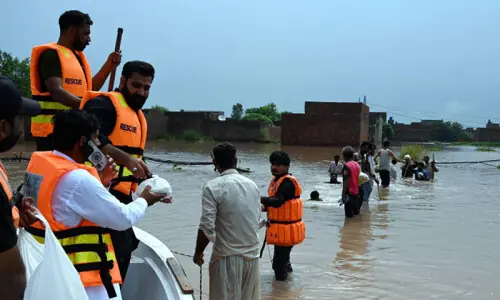
WITH all eyes on Islamabad and the Lal Masjid siege, attention has been diverted from the human tragedy unfolding in parts of Balochistan and Sindh. The torrential rains may have abated but there is no end in sight to the misery of those who have lost everything to the fury of nature. Floods have swept away household goods, crops and livestock while devastated road networks are limiting access to outside sources of food. According to Unicef, at least 300,000 people in Sindh and Balochistan desperately need water, first aid and ready-to-eat rations — a mammoth undertaking that could cost upwards of 17 million dollars. Other non-governmental organisations estimate that 25,660 tonnes of food will have to be provided to flood victims over a period of three months. The emphasis on ready-to-eat supplies is readily explained: the homeless, at least for the time being, simply have no access to food, fuel or cooking utensils. The relief provided so far, experts say, has been far from sufficient. In Balochistan, at least 50,000 tents are needed to house nearly 2.5 million displaced persons. Temporary shelter is a pressing problem in Sindh too.
Seventeen million dollars should be peanuts for a government that never tires of boasting about its foreign exchange reserves and the prosperity it has brought to the country. If ready-to-eat rations are not available in bulk in Pakistan, these can easily be imported. At the same time, there can be no excuse whatsoever for manpower shortages or inadequate transport facilities. Every possible resource at the disposal of the provincial and federal governments and the armed forces must be mobilised forthwith. This is also a time for the multinational companies that profit handsomely from business in Pakistan to show a degree of corporate social responsibility. MNCs engaged in the food-processing business must step forward with supplies of canned and other ready-to-eat foods free of cost. Those producing bottled water also have a role to play, as do the pharmaceutical companies because medicines and oral rehydration solutions are in critically short supply. Times of crisis can bring out the best, and worst, in people. The choice is clear.
Violence against children
AS pointed out in a report recently published by a local NGO, children in the country are often the victims of violence. With close to 10 million child workers in the country and with no system of monitoring employers who take full advantage of their age and pecuniary circumstances, it is no surprise that young workers are often physically and verbally abused. The same is true of children who are at school or studying at madressahs where corporal punishment is routine. Ignorance, poverty and fear keep them from seeking help from the few social forums and state institutions that could intervene to stop the violence perpetrated against them. The extent of frustration among such children is evident from the unusual rise in child suicide cases in 2006. Statistics show that 180 children took their own lives last year, but the actual number could be much higher.
This state of affairs calls for speedy formulation of a child protection policy that the government has been mulling over for some time so that children can be protected from all forms of violence — and also from neglect that is responsible for much of the emotional trauma they suffer. Unfortunately, such a policy can be effective only when the need to prioritise the rights of children is recognised. This is sorely missing in an environment which is not known to be child-friendly and where even basic rights such as proper healthcare, adequate nutrition and education are inaccessible to a large number of children. What is also tragic is the role of parents. Because of their financially straitened circumstances and the burden of looking after large families, they are unable to give their children the care and attention they need. These factors, together with weak law enforcement, encourage the trend of violence against children. Social awareness and a firm stance by the government against those who abuse children are needed to reverse it.
The battle for Islamabad
COULD the tragedy that began unfolding in Islamabad last week have somehow been avoided? It isn’t particularly easy to imagine how. The authorities have, with some justification, been criticised for permitting an open sore to fester for so long. It is possible that earlier action would have entailed fewer casualties and a less messy denouement. The validity of that view is contingent, however, on the time-scale one has in mind.
Had the Lal Masjid menace been identified and dealt with years ago, chances are that the task would indeed have been simpler. If we are talking months or weeks, the difference may have only been marginal. It is indeed profoundly unfortunate it was allowed to come to this.
The fact that several bouts of negotiations proved fruitless may not be unrelated to the government’s choice of negotiators: Chaudhry Shujaat Hussain and Ijazul Haq invariably seemed all too eager to accept the outlandish demands of the mosque’s clerics without obtaining any meaningful reciprocal concessions. Either their skills in this department left a great deal to be desired, or they were pursuing an agenda at odds with the purported policies of General Pervez Musharraf.
At any rate, the situation had come to a pass where inaction was rapidly sapping the administration’s residual credibility. It is widely assumed that the kidnapping of six Chinese women from an acupuncture clinic proved to be the last straw, after a vehement protest from Beijing. What is clear is that the students of the two seminaries linked to Lal Masjid were out of control and increasingly inclined to take the law into their own hands, obviously at the instigation of the pair of maulanas in charge of the fief, the brothers Abdul Aziz and Abdul Rashid Ghazi.
The damaging psychological power these two exercised over their charges was evident in the latter’s single-minded vandalism, in their encroachments on state property, in their vigilantism against alleged purveyors of vice and in their abduction of security personnel. But the horrific extent of the brainwashing was revealed by the reported reluctance of some seminary pupils, including young children, to abandon the besieged Lal Masjid, because they wished to “embrace martyrdom”.
It has been claimed that coercion was employed to prevent certain other students from leaving, and there was talk of hostages and human shields. But in fact even those who supposedly volunteered to stay on until the bitter end weren’t in fact exercising their free will. They were, in a sense, shackled to the mosque.
Jamia Hafsa and Jamia Fareedia may have been among the largest seminaries in the country, but they were by no means the only ones where a blinkered version of the faith is drummed into the minds of thousands of children and adolescents. Those who 20 or 30 years ago encouraged the evolution of madressahs into jihad academies were clearly mistaken if they thought it would eventually be simple enough to reverse the trend. More likely, they never really spared a thought for the consequences.
Madressahs have proliferated over the past decade or two, becoming relatively well-funded substitutes for regular schools as well as for social institutions such as orphanages. This reflects a failure on the part of the state, an increasing level of dysfunction that successive administrations have shown little interest in tackling.
Children often end up in madressahs not because their parents or guardians are particularly keen on an exclusively religious schooling, but because the seminaries offer free food and shelter. Would they be equally popular in the face of competition from, say, a nationwide network of state-run boarding schools? And wouldn’t expenditure on such a network constitute an infinitely more promising investment in the nation’s future than a burgeoning defence budget?
The apparent attempt at a getaway by a burqa-clad Maulana Aziz offered a spot of comic relief in an otherwise bleak scenario, but there was never any question of a happy ending. The least painful outcome would obviously have been a decision by Maulana Ghazi to give himself up and allow the remaining students and teachers to peacefully emerge from the premises.
The authorities behaved sensibly in postponing an all-out assault, evidently in order to minimise casualties. At the same time, there was more than the element of intelligence failure associated with the affair. After the initial emergence of 1,200 or so students, the government appeared to have no clear idea of how many remained behind, or how much weaponry was stockpiled in the supposed places of prayer and learning.
The charge that a hard core of militants associated with organisations such as Lashkar-i-Tayyaba and Jaish-i-Mohammed was entrenched in the mosque was aired several days after the siege began, and there was no guarantee its culmination would bring clarity.
And this despite the proximity of the ISI headquarters to Lal Masjid, which meant that military intelligence personnel regularly went there to pray. Or perhaps because of it, given persistent allegations that the two maulanas owed their relative untouchability to connections in the military hierarchy. After all, their father, Maulana Abdullah — the mosque’s first preacher and a vociferous advocate of jihad — was believed to be close to the military dictator General Ziaul Haq.
The family connection certainly came in handy for Maulana Aziz when he was detained three years ago on suspicion of involvement in terrorist activities: he was freed on the intervention of Zia’s son Ijazul Haq, who, almost unbelievably, holds the portfolio of religious affairs under Musharraf.
Even more bizarrely, there is no indication that Ijaz’s resignation was sought when the latest episode in the saga began to unfold. But then, governments in Islamabad are notorious for refusing to heed the lessons of the past. What else could explain the redeployment of Shujaat as chief negotiator in a last-ditch attempt to persuade Ghazi and his cohorts to give up?
Meanwhile, a possible attempt last week to shoot down the presidential aircraft was, it appears, foiled by the incompetence of the attackers. The available details are sparse, but the very presence of anti-aircraft guns on a rooftop in the vicinity of Chaklala airport points towards a grave security lapse.
However desirable a transition from the Musharraf era may seem, it would be utterly disastrous for Pakistan were it to be achieved in anything other than peaceful circumstances. It is unclear whether the would-be assassins were motivated by the Lal Masjid affair, but it’s safe to assume the prayers of the mosque’s stalwarts were with them.
Incompetence on the part of the bloody-minded has also lately been instrumental in preventing a couple of other tragedies: it was extremely fortunate that, late last month, two Mercedes cars primed to explode in the heart of London were discovered before they could do any harm. And when the unsuccessful terrorists rammed a jeep into a Glasgow airport terminal two days later, they were able to cause only limited damage.
Fortuitously, the abortive attacks did not reinforce the impression of Pakistan as Terrorism Central — a somewhat simplistic but not entirely inaccurate label. None of the suspects taken into custody in Britain appears to have had anything to do with Pakistan.
Most of them had moved to the country recently. Most of them had worked in one capacity or another for the National Health Service. Several of them are doctors or medical technicians. One of them — who set himself alight at Glasgow airport after dousing himself with petrol, suffering 90 per cent burns — was a highly qualified engineer.
Not surprisingly, they are all Muslims, albeit of disparate nationalities. There have been hints of other connections. A mosque in Cambridge has been mentioned in dispatches. There are also vague indications of a connection with Hizb ut-Tahrir, an organisation whose raison d’etre includes the re-establishment of a caliphate; it is proscribed in several Arab countries but boasts active branches in a number of western nations.
It would be premature to conclude that all the arrested suspects — including a doctor from Bangalore who was apprehended by the Australian police in Queensland — are indeed guilty of attempted mass murder, but some of them clearly had that sort of thing in mind. The question is: to what end?
The London and Glasgow incidents have sparked or reignited a bunch of controversies. There is a degree of shock, for instance, at doctors being implicated in attempts to take, rather than save, lives. Appalling as it may seem, that doesn’t seem like a huge contradiction: after all, doctors are as prone to flaws of character and intellect as all other human beings.
A more interesting debate hinges on whether Britain was targeted because of its role in Iraq and Afghanistan, or was it merely a western target of convenience for men guided by a murderous ideology?
If that sounds like a trick question, maybe that’s because it has a tricky answer. Tony Blair’s unquestioning support for American military misadventures is widely opposed among non-Muslims and Muslims alike, but the opposition is predominantly non-violent. The violence comes from those who may well be angered by Iraq, but also have other resources to draw upon. Those are the resources we should all be worrying about, in Britain, Pakistan and so many other parts of the world.
It has been suggested that the deadlier interpretations of Islamic scriptures and traditions, if they are indeed misguided, can best be combated within the faith, not least via sermons at mosques. There is little evidence so far that this is happening on a meaningful scale. The alternatives, as the events in Islamabad make plain, are considerably more unpleasant.
mahir.worldview@gmail.com
| © DAWN Group of Newspapers, 2007 |