Blair is the wrong choice
THERE is never a dull moment in politics. But it is in international, rather than domestic, affairs that far stranger things take place. Nothing demonstrates the validity of this observation more than last week’s announcement that the Middle East Quartet has appointed former British Prime Minister Tony Blair as its special envoy to the region.
That an appointment of such importance and sensitivity could have been engineered with such ease and efficiency is fresh proof of the manipulative powers of the US and the UK.
During the 10 long years that he was prime minister, Tony Blair enjoyed close and cordial relations with both Presidents Clinton and Bush. In fact, the Clinton White House considered Blair the foreign leader closest to their boss. Regarding his relationship with the current US president, Blair was seen a virtual soul-mate and sounding board on most major foreign policy issues.
The extent of their bonding was such that Blair defied public opinion to join the US in its invasion of Iraq and also contributed troops to an adventure that was to lead to the British electorate’s disenchantment with him.
Smart, intelligent and highly articulate, Blair is also a powerfully persuasive interlocutor. Given his knowledge of and strong interest in the Middle East, as well as his personal relationship with the leaders of the region, Blair would appear to be the ideal candidate for this exceedingly difficult task.
As the leader of the region’s major former colonial power, his role and expertise could be a valuable asset. It was after all Britain that was the strongest supporter and financier of the Zionist movement. It was also Britain that was instrumental in the fulfilment of the Zionist dream, namely the establishment of a Jewish commonwealth in Palestine. Britain’s commitment in the form of the infamous Balfour Declaration represented a major triumph for Zionist diplomacy.
When the declaration was issued, the Jewish population of Palestine numbered some 56,000 against an Arab population of 600,000 or less than 10 per cent of the total. Considering that the Arabs constituted over 90 per cent of the population, the promise not to prejudice their civil and religious rights had a distinctly hollow ring to it since it ignored their political rights. It was also in violation of the earlier British promise to Hussein, the Sharif of Makkah, to support the establishment of an independent Arab kingdom after the war, in return for an Arab revolt against the Ottoman empire.
It was also against the provisions of the secret Sykes-Picot agreement of 1916 to divide the Middle East into British and French spheres of influence in the event of an Allied victory. These violations of solemn promises have continued to haunt the British to this day. But to Chaim Weizmann, the father of modern Zionism, these niceties were totally irrelevant, for the Balfour Declaration, despite all its ambiguities and limitations, handed the Jews “a golden key to unlock the doors of Palestine and to make themselves the masters of the country”.
Well-known historian Tom Segev has pointed out in his book ‘One Palestine, Complete’, that “contrary to the widely held belief of Britain’s pro-Arabism, British actions convincingly favoured the Zionist enterprise.” In this, the British believed they were winning the support of a strong and influential ally. British Foreign Secretary Balfour was to later confess in his memoirs: “Zionism, be it right or wrong, good or bad, is of a far profounder impact than the desires and prejudices of the 700,000 Arabs who now inhabit that ancient land.”
Even more interestingly, the then British Prime Minister, Lloyd George, explained his support for the Zionist movement on account of it being “a highly influential political power, whose goodwill was worth paying for.”
And yet, Blair’s appointment has been greeted with almost universal derision and ridicule. What explains this contradictory reaction? For one, Blair is perceived as a person who has never hesitated to discard principles in favour of personal predilections, or to jettison inconvenient beliefs and to trim his sails to suit prevailing winds. But 10 years in office have exposed the man behind the mask that Blair had so very assiduously built for himself.
Like most of his predecessors, Blair, too, sought to bask in the reflected glory of the power and majesty of the United States, on occasions oblivious of the views of colleagues and party stalwarts. On the Iraq issue, he involved his government in falsifying and doctoring intelligence reports to strengthen the Bush administration’s accusations against Saddam Hussein. This was done so blatantly that a number of cabinet colleagues were constrained to quit their posts, rather than be a party to this deception.
In all this, his primary objective was not the promotion of democracy and human rights in the Middle East, but the destruction of the region’s only potential challenger to Israel’s domination of the region. How ironic that the Iraq fiasco, planned and executed to demonstrate Britain’s power and influence, should prove to be Blair’s final undoing. This may explain the widespread opposition, including within Britain, to Blair’s appointment.
Few world leaders, with the notable exception of the Israelis and President Mahmoud Abbas, have had anything good to say about it. Russia is reported to have expressed its opposition to it in no uncertain terms, while European leaders have murmured that it was Bush’s reward to his “poodle” for his loyalty. Interestingly, the current EU president, the German foreign minister, was not even aware of his appointment until it was announcement. So much for the claim of consultation with stakeholders.
The media has also savaged what it calls a conspiracy between Bush, Blair and UN Secretary-General Ban Ki-moon. Robert Fisk calls Blair “totally discredited in the region”. Writing in The Independent, Fisk said he was surprised that “this vain, deceitful man, this proven liar, a trumped up lawyer who has the blood of thousands of Arab men, women and children on his hands is really contemplating being our Middle East envoy.” The Guardian said Blair’s name was associated with catastrophe.
It is, however, the Arabs who view Blair’s appointment as sheer lunacy. With unusual unanimity, all mainstream newspapers in the region have expressed a deep sense of impending doom. Even notables like former Egyptian minister, Ahmad Maher, called it a “mistake” and said that the US should have found other ways to reward Blair for his services. They recalled the fate of the former UN envoy, the respected James Wolfensohn, who could make no headway because of combined US-Israel opposition to any initiative that was even remotely fair and balanced. Similar views were also expressed in traditionally pro-US countries.
Mahmoud Abbas’s endorsement is, however, not surprising, given his increasing subservience to Israeli interests. But Hamas leaders have made it clear that they did not expect anything from Blair, so whatever he did would be of no relevance to them. Even independent analysts have pointed out that although Blair would wax lyrical at the mere mention of the Palestinian issue and talk of a two-state vision for the region, he did all that was possible to strengthen Israel’s stranglehold over the occupied areas.
It was, however, his conduct during the Israeli invasion of Lebanon last year that revealed his true character. Notwithstanding Lebanon’s pro-West government’s desperate pleas for help, Blair opted to join the Bush administration in preventing the US Security Council from calling upon Israel to agree to a ceasefire until such time that its war aims had not been achieved. Earlier, he had joined the US in encouraging Ariel Sharon to place Yasser Arafat in confinement till his last days, thereby depriving the Palestinians of an elected leader, who could have been a credible and effective interlocutor.
Blair’s attitude to Islam, too, has raised many questions. While he has spoken of his respect for the religion, he has joined Bush in waging wars against those he perceives as representing “radical Islam”, a catch-all phrase in which he places all those regimes and peoples who are opposed to Anglo-American plans to redraw the map of the Middle East.
What does Blair’s appointment portend for the Palestinians? Clearly more misery, because Blair’s focus will not be on ending Israeli occupation, but on helping the Palestinian Authority improve governance in the West Bank. If true, then we can expect further measures by Israel, in collaboration with the US and the UK, to perpetuate its occupation.
Admittedly, the occupied territories suffer from corrupt and inefficient administration, but the root cause of violence and turmoil lies in the four-decade long occupation. Moreover, by refusing to bring Hamas into the dialogue process, Gaza is being pushed into economic deprivation and political isolation that will encourage greater violence which will only reinforce the West’s projection of the people of Gaza as “terrorists”.
Is this another piece of evidence of the West’s age-old practice of “divide and rule”? After all, more than any other world leader, it is Blair who has contributed to dividing the Middle East into two hostile camps — the so-called moderates and the so-called radicals. No less disturbing has been the role of the UN secretary-general, who by acquiescing in this Anglo-American conspiracy to appoint Blair, has damaged the world body’s credibility. Difficult times lie ahead for the Palestinians. They need to set their own house in order, but it is also incumbent on major Arab regimes to stand by these long-suffering people.
The writer is a former ambassador
Through democracy alone
ISLAMABAD is a broad city with wide roads and deep runs of thick trees and green grass. Houses are expansive, neatly tucked into self-sufficient sectors, with markets, eating places and mosques. General Mohammad Ayub Khan who founded the city had a neighbourhood concept, with people from different provinces and thoughts living as a community.
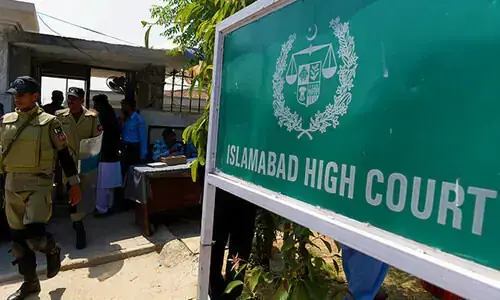
Lal Masjid, where radical Islamic students and government forces clashed this week, is one of the mosques not far from the diplomatic enclave, the president's house, the National Assembly and the Supreme Court. The mosque has become more of a seminary than a place for praying. Nobody expected that the students studying there would one day copy the Taliban, demanding that the Sharia be imposed in Pakistan.
The posture of students, who have become increasingly militant over the last few months, would not have brought the security forces to confront them if Lal Masjid had not become a state within a state. The slogans of jihad against the General Pervez Musharraf’s government and the threats of using suicide squads were bad enough. The worst was when the students began kidnapping policemen to prove that their writ ran whenever they wanted to prove it.
When seven Chinese nationals were whisked away by seminary students, they went too far. No doubt, they were released but the government lost face because the Chinese government behaved as if it did not have enough confidence in the authority of the Musharraf government.
The students did not sit still and some 100 of them attacked the adjoining government building and a security picket. This was the official version. When confrontation converts into a clash, it is difficult to say who fired the first shot. Curfew in the area had quietened things at the time of writing. Except for stray incidents in Abbottabad and a couple of other places, the clash at Lal Masjid had no visible effect.
I feared a strong reaction by the religious parties or its conglomeration, the MMA. Apparently, President Musharraf had discussed the matter with them before taking action. Otherwise, the state governments in Balochistan and the NWFP would not have been intact since the religious parties rule there with the help of the Musharraf-blessed Muslim League (Q).
This also proves that the religious parties are opposed to what the Lal Masjid crowd, including burqa-clad women, had been doing. It is difficult to imagine what kind of pressures would be brought on the religious parties to part company with Musarraf. But the Lal Masjid incident has infuriated the radicals to do their best to wean away the MMA from the Muslim League.
The religious parties may themselves be facing a dilemma. They realise that the public wants a liberal, democratic Muslim state while the Lal Masjid crowd wants to impose bigotry and a system which people are not ready to adopt.
In fact, even religious parties have little support from the public. But for Musharraf's help in the last election, the religious parties would not have secured so many seats as they did. His strategy was to stall as many members of the Pakistan People's Party (PPP) and the then Muslim League from entering the National Assembly.
The religious parties, which supported Musharraf in retaining his uniform, may not want to demolish their bridges with Musharraf in case he turns towards them if and when his efforts for rapprochement with Benazir Bhutto fail. Musharraf's confrontation at Lal Masjid definitely suits the PPP because the spread of radicalism affects the democratic temper.
Benazir Bhutto has been saying repeatedly that only the return of democracy — through free and fair elections — can stop fundamentalism from taking root in Pakistan. My impression is that once Musharraf contains the Lal Masjid crowd and its sympathisers, he might go for an election with Benazir Bhutto if possible or without her if necessary. He has realised that the genie of religious chauvinism he had released to fight progressive and democratic forces was not going to go back into the bottle and is turning its attention on him. Probably, he saw the ground reality when there was a fatal attack on him same time ago.
America may have applied too much pressure. US Vice-President Dick Cheney, during his visit to Pakistan earlier this year, reportedly reprimanded Musharraf for failing to rein in the militants. The CIA is said to have told Islamabad that the Lal Masjid crowd was being guided by the Al Qaeda and that the Taliban-like students constituted the bulk of the radicals.After giving an extra $750 million, Assistant Secretary of State Richard Boucher said that “the development of Pakistan” was what they had in view and it was spelled out as the defeat of Talibanisation.
Islamabad has itself been worried over a report which was presented to its National Security Council. The report, has said that the Taliban have reorganised themselves and their influence was spilling over to the areas other than those bordering Afghanistan, to the detriment of the security forces’ morale. The report may have been the last straw. It looks as if Musharraf had no option except to act when Talibanisation was taking place right under his nose in, the Lal Masjid in Islamabad.
Military action is all right as far as it goes. With a sullen middle class, following the lawyers’ courageous agitation, and with alienated political parties, Musharraf cannot fight the Taliban or their type.
This has to be done by a people who can be harnessed by political parties through a democratic set-up. Weapons do not represent democracy, public response does. In fact, the Lal Masjid crowd would not have gained importance — and strength — if Pakistan had a democratic structure.
Yet, democracy does not come by holding free and fair elections alone. Institutions have to be strengthened so that they can assert themselves. For example, the manner in which Chief Justice Iftikhar Chaudhry has been dismissed shows that the president’s fiat rules, not the law.
Former Chief Justice of Sindh High Court Wajihuddin Ahmed has aptly said: “If the full court restores the Chief Justice, it would be a salutary step in the direction of an independent judiciary. If that comes about, it is a bitter pill that those in power have to swallow. A bitter pill because they are not used to dealing with an independent judiciary. They will need to make changes in order to be able to live with it, and they will have to live it.”
Unless democracy is restored in Pakistan to full length — Washington should note it — religious militancy cannot be fought. Today there is one Lal Masjid, tomorrow there will be many more. Only democratic credentials can retrieve Pakistan.
The writer is a senior columnist based in New Delhi
Same old protectionism
TRYING to salvage an American trade policy, the Bush administration took the unusual step of embracing bipartisanship. Unfortunately, the overture hasn't been reciprocated.
In May, the administration accepted Democratic demands for tougher labour and environmental standards in return for Democratic approval of free-trade agreements with Peru and Panama -- and the possibility of more. "Today marks a new day in trade policy," House Speaker Nancy Pelosi said.
But last week, the speaker, along with House Majority Leader Steny H. Hoyer, Ways and Means Committee Chairman Charles B. Rangel and Ways and Means trade subcommittee Chairman Sander M. Levin, dashed those hopes. There will be no more "fast-track" authority for the administration to negotiate trade deals, they declared, until that glorious day when we "expand the benefits of globalisation to all Americans."
The Panama and Peru deals may still sneak through, although Mr Rangel will be going to Lima and Panama City soon to discuss how those sovereign nations can change their laws to suit the US Congress. Much bigger proposed agreements with Colombia and South Korea are dead, the Democrats say.
The Democrats insist their stand is a principled one. On Colombia, the ostensible issue is human rights: America's staunchest Latin American ally must show unspecified "concrete evidence of sustained results," though its record has already improved. As for the US-South Korea Free Trade Agreement, the biggest such proposed pact since the 1993 North American Free Trade Agreement, Democratic objections centre on access to Korea's market for US autos.
Do they have a point? South Korea is the world's ninth-largest car market, with one million vehicles purchased in 2006 -- but only 40,000 from abroad, 5,000 of those from the United States. Legitimate US concerns include not only an eight per cent tariff but also a sales tax and environmental regulations that apply disproportionately to US autos.
The trade agreement goes a long way toward resolving these problems.
––The Washington Post
| © DAWN Group of Newspapers, 2007 |