A breakthrough at last?
THE meeting between the ambassadors of Iran and the US in Baghdad on Monday could well be the turning point that chroniclers often look for when they write the history of nations. After 27 years of stand-off when they refused to have any contact between themselves or enter into a dialogue to resolve problems, the two governments have finally decided to open lines of communication. This move has naturally been welcomed by the world community, especially at a time when Iraq has emerged as a major flashpoint in the Middle East. Monday’s meeting is a tacit admission by the Bush administration, which created the crisis by invading that unhappy country, that it cannot bring peace to the region singlehandedly. Given Iran’s influence in Iraq — Tehran is accused of arming militant elements to retain its hold on the Shia-dominated southern regions — it has now been recognised that no settlement of the Iraqi crisis is possible without Iran’s cooperation. Of course, the talks held at the behest of the Iraqi prime minister have not found the key to a solution. Neither were they expected to. But they have opened the door for a dialogue which, hopefully, will be initiated in the next few weeks. As had been decided before the two sides met, the talks were confined to the violence in Iraq, which it is felt can be controlled if Iran decides to play a positive role in the region. Thus the Shia leader Muqtada al-Sadr, who derives his strength from Iran where he is also believed to seek sanctuary in times of need, has of late exercised restraint in his military activities. He has also expressed his willingness to work with Prime Minister al-Maliki for stability in Iraq. Against this backdrop, the Baghdad meeting was of considerable significance. The two sides traded allegations and counter-allegations but they also exchanged ideas, the most important of which was the establishment of a trilateral security mechanism comprising Iran, Iraq and the US. Although this panel has not been formally announced, the Iraqi press has reported that it will be meeting within a month. If progress is made in this direction, this can be regarded as a breakthrough which could be the beginning of a phase that could see Iraq being durably pacified and eventual American troop withdrawal from that country.
Many hopes are pinned on the Baghdad talks which, it is hoped, will lead to a détente coming in the wake of the opening of a communication line between the two countries which have kept the world on tenterhooks. Since the Iranian Islamic revolution in 1979 — that was followed by the hostages crisis — relations between Washington and Tehran have remained frozen, even though the Islamic revolutionary government managed to normalise its ties with the Europeans and other western powers. This led to a state of imbalance in international politics, given that Iran is a major power in the region and the United States is a superpower with high stakes in the Middle East. Iraq has not been the only bone of contention. A controversy on Iran’s programme of uranium enrichment has also created a serious crisis with the world holding its breath as Washington has kept it guessing whether it is set to launch an attack on Iran’s nuclear installations. This issue was not discussed in Baghdad but may well be taken up now that the ice has been broken.
Tahir Mirza
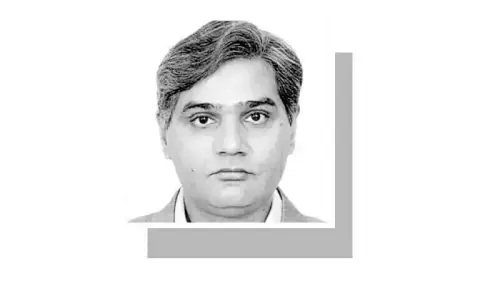
TAHIR MIRZA’S death on Tuesday in Karachi removes from the scene a versatile journalist who worked tirelessly throughout his life for the cause of the underdog. Most of his career was spent in print journalism, but he had self-fulfilling years in electronic journalism too when he escaped Ziaul Haq’s military dictatorship to work with the BBC’s Urdu service. Beginning his career as a reporter in Dhaka with a news agency, Mirza later moved to Lahore to work with the Civil and Military Gazette and after its closure with the Pakistan Times. Liberal and progressive in his views, Mirza associated himself with Mazhar Ali Khan to found the weekly Viewpoint. Despite its small circulation, Viewpoint represented the voice of non-conformism during the Bhutto and Ziaul Haq years, its pages testifying to the barbs in Mirza’s writings. He had two stints at Khaleej Times, first as an assistant editor and later as executive editor, but quit on a matter of principle, because the owner wanted him to do ghost writing for him. Throwing away a very handsome salary on grounds of principle, Mirza returned to Lahore to become Dawn’s resident editor. He became Dawn’s editor in 2003 after working as its Washington correspondent, during which he covered 9/11 and later the Camp David summit between President Pervez Musharraf and President George Bush.
Those who knew Mirza from close quarters, especially his professional colleagues, were impressed by the geniality of his character and the sophistication of his personality that sprang from his Delhi family’s literary and scholarly background. Cultured and suave, he never tried to be bossy with his colleagues, had a lively sense of humour at times tinged with naughtiness, and enlivened gatherings with appropriate quotes from Urdu and English poetry to make a point or convey a message. A professional to the core, he will be remembered by his friends, colleagues and admirers in Pakistan and abroad for his nobility of character, the high standards of professionalism he practised and upheld, and his crusade for the cause of the poor and the underprivileged.
Taliban’s ban on music
THE government can no longer afford to ignore the threats being posed to society by Islamic militants, the latest being the Taliban ordering the shutting down of music shops by July 1 in Darra Adam Khel. By ignoring the question of Islamists trying to impose their version of religion on the people, the government is only strengthening the militants’ hold. They have been emboldened to issue all kinds of decrees in the name of religion — from disallowing girls to go to school to bombing music shops because they consider music un-Islamic — while the authorities look the other way. They are always slow to act and when they do — as in the case of Maulana Fazalullah in Swat by getting him not to oppose administering polio vaccine, among other things — the damage becomes difficult to undo. Had the government acted against the cleric much earlier, the number of children who did not get vaccinated would have been less than the 25,000 that it is today. The same is true about the Taliban in the tribal belt who have banned music cassettes from being played or sold and have gone to the extent of threatening music and even barber shops with bombings. They have stopped bus owners from playing music, at times removing cassette players and destroying them.
These things simply cannot go on. No one has the right to enforce religious prohibitions of his own notions, nor does anyone have the right to commit crimes in the name of religion. The government has negotiated with the Taliban on several occasions. Why can’t it on this very serious issue? Anyone who threatens the peace of the tribal area — and the Taliban are doing precisely that elsewhere too — must be dealt with under the law.
Wounded nation bleeds again
CRISSCROSSED by a confusing pattern of confessional, sectarian and tribal divisions, with huge Palestinian refugee camps adding to the complexities of its composition, Lebanon has long been prone to outbreaks of internecine violence and warfare. The country’s proximity to Syria and Israel adds to its combustibility. The invasion and occupation of Iraq has done its bit to enhance regional instability.
Each of these factors appears to have contributed in some measure to the explosion that rocked the country last week, although the incendiary charge evidently came from a relatively novel source: a hitherto little-known organisation that calls itself Fatah al-Islam. It has been accused of having connections with — or at least deriving inspiration from — Al Qaeda. Its apparent aim is to establish Sharia rule in all Palestinian camps in Lebanon as a precursor to “liberating” Jerusalem.
Although it shares its name with the largest faction in the Palestine Liberation Organisation, Fatah al-Islam is not a Palestinian force: its membership is said to consist of jihadis from various Arab countries and may include some Pakistanis. Its leader, Shaker Youssef al-Absi, is said to have served a prison term in Syria for terrorist activities.
According to some reports, he was sentenced to 12 years but the Syrian authorities decided to let him go after three; some American commentators find it remarkable that he is alive at all, given that Damascus prefers capital punishment in such cases.According to most western media sources, Fatah al-Islam is a Syrian-sponsored entity that was instructed to provide a distraction ahead of a widely anticipated decision by the United Nations Security Council on a tribunal to try suspects in the February 2005 assassination of former Lebanese prime minister Rafik Hariri.
It is believed that Syrian agents played a role in that act of terrorism. Last November, on the day that the Security Council first approved plans for a Lebanese trial in connection with Hariri’s murder, cabinet minister Pierre Gemayel, the scion of Lebanon’s most prominent Maronite Christian family, was gunned down in mysterious circumstances.
Syria ended its two-decade military presence in Lebanon — but not its covert role in the country’s affairs — after a popular upsurge in the wake of Hariri’s assassination. A connection between Damascus and Fatah al-Islam is by no means out of the question, but there is no conclusive proof of it either. Syria still has friends among mainstream Lebanese political organisations, so why should it go to the trouble of associating itself with a jihadi outfit? Furthermore, if it is indeed true that the powerful Shia organisation Hezbollah is jointly sponsored by Syria and Iran, where is the logic in Damascus simultaneously backing and arming a Salafist group?
True, the political equations in Lebanon are not always amenable to logic. As Hariri reputedly used to say about his country, “Believe nothing of what you are told and only half of what you see.” And the extent to which appearances can be deceptive is demonstrated by an alternative view of the present goings-on that bears no resemblance to official statements out of Washington or Beirut.
The Pulitzer prize-winning American investigative reporter Seymour Hersh revealed some months ago that the Bush administration was indirectly funding jihadi groups in Lebanon, through Saudi Arabia and the Sunni establishment in Beirut, as a means of undermining Hezbollah. The latter is Washington’s primary bugbear in Lebanon, and it was particularly spooked by Hezbollah’s ability to stave off defeat at the hands of Israel last year — a feat that may yet cost Israel’s prime minister Ehud Olmert his job.
The Lebanese Sunni component takes the shape of the Future Movement bloc led by Rafik Hariri’s son, Saad. One of the militias they sponsored is known as Jund al-Sham and based in the Ain al-Hilweh refugee camp. Fatah al-Islam established its base in the Nahr al-Bared camp near Tripoli in September-October last year, shortly after Israeli troops withdrew from southern Lebanon following their failure to destroy Hezbollah.
Hezbollah has played no part in the fighting that erupted last week. So, what went wrong? Well, the US-Saudi-Future Movement club apparently began getting cold feet, partly as a consequence of Hersh’s investigations.
The trouble was precipitated by the Hariri group’s suspension of payments to Fatah al-Islam, which retaliated by raiding one of the group’s banks — hence the reference in news reports to an attempted bank robbery. Lebanon’s Internal Security Forces (ISF), reportedly loyal to the Future Movement, were called in but couldn’t cope, and they in turn sent an SOS to the Lebanese army.
Fatah al-Islam did not attack the ISF because it still hoped to persuade Hariri to pay up, but it went after the army with a vengeance. Palestinian refugees were, yet again, caught in the crossfire and appear to have borne the brunt in terms of casualties as the army unleashed artillery barrages into the camp and Fatah al-Islam snipers hit back.
There were mediation efforts under way, with Hamas as well as the PLO’s Fatah organisation playing a leading role, but at the beginning of the week the prospects of the militants surrendering to the army were muddled. If some sort of a compromise cannot be worked out and the army feels obliged to invade the camp, a serious escalation in the level and scale of violence cannot be ruled out.
Nahr al-Bared is home to 40,000 or so refugees, a small proportion of whom were able to escape during a lull in fighting last week. Most of them, however, have nowhere to go.
The dozen or so Palestinian camps dotted across Lebanon are home to some 400,000 refugees who, nearly 60 years after the catastrophe that drove them from their homeland, have very few rights. They don’t even qualify as second-class citizens, while the right of return to the land they left behind remains a mirage.
Fatah al-Islam may have had little to do with the refugees in Nahr al-Bared, but a violent invasion of the camp, entailing even more casualties, could spark what Hezbollah’s Hassan Nasrallah has described as an uncontrollable cycle of violence. Hezbollah claims it is determined not to get caught up in Shia-Sunni warfare, but in the event of an eruption it would find it hard to steer clear.
The scenario that depicts Fatah al-Islam as a proxy for US, Saudi and Future Movement interests is based in large part on an exclusive eyewitness account in CounterPunch by the Tripoli-based Franklin Lamb, an American who last week found himself ferrying supplies to Nahr el-Bared alongside Palestinian aid workers. It is broadly corroborated by Hersh and a handful of other reporters.
Asked in an interview last week whether it made any sense whatsoever for the US to be funding Sunni jihadis in one country while combating them in another, Hersh pointed out that such dichotomies were not unusual: “We’re in the business now of supporting the Sunnis anywhere we can against the Shia... We’re in the business of creating in some places, Lebanon in particular, a sectarian violence.”
The mainstream media outside the Middle East hasn’t so far paid much attention to this perspective. It may appear to defy logic, common sense and a basic sense of morality, but it is not at odds with the American track record — although, if it’s broadly veracious, the level of ruthless cynicism behind it may seem mind-boggling even by US standards.
Should it turn out, on the other hand, that the intelligence agencies of Bashar al-Assad — who was returned to power for seven years in a conveniently competition-free vote this week — are behind Fatah al-Islam, that would be equally unconscionable.
Meanwhile, regardless of the American role in this particular instance, there’s another phenomenon at work for which it would be even harder for the US to evade responsibility.
In the 1980s, the US practice, in connivance with Pakistan and Saudi Arabia, of inviting Arab and other Muslim recruits for the jihad in Afghanistan subsequently led to blowback in the shape of reinvigorated (and often violent) Islamist movements throughout the Middle East, not least in Algeria, Egypt and Jordan, as well as the September 11 terrorist attacks on the US.
The war in Iraq has produced similar consequences, even though American invitations to the jihadis took a different form this time around. At least some of the members of Fatah al-Islam are believed to be veterans of the Iraq conflict, while the others include those who couldn’t make it into Iraq.
It must naturally be hoped that the present stand-off will shortly be resolved and that none of the scenarios involving a wider conflagration will come to pass.
On a broader level, however, a Lebanon at peace with itself is inconceivable outside the context of a dramatically changed regional environment. It’s all very well to deplore the influence of Syria or Iran at the first sign of trouble, but they are by no means the only outside powers meddling in Lebanese affairs: covert interference by the US, Israel and Saudi Arabia is at least equally reprehensible.
At the same time, the unsettled state of affairs in Iraq and the endless Israeli-Palestinian strife continue to contribute towards queering the pitch in Lebanon.
The cessation of external interference is impossible to envisage in the short run. In the longer run, Lebanon will, hopefully, regain its balance without descending into the carnage that characterised the 1975-90 period. At the moment, however, one of its innumerable wounds is bleeding once more and “friends” such as the US are ferrying planeloads of weaponry rather than bandages.
mahir.worldview@gmail.com
| © DAWN Group of Newspapers, 2007 |