The Dargai carnage
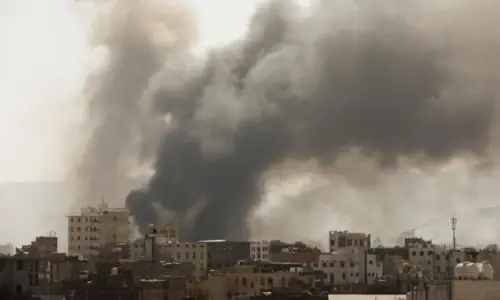
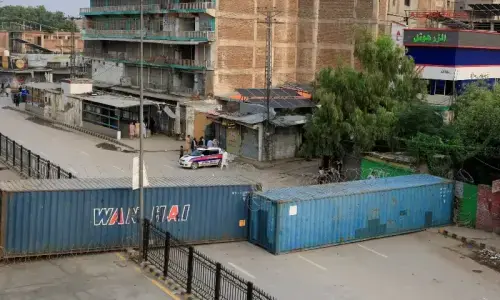
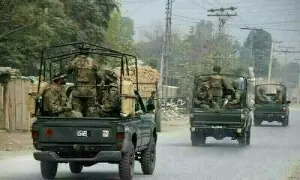
THOSE who blame Pakistan for not doing “enough” in the fight against terror should have seen the bodies of the 42 Pakistani military trainees blown to pieces or mutilated beyond recognition by a suicide bomber in Dargai on Wednesday. This is the price Pakistan is paying and will perhaps continue to pay in a war that has no borders and where the invisible enemy strikes at a place and time of his choosing. Who are the diabolical elements behind this crime is not difficult to guess. It is obvious that the Dargai bombing was the militants’ revenge for the Bajaur strike. No objective version of what happened near Damadola on Oct 30 is available. While some tribal militants and their sympathisers insist that those killed in the air strike were all students, the government has now come out, nearly a fortnight after the event, with the identity of 37 of the dead. President Musharraf has called those claiming the dead at Damadola to be madressah students as lying, while the list released by the ISI on Wednesday gives their age as varying between 12 and 34. The full list of casualties is yet to be released, but Wednesday’s provisional list includes at least one 11-year-old, one 12-year-old and two of 13 years. Whether they were all genuine madressah students or they were all militants or potential terrorists does not minimise the crime either at Bajaur on Oct 30 or its revenge at Dargai on Wednesday.
The issue now boils down to how Pakistan plans to fight terrorism within its borders. The attack in Dargai is not the first of its kind outside FATA. Terrorists loyal to Al Qaeda or those whose identity till this day has remained a mystery have attacked civilian and military targets in various parts of the country. These include the attempts on the life of the president and the prime minister, the countless attacks on imam bargahs and Shia religious processions in some of the major cities, the suicide-bombing that killed French navy engineers, the powerful explosion at the US consulate in Karachi, and the well-planned attack on the Karachi corps commander’s convoy. All these attacks showed planning, indoctrination, training and the determination to wage what looks like a war on the state of Pakistan.
Given the wave of fanaticism sweeping parts of our society — and, regrettably, the sympathy that militant elements enjoy in some quarters — one can expect more such attacks. The government, no doubt, has to be firm, but it must know that a policy based solely on force is unlikely to prove successful. The Sept 5 deal in Waziristan has shown the way. Even though it is not an ideal deal, the agreement with the tribal elders demonstrates how the cooperation of the peaceful sections of society can be won over to isolate foreign terrorists and their local collaborators. Bajaur rankles, because the air strike took place on the day an agreement similar to the Sept 5 deal was to be signed. That attack and what happened at Dargai on Wednesday could perhaps make that task difficult. The dead at Bajaur also included Afghan nationals. This only serves to emphasise the need for Pakistan to pressure the Karzai government into doing more to stop incursions into Pakistan, instead of blaming Islamabad for its own incompetence.
Testing times for Bangladesh
THESE are testing times for Bangladesh. President Iajuddin Ahmed, who took over as head of the caretaker government 10 days ago, has failed to defuse the political crisis that grips this country and 25 people have been killed in the last 10 days. The Awami League (AL), led by Shaikh Hasina Wajed, has demanded the removal of the chief election commissioner as the proof of the interim government’s impartiality and neutrality. If this is not done till Friday, she has threatened to launch a movement that will obviously jeopardise the prospects of the January elections. What would happen next is anybody’s guess. The election commissioner has refused to resign and it is said that constitutionally there is no way he can be forced to step down. This vindicates Begum Wajed’s charges that he is biased towards the Bangladesh Nationalist Party (BNP) as he was appointed by Begum Khalida Zia when she was in office.
All this has made the situation in Bangladesh volatile and the country could be dragged into the pit of turbulence, terrorism and violence. If this happens, the gains made by the democratic forces in the last 16 years would be undone and the military could seize power. What is worrisome is that this time religious militancy would be calling the shots. True, both the major parties are secular but one of them — the BNP — has relied on a religious party to win power. The problem is that when a party believes in a no-holds-barred approach that encourages violence and terror, as Bangladesh’s Jamaat-i-Islami does, the principles of democracy are thrown to the winds. Even a handful of militants, who may not be enjoying the support of the moderate majority, can do enough harm to the country’s political system. The BNP entered into a coalition with the Islamists in its drive for power without realising that this will give a boost to religious militancy. The bomb blasts and the slaying of two judges by Islamic groups in 2005 have confirmed the debut of Islamic militancy in Bangladesh. That is the bigger challenge to the country’s democracy which has so far suffered badly because of the failure of the BNP and the AL to work in harmony within the framework of a two-party system.
Peace deal in Nepal
TUESDAY’S midnight deal between the Maoist rebels and the Seven-Party Alliance comes as a ray of hope for the Nepalese who see the agreement as a significant step towards the restoration of peace and democracy in their country. Nepal has come a long way since the events of last April when thousands of Nepalese took to the streets against the restrictions imposed on civil liberties by King Gyanendra, under whose rule the country had regressed to the point of becoming an absolute monarchy. However, after parliament was reinstated, the monarchy was shorn of its powers. Its future continues to hang in the balance as the Maoists say that they will oppose dynastic rule. This is likely to remain a sticking point within the interim government which is to be constituted before the end of the month and which will give the Maoists 73 out of 330 seats.
But perhaps the best part of the deal is the rebels’ renouncement of guerrilla warfare. According to the agreement, their arms are to be put away, and though the rebels will retain the keys to the lockers, the weapons will be under UN supervision. The army, too, is to hand in an equal number of weapons. Years of a bloody insurgency have taken their toll on the Nepalese economy as well as on the patience of civilians whose lives and businesses have been badly disrupted by regular strikes and violence. This is a golden opportunity for the rebels to prove their worth as a political force. Although they control most of the Nepalese countryside, their strong-arm tactics have angered many people. But now, by laying down their arms and entering into a peaceful power-sharing arrangement with the politicians, they stand a good chance of gaining acceptance among the people.
Essence of Islamic thought
THE essence of Islamic revolutionary thought consists of the idea that it is not enough to practise Islam in one’s personal life only. Islam has essentially to be practised in the social, economic, and political fields as well.
In other words, this implies that the establishment of the sovereignty of Almighty Allah both in the “religious” as well as the “secular” domains is a must.
There is no dichotomy in Islam between collective and individual life. The underlying and pervasive idea in this context, which is also an integral part of the Islamic revolutionary thought, is that the struggle to establish unqualified and unconditional ascendancy of the Holy Qur’an and the Sunnah of Prophet Muhammad (SAW) is obligatory upon all the Muslims. The goal of this struggle is, to achieve the domination of the True way of life (Deen al-Haq), so that the Islamic system of social justice — which is the most balanced synthesis of human freedom, fraternity, and equality, and which embodies the Divine attributes of benevolence, providence, and justice — can be established on earth.
Unfortunately the conception of many of our traditional ulema appears to be seriously flawed and misguided in this respect. They are usually of the opinion that implementation of the Islamic laws or Shariah is all that is required to turn an un-Islamic country into an Islamic one. But they seem to ignore the fact that the laws always sub-serve the system. If the system is corrupt, the Islamic laws would simply protect and enhance the corruption.
In order to make Islamic Laws effective, prevailing feudal order and interest-based banking system, which are the biggest tools of exploitation and corruption, must be abolished. However, since these form the power basis of the present corrupt system, the only way to abolish them is through revolution. In this context, it is not difficult to imagine why the Islamic revolutionary thought is condemned and denigrated by the West as one of the most despised evils in today’s world.
The reason for their extreme aversion is based on the fact that only the system of social justice of Islam with its dynamic interpretation and the revolutionary process can bring about the fundamental change. It is therefore the revolutionary Islam that poses a real challenge to the corrupt and exploitative capitalistic system based on greed, lies and deception that was born in Europe but which has come to dominate the entire globe.
What is secularism? Any number of religions can be accommodated under a secular system, but nothing doing with the collective affairs of a society, which will be decided by the privileged class — the elite. Such a concept is diametrically opposed to the basic teaching of Islam. There is no clergy or hero-worship in Islam. In Islam, there is no discrimination on the basis of caste, colour or creed; the only basis of differentiation would be the following of Islam.
The Holy Qur’an describes Islam as Deen-ul-Haq, the true way of life. The very connotation of the word Deen — as in contrast to religion — is a declaration of war against secularism. This is because the word religion is commonly used in a rather narrow sense, its scope being limited to a set of dogmas, some rituals for worship, and a number of social customs to celebrate important life-events.
Deen, on the other hand, is a system of life in which human beings consciously surrender themselves to the sovereignty of a Higher Authority, and live a life of total obedience to that Higher Authority. Islam is a Deen not religion which means a system of life where Almighty Allah is worshipped and obeyed in each and every aspect of human life.
The true way of life, Deen-ul-Haq, is not meant to survive submissively as a religion under the umbrella of secularism; instead the Holy Qur’an makes it abundantly clear that Islam is meant to dominate all the man-made systems and ideologies, without which a significant portion of Islam would remain confined to the realm of theory only. It’s not that Islam cannot survive or support itself without political authority, rather, it is the political authority that grows more and more corrupt unless it is subordinated to the commands of the Holy Qur’an and the Sunnah of Prophet Muhammad.
The struggle to establish the domination of Islam is one of our basic, though unfortunately forgotten, duties. The system of social justice of Islam was established by Prophet Muhammad after a relentless and unyielding revolutionary struggle of twenty years and many sacrifices of men and material. In the same way, the system of Islam shall be established in the world once again, by the true believers of Islam, according to the sayings of the Prophet (SAW).
Democrats’ victory
FOR six years, latterly with the backing of both houses of a markedly conservative Republican Congress, George Bush has led an American administration that has played an unprecedentedly negative and polarising role in the world’s affairs. On Tuesday, in the midterm US congressional elections, American voters rebuffed Mr Bush in spectacular style and with both instant and lasting political consequences.
By large numbers and across almost every state of the union, the voters defeated Republican candidates and put the opposition Democrats back in charge of the House of Representatives for the first time in a dozen years and have narrowly won control of the Senate too. Either way, the results change the political landscape in Washington for the final two years of this now thankfully diminished presidency. They also reassert a different and better United States that can again offer hope instead of despair to the world. Donald Rumsfeld’s resignation last night was a fitting climax to the voters’ verdict. Thank you, America.
In US domestic terms, the 2006 midterms bring to an end the 12 intensely divisive years of Republican House rule that began under Newt Gingrich in 1994. These have been years of zealously and confrontational conservative politics that have shocked the world and, under Mr Bush, have sent America’s global standing plummeting.
That long political hurricane has now at last blown itself out for a while, but not before leaving America with a terrible legacy that includes climate-change denial, the end of biological stem-cell research, an aid programme tied to abortion bans, a shockingly permissive gun culture, an embrace of capital punishment equalled only by some of the world’s worst tyrannies, the impeachment of Bill Clinton and his replacement by a president who does not believe in Darwin’s theory of evolution. The approval by voters in at least five more states of same-sex marriage bans - on top of 13 similar votes in 2004 - shows that culture-war politics are far from over.
Exit polls suggest that four issues counted most in these elections — corruption scandals, the economy, terrorism and Iraq. In the end, though, it was the continuing failure of the war in Iraq that has galvanised many Americans to do what much of the rest of the world had longed for them to do much earlier. It is too soon to say whether 2006 now marks a decisive rejection of the rest of the conservative agenda as well. Only those who do not know America well will imagine that it does.
The Democratic victory was very tight in many places, but its size should not be underestimated. November 7 was a decisive nationwide win for the progressive and moderate traditions in US political life. The recapture of the Senate, if it happens, will involve captures from the Republicans in the north-east, the north-west, the midwest and the south. The Democrats won seven new state governorships on Tuesday, including New York and Ohio, and now control a majority nationwide.
Republican governors who held on, like Arnold Schwarzenegger in California and Charlie Crist in Florida, only did so by distancing themselves from Mr Bush. The statewide Democratic wins in Ohio give their 2008 presidential candidate a platform for doing what John Kerry failed to do in this crucial state in 2004. Claire McCaskill’s win in the Missouri Senate race showed that Democrats can win a state which almost always votes for the winning presidential candidate.
If Jim Webb has won the recounting Virginia Senate seat, Democrats will have gone another step towards re-establishing themselves in a changing part of the south. In almost every one of these cases, as in the Connecticut contest won by Joe Lieberman running as an independent, the Democrats have won by cleaving to the centre and winning the support of independent voters. The new House Speaker Nancy Pelosi may be the Armani-clad San Francisco leftwinger of the caricaturists’ dreams but she heads a caucus that will demand caution on some of the baby- boomer liberal generation’s pet subjects.
The big questions under the new Congress will be the way that Mr Bush responds to this unfamiliar reduction in his authority and whether the Democratic win will push the president into a new Iraq policy. At his White House press conference yesterday, Mr Bush inevitably made plenty of suitably bipartisan and common- ground noises. He had little alternative. But they rang hollow from such a tarnished and partisan leader. It will take more than warm words in the immediate aftermath of an election reverse to prove that Mr Bush is now capable of working in a new way.
The departure of the disastrous Mr Rumsfeld has come at least three years too late. But it shows that Mr Bush has finally been forced to face the reality of the Iraq disaster for which his defence secretary bears so much responsibility. As the smoke rose over the Pentagon on 9/11, Mr Rumsfeld was already writing a memo that wrongly pointed the finger at Saddam Hussein.
He more than anyone beat the drum for the long-held neoconservative obsession with invading Iraq. It was he who insisted, over the advice of all his senior generals, that the invasion required only a third of the forces that the military said they needed. He more than anyone else is the architect of America’s humiliations in Iraq. It was truly an outrage that he remained in office for so long.
But at least the passing of Mr Rumsfeld shows that someone in the White House now recognises that things cannot go on as before. Business as usual will not do, either in general or over Iraq.
—The Guardian, London