4
4
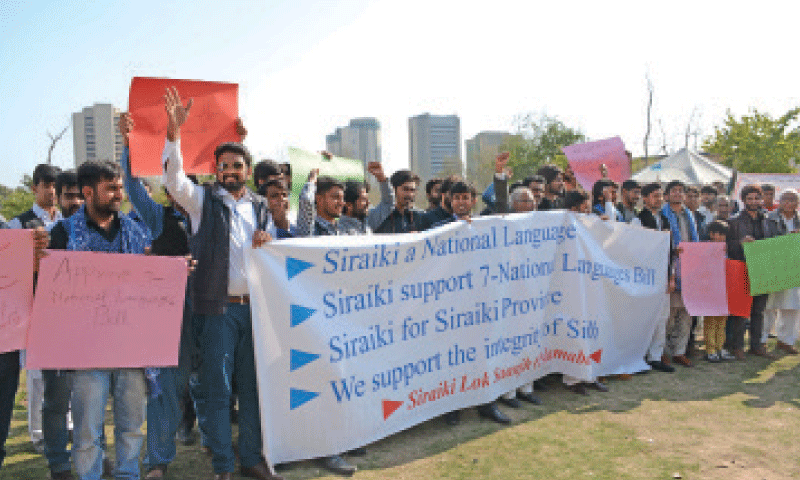

ISLAMABAD: The discussion during the concluding session of the mother languages symposium veered towards the Chinese language on Tuesday, with participants claiming the China Pakistan Economic Corridor could become the new East India Company and wipe out opportunities for Pakistanis.
Government representative Marvi Memon, however, disagreed with the argument, saying: “I totally disagree that the Chinese language can become a threat to the languages of Pakistan.” Ms Memon, the chairperson of the Benazir Income Support Programme, has worked on the promotion of local languages, and chaired Tuesday’s session.
During the symposium, writers and literary figures gathered at the Pakistan Academy of Letters (PAL) to draft a policy for the government, calling for more national languages in the country.
The discussion turned towards Chinese when Pashto writer Saleem Raza spoke about how the East India Company occupied the subcontinent, giving people no choice but to learn English and culminating in English becoming the official language.
Mother language symposium discusses introduction of Chinese language in Pakistan
Mr Raza told Dawn he was quite sure that within a few decades, people in Pakistan would not be able to do business or get jobs without learning Chinese.
“The Chinese will bring their language and culture to Pakistan. They will start businesses and will employ those who will be able to speak Chinese. People will have no choice but to learn Chinese. Institutes have already opened in Gwadar,” he claimed.
“Currently, we fear that local languages are being ignored, and steps should be taken to promote them. But after a few decades, even Urdu and English will face the same threat, because Chinese will become the status symbol, and people will enrol in courses to learn Chinese the way they now enrol in spoken English courses.”
However, Ms Memon argued that measures will be taken to protect local languages. She said she has decided to publish a book containing inspirational stories of 100 beneficiaries in 74 different languages.
However, the participants said there are only 16 languages in Pakistan with local scripts, and it would not be possible to write stories in 74 languages. It was then decided that audio recordings would be made of the beneficiaries, which will be provided with the book. The book, which will contain stories in 16 languages, will also be published in Urdu and English.
While speaking about the two-day symposium earlier, PAL Chairman Dr Qasim Bughio said India uses the trilingual formula, which means every student has to study Hindu, English and a local state language.
“The formula, which is very successful, was made when some Indian states demanded separation because their languages were being ignored. Now even civil servants have to learn the language of the state before starting work. We can also adopt it,” he explained.
Mr Bughio said there have been suggestions that provinces be allowed to teach local languages, but they should also teach the history and languages of other provinces. Language engineering, such as machine-readable dictionaries and translation, was also suggested.
The PAL chairman said the 11 most widely spoken languages should be declared national languages, and a language commission should be formed, in addition to provincial language authorities.
Prof Dr Wasima Shahzad from Air University said a linguistic survey should be carried out, and suggested that people should be asked about their languages during the census for data on how widely spoken specific languages are in the country.
“The data could be useful for policymaking,” she said. “New software and keyboards should be devised for translations.”
Ms Memon assured the participants that the suggestions will be considered by the government and steps will be taken to increase the number of national languages, saying the PML-N manifesto included the promotion of local languages.
Published in Dawn, February 22nd, 2017