
The negation of the self is often misconstrued as the denial of one’s own being. Sufis do not do that. For them the negation of the self is a transcendent urge to become part of a larger being, which could either be God or the beloved in human form. According to a western thinker, to agree is to merge. This is exactly what the Sufi does. He merges with the larger being because he is in agreement with Him or whoever he is in love with.
Artist Fatima Zahra Hassan names the latest body of her work ‘Annihilation’. Through her paintings, on display at the Chawkandi Art Gallery, she has tried to explore the line attributed to Ibn Arabi, ‘I follow the religion of love.’
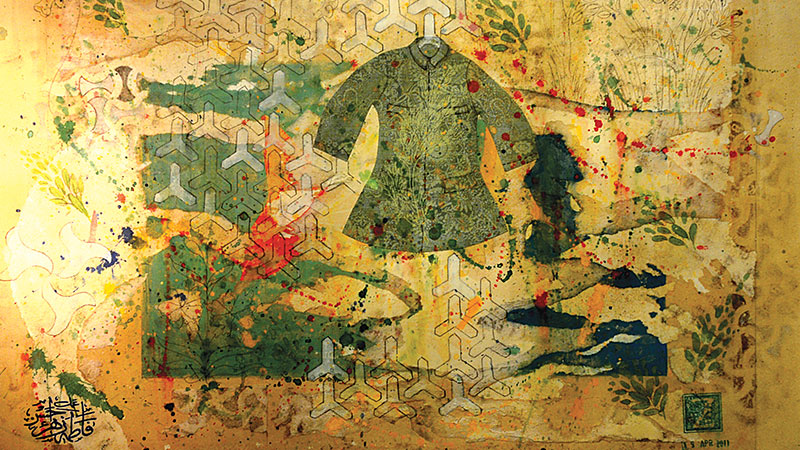
The religion of love is the central idea of the show. However, what the artist has been able to achieve through her noteworthy work goes beyond that. Annihilation to her doesn’t mean destruction. It is the longing, the desire to be associated with something bigger than sentient or emotional responses to different aspects of life. ‘Green Coat in Wilderness’ (watercolour, gouache, natural pigments, collage on tea-stained wasli paper) speaks of a historic character in Muslim history, and yet the technique that Fatima Zahra has employed, with smudges all over the artwork with a hint of certain contemporary matters such as ‘drones’, imply the ruthless progression of history. Merely following the religion of love doesn’t help; practising and exploring it further are just as important.
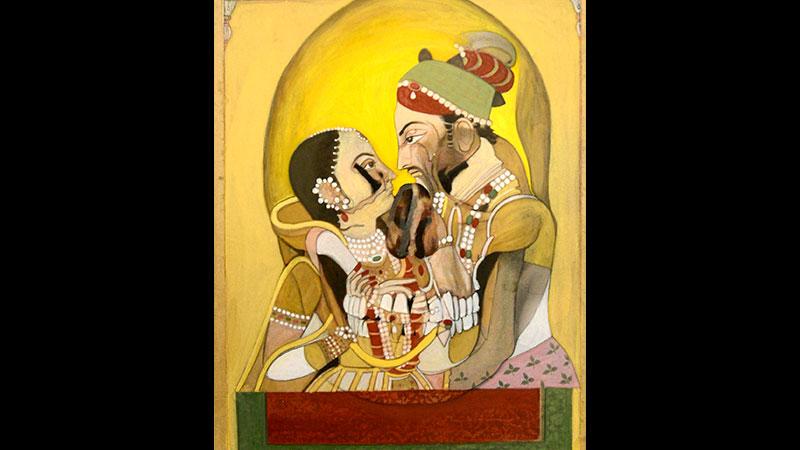
With the ‘Annihilation’ series (natural pigments, watercolour, gouache on wasli paper) the artist intelligently plays with symbols. The fact that the human skull is not completely skinned is an indication of partial death. It could be partial immortality, depending which side of history’s fence the viewer likes to position himself.
Fatima Zahra Hassan makes her art readily relatable to life despite throwing in a variety of media, and concepts, to convey her message.
The exhibition will continue till Jan 8.