Khyber Pakhtunkhwa Governor Faisal Karim Kundi on Sunday chaired the first meeting of the KP Advisory Council, which was formed by the federal government following the imposition of an emergency and governor’s rule in the province.
At the outset of the meeting, all members of the council introduced themselves and their portfolios.
Addressing the meeting, Kundi congratulated the members of the council, while noting that they would have to face many challenges. He said that they would get a briefing on the portfolios they had been assigned and would get a few days to familiarise themselves.
“We have to fast-track things. There will be zero tolerance on corruption. Things should be done in a timely manner,” he said, adding that they would have to demonstrate a clear difference from the work done by their predecessors.
He said that the first order of business was the law and order situation, adding that there should be no hesitation in taking inspiration from the other provinces.
He said that the current situation was an “opportunity” as he called for building the province’s soft image.
“If we have peace, we will get tourists and investors. My support is with you. I am available for you 24/7,” he said.
Kundi then went on to read out a message for the people of the province, in which he said that due to “extraordinary circumstances”, “necessary measures” were taken under the Constitution.
He said that he would refrain from levelling allegations and political rhetoric.
“I have one message: peace, protection and stability have to be brought back to KP,” he said. He added that the people of KP had paid a huge price for the terrorism that plagued the province.
“The time has now come to give the people of the province, who have rendered these sacrifices, the right to peace. Our fight is against terrorism. Our fight is against the ideology and network which facilitates terrorism and weakens the implementation of the law,” he said.
He also said that Pakhtuns were not a cause of terrorism, but were the “biggest victims”. Therefore, the state had resolved that terrorism would be eliminated from KP and the people would be allowed to live their lives without fear.
“My first priority will be protecting the peace and the people. Right now, our biggest priority is taking effective steps against terrorism. For this, the capacity of the police and the Counter Terrorism Department will be increased,” he said.
He went on to say that another objective would be to cater to the people.
“Mere statements are not the real test of a government, rather the service it provides to the people,” he said. Kundi said that the council would focus on healthcare, education and employment.
The last objective, he said, would be to eliminate the whole ecosystem giving rise to terrorism in the province.
“We cannot solve the issue by just targeting terrorists. Those facilitating and financing … must be eliminated,” he said, adding that those involved in terrorism would be dealt with according to the law.
He assured the people of KP that the “extraordinary steps” taken were not meant to target a particular party or group. Kundi said that the main purpose was to ensure peace and security as he asked for their cooperation.
Security situation reviewed
Separately, Kundi chaired a high-level meeting regarding the security situation in the province, during which he was briefed in detail on the overall situation, counter-terrorism efforts and the current circumstances.
According to a handout, it was decided during the meeting that all containers currently placed in Peshawar will be removed in phases “as soon as possible”.
“Internet services will be partially restored based on necessity,” the statement added.
It was also decided during the meeting to enhance the compensation package for martyred police personnel and to review police salaries, as well as to pay “special attention” to the education and training of the heirs of martyred personnel.
The governor commended the role of the administration and the police, remarking that it was a “positive development” that no untoward incident had occurred amid the prevailing circumstances, the handout said.
He added that eradicating terrorism was a “top priority” and that the operational capacity of the police and Counter-Terrorism Department (CTD) would be further improved to achieve this goal.
“The meeting was attended by Advisor on Home Affairs Kifayatullah Khan, Chief Secretary Dr Muhammad Fakhr-e-Alam Irfan, Inspector General of Police Zulfiqar Hameed, Additional Chief Secretary (Home) Amjad Ali Khan, Additional IG Special Branch Muhammad Kashif Alam, Additional IG CTD, CCPO Dr Mian Saeed, Joint Director General IB Arshad Ali Khan, and other relevant officials,” the statement added.
ISLAMABAD: The federal government on Sunday authorised the deployment of Pakistan Army troops and assets in aid of civil power in Khyber Pakhtunkhwa, after imposing an emergency and governor’s rule in the province.
The authorisation of the army deployment was made through Statutory Regulatory Order, issued by the interior ministry on Sunday.
According to the order, a copy of which is available with Dawn, the federal government authorised the deployment of army troops and assets in aid of civil power for the “safety of life, security of persons and property of citizens as well as security of government installations” in the province.
The authorisation lasts for the duration of the proclamation issued regarding the imposition of an emergency and governor’s rule. The notification cited powers conferred to the government under Article 245 of the Constitution.
KP Governor Faisal Karim Kundi, in consultation with the Military Operations Directorate at General Headquarters in Rawalpindi, would determine the number of troops and assets necessary, the notification added.
Copies of the order were forwarded to the president’s secretary, prime minister’s adviser, the KP governor’s secretary, the Military Operations Directorate GHQ Rawalpindi, the KP home secretary, the inspector general of police (IGP) in the province, the Peshawar High Court registrar and other officials.
The emergency imposition comes a day after PM Shehbaz met President Zardari and discussed the country’s overall security situation.
That meeting came amid heightened tensions between the PML-N-led federal government and the KP government led by the PTI — which is in opposition in the Centre. They have been at odds over various issues, particularly on the counterterrorism policy, which was one of the main reasons behind the breakdown of their Oct 3 talks.
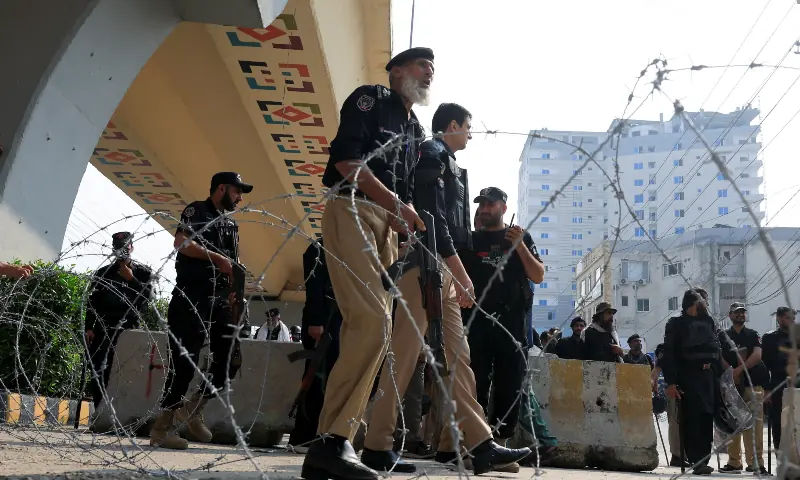
Police guard a road leading to Red Zone, in Peshawar on October 11, 2026. — Reuters
The PTI has said it was being left out of security decisions concerning KP, which the Centre has denied. It also calls for reviewing the counterterrorism policy and opposes military operations.
On the other hand, the Centre has been criticising the KP government’s efforts to combat terrorism in the province and objects to its stance on dialogue with the Afghan Taliban.
Shipping containers block roads
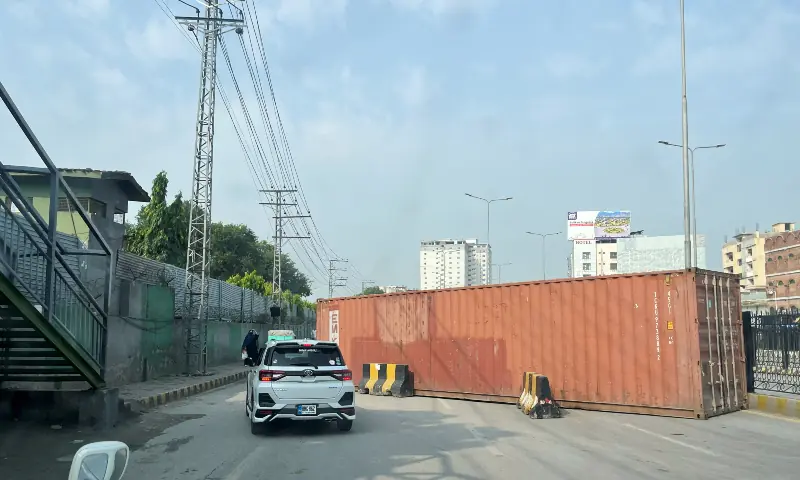
Shipping containers were placed around the city of Peshawar to block roads after the imposition of the emergency.
Containers were placed near Peshawar’s railway station to block the routes towards Khyber Bazaar, Shoba Bazaar and beyond. They were also placed near Edwardes College to block entry to Jail Road and Malik Saad Shaheed Flyover, while people were turned away from Sher Shah Suri Road as it was reported to be completely closed.
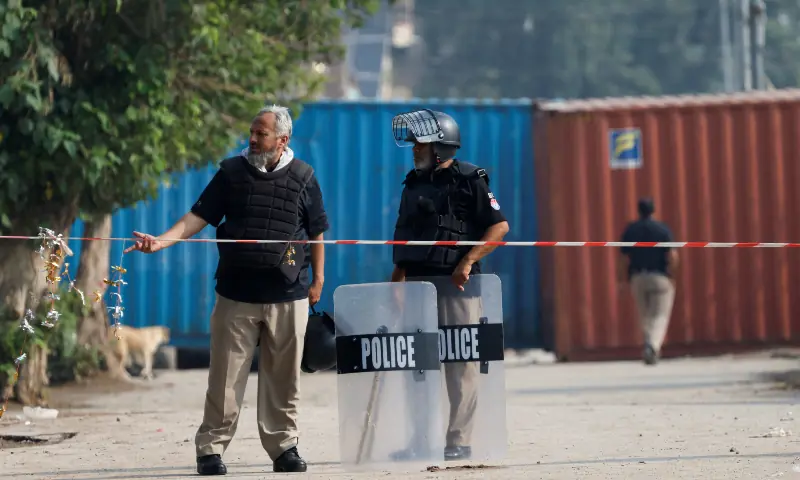
Police were reportedly deployed in significant numbers, particularly around Governor House. The deployment included personnel called from other districts.
Police and personnel of law enforcement agencies (LEAs), including many in plainclothes, were seen patrolling the roads leading to Governor House, the central police office, Peshawar police headquarters and other government installations largely located in the Red Zone, a correspondent reported.
Vehicles with tinted glasses, police mobile vans, armored personnel carriers and other LEA vehicles were reportedly the only transport visible in and around the cantonment area, with life at a standstill and the area appearing deserted.
Another correspondent reported that the road leading to Khyber Road was shuttered by a container and the traffic control gate closed. A large number of police personnel were also seen around Surey Pul, a favoured spot for protesters.
Grand Trunk (GT) Road was blocked by containers at Firdous Chowk and the correspondent reported a large number of police personnel in the area. Only pedestrians were allowed to move ahead.
Additionally, containers near Bala Hisar Fort and outside the Pakistan International Airlines (PIA) office on Arbab Road blocked entry towards Mall Road.
A vehicle moves past a shipping container used to block a road leading to the Red Zone, in Peshawar on October 11, 2026. — Reuters
Only official vehicles were being allowed to travel from Governor House towards the Chief Minister’s House, while tight security was reported on Sahibzada Abdul Qayyum road where they are located. The Civil Secretariat was seen to be deserted.
Royal Artillery (RA) Bazaar has been closed, while Saddar remains partially open.
Additionally, Peshawar’s Bus Rapid Transit (BRT) stations were reported to be shuttered by Dawn’s correspondent.
The stretch of Khyber Road connecting to University Road and Airport Road at Aman Chowk was reported to be open but with low traffic. A large police contingent was seen at Aman Chowk. Meanwhile, University Road was blocked by containers at Tehkal, and containers at Stadium Chowk allowed for only single-file passage of vehicles on both sides.
Earlier, traffic jams were reported due to the closure of Khyber Road, which connects GT Road with the eastern side of University Road and serves as the main artery and choke point. The resulting diversions created pressure on auxiliary roads.
The area is part of the cantonment, and the Red Zone contains important installations such as the Corps Commander’s House, civil secretariat, central police office, CM Secretariat, CM House and Governor House.
All telecoms services, including landline and DSL, are reported to be suspended in the provincial capital. The city had witnessed a nearly 48-hour mobile service blackout just days ago, on account of the presence of the PTI in the city for its long march.
With networks suspended, people faced immense issues in withdrawing money from bank accounts, as ATMs remained out of service for the entire day.
Aside from the suspension of cellular network and broadband services, however, the situation remained normal for those living on Kohat Road, Charsadda Road, GT Road beyond Pir Zakorhi Bridge, and the area bordering the Khyber district, as well as others on the outskirts of the provincial capital. Vehicles of the armed forces were also reported to be patrolling cantonment areas and a heavy deployment of police was reported in both the city and its outskirts including Kohat Road, GT Road, University Road and Warsak Road.
Separately, a holiday has been declared for schools, colleges and universities in the district on Monday (Oct 12), according to a notification issued by the deputy commissioner of Peshawar.
“It is hereby notified that all educational institutions, both public and private, including schools, colleges and universities, shall remain closed on October 12, 2026 (Monday) located within the territorial jurisdiction of District Peshawar,” the notification said.
On Saturday, KP Inspector General of Police (IGP) Zulfiqar Hameed put district police on alert for possible violent protests and sabotage in the event of an emergency in the province, emphasising caution in the use of force.
Police personnel stand guard near shipping containers blocking a road leading to the Red Zone in Peshawar on October 11, 2026. — Reuters
A notification issued by the IGP’s office directed not only officers in Peshawar but also district police officers (DPOs), sub-divisional police officers (SDPOs) and even station house officers (SHOs) to personally monitor the situation.
It said DPOs could issue appropriate directions, instructions or guidelines to regulate protests and ensure public safety. In the event of violence, they could also take necessary legal action.
It added that the use of force was to be carried out on a gradated basis, noting that in the first phase, protesters should be clearly warned against violence before police began to use forceful measures.
Information Minister Attaullah Tarar on Sunday alleged that the PTI-led government in Khyber Pakhtunkhwa had a “nexus” with terrorist groups, as the Centre explained that the province’s security situation necessitated the imposition of emergency there.
The press conference by government ministers — Tarar, Interior Minister Mohsin Naqvi, Law Minister Azam Nazeer Tarar, and Minister of State for Interior Tallal Chaudhry — came shortly after the Centre imposed emergency in KP, citing the provincial government’s lack of efforts to combat terrorism.
The Centre and the PTI — which was in power in KP — have been at odds over various issues, particularly on the counterterrorism policy, which was one of the main reasons behind the breakdown of their Oct 3 talks.
Addressing the media in Islamabad, the information minister said all cabinet members who attended Sunday’s meeting were of the view that the “PTI government in KP is hand in glove with terrorists and has an unholy alliance with terrorists”.
“Terrorists have a clear say in how each district will be run,” he alleged, citing reports from the Intelligence Bureau and law enforcement agencies (LEAs).
He contended that while other political parties faced terrorist attacks in the region, the PTI got “secure access and passage” thanks to its alleged alliance with such groups.
“What is the reason that even police stations of some districts have been sublet to the Taliban?” Tarar asked, emphasising that the case was not merely of inaction and incompetence but of “empowering” the terrorists.
The minister went on to allege that a “power-sharing formula was gradually taking shape between terrorists and the PTI’s KP government, which was starting from southern districts and was ingressing further into the entire KP”.
He said the “unholy alliance and the nexus between them, as a result of which they had outsourced several districts to terrorists,” enabled the martyrdom of people and attacks on civilian infrastructure.
“I say this publicly that these [Taliban] are foreign-funded people who want to bring our country to destruction,” he said, asserting that a provincial government’s facilitation towards such elements was a “constitutional breakdown”.
Tarar referred to the recent bill regarding police assignments and alleged that the KP government wanted to “hire individuals from terrorist groups in the police”. “They were gradually dragging the entire province towards destruction, irrefutable proof and evidence of which is available.”
Meanwhile, the interior minister warned the groups gathered in parts of KP — an apparent reference to PTI supporters taking part in its long march — to disperse as they did not have any “provincial protection”.
“Whoever is caught, complete legal action will be taken and that person themselves will be responsible for it. We will deal with them strictly, so it is my request that please disperse.”
Responding to a query, Naqvi said, “We have to restore law and order in KP, and we will take whatever action is needed for that, and we will normalise the situation as soon as we can.”
Asked about the reported arrests of KP ministers, Naqvi said individuals would be held under preventative detention where required to maintain law and order, whereas those “wanted will be arrested”.
Responding to a query highlighting terrorism in Balochistan, the interior minister said counterterrorism operations in recent months there had resulted in a “difference” in the situation there.
On the KP emergency, the law minister explained that an Area Development Secretariat (ADS), overseen by the governor, has been formed by the federal government to directly manage 12 districts “that were nearly in a war situation”.
He noted that Parliament assumes the legislative powers of the provincial assembly as the latter stands non-functional.
KP Advisory Council formed
The minister then questioned the KP cabinet’s performance, hailed the province getting “riddance from this group” and provided details of a technocratic KP Advisory Council.
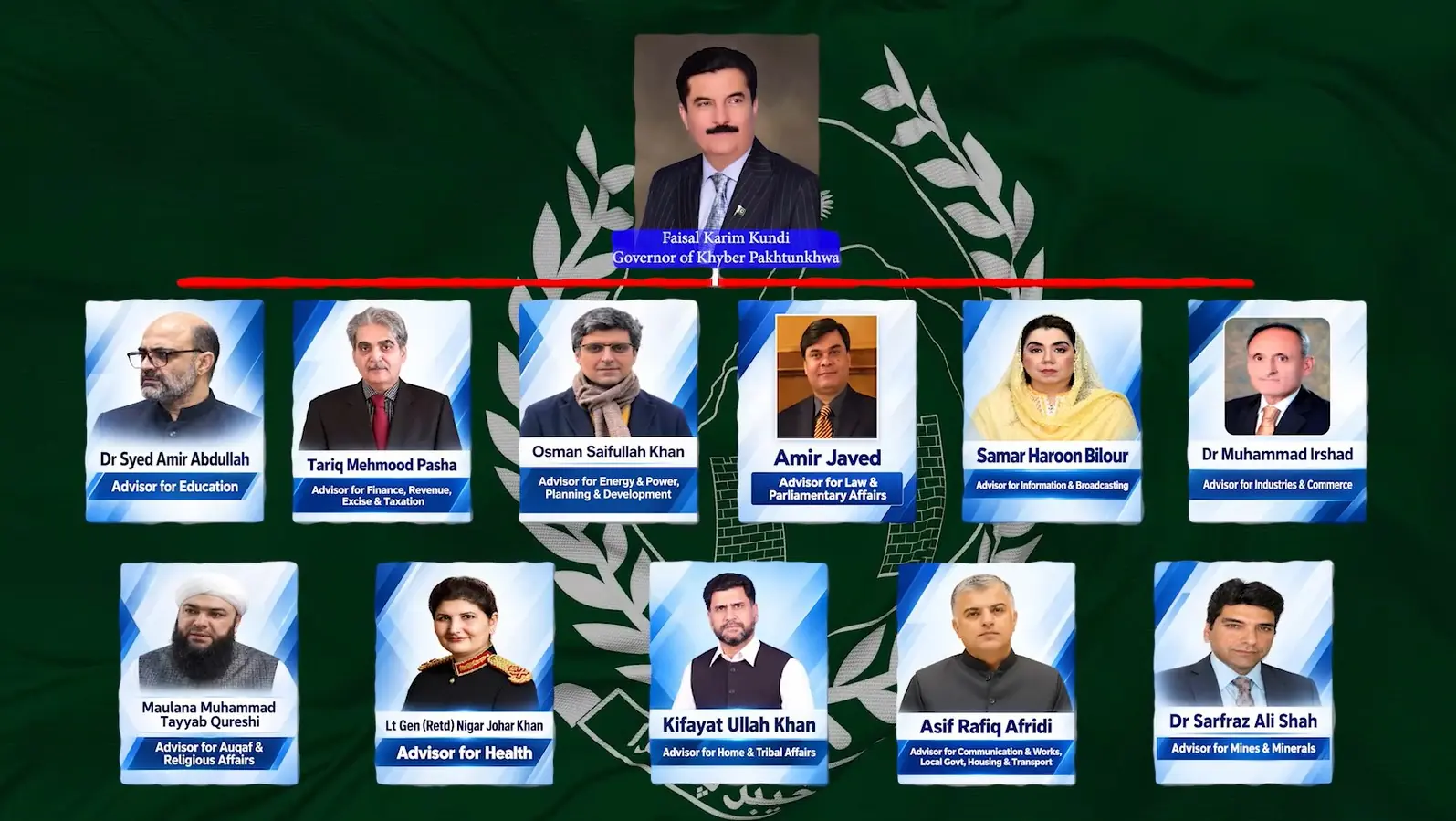
The 11-member council has been formed by the Centre as part of the emergency measures under Article 232 of the Constitution, according to an order seen by Dawn. It will assist the governor in exercising the functions of the KP government on behalf of the federal government.
Through the order, the Centre also appointed Advocate Sanaullah as the KP advocate general.
The province’s home affairs will be overseen by former prisons chief Kifayatullah Khan, described as “very competent” by Tarar.
Tariq Mahmood Pasha, a former FBR chief and an aide to then-finance minister Ishaq Dar, has been assigned as advisor for finance affairs.
MNA Samar Haroon Bilour has been appointed as information adviser, while retired Lt Gen Nigar Johar has been tasked with health affairs.
Former advocate general Amir Javed was assigned the portfolio for law; ex-senator Osman Saifullah Khan will advise the governor on energy and power; Asif Rafiq Afridi was given the portfolio for communication and works; while Maulana Tayyab Qureshi will oversee religious affairs.
Tarar noted that all chosen advisers had either doctorate degrees or extensive experience in public service.
These included Adviser for Industries and Commerce Dr Muhammad Irshad (a former FBR chief with a PhD in finance), Adviser for Mines and Minerals Dr Sarfraz Ali Shah (who had a PhD in economics) and Adviser for Education Dr Syed Amir Abdullah (with a PhD in international relations).
The Cabinet Division has issued an order by the federal government that said that after the proclamation of an emergency, the government of KP “cannot be carried on in accordance with the provisions of the Constitution”.
Exercising its powers under Article 232, the government ordered that an Area Development Secretariat (ADS), under the superintendence of the Area Representative and Development Council (ARDC), be immediately established to “restore law and order, safeguard the security of the citizens of Pakistan and ensure good governance and development” in Dera Ismail Khan, Tank, Lakki Marwat, Bannu, Bajaur, Mohmand, Khyber, Kurram, Orakzai, North Waziristan, South Waziristan (Upper) and South Waziristan (Lower).
It said that the ARDC shall be a representative council comprising the notables from the designated districts and shall be headed by a chairman. The members, the chairman, the vice chairman and the spokesperson of the ARDC shall be appointed in such manner and for such duration, as may be determined.
The order further said that the ADS shall be headed by the additional chief secretary of the designated Districts, who shall be the administrator of these areas.
“Officials of the provincial government and of other bodies or authorities posted in the designated districts shall be placed under the operational and administrative control of ADS. Any further postings/transfers to the designated districts may be ordered by the prime minister on the recommendation of the administrator, from time to time,” it said.
It said that the administrator shall perform all the functions of and exercise all executive, administrative, and law enforcement powers vested in or exercisable by the provincial government in the designated districts.
It said that the administrator may: establish organisational setups for governance, security and development in selected districts with command over district administration, law enforcement and all line departments; issue binding orders to civil, police, and military authorities; issue orders for operational, organisational and administrative functions of ADS; issue orders for allocation and transfer of funds; coordinate with federal agencies, armed forces and provincial bodies for law enforcement and security of the areas; reorganise departments and take necessary actions for public safety, economic stability, relief operations and provision of essential services; and take such other measures as are necessary for the purposes of effective and good governance, maintenance of law and order and provision of services in the designated districts.
“All orders, notifications, directions, or actions taken by the administrator shall have the same legal effect as if issued by the provincial government,” it read.
The order further said that provisions of Chapter 3 (provincial governments) of the Constitution’s Part IV and Clause 3 of Article 175, which pertains to the separation of the judiciary from the executive, will not apply to the designated districts. KP Government Rules of Business 1985 will not apply either.
Naqvi details govt efforts to resolve issues
In his remarks, the interior minister said the Centre tried to take the KP government on board in the counterterrorism fight, but the efforts were in vain due to a lack of response from the latter.
At the outset of Sunday’s briefing, Naqvi said, “Today was not an easy day for us. For over one month, we continuously tried to take the KP government on board. I was personally in touch with them in the background; our only goal was to onboard them so that we could fight together against terrorism.”
The minister went on to reveal that he was in contact with PTI leaders until 11:45pm last night and had been communicating with them “all day about the draft’s para four”. “They did not respond all day.”
“I told them that we can still avoid the situation. Things have gone too far, but we can still do something to delay tomorrow morning’s situation,” he said, referring to the imposition of emergency that the Centre had been mulling.
Naqvi also highlighted efforts by veteran politician Maulana Fazlur Rehman to reduce tensions, but no solution could be found.
He even said the Centre communicated to the PTI repeatedly that it had “no issue” with the party’s long march. “Our issue was entirely terrorism-related, and we want to take you on board on it.”
While acknowledging that there were many issues related to KP’s governance, Naqvi said, “My and the entire interior ministry’s point of view was clear: the situation was not linked to politics even one per cent. We were purely seeing this on the basis of terrorism.”
Referring to the Oct 3 talks between the Centre and PTI, he contended that the situation would have been different if they had reached an agreement back then.” “Even if last night they had said yes, it (emergency) would not have happened.”
He added, “Ask them who their masterminds are. Who were sabotaging them?”
The interior minister then elaborated on the security challenges KP faces, stating that the situation was “really bad” in 12 districts. “In some districts, you cannot even leave your house in the evening.”
“We had multiple meetings with Sohail Afridi, and the only topic was terrorism; no political conversation happened,” he emphasised. The minister said a plan was proposed to strengthen KP Police in five districts initially and eventually hand over security to it in six months, then repeat the process in another five districts.
“They said they had a lack of funds, but it is on the record that we said that we will provide any more funds you need. This was a four-month-old conversation but still no work has happened on it.”
The minister further claimed that the PTI team had agreed on imposing emergency in 12 districts, but added that they were “scared of being seen meeting with us”. “We had clarity on one thing that we did not want to involve politics in this.”
He further alleged, “Their connections with the Taliban are no secret. I would not say anything further.”
The minister remarked that the security situation was extremely bad in certain districts, yet the PTI was able to hold rallies and “not even one person was harmed”.
“We only had two options: either we would see the martyrdoms daily, or we end them. So this difficult decision we have made has a background,” he maintained, adding that the federal government tried its best to avoid it.
During the briefing, Naqvi claimed that “demands” the PTI put forward were already being considered last month, before the opposition party announced its long march towards Islamabad. “Some of their own people could not understand why the long march was taking place.”
He recalled that Prime Minister Shehbaz Sharif wanted to hold talks with the National Assembly opposition leader last month and proposed forming a committee, but the government did not get any confirmation.
“We were trying our best to hold the meeting before the prime minister left so that the situation could be diffused,” he said, noting that a committee for the Oct 3 talks was formed later.
According to the interior minister, the consultations took place for two days and credited PTI MNA Asad Qaiser for saying with “clarity that it is not possible that we take even a step back on terrorism”.
“We will not do it for you; we will do it for Pakistan, and we will fight united against terrorism,” Naqvi quoted Qaiser as saying, adding that he requested the ex-NA speaker to take the KP government on board.
The minister then reiterated that an agreement draft was revised four times, after which the government negotiation committee found out a new draft had been presented by the opposition team.
“Although the previous day the chief minister had authorised them to agree on their behalf, the next day it all changed,” Naqvi said.
ISLAMABAD: The federal government on Sunday imposed an emergency and governor’s rule in Khyber Pakhtunkhwa following the president’s approval of the recommendations by the federal cabinet.
The measures have been approved under Articles 232 and 234 of the Constitution, the President House said in a statement. The two provisions pertain to the proclamation of emergency and governor’s rule.
Following the imposition, internet disruptions were being reported from parts of Peshawar, with Dawn unable to contact its correspondents there.
According to sources in the telecom sector, mobile network and data services have been slowed or shut down in selected areas of some cities. However, there is no province-wide shutdown of mobile data or internet.
Internet watchdog NetBlocks said network data showed a major disruption to internet connectivity in parts of KP as emergency was imposed.
The federal government also authorised the deployment of Pakistan Army troops and assets in aid of civil power in KP. On the ground, shipping containers were placed around the city of Peshawar to block several roads, with heavy police deployment.
The decision to impose the emergency provisions came during an emergency meeting of the federal cabinet chaired by Prime Minister Shehbaz Sharif, where he was briefed on the security situation in KP.
A statement issued by the Prime Minister’s Office (PMO) said cabinet members reviewed the situation and took note of the “provincial government’s deliberate disengagement from the fight against terrorism”.
The members proposed, given the “gravity” of the situation, that the PM advise the president to exercise “his constitutional authority and impose an emergency in the province under Articles 232 and 234 of the Constitution”.
The emergency imposition comes a day after PM Shehbaz met President Zardari and discussed the country’s overall security situation.
That meeting came amid heightened tensions between the PML-N-led federal government and the KP government led by the PTI — which is in opposition in the Centre. They have been at odds over various issues, particularly on the counterterrorism policy, which was one of the main reasons behind the breakdown of their Oct 3 talks.
The PTI has said it was being left out of security decisions concerning KP, which the Centre has denied. It also calls for reviewing the counterterrorism policy and opposes military operations.
On the other hand, the Centre has been criticising the KP government’s efforts to combat terrorism in the province and objects to its stance on dialogue with the Afghan Taliban.
It may be recalled that in July 2024, when Afridi’s predecessor Ali Amin Gandapur was the chief minister, the KP Assembly passed a resolution urging the federal government to consult with it and the provincial government before launching a new military operation.
The resolution, passed by a majority vote, cautioned that proceeding without provincial consent could hinder the offensive’s success and result in adverse consequences, for which the federal government would be responsible.
In December that year, the assembly voted unanimously against a potential military operation in parts of Khyber and Bannu districts.
About a year later, after Afridi became the KP CM, the provincial assembly convened a grand jirga with Governor Faisal Karim Kundi and other parties in attendance. The moot unanimously demanded that the Centre prioritise negotiations with Afghanistan and consult the KP government over Afghan policy.
Constitutional provisions
Emergency
Article 232 of the Constitution provides for the proclamation of emergency in a province.
It says, “If the president is satisfied that a grave emergency exists in which the security of Pakistan, or any part thereof, is threatened by war or external aggression, or by internal disturbance beyond the power of a provincial government to control, he may issue a Proclamation of Emergency.”
However, invoking this article “due to internal disturbances beyond the powers of a provincial government to control” requires a resolution from the provincial assembly of that province.
In case the president “acts on his own” — which is not currently the case — the Proclamation of Emergency is to be placed before both houses of Parliament for approval by each house within 10 days.
According to this provision, parliament “shall have power to make laws for a province, or any part thereof, with respect to any matter not enumerated in the Federal Legislative List” during the time of the proclamation of an emergency.
Nothing in this Article shall restrict the power of a provincial assembly to make any law which the Constitution empowers it to make, but if any provision of a provincial law is repugnant to any provision of an Act by Parliament, the latter would prevail and the provincial law would be void as long as the parliamentary Act is in effect.
Governor’s rule
On the other hand, Article 234 deals with the imposition of the governor’s rule “in case of failure of constitutional machinery in a province”. For imposition of the governor’s rule, the president simply requires a request from the provincial governor, it says.
“A proclamation issued under this Article shall be laid before a joint sitting and shall cease to be in force at the expiration of two months, unless before the expiration of that period it has been approved by resolution of the joint sitting and may by like resolution be extended for a further period not exceeding two months at a time,” the Constitution reads.
However, it adds that no such proclamation shall in any case remain in force for more than six months.
Article 233, which provides powers to the president to suspend certain fundamental rights during the emergency period, was not mentioned in the summary signed by President Zardari.
Where is Sohail Afridi?
A couple of hours after the imposition of emergency was announced, KP Information Minister Shafi Jan, who had been accompanying now dysfunctional KP Chief Minister Sohail Afridi on the PTI’s long march, claimed that the he had been taken into custody.
Dawn contacted police for a confirmation soon after Jan’s claim, but there was no response.
Meanwhile, MNA Shahid Khattak also claimed Afridi’s “arrest”, as well as MNA Junaid Akbar and others from there party.
Later, the PTI issued a statement, condemning the “arrest” of Afridi and other and describing it as an act of “political victimisation and an attempt to weaken the province’s elected leadership and democratic institutions”.
It quoted PTI spokesperson Sheikh Waqas Akram as saying that Afridi’s “arrest” could not be viewed in isolation from the federal government’s decision to impose emergency and governor’s rule.
“The developments reflect a broader effort to bypass elected institutions and undermine the constitutional authority of the province.
“The arrest of Chief Minister Sohail Afridi and Junaid Akbar has exposed the political nature of the federal government’s actions. These measures are not directed at addressing security challenges; they are intended to weaken PTI, undermine the elected government of Khyber Pakhtunkhwa and disregard the democratic will of its people,” he said.
Akram demanded the “immediate and unconditional release” Afridi, Akbar and “all other political detainees arrested in connection with the ongoing action against PTI”. He also demanded that the federal government publicly disclose the “legal grounds, specific charges and procedural basis for the arrests of the chief minister and the PTI provincial president”.
However, he sounded less certain while speaking on Geo News programme ‘Naya Pakistan’. He said they had received reports of Afridi and Akbar’s arrest, and adding that they were unable to confirm whether Jan and Khattak, too, had been taken into custody.
“We are unable to contact some people […] Because the internet has been suspended in several areas, we are unable to contact. You do not know the havoc they have created in KP. People are escaping and going into hiding,” he said.
In a clip shared on PTI’s official X account, Salman Akram Raja, the party’s secretary general, said, “We do not know where Sohail Afridi is, in what condition he has been kept. Junaid Akbar is also missing.”
When Minister of State for Interior Tallal Chaudhry was asked about reports of Afridi’s arrest during ‘Naya Pakistan’, he said some individuals had been detained in view of the law and order situation but did not confirm whether they included Afridi.
He said those who did not have a criminal record or were not wanted would be released.
Council, chief secretary appointed
Following the imposition of emergency, the federal government formed an 11-member technocratic KP Advisory Council to assist the governor with running the province.
Later, Governor Kundi also chaired the first meeting of the council, vowing to restore peace in the province.
Earlier in the day, the federal government appointed Dr Muhammad Fakhr Alam Irfan as the chief secretary of KP, according to an official notification, a copy of which is available with Dawn.
The appointment will take effect immediately and remain in place until further orders, it said.
Dr Irfan, a Grade 22 officer of the Pakistan Administrative Service (PAS), was previously serving as secretary of the Power Division in the federal Ministry of Energy. He hails from Mardan.
In a separate notification, the federal government also placed Muhammad Yahya Akhunzada at the disposal of the KP government with “immediate effect and until further orders”.
Akhunzada, a Grade 20 PAS officer, was serving as an additional secretary at PMO.
He hails from Charsadda and has also served as additional political agent for North and South Waziristan, secretary of health, information and education in KP, and commissioner of Dera Ismail Khan.
‘Peace cannot be established by weakening provincial autonomy’
PTI Chairman Gohar Ali Khan strongly condemned the imposition of emergency in KP and “completely rejected” it.
“This is an extremely alarming and grave political mistake and an undemocratic measure — the people will never accept such actions against their rights,” Gohar wrote in a post on X.
He stated: “There is still time; this decision can be withdrawn in a few days. Let the federation set aside its ego, understand the ground realities, accept legitimate demands, respect the sentiments and emotions of the people, and save the country from further political and economic damage and from pushing back the democratic process.
“Revisiting political decisions is not a sign of weakness but of wisdom in the national interest — otherwise, great damage will be done.”
Stressing that the mandate of the people of KP was their constitutional and legal right, the PTI chairman said: “Peace cannot be established, nor stability brought, by ignoring this mandate, weakening provincial autonomy, and creating conflict between the federation and the province.”
He asserted that there was “no disagreement on eliminating terrorism, but the fight against terrorism cannot be used as a justification to suppress the people’s voice, achieve political objectives, or limit the province’s constitutional authority”.
“Terrorism can only be combated through national unity and a joint strategy,” Gohar maintained.
“The federation cannot be strengthened by weakening the provinces. The solution to problems lies not in force, confrontation, and extraordinary measures, but in political wisdom, supremacy of the Constitution, and meaningful negotiations and practical steps.”
The PTI chairman said his party will raise the matter on “every constitutional, legal, and democratic forum for the protection of the people’s mandate, provincial autonomy, and constitutional and democratic rights”.
Later in the day, Gohar said PTI would challenge governor’s rule through the courts, assemblies and public forums.
The PTI parliamentary committee held a meeting and categorically rejected the imposition of an emergency and governor’s rule in KP. In a statement issued afterwards, it termed the development “a direct assault on the public mandate and an unacceptable move”.
“In a three-hour-long meeting of the PTI parliamentary party, the imposition of an emergency and governor’s rule in KP was strongly condemned and unanimously rejected. The meeting declared this step contrary to facts, unconstitutional, undemocratic, and a blatant insult to the public mandate of the province,” the statement said.
“The parliamentary party made it clear that measures to render the elected provincial government ineffective and usurp its constitutional powers could pose grave threats to the federal system and democratic traditions. Such decisions will increase political instability and public unrest in the province, while already existing tensions between the federation and the province will further intensify,” it added.
The statement added that the solution to political differences should be found through constitutional and democratic procedures and mutual consultation, rather than through force and coercion.
It also raised serious questions regarding the conduct of the federal government.
“The parliamentary party took the stance that if terrorism and the deteriorating law and order situation are the primary justification for the imposition of emergency, then why is the situation in Balochistan being ignored?” the statement asked.
The meeting also made it clear that Afridi was the elected chief minister and a member of the provincial assembly.
“Measures regarding his arrest, detention, or the usurping of his constitutional and democratic powers were strongly condemned. The meeting termed such actions an insult to the public mandate and a dangerous precedent for democratic traditions,” it said.
The Tehreek-i-Tahafuz-i-Ayin-i-Pakistan (TTAP), of which PTI is a part, termed the move a violation of the Constitution.
In a statement, the opposition alliance particularly assailed President Zardari’s PPP, claiming that the “most undemocratic actions and the imposition of governor’s rule” had been the hallmark of the party in the country’s history.
“On the one hand, despite the extremely dire administrative and law and order situation in Balochistan, no such step has been taken, while on the other hand, this province — whose assembly and government stand on the true and real mandate of the people — has been targeted,” it contended.
TTAP said it would convene a meeting on the matter and announce a joint course of action.
Governor Kundi urges unity for ‘new chapter’
Meanwhile, Governor Kundi said the decision was made for “establishing peace in Khyber Pakhtunkhwa, the prosperity of its people, and the development of the province”.
“I am your governor, but beyond that, I want to play my role as a servant of this soil and a protector of your rights. Let us come together to bring peace to Khyber Pakhtunkhwa and begin a new chapter of our province’s development,” he said in a statement.
Kundi assured the public that it was his responsibility to raise their issues on the relevant forums.
Recalling the sacrifices made in the fight against terrorism, he said, “Now the time has come that we do not let these sacrifices go to waste and together establish lasting peace in our province.”
The PPP leader urged the public to set aside their political differences and unite for the province’s peace, the protection of its people, and the future of the coming generations.
“We must not let our differences become an obstacle in the path of our province’s common interests.”
Cannot allow PTI to destabilise the economy: PM tells cabinet
Addressing the cabinet meeting, the premier said the PTI-led KP government cannot be allowed to derail the stabilising economy amid tensions between the two sides.
“I will not allow them (PTI) to destabilise the economy,” he said during the meeting.
On terrorism in KP and Balochistan, the premier said, “The way common citizens are being martyred, the way police officials and security officials, children and mothers [..] there can be nothing more heart-wrenching.”
He recalled that Pakistan has repeatedly urged neighbouring Afghanistan to rein in the terrorist elements; however, “they still do not understand it”.
PM Shehbaz also reiterated his condemnation of the recent deadly Houthi attack on Saudi Arabia, noting the long-standing fraternal ties between Saudi Arabia and Pakistan.
“Our only goal is that peace should be restored in the region,” he said.
“Pakistan expresses solidarity with Saudi Arabia and stands with it. We will not tolerate any aggression against Saudi Arabia,” he said, adding that it was a “red line” for Pakistan.
During his address, PM Shehbaz also spoke of the recent staff-level agreement reached with the International Monetary Fund (IMF).
“It is hoped that we will unlock the $1.2 billion tranche within this year,” he said, recalling a meeting with the IMF’s Managing Director Kristalina Georgieva at the sidelines of the United Nations General Assembly (UNGA) last month.
He commended the political and military leadership for “working together day and night” in bringing fiscal discipline to Pakistan.
The premier recalled his visit to London last month, where he had met with senior executives from leading global financial institutions.
He also spoke of Pakistan’s diplomatic efforts in the international community, taking note of the appreciation Pakistan has received for mediation in the Middle East conflict.
“Pakistan continues to play its role with hard work and sincerity,” he said, particularly lauding the role of the Chief of Defence Forces and Chief of the Army Staff Field Marshal Asim Munir.
Security forces killed seven terrorists in an intelligence-based operation (IBO) in Khyber Pakhtunkhwa’s North Waziristan district, state broadcaster Radio Pakistanreported on Friday.
The terrorists belonged to Fitna al Khawarij , a term the state uses for terrorists belonging to the banned Tehreek-i-Taliban Pakistan (TTP).
According to security sources, a large quantity of weapons and ammunition was also recovered from the terrorists.
President Asif Ali Zardari commended the security forces’ operation, which also destroyed the terrorists’ hideouts.
In a statement, the president said “the conspiracies of the terrorists’ foreign patrons and their local facilitators will be thwarted at any cost”.
The entire nation stands with its security forces in the war against terrorism, he added.
Prime Minister Shehbaz Sharif also paid tribute to the security forces for their successful operations against Fitna al-Khawarij, according to state broadcaster.
In a statement, he reaffirmed the government’s resolve to completely eradicate terrorism from the country.
KP has long faced security challenges. In August, the province, excluding the merged districts, recorded 54 terrorist attacks compared with 36 in July, representing an increase of 50 per cent, according to data compiled by the Pakistan Institute for Conflict and Security Studies (PICSS).
A day earlier, security forces killed nine terrorists in an intelligence-based operation (IBO) in North Waziristan.
On Wednesday, security forces killed 13 terrorists in another IBO in North Waziristan. On Tuesday, in yet another North Waziristan IBO, security forces killed five terrorists, state media said, while seven were killed on October 2.
On September 30, security forces killed three terrorists in an IBO in Mir Ali. A day before that, in an IBO in the Bara area, security forces killed five terrorists. On Sept 28, four terrorists were killed during an IBO in Dera Ismail Khan.
On Sept 26, a dozen people lost their lives while 35 others were injured in a suicide blast that targeted the Aman Mela police checkpost in DI Khan’s Darazinda tehsil. On Sept 18, a major attack in the old Police Lines in Kohat claimed 23 lives and injured about 100 others.
Eight terrorists were killed during an overnight clearance operation. On Sept 17, security forces killed 10 terrorists in separate operations in KP between Sept 15 and 17. Earlier that month, over 20 terrorists were killed during multiple engagements in KP between Sept 3 and 5.
THE fact that a consensus on how to deal with terrorism originating in Taliban-ruled Afghanistan eludes regional states was made clear at the recently held Moscow Format moot. The event was attended by nearly all of Afghanistan’s neighbours, including Pakistan. However, there was no joint statement issued because, in the words of the Russian envoy for Afghanistan, “our Afghan and Pakistani colleagues didn’t see eye to eye”.
The Taliban regime had also sent its representatives. The main sticking point was the Taliban’s objection to including Afghanistan in a “terrorist context”. However, as Pakistan’s envoy put it, it was essential to address “the menace of terrorism emanating from Afghan soil”. Russia offered its good offices to help de-escalate matters between Kabul and Islamabad, though it noted that the Moscow Format was not a forum for resolving bilateral disputes.
Both the Taliban’s denialism, and Russia’s apparently soft stance towards the Afghan terrorism problem, are unfortunate. Groups that find shelter in Afghanistan under the Taliban threaten the entire region. Thus, all of Afghanistan’s neighbours need to speak with one voice regarding the ‘export’ of terrorism.
Russia is the only state that recognises the Taliban regime. Moscow has its own reasons for indulging the Taliban; these include the need to fight IS-K, which is a common enemy of Russia and the Taliban rulers, as well as to check US and Western influence in Afghanistan. But engagement with Kabul must not be allowed to obscure the fact that some of the deadliest terrorist groups in the world find refuge on Afghan soil.
Other regional forums, such as the SCO and the ECO, have highlighted the need to address the terrorist threat emanating from Afghanistan. China, which has significant economic interests in Afghanistan, has also pointed to this terrorist threat. The UN Security Council, too, has frequently noted that Afghanistan under Taliban rule has once again become a haven for various terrorist groups.
Pakistan’s insistence, therefore, that Afghanistan’s terrorism problem be highlighted reflects the reality of the situation. If Kabul addresses the issue sincerely and restrains terrorist groups, it will benefit not only the Afghan people but the entire region.
PESHAWAR: Seven policemen were injured when terrorists attacked a police checkpost in Kohat early on Wednesday.
“The attack was successfully repulsed. The injured cops are safe,” a senior police official, who requested to remain anonymous, told Dawn.
According to police sources, the policemen were injured after terrorists hurled a hand grenade at the checkpost located in the jurisdiction of the Gombat police station.
The injured were shifted to hospital, where their condition was stated to be out of danger, the sources added.
Khyber Pakhtunkhwa information minister Shafi Jan strongly condemned the attack, describing it as “extremely regrettable and cowardly”. The statement issued by his office identified the installation as the Shadi Pur checkpost.
He said terrorists would never succeed in achieving their “nefarious objectives” through such actions and expressed his best wishes for the early recovery of the injured police personnel.
Jan said the provincial government had enhanced the capacity of the Khyber Pakhtunkhwa police and the Counter Terrorism Department (CTD) in the fight against terrorism and equipped police with modern weapons and technology.
He said efforts to eliminate the “menace of terrorism” would continue.
According to a recent report from the Centre for Research and Security Studies, Pakistan recorded a sharp 83 per cent increase in violence-linked fatalities during the third quarter of 2026, reversing a declining trend reported in the first and second quarters as terrorism and counter-terrorism deaths surged nationwide.
Balochistan and KP remained the epicentres of violence, jointly accounting for 98pc of all fatalities during the period. Balochistan recorded 829 deaths, nearly 59pc of the national total, while KP reported 556 fatalities, accounting for more than 39pc.
A day earlier, four Federal Board of Revenue officials were martyred in firing by unidentified men, while a separate attack on a highway traffic police vehicle left a police official martyred and another injured in Dera Ismail Khan.
On Sept 27, 14 people, including two rescue officials, were martyred and 35 sustained injuries after a suicide bomber rammed an explosive-laden vehicle into a police checkpost in and then targeted an ambulance taking bodies to hospital in DI Khan.
On Sept 18, a major attack in the old Police Lines in KP’s Kohat claimed 23 lives and injured about 100 others. Eight terrorists were killed during an overnight clearance operation.
Prime Minister Shehbaz Sharif on Wednesday said rising terrorism in Khyber Pakhtunkhwa “must be stopped” at any cost.
He made the remarks during a meeting with Federal Minister for Kashmir Affairs and Gilgit-Baltistan Amir Muqam in Islamabad, according to a statement issued by the Prime Minister’s Office (PMO).
During the meeting, views were also exchanged on matters related to Azad Jammu and Kashmir (AJK), Gilgit-Baltistan (GB) and Khyber Pakhtunkhwa (KP), the PMO said.
“It is our desire that KP should also develop like other parts of the country,” the premier was quoted as saying.
“We regard with appreciation the sacrifices of the people of KP against terrorism,” he added.
The federal minister also briefed the prime minister on ongoing matters and progress in AJK and GB, the statement said.
The prime minister directed that effective measures be continued to ensure the welfare, development and provision of basic facilities for the people of AJK and GB.
He said the development of AJK and GB and the prosperity of their people were among the government’s priorities, according to the statement.
PM Shehbaz on Tuesday expressed dismay over the “unfortunate events” in AJK in recent months, adding that, however, the law took its course.
The government and the JAAC have been at odds over various issues, most notably the committee’s demand to abolish the 12 refugee seats in the AJK Legislative Assembly, which resulted in violence-marred protests across the region.
KP has also been witnessing terrorist attacks and security challenges for a long time. The province, excluding the merged districts, recorded 54 terrorist attacks in August compared with 36 in July, representing an increase of 50 per cent, according to data compiled by the Pakistan Institute for Conflict and Security Studies (PICSS)
On Tuesday Security forces killed five terrorists in an intelligence-based operation (IBO) in North Waziristan.
On October 2, security forces killed seven terrorists in an IBO in North Waziristan.
Security forces eliminated 18 terrorists in separate engagements in Khyber Pakhtunkhwa and Balochistan, state media reported on Wednesday, citing security sources.
In KP, Pakistan TV reported that security forces “killed 13 Fitna al-Khawarij terrorists in an intelligence-based operation in North Waziristan, as operations against militant groups continue under the Azm-e-Istehkam vision”.
Separately, in Balochistan’s Mastung district, security forces killed five terrorists belonging to Fitna al-Hindustan, Pakistan TV reported.
It added that security forces recovered heavy weapons and ammunition from the slain terrorists, and clearance and search operations were underway under Operation Radd-ul-Fitna 3.
Fitna al Khawarij is a term the state uses for terrorists belonging to the banned Tehreek-i-Taliban Pakistan, while the state has designated Balochistan-based terrorist groups as Fitna-al-Hindustan to highlight India’s alleged role in terrorism and destabilisation across Pakistan.
President Asif Ali Zardari and Prime Minister Shehbaz Sharif have commended the security forces for their successful operations against terrorists in KP and Balochistan, according toRadio Pakistan.
In his statement, the president said the operations were “a clear expression of the firm resolve against terrorist elements”.
In a separate statement, the prime minister said operations against Fitna-al-Khawarij will continue until the complete elimination of terrorism and the establishment of lasting peace in the country.
He said terrorists seeking to undermine the country’s peace and security will not be allowed to succeed in their “nefarious designs”.
Terrorism in KP, Balochistan
KP and Balochistan have witnessed terrorist attacks and security challenges for a long time.
KP, excluding the merged districts, recorded 54 terrorist attacks in August compared with 36 in July, representing an increase of 50 per cent, according to data compiled by the Pakistan Institute for Conflict and Security Studies (PICSS).
A day earlier, in another North Waziristan IBO, security forces killed five terrorists, state media said.
On October 2, security forces killed seven terrorists in an IBO in North Waziristan. On September 30, security forces killed three terrorists in an IBO in KP’s Mir Ali. A day before that, in an IBO in KP’s Bara area, security forces killed five terrorists. On Sept 28, four terrorists were killed during an IBO in Dera Ismail Khan.
On Sept 26, a dozen people lost their lives while 35 others were injured in a suicide blast that targeted the Aman Mela police checkpost in DI Khan’s Darazinda tehsil. On Sept 18, a major attack in the old Police Lines in KP’s Kohat claimed 23 lives and injured about 100 others. Eight terrorists were killed during an overnight clearance operation. On Sept 17, security forces killed 10 terrorists in separate operations in KP between Sept 15 and 17. Earlier that month, over 20 terrorists were killed during multiple engagements in KP between Sept 3 and 5.
Meanwhile, in Balochistan’s Chagai, security forces killed two terrorists on Sept 29.
The military’s media affairs wing said on Sept 27 that more than 71 terrorists had been killed in Shaban and other areas of Balochistan in the previous 96 hours. On Sept 17, three terrorists were eliminated in an IBO in Balochistan’s Awaran district’s Badrang area. Another three were killed in Mastung on Sept 14. Earlier in September, 21 terrorists were killed in separate engagements in Nokcha, Chagai, Ziarat Cross, and Pishin.
The number of terrorist attacks in the province increased by seven per cent from 83 in July to 89 in August, according to PICSS’ monthly assessment. As per the report, Balochistan was declared the province “most affected” by terrorism.
Pakistan’s Special Representative for Afghanistan Mohammad Sadiq on Monday said that terrorism remained at the core of Afghanistan’s problems, reaffirming that Pakistan would continue to take “all appropriate measures” for ensuring the safety of its citizens, in accordance with international law.
Sadiq made these remarks at the eighth meeting of Moscow Format Consultations on Afghanistan in the Russian capital.
The moot brought together Afghanistan and other countries of the region to discuss the situation in Afghanistan and issues of regional concern, the Foreign Office (FO) said in a statement.
Separately, Sadiq posted a transcript of his address at the meeting, according to which he told the moot that the roots of terrorism emanating from Afghanistan were in a “nexus between the Taliban regime and terrorist groups […] that operate with impunity on Afghan soil”.
“The situation is worsened by external actors and spoilers who support proxies inside Afghanistan to target Pakistan and other countries in the region,” he added.
Sadiq highlighted that five years into the Taliban rule in Afghanistan, “Pakistan faces the most serious security threat.”
Over the last three years alone, he said, more than 4,700 Pakistanis had been killed due to terrorism emanating from Afghanistan.
“No country would tolerate such a situation,” he remarked. “Thousands of innocent Pakistani civilians and security personnel have been martyred in the last few years. A result of terrorist attacks planned, financed, supported and carried out from Afghan soil. The Taliban regime is complicit in this. No responsible state can remain passive when its security is repeatedly undermined. and its people are viciously targeted.”
The special representative said Pakistan’s counterterrorism operations were conducted in response to the terrorist attacks being perpetrated from Afghan soil.
“These operations are precise, intelligence-based and defensive in nature. Pakistan’s actions are in exercise of its right to self-defence, to ensure the safety and security of its citizens. These actions are directed solely against the terrorist outfits based in Afghanistan that pose a threat to the region and beyond.”
Sadiq continued that Pakistan had been, and would continue to take “all appropriate measures to uphold the safety and security of its citizens in accordance accordance with with international law, and based on the principles of necessity and as a measure of last resort”.
“All measures taken by Pakistan constitute legitimate defensive actions against sanctuaries and bases used for planning, training and launching terrorist attacks inside Pakistan.
“The scale and scope of our actions represent restraint, particularly in light of the severity of the challenge we face.”
Sadiq said Islamabad desired peace in the region and had “remained patiently engaged” in political and diplomatic efforts aimed at addressing terrorism emanating from Afghan soil.
“It is unfortunate that Pakistan’s numerous goodwill gestures and highly responsible approach were misconstrued, resulting in increased terrorist attacks from Afghan soil, with the active support and backing of the Taliban regime.
“Pakistan reiterates its strong resolve and determination to uproot the menace of terrorism emanating from across the border. We call upon the Afghan authorities to end the impunity with which terrorist groups continue to operate from their soil,” he said.
Sadiq also expressed hope that “countries in the region will work together to address the sources of instability in our immediate neighbourhood, with a view to achieving our collective objectives of regional peace, stability and prosperity”.
“We expected the Taliban regime would take concrete and verifiable actions against those terrorist groups. Regrettably, they failed to act in complete disregard for the legitimate security concerns of Pakistan and other countries. We hope that the Taliban will honour their commitments made to the international community,” he said.
Sadiq said Pakistan and Afghanistan were immediate neighbours having historical relations and fraternal bonds.
“Peace and stability in Afghanistan is in the national interest of Pakistan.”
Earlier in his address, Sadiq noted that the meeting was taking place at a “time of immense turmoil”.
“The regional and global environment is fraught with challenges. Proliferating crises across the world, the ongoing conflict in West Asia, and disruptions in global energy markets have put unprecedented strain on our region and beyond.
“At the same time, regional countries remain highly vulnerable to destabilising threats caused by terrorism, drug smuggling, illegal migration, and human trafficking,” he said.
He noted that it had been five years since the transition in Afghanistan, with the Afghan Taliban taking the reins in Kabul in August 2021.
This represented a “critical milestone” to assess the situation on the ground, he said.
In the period after August 2021, Pakistan joined the regional countries in the efforts to help stabilise the situation in Afghanistan and address the humanitarian needs of people of Afghanistan, the special representative continued.
“As a close neighbour, Pakistan engaged at the highest level, facilitated humanitarian relief efforts, and provided visas to vulnerable Afghans. Pakistan also extended trade and transit incentives to support Afghan economy, participated in regional initiatives and connectivity projects, and remained at the forefront of the efforts to facilitate Afghanistan’s integration into the international community.”
These endeavours, he said, were driven by “our shared commitment to a peaceful, stable and prosperous Afghanistan”.
“Our regional engagement had been central to assisting the Afghan authorities as they worked towards rebuilding their country.”
However, he said, despite these efforts, Afghanistan stood at a critical juncture.
“The country faces a deteriorating humanitarian crisis, and is grappling with multiple challenges driven by severe food insecurity, extreme climate shocks, water scarcity, and recurrent natural disasters and [a] permissive environment allowing terrorism to grow.”
While it remained essential to call for sustained support, it was equally imperative to assess the progress towards resolving the legitimate concerns of regional states and the wider international community, Sadiq emphasised.
“Nowhere is the lack of progress more evident than on the issue of counterterrorism, ensuring women’s rights and girls’ education, and promoting inclusivity. Continuing restrictions on women and girls, absence of any meaningful efforts to ensure broad-based governance, and the lack of progress on counterterrorism commitments not only impede Afghanistan’s long-term development and stability, they also threaten regional security and undermine our collective efforts towards regional peace and prosperity,” he said.
Sadiq said the situation required careful reflection.
“There is a need to ask whether the Taliban regime’s policies have advanced the collective objective of helping ordinary Afghans, and whether these policies have helped Afghanistan in responding to the legitimate concerns of the immediate neighbours,” he said.
According to the FO statement, Russian Foreign Minister Sergey Lavrov also attended the session and addressed the participating delegations.
The consultations at the meeting focused on regional peace and security, counterterrorism, economic cooperation and connectivity, as well as continued engagement with Afghanistan, the FO said.
It added that apart from Sadiq, the delegation from Islamabad included Ambassador to Russia Faisal Niaz Tirmizi, Ambassador to Afghanistan Ubaidur Rehman Nizamani and other senior officials.
The Moscow Format is a Russia-led regional consultation mechanism that was initiated in December 2016.
Cross-border terrorism and fraught Pak-Afghan ties
As its eighth meeting takes place, Islamabad continues tourge the Taliban administration in Kabul to dismantle terrorist sanctuaries on Afghan soil, particularly those linked to the banned TTP, that are used for attacks in Pakistan. Officials say these repeated appeals have gone unheeded.
According to a UN Security Council-mandated monitoring report — covering the period from Dec 16, 2025 to June 9, 2026 — Afghan Taliban’s continued support for TTP has contributed to a rise in the frequency and lethality of terrorist attacks in Pakistan, even as Kabul has taken some initial steps to rein in the group.
The report also points to growing operational and facilitation linkages among TTP, Al Qaeda, ISKP and BLA.
Ties between the two neighbours have been strained in the past few years amid Islamabad’s concern over cross-border terrorism.
On the night of February 26, following unprovoked firing by the Afghan Taliban from across the border, Pakistan launched Operation Ghazab lil Haq against terrorist hideouts.
September witnessed another bout of conflict between Pakistan and Afghanistan.
On Sept 21, in response to recent major terrorist attacks in Khyber Pakhtunkhwa, Pakistan conducted “calibrated” airstrikes in the border region with Afghanistan against terrorist hideouts, with the government saying more than 28 terrorists were killed.
Information Minister Attaullah Tarar described the action as part of Operation Ghazab lil Haq, which was launched on the night of Feb 26 in response to unprovoked cross-border firing by the Afghan Taliban.
Days later, Pakistan shot down eight drones launched from across the border that had entered Pakistani airspace near the Torkham border and Kohat. It was also reported that the Afghan Taliban engaged in unprovoked firing the night before near Kurram as security forces foiled an attempt by terrorists to cross into Pakistan.
In retaliation to the drone incursion, Pakistan conducted “precision aerial and drone strikes” in 10 locations across Afghanistan.
The Foreign Office (FO) said a demarche was also delivered to the Afghan side on account of an airspace violation by drones on Sept 23. The demarche was delivered on Sept 26, the FO spokesperson said in a statement.
On Sept 25, the information ministry had also dismissed claims by the Afghan defence ministry of a Pakistani post having been destroyed near the Spin Boldak border — the frontier between Balochistan and Kandahar.
Then last week, Inter-Services Public Relations (ISPR) Director General Lt Gen Ahmed Sharif Chaudhry said that Pakistan had the right to self-defence and “everything that is necessary will be done” in response to terrorism emanating from Afghanistan.
QUETTA: The judicial commission investigating the terrorist attack on the Mangi Dam Pumping Station in Ziarat district on Thursday reviewed a report submitted by the National Cyber Crime Investigation Agency (NCCIA) regarding action taken against fake news and social media accounts allegedly involved in spreading misinformation following the attack.
The commission, headed by Justice Muhammad Amir Nawaz Rana, held the hearing in open court and recorded the statements of several witnesses.
In compliance with the commission’s directives, the NCCIA submitted a report detailing the measures taken since the attack and the action initiated against the dissemination of fake news on social media.
The report said several social media accounts allegedly involved in spreading fake news had been blocked, while further action against such accounts was underway.
Meanwhile, the director of the Pakistan Telecommunication Authority also submitted responses before the commission.
The commission reviewed the statements of the witnesses and the reports submitted during the hearing before adjourning further proceedings until the next hearing.
DERA GHAZI KHAN: Dera Ghazi Khan police foiled drone attacks by terrorists on two check posts on the boundary of Punjab and Khyber Pakhtunkhwa.
District Police Officer Sadiq Baloch told this scribe that terrorists belonging to the Fitna al-Khawarij carried out drone attacks on the Jhangi and Lakhani pickets of the Wahowa Police Station.
The terrorists dropped three bombs from a drone on the Jhangi check post, one landed on the roof and two outside. Similarly, two bombs were dropped on Lakhani, one landing on the rooftop and the other in the courtyard.
The police personnel responded promptly and foiled the attack, averting major damage.
One employee was slightly injured in the attack on the Lakhani check post, the DPO stated and added that the terrorists fled after police retaliated.
A police search operation is going on in the area following the incident.
Seven terrorists were killed in the Eidak area of Khyber Pakhtunkhwa’s North Waziristan district during an intelligence-based operation (IBO), state media reported on Friday, citing security sources.
“Security forces pursued the terrorists of Fitna al Khawarij with determination and combat skills and destroyed their hideouts,” Radio Pakistan said. Fitna al Khawarij is a term the state uses for terrorists belonging to the banned Tehreek-i-Taliban Pakistan (TTP).
President Asif Ali Zardari lauded security forces for the successful operation, a statement issued by his office said.
“Under the Azm-i-Istehkam initiative, the efforts of the security forces to completely eliminate terrorism and establish lasting peace are commendable,” the president was quoted as saying.
KP has been witnessing terrorist attacks and security challenges for a long time. The province, excluding the merged districts, recorded 54 terrorist attacks in August compared with 36 in July, representing an increase of 50 per cent, according to data compiled by the Pakistan Institute for Conflict and Security Studies (PICSS).
On September 30, security forces killed three terrorists in an IBO in KP’s Mir Ali. A day before that, in an IBO in KP’s Bara area, security forces killed five terrorists. On Monday, four terrorists were killed during an IBO in Dera Ismail Khan.
Last week, a dozen people lost their lives while 35 others were injured in a suicide blast that targeted the Aman Mela police checkpost in DI Khan’s Darazinda tehsil.
On Sept 18, a major attack in the old Police Lines in KP’s Kohat claimed 23 lives and injured about 100 others. Eight terrorists were killed during an overnight clearance operation.
On Sept 17, security forces killed 10 terrorists in separate operations in KP between Sept 15 and 17. Earlier in the month, over 20 terrorists were killed during multiple engagements in KP between Sept 3 and 5.
Inter-Services Public Relations (ISPR) Director General Lt Gen Ahmed Sharif Chaudhry said on Thursday that Pakistan had the right to self-defence and “everything that is necessary will be done” in response to terrorism emanating from Afghanistan.
Pakistan has seen a surge in terrorism since the banned Tehreek-i-Taliban Pakistan (TTP) ended its ceasefire deal with the government in November 2022, vowing to increase attacks.
In response, the government labelled the group as Fitna-al-Khawarij (FAK) and directed the use of the term khariji for attackers.
The military spokesperson’s assertion came during a press briefing that was mainly focused on rebutting Indian media reports that an individual wanted in connection with the April 22 Pahalgam terrorist attack last year had been killed during an “encounter” in occupied Kashmir.
When asked about terrorism and attacks from Afghanistan, he said: “Our policy is very clear that there is no compromise on the territorial integrity, sovereignty, and any threat to the security and stability of Pakistan.
“Pakistan has a right to self-defence, and come what may, everything that is necessary will be done. I hope that gives you an idea as far as the perspective of the armed forces is concerned.”
“What we will do and when we will do (it) with the Afghan Taliban regime is up to us to decide,” the DG ISPR said in response to a question regarding the recent increase in strikes on Afghanistan. “They have made their choice of abetting and sponsoring terrorism.”
He added that the question that should be asked by the international media was where was Bashir Zeb — “an international terrorist of an internationally recognised terrorist organisation” — and Noor Wali, “the khariji”.
“Why are there Afghans who are part of the formations coming and exploding here? What is Afghanistan doing about it? That is the relevant question,” he said.
The spokesperson added that to safeguard Pakistan’s citizens, particularly in Khyber Pakhtunkhwa and Balochistan, “whatever needs to be done, we will do it, at the time and place and (via) the method that we think is most feasible”.
He stressed, however, that “Pakistan has got nothing against the Afghan people, absolutely nothing … The problem is with this Afghan Taliban regime”.
He termed the Afghan Taliban regime “non-inclusive”, “non-representative” and “non-elected”, adding that as a “forced” regime, it required a status of insecurity and oppression in which such regimes thrived.
“So for that, they have gathered all the terrorist organisations of the world, the whole alphabet — the whole soup is there,” he said, listing Al-Qaeda in the Indian Sub-continent (AQIS), the militant Islamic State Khorasan Province (ISKP), East Turkistan Islamic Movement (ETIM), Islamic Movement of Uzbekistan (IMU), FAK, and Fitna al Hindustan.
He also raised the question of an Aug 26 meeting headed by the governor of Kandahar, Mullah Shirin, and involving Al-Qaeda, Bashir Zeb, Gul Bahadur and the Afghan Taliban, in which, Chaudhry said, they coordinated how to combine their forces as they were being “beaten out of hell” individually.
In this meeting, he added, the Afghan Taliban agreed to coordinate, and the banned Balochistan Liberation Army (BLA) also requested Gul Bahadur for manpower.
“What is common between BLA and Fitna al Khawarij? Nothing,” Chaudhry said, adding that the Baloch were egalitarian and gender equal, especially in the south. By contrast, he said, the TTP treated women “as fodder, as cattle”.
“What is common amongst them? Money. The Afghan Taliban, who are sheltering them,” he stated, adding, “Any country will do everything to safeguard its citizens.”
Islamabad has repeatedly urged the Taliban administration in Kabul to dismantle terrorist sanctuaries on Afghan soil, particularly those linked to the banned TTP, that are used for attacks in Pakistan. Officials say those appeals have gone unheeded.
According to a UN Security Council-mandated monitoring report — covering the period from Dec 16, 2025 to June 9, 2026 — Afghan Taliban’s continued support for TTP has contributed to a rise in the frequency and lethality of terrorist attacks in Pakistan, even as Kabul has taken some initial steps to rein in the group.
The report also pointed to growing operational and facilitation linkages among TTP, Al Qaeda, ISKP and BLA.
On the night of February 26, following unprovoked firing by the Afghan Taliban from across the border, Pakistan launched Operation Ghazab lil Haq against terrorist hideouts.
Pak-Afghan tensions
September witnessed another bout of conflict between Pakistan and Afghanistan.
On Sept 21, in response to recent major terrorist attacks in Khyber Pakhtunkhwa, Pakistan conducted “calibrated” airstrikes in the border region with Afghanistan against terrorist hideouts, with the government saying more than 28 terrorists were killed.
Information Minister Attaullah Tarar described the action as part of Operation Ghazab lil Haq, which was launched on the night of Feb 26 in response to unprovoked cross-border firing by the Afghan Taliban.
Days later, Pakistan shot down eight drones launched from across the border that had entered Pakistani airspace near the Torkham border and Kohat. It was also reported that the Afghan Taliban engaged in unprovoked firing the night before near Kurram as security forces foiled an attempt by terrorists to cross into Pakistan.
In retaliation to the drone incursion, Pakistan conducted “precision aerial and drone strikes” in 10 locations across Afghanistan.
A demarche was also delivered to the Afghan side on Sept 26 on account of the Sept 23 airspace violation by drones, the Foreign Office said.
On Thursday, Pakistan again carried out “well-planned and calibrated” airstrikes against terrorist hideouts in Afghanistan, the information ministry said, which resulted in the deaths of “multiple terrorists”.
The Iranian mission to the United Nations has rejected claims surrounding the timing of the departure of the Iranian delegation headed by Foreign Minister Seyyed Abbas Araghchi from New York, IRNA reports.
In a statement, Iran’s mission to the UN said, “The Iranian delegation left New York on Monday evening, in accordance with the schedule that had also been communicated to the US.Department of State in advance on September 17.”
“Having achieved nothing, the State Department has resorted to propagating baseless and worthless news,” the mission added.
Security forces killed six terrorists in an intelligence-based operation (IBO) in Balochistan’s Kachhi district, security sources said on Thursday, according to state-run Radio Pakistan.
According to security sources, terrorists affiliated with Fitna al Hindustan were successfully targeted using quadcopters in Kachhi’s Sanni area.
The state refers to designated Balochistan-based groups as Fitna al Hindustan to highlight India’s role in terrorism and destabilisation across Pakistan.
Radio Pakistan reported that a large quantity of arms and ammunition was recovered from the terrorists.
Balochistan has witnessed an increase in terrorist attacks in recent weeks, prompting security forces to intensify counter-terrorism operations.
On Tuesday, security forces killed two terrorists in Balochistan’s Chagai.
The military’s media affairs wing said on Sept 27 that more than 71 terrorists had been killed in Shaban and other areas of Balochistan in the previous 96 hours. On Sept 17, three terrorists were eliminated in an IBO in Balochistan’s Awaran district’s Badrang area. Another three were killed in Mastung on Sept 14.
Earlier in September, 21 terrorists were killed in separate engagements in Nokcha, Chagai, Ziarat Cross, and Pishin.
The number of terrorist attacks in the province increased by seven per cent from 83 in July to 89 in August, according to a monthly assessment by the Pakistan Institute for Conflict and Security Studies. As per the report, Balochistan was declared the province “most affected” by terrorism.
Security forces killed three terrorists in an intelligence-based operation in the Mir Ali area of Khyber Pakhtunkhwa’s North Waziristan district, state broadcaster PTV reported on Wednesday, citing security sources.
The sources added that hideouts of the Fitna al Khawarij were targeted in Mir Ali and surrounding areas. Fitna al Khawarij is a term the state uses for terrorists belonging to the banned Tehreek-i-Taliban Pakistan (TTP).
A large quantity of weapons and ammunition was recovered from the terrorists killed during the operation, security sources said.
According to PTV, security forces also thwarted an attempt by the terrorists to intercept a ration truck near the Mir Ali Bazaar.
It added that security forces were committed to the complete elimination of terrorism under the counter-terrorism campaign ‘Azm-e-Istehkam’.
President Asif Ali Zardari and Prime Minister Shehbaz Sharif have lauded security forces for their successful operation in Mir Ali, Radio Pakistan reported.
President Asif Ali Zardari said that the operation against terrorism would continue to ensure peace in the country, adding that the designs of the terrorists would be foiled at all costs.
PM Shehbaz, meanwhile, held that eliminating terrorism remained the government’s top priority, according to state media.
KP has been witnessing terrorist attacks and security challenges for a long time. The province, excluding the merged districts, recorded 54 terrorist attacks in August compared with 36 in July, representing an increase of 50 per cent, according to data compiled by the Pakistan Institute for Conflict and Security Studies (PICSS).
A day earlier, in an IBO in KP’s Bara area, security forces killed five terrorists. On Monday, four terrorists were killed during an IBO in Dera Ismail Khan.
Last week, a dozen people lost their lives while 35 others were injured in a suicide blast that targeted the Aman Mela police checkpost in DI Khan’s Darazinda tehsil.
On Sept 18, a major attack in the old Police Lines in KP’s Kohat claimed 23 lives and injured about 100 others. Eight terrorists were killed during an overnight clearance operation.
On Sept 17, security forces killed 10 terrorists in separate operations in KP between Sept 15 and 17. Earlier in the month, over 20 terrorists were killed during multiple engagements in KP between Sept 3 and 5.
PAKISTAN can’t achieve sustained economic growth by treating security as a separate problem for the security apparatus to handle while economists focus on investment, exports, productivity and fiscal reform.
Insecurity destroys the very conditions on which economic development depends, while development strengthens the foundations of security. Our crisis makes this nexus impossible to ignore. For decades, discussions on investment, production, growth, and development have largely focused on economic policies while underestimating the non-economic environment in which they operate. Yet, security of life and property, political stability, rule of law, judicial independence, federal-provincial coordination, accountability, and regional peace directly affect economic outcomes. Unless these improve, returns from economic reforms will remain below potential.
Increasing militancy and Pakistan’s top position on the Global Terrorism Index 2026 are damaging lives and economic prospects. The recent attack on a police compound in Kohat, in which 37 people, including military personnel, were killed, received international coverage. Foreign business people and executives reportedly cancelled planned visits, while travel advisories issued by several governments can discourage their nationals from visiting Pakistan. In 2025, TTP attacks in KP and BLA strikes in Balochistan caused hundreds of casualties among security personnel. The past decade’s trend shows that terrorism is no longer episodic. It is a structural constraint on investment, trade, tourism, development and employment.
The origins of the TTP challenge go back several decades. Pakistan’s decision in the 1980s to align with the US in opposing the Soviet occupation of Afghanistan had consequences beyond the immediate strategic goal. The proliferation of arms and drugs, sectarian violence, growth of militant groups and the spread of extremist ideologies created a social and institutional environment that facilitated terrorism in Pakistan.
After the Soviets left Afghanistan, Pakistan became involved in efforts to shape a political settlement among Afghan factions. The failure of power-sharing arrangements and the ensuing civil war led to the emergence of the Taliban, who captured Kabul in 1996. Pakistan supported their regime. But 9/11 fundamentally altered the situation. Pakistan joined the global campaign against terrorism, itself becoming a major target. When the US decided to leave Afghanistan, Pakistan played an important role in the Doha process. The Ashraf Ghani government’s collapse in 2021 and the Taliban’s return led to expectations that cross-border terrorism would decline. Instead, the TTP, now equipped with modern weapons left behind by Nato forces, intensified their attacks.
The challenge is to build security through development, and development through security.
Diplomatic efforts involving China, Saudi Arabia and Türkiye have not produced a durable solution. Insecurity along the western frontier has disrupted bilateral trade, imposing costs on manufacturers, traders and transport operators, especially in KP and Balochistan. Security and commerce are now directly linked. Balochistan poses a different but equally serious challenge. It has seen a sharp escalation in asymmetric warfare and insurgency. Highways, railways, bridges, gas pipelines, electricity transmission lines, and other infrastructure have been targeted. Mine workers, labourers from other provinces and government officials have been attacked or abducted. In places, the state’s administrative presence and writ have been weakened.
The economic consequences are immediate. Chinese nationals and companies in Pakistan need extensive security. Attacks on Chinese citizens in Karachi, Dasu and elsewhere have led to concerns in Beijing and slowed some CPEC-related activities. Gwadar’s industrial potential remains largely unrealised, partly because Chinese companies are reluctant to deploy personnel in insecure conditions. An industrial zone won’t flourish when investors can’t operate confidently.
Security operations alone can’t resolve Balochistan’s problem. Kinetic action is necessary against militants but must be accompanied by development. Balochistan suffers from serious deficits in education, health, clean water, infrastructure, employment and private investment. When economic opportunities are few, grievances become a source of recruitment for insurgent groups. So the province needs not just security spending but also a development strategy to create jobs, boost local institutions, and ensure communities see tangible benefits from Balochistan’s natural resources and strategic location. Regional instability adds to the problem. Disruption of trade with Iran and closure or restriction of border crossings such as Chaman have hurt exporters and communities that rely on cross-border commerce. Clearly, peace is not just a diplomatic aim; it is an economic asset.
Pakistan must use its diplomatic capital to promote regional economic integration. Better ties with Afghanistan, structured dialogue with India, stable relations with Iran, and expanded links with Central Asian states can enlarge its economic space. Afghanistan, Iran, north India, and Central Asia can be important markets for Pakistani goods and services. Gwadar could become a transshipment and logistics gateway for landlocked Central Asian economies, generating transit revenues and creating opportunities for Pakistani exporters. Uzbekistan, Kyrgyzstan and Tajikistan offer markets that Pakistan has so far penetrated modestly. Regional connectivity can revive projects such as the Iran-Pakistan gas pipeline, TAPI, and CASA, subject to their political, financial, commercial, and security feasibility.
Greater regional trade will create demand for transport, logistics, warehousing, banking, insurance, IT and manufacturing. It will create jobs and give border communities greater economic stake in stability. None of this means that economic reforms should wait for peace. Quite the contrary. Fiscal reform, energy sector restructuring, taxation, deregulation, privatisation, export diversification, human capital development and institutional reform must continue uninterrupted. But they must be supported by steps that reduce the security premium imposed on economic activity.
Security and development are two sides of the same national strategy. Insecurity raises transaction costs, discourages investment, destroys infrastructure, disrupts trade, deters foreign personnel and limits employment. Lack of economic opportunity, weak institutions and regional isolation can deepen the conditions in which insecurity flourishes. The goal should be to create an economy in which security, development and opportunity reinforce each other. Military capability can suppress threats. But only sustained economic development, effective institutions, political stability and regional peace can remove many of the conditions that allow those threats to regenerate.
Our choice is not between security and development. The challenge is to build security through development, and development through security. Until that nexus becomes the organising principle of policy, economic reforms will operate below their potential and Pakistan will remain vulnerable to cycles of instability, low investment and weak growth.
THE KP government is stuck in an unenviable spot. On one hand, the chief minister has taken it upon himself to keep the PTI alive and relevant, by channelling the considerable public sympathy behind it into tangible street power. On the other, he must lead a fightback against the resurgent wave of terrorism in his province, where casualties keep mounting. There is no easy choice for someone who is a provincial chief executive as well as a political leader; in fact, there is no choice at all.
On Sunday, a day after he had announced putting off the opposition’s planned protest march to Islamabad, Chief Minister Sohail Afridi visited Dera Ismail Khan to check in with those wounded in a deadly gun-and-bomb attack in Darazinda over the weekend.
The attack targeted a police and customs check-post and killed at least 12; militants then fired on an ambulance carrying the victims, killing two rescue workers. Accompanied by his predecessor, Ali Amin Khan Gandapur, he asked for his province’s input to be incorporated into the national counterterrorism policy, so it could “reflect the ground realities”. “Peace cannot be established without taking the people of KP into confidence,” he said. Mr Afridi complained about the non-provision of modern weapons and equipment from the centre despite payments being made.
Unfortunately, he could not steer clear of politics and accused “some elements” in the federal government of polarising the country, while daring them to make good on the threat to impose governor’s rule in KP. Federal ministers responded on Monday, slamming the PTI government for “failing to provide leadership, resources or power” to the security forces. “If Pakistan is burning in the fire of terrorism, it is because of KP’s incompetent leadership,” the minister of state for interior remarked, sitting alongside the information minister. The state minister also accused the provincial government of having “a soft attitude” on Afghanistan. The information minister, meanwhile, branded the PTI the ‘B team’ of the banned TTP. “You will now have to decide if you are with Pakistan or with Afghanistan,” he added.
This is extremely poor leadership and statesmanship from top-level leaders at a time when national unity is needed. Pakistan’s fight against violent extremism long predates the current crisis, and it is deeply unfortunate and disingenuous to cast it as a problem created solely by a single political party. That said, the KP government must demonstrate far greater responsibility in meeting the governance challenges it faces. The chief minister cannot lead a political movement at a time when citizens are dying on an almost daily basis. There is an urgent need to tone down the rhetoric and tackle terrorism as a collective challenge for both the affected provinces and the federation.
Security forces killed four terrorists during an intelligence-based operation (IBO) in Khyber Pakhtunkhwa’s Dera Ismail Khan on Monday, state-run APP reported citing sources.
The report said the slain terrorists belonged to Fitna-al-Khawarij, a term the state uses for the banned Tehreek-i-Taliban Pakistan.
The sources said that the operation was conducted based on close intelligence-based surveillance of terrorist movements by the security forces, according to APP.
A large quantity of weapons and ammunition was recovered from the terrorists, as well as Afghan currency, they added.
KP has been witnessing terrorist attacks and security challenges for a long time.
The province, excluding the merged districts, recorded 54 terrorist attacks in August compared with 36 in July, representing an increase of 50pc, according to data compiled by the Pakistan Institute for Conflict and Security Studies (PICSS).
More recently, on Saturday, a dozen people lost their lives while 35 others were injured in a suicide blast that targeted the Aman Mela police checkpost in DI Khan’s Darazinda tehsil.
Earlier this month, police said they foiled an attack by TTP terrorists on a checkpost in DI Khan’s Daraban area. No casualties were reported among the police personnel.
On Sept 18, a major attack in the old Police Lines in KP’s Kohat claimed 23 lives and injured about 100 others. Eight terrorists were killed during an overnight clearance operation.
DERA ISMAIL KHAN: Three traffic policemen were martyred when unidentified armed men opened fire on their mobile van in the Wazirabad Bazaar area of Khyber Pakhtunkhwa’s Tank district, a senior police official confirmed.
“Three traffic policemen travelling in the mobile van were martyred on the spot in the attack,” District Police Officer Abdul Samad Khan told Dawn, adding that the attackers fled the scene.
Khan said the attackers had also taken away the traffic police vehicle after the incident. However, the vehicle was later recovered from the Garah Budha area, he added.
He added that two passers-by were also injured in the firing and were shifted to a hospital for treatment.
“Police have sealed the roads and other possible routes, including pedestrian tracks, to prevent the attackers from escaping,” the DPO told Dawn. He said efforts were underway to trace and arrest those involved.
The attack triggered a security operation in the area, with police personnel deployed at various points and search efforts continuing. Further details about the identity of the attackers and the motive behind the attack were not immediately available.
Khyber Pakhtunkhwa Governor Faisal Karim Kundi expressed deep sorrow over the attack and sought a report from the relevant senior authorities. In a statement, the governor conveyed his condolences to the bereaved families and colleagues of the martyred policemen.
Kundi directed the authorities to ensure that all possible medical treatment was provided to the injured and prayed for their early recovery.
Earlier this month, at least 21 people, including 15 police officials, were martyred when an explosives-laden vehicle detonated near a mosque in Kohat Police Lines, followed by terrorists storming the compound and attacking police facilities, according to senior police and district health officials.
On July 26, a terrorist attack on a joint police checkpost in Khyber Pakhtunkhwa’s Tank district martyred 15 people, including 14 security personnel, the military’s media wing.
Among those martyred were 12 soldiers, two policemen and a government official.
In another attack during the same month, two cops were martyred and as many injured in what police suspected was an improvised explosive device (IED) attack.
KP has been facing security challenges, and according to monthly data compiled by the Pakistan Institute for Conflict and Security Studies (PICSS), mainland KP recorded 54 terrorist attacks last month, marking a 50 per cent increase compared to July.
KP CM Sohail Afridi and his predecessor, Ali Amin Gandapur, inquire after those injured in the Darazinda attack.—Dawn
DERA ISMAIL KHAN: Khyber Pakhtunkhwa Chief Minister Sohail Afridi on Sunday called for better cooperation between the provincial and federal governments on security matters, saying the counterterrorism policy should reflect ground realities.
The chief minister made these comments during his visit to Dera Ismail Khan to visit the wounded, a day after a deadly bombing targeting a police and customs check-post killed more than 12 people, including rescue officials, in Darazinda.
He was received by his predecessor Ali Amin Gandapur, and the two subsequently visited the hospital where the injured were being treated.
Addressing the media, Chief Minister Afridi said his government had warned about the deteriorating security situation in the province and added that people, police personnel and soldiers were bearing the brunt of violence.
Afridi visits victims of Dera Ismail Khan attack alongside predecessor Ali Amin Gandapur; urges Centre to involve the province in decision-making, provide resources
He said his government provided an additional Rs35 billion to the KP police in the previous financial year for maintaining peace and security. He claimed the province also made payments to federal agencies for the provision of modern weapons, equipment and armoured personnel carriers (APCs), but the required equipment had yet to be delivered.
RESIDENTS offer funeral prayers for a blast victim in Lakki Marwat. Terrorists rammed an explosives-laden vehicle into a security post, killing at least 11 people.—AFP
He demanded that the federal government provide APCs to the province without further delay and said the people of KP should be taken into confidence before making decisions about peace and security. “We are picking up coffins on a daily basis,” the CM said, calling for greater cooperation between the federal and provincial governments on security matters.
“Peace cannot be established without taking the people of KP into confidence,” he said, adding that his government did not accept policies formulated behind ‘closed doors’.
CM Afridi said that anyone taking up arms against Pakistan was a terrorist and expressed concern over the security situation in KP and Balochistan. He said families of those killed in acts of terrorism would be provided with a martyr package.
The chief minister also launched a diatribe against ‘some elements’ in the federal government, accusing them of polarising the country. He said those threatening to impose governor’s rule in KP should go ahead and do it instead of issuing threats.
Officials laid to rest
Meanwhile, Customs official Farman Khan, who embraced martyrdom in the D.I. Khan suicide bombing, was laid to rest in Ghazni Khel in Lakki Marwat district on Sunday. His body was brought to his hometown from D.I. Khan early in the morning. The martyred official was known in the area for patronising and promoting sports and engaging in social and welfare work.
The funeral prayers of the slain personnel were offered at the Ejaz Shaheed police lines on Saturday night. Besides Customs Havaldar Farman, Sepoy Osama and Rescue 1122 officials Imtiaz and Sharifullah were among the deceased. Police personnel presented a guard of honour, while officials laid floral wreaths.
Our correspondent in Lakki Marwat also contributed to this report
BANNU: Terrorists allegedly took 13 people hostage on Friday as they were moving to a safer location due to the ongoing tensions between a local peace committee, police and militants in the mountainous Hathikhel area of Wazir subdivision, local sources said.
According to sources, the people were stopped while they were transporting their belongings in vehicles to leave the area.
The hostages were identified as four brothers, Rehmanullah, Farmanullah, Laiq and Sadiq; Mir Ali, Mohammad Raziq, Azim Khan and three brothers, including Sameen, Hamidullah and Rakhidullah. Three other individuals could not be identified.
Police have not issued an official statement regarding the incident. However, police sources confirmed the incident.
Meanwhile, a photograph purportedly showing the alleged hostages has also circulated on social media.
The photograph also appears to show Nasir alias Gidarh, a local commander of the banned Tehreek-i-Taliban Pakistan. The photograph and the identities of those shown in it could not be independently verified.
Local sources said terrorists were allegedly trying to prevent residents from leaving the area and had imposed certain restrictions on those seeking to relocate.
According to the sources, some families who failed to comply with the conditions allegedly had their houses demolished. These claims, however, could not be officially confirmed.
The deteriorating security situation in Hathikhel and adjoining mountainous areas has continued to cause difficulties for residents, with several families reportedly moving to safer locations.
DERA ISMAIL KHAN: A dozen people lost their lives while 35 others were injured on Saturday when a vehicle laden with explosives was rammed into the Aman Mela police checkpost in Dera Ismail Khan’s Darazinda tehsil, officials said.
Separately, two rescue workers were killed and another was injured when a Rescue 1122 ambulance came under fire while transporting bodies of victims from the blast.
DI Khan Regional Police Officer (RPO) Ghulam Mubashir Maken, citing an initial assessment, confirmed the casualties from the blast. He clarified that no law enforcement or security personnel were among the deceased, which included a Customs official and civilians.
The deceased comprised nine men, two women and a minor.
According to police and Rescue 1122 officials, an unidentified attacker rammed the explosives-laden tractor trolley into the checkpost. DI Khan District Police Officer (DPO) Ziauddin Ahmed confirmed that it was a suicide blast.
The blast destroyed a large portion of the checkpost and completely demolished a house adjacent to the post. The intensity of the explosion was such that it was heard over a considerable distance, according to local officials and residents. Heavy firing was also heard following the blast.
The Aman Mela checkpost, located near Mughal Kot and Darazinda on the DI Khan-Quetta Road, is used by police for security and checking along the route. It is situated close to the border between Khyber Pakhtunkhwa and Balochistan.
According to RPO Maken, 25 of the injured were taken to the district headquarters (DHQ) hospital. Meanwhile, District Excise Officer Faheem Wazir said Excise personnel present at the checkpost remained safe.
A bomb disposal team was also sent to the site to determine the nature of the explosion and examine the scene, police said.
DPO Ahmed and the superintendent of police for the Saddar area had reached the site soon after the explosion and supervised the rescue operation. A Rescue 1122 spokesperson noted that their teams were on the site for relief operations, but mobile phone services were unavailable in the area.
Later in the day, a Rescue 1122 spokesperson said the search, recovery and relief operation at the site had been completed.
More than 25 personnel, six ambulances and a fire vehicle took part in the relief operations, according to the rescue service. On the directions of District Emergency Officer (DEO) Mohammad Arif Khan, four additional ambulances with staff were dispatched from DI Khan to assist in evacuating the injured.
2 killed as ambulance comes under fire
Rescue 1122 said two of its workers were killed while another was seriously injured when an ambulance transporting some bodies recovered from the blast site was targeted by unidentified assailants near Aman Mela.
The deceased rescue workers were identified as Sharifullah and Imtiaz, while Anees sustained injuries in the firing, according to a Rescue 1122 spokesperson.
The injured worker was provided immediate medical treatment and taken to a hospital. Despite the firing incident, rescue teams had continued the operation to transport the bodies and assist those affected by the blast.
State broadcaster Radio Pakistan attributed the attack to Fitna al Khawarij, a term the state uses to refer to the banned Tehreek-i-Taliban Pakistan (TTP).
The report added that an operation by the security forces against the terrorists was underway.
‘Political priorities must reflect the pain of our people’
Chief Minister Sohail Afridi, in a video statement, condemned the attack and highlighted the funds allocated for police in KP’s budget. He also once again called for a “policy shift” on the federal government’s part regarding counterterrorism.
Meanwhile, KP Governor Faisal Karim Kundi sought a report from senior officials on the incident and directed that every possible medical facility be provided to those injured.
“The attack is a nefarious conspiracy by Fitna al-Hindustan Khawarij,” the governor said.
The state refers to designated Balochistan-based groups as Fitna al Hindustan to highlight India’s role in terrorism and destabilisation across Pakistan.
In the wake of the blast, Kundi also requested the PTI to call off its march to Islamabad planned for Oct 4.
Tagging CM Afridi’s X account, he wrote: “For the sake of Khyber Pakhtunkhwa and our people, let us put political differences aside and stand together as one.
“Our people are paying the price in blood. They deserve solidarity, security and leadership focused on protecting their lives.”
In an earlier post on X, Kundi said, “At a time when KP is mourning, political priorities must reflect the pain of our people.”
He asserted that the provincial government “must take responsibility and put the security and lives of our people at the centre of its priorities”.
“They do not need test matches or long marches. They need peace.”
Condemnations
President Asif Ali Zardari strongly condemned the blast in a statement issued by the Presidency and expressed grief over the lives lost.
The president ordered that the best medical facilities be provided to the injured, and that relief operations be made “more effective”.
“Making innocent citizens and law enforcement personnel a target of terrorism is highly condemnable,” he was quoted as saying.
“Operations against terrorists belonging to Fitna al Hindustan and Fitna al Khawarij, who perpetrate heinous acts with foreign support, must be made more effective.”
Denouncing the attack, Prime Minister Shehbaz Sharif expressed sorrow over the loss of precious human lives.
He said the sacrifices of the nation’s guardians in the war against terrorism “will never be allowed to go in vain”. “The government is determined to completely eradicate terrorism from the country,” he was quoted as saying.
In a statement issued by his ministry, Interior Minister Mohsin Naqvi also strongly condemned the “suicide blast at the anti-smuggling Aman Mela police checkpost” and expressed his condolences to the bereaved families.
“The cowardly acts of kharjis cannot weaken the nation’s firm resolve against terrorism,” he was quoted as saying, using a term the state employs to designate terrorists.
“Khyber Pakhtunkhwa is on the front lines of the fight against terrorism.”
Naqvi noted that people from all walks of life have made sacrifices against terrorism, adding that the state deeply values the sacrifices of martyrs.
PPP Chairman Bilawal Bhutto-Zardari said that the “terrorist attack” in DI Khan, following the recent bloodshed in Kohat, was “another painful reminder of the terrorism threat Pakistan continues to confront”.
“My deepest condolences to the families of our martyrs and prayers for the injured. The nation stands firmly with our courageous police, law-enforcement agencies and security forces,” he said.
“Pakistan has defeated terrorism before, and we will defeat it again. Terrorists, their facilitators, financiers and sponsors will be held accountable and no territory beyond our borders will be allowed to serve as a sanctuary for terrorism against Pakistan,” he said.
“We will neither be intimidated nor divided. Pakistan will prevail,” Bilawal said.
Finance Minister Muhammad Aurangzeb also condemned the blast at the “Customs joint check post”.
Rise in terrorism
KP has witnessed an increase in terrorist activity in recent months, with law enforcement agencies and security forces being targeted, prompting authorities to intensify counterterrorism operations.
Earlier this month, police said they foiled an attack by TTP terrorists on a checkpost in DI Khan’s Daraban area. No casualties were reported among the police personnel.
On Sept 18, a major attack in the old Police Lines in KP’s Kohat claimed 23 lives and injured about 100 others. Eight terrorists were killed during an overnight clearance operation.
In response to that and other terrorist incidents, Pakistan days later conducted “calibrated” airstrikes in the border region with Afghanistan against terrorist hideouts, with the government saying over 28 terrorists were eliminated.
Mainland KP, excluding the merged districts, recorded 54 terrorist attacks in August compared with 36 in July, representing an increase of 50 per cent, according to monthly data compiled by the Pakistan Institute for Conflict and Security Studies (PICSS).
WHILE visiting the British parliament a few years ago, I was struck by the tradition —observed by prime ministers — of paying homage and expressing gratitude at the start of the weekly question time session to British armed forces personnel who had been killed or injured in action. It was the time of the Afghan war and British troops were stationed in Afghanistan.
I thought it was a great tradition that reminded everyone of the sacrifices made by the soldiers and sent a powerful message to the troops that their countrymen had the highest regard for them and their sacrifices.
Although Pakistan follows the British parliamentary system, almost all Pakistani prime ministers have avoided personally answering questions in parliament. As prime minister, Yousuf Raza Gilani used to answer many supplementary questions himself when he was in the House — but that was not a part of the set parliamentary procedure.
Imran Khan had promised to follow this British tradition when he was prime minister and personally answer questions. However, he neither tried to change the parliamentary rules nor did he ever answer any questions in parliament.
Both Houses and the provincial assemblies observe question hour but there is no parliamentary tradition of routinely acknowledging the sacrifices of the country’s shuhda and ghazis.
The president, prime minister, ministers and senior civil and military officers do issue statements, and legislatures occasionally pass resolutions honouring those fighting a bloody war against terrorism; but the possibility of a weekly tribute did cross my mind. After all, hardly a day passes without hearing of security personnel — in the armed forces, paramilitaries, police and other security bodies — who have lost their lives in the line of duty.
We need committees that are more active in debating national security.
Almost all sources of information show that the number of violent terrorist incidents, casualties and fatalities in Pakistan have reached their highest level in a decade. In fact, 2025 was the bloodiest year since 2014. According to the South Asian Terrorism Portal, the number of violent terrorist incidents in 2025 was 1,077 with fatalities among the forces and civilians touching 1,229 and 655 respectively during the year.
The data gathered for 2026 points to even higher figures when compared to the average monthly figures for 2025. For example, the number of terrorism incidents increased to a monthly average of 118, compared to 90 in 2025.
Similarly, average monthly fatalities of civilian and security forces personnel in the first nine months of 2026 (up to Sept 21) have increased to 74 from 55 last year and to 114 from 102, respectively. These figures indicate a steep spike in attacks, particularly carried out by two major terrorist groups that the state aptly refers to as Fitna al-Khawarij and Fitna al-Hindustan.
We do not see the level of concern and debate within democratic institutions that is warranted by the rise in acts of terrorism. We have four key standing committees relating to the issue in parliament — separate Senate and National Assembly standing committees on defence and two other committees of the Senate and National Assembly on the interior.
In addition, each of the four provincial assemblies has a standing committee on home affairs. Whatever little record is available on these legislatures’ official websites does not indicate that the committees have been often and actively debating the rising incidence of terrorism in the country — especially in KP and Balochistan —in detail, which should have been done in view of the situation.
The plenaries of the six national and provincial legislatures have debated the issue on and off, and passed resolutions too. I am sure that more frequent discussions in the legislative bodies would not only contribute to finding more effective ways in which the menace of terrorism can be combated at the people’s level, but the attention given by the legislators to this issue would further boost security personnel’s morale.
In 2019, the Speaker of the National Assembly had constituted a joint (National Assembly and Senate) committee on national security under his own chairmanship and included the senior-most parliamentarians and ministers.
But since the last election in 2024, the committee has apparently ceased to exist. It doesn’t necessarily mean that we need a parliamentary committee on national security while the committees on defence and interior already exist. However, what we need are committees that are more active in debating national security.
The public should be confident that national security issues are being discussed and timely decisions being made at the appropriate forum. In this context, it is difficult to understand the relatively inactive state of the National Security Committee, which was created in 2013.
The Committee, which brings together the top civil and military leadership under the chairmanship of the prime minister, has not met even once during the current calendar year. Given the prevailing circumstances and the mandate of the NSC, it should meet more regularly, preferably on a monthly basis. Just for comparison, Britain’s National Security Council meets every week under the prime minister although the UK has far fewer security issues than Pakistan.
It is hoped that the National Counter Terrorism Authority — a very important body especially in the present context — will not only become more active under its new national coordinator Maj-Gen Faisal Naseer but will also attempt to raise its public profile by, for example, sharing at least a sanitised version of the progress on the implementation of the National Action Plan with the people, their representatives and the media. Extending its outreach will bolster public trust.
The writer is president of the Pakistan-based think tank Pildat.