President Donald Trump on Monday said the ceasefire in the Middle East war was on “life support,” rejecting Iran’s latest counteroffer, which it said had included demands for the release of frozen assets and the end of a US blockade.
The president’s reaction to Iran’s position — itself a response to a US proposal — sent oil prices soaring and dashed hopes that a deal could be quickly negotiated to reopen the Strait of Hormuz to commercial shipping.
After slamming the response as “TOTALLY UNACCEPTABLE”, Trump insisted the US would see a “complete victory” over Iran, adding that the truce, which has largely halted fighting in the Gulf for over a month, was on its last legs.
“The ceasefire is on massive life support, where the doctor walks in and says, ‘Sir, your loved one has approximately a one per cent chance of living,’” he told reporters on Monday.
The developments unnerved global energy markets already thrown into chaos by the war and the overlapping blockades imposed by Iran and the US in the Strait of Hormuz — a vital conduit for oil and gas shipments.
“The energy supply shock that began in the first quarter is the largest the world has ever experienced,” the CEO and president of Saudi oil giant Aramco, Amin Nasser, told investors.
“If the Strait of Hormuz opens today, it will still take months for the market to rebalance, and if its opening is delayed by a few more weeks, then normalisation will last into 2027,” he said.
Hunger and starvation
Aside from energy, the world also faces a shortage of fertiliser, much of which comes from Gulf ports, and hence food for tens of millions of people.
Jorge Moreira da Silva, executive director of the United Nations Office for Project Services (UNOPS), told AFP there were just a few weeks left to avert a potentially “massive humanitarian crisis”.
“We may witness a crisis that will force 45 million more people into hunger and starvation.” Trump did not say what had offended him in Iran’s response, but Tehran’s foreign ministry said it had called for an end to the US naval blockade of its ports and to the war “across the region” — implying a halt to Israel’s strikes targeting Hezbollah in Lebanon.
Crucially, ministry spokesman Esmaeil Baqaei told reporters, Iran demanded the “release of assets belonging to the Iranian people, which have for years been unjustly trapped in foreign banks”.
This would not be just a return to the status quo before the United States and Israel launched the war on February 28, but a victory in the Islamic republic’s long-standing campaign against its economic isolation.
“We did not demand any concessions. The only thing we demanded was Iran’s legitimate rights,” Baqaei said.
An end to international sanctions would diminish Washington’s leverage over Tehran as it tries to secure a lasting end to Iran’s nuclear enrichment. The US, Israel and their allies have long accused Iran of seeking atomic weapons, an accusation Tehran has repeatedly denied.
‘It’s not over’
Israeli Prime Minister Benjamin Netanyahu insisted the conflict would not end until Iran’s nuclear facilities were destroyed.
“It’s not over, because there’s still nuclear material — enriched uranium — that has to be taken out of Iran,” he told US broadcaster CBS’s 60 Minutes.
“There’s still enrichment sites that have to be dismantled.”
The Wall Street Journal, citing people familiar with the matter, said Iran’s counter-proposal had included the possibility of diluting some of its highly enriched uranium, with the rest transferred to a third country.
Iran had sought guarantees that the transferred uranium would be returned if negotiations failed or Washington abandoned the agreement, sources told the Journal.
‘Restraint over’
US officials have stressed it would be “unacceptable” for Tehran to control the international waterway.
Trump told Fox News that he was considering reviving a short-lived US operation to escort oil and other commercial shipping through the Hormuz, but that he had not yet taken a final decision.
Saudi sources previously told AFP that Saudi Arabia had prohibited the US from using its airspace and bases for the operation the first time around over fears “it would just escalate the situation and would not work”.
The US Navy is also blockading Iran’s ports, at times firing on ships to disable them or boarding and diverting them.
In a social media post on Sunday, the spokesman for the Iranian parliament’s national security commission warned Washington: “Our restraint is over as of today.”
“Any attack on our vessels will trigger a strong and decisive Iranian response against American ships and bases,” Ebrahim Rezaei said.
On Sunday, President Donald Trump stepped in to raise the stakes of an already volatile standoff, announcing that the United States Navy would begin “BLOCKADING” the Strait of Hormuz — delivered, in classic Trump fashion, the emphatic all-caps. The deadline passed at 7pm (PST) on Monday.
The developments came after a night of diplomacy in Islamabad that promised more than it delivered, with inconclusive takeaways and very little to show for 21 hours of deliberations. The negotiations ended with a terse briefing from JD Vance, confirming what everyone had been hoping to avoid: nothing had been agreed.
Judging from the string of off-the-cuff, rhetorically charged posts on Trump’s Truth Social feed, he appears to have revived what once again looks like the ‘madman theory’ — using brinkmanship and unpredictability as a strategic bargaining chip. He seems to be signalling that if Iran can rattle markets by blocking one of the world’s primary energy arteries, Washington can rattle them harder.
The rationale is pretty straightforward: either every ship sails freely, or none do.
But can he realistically do that? Can any state, however powerful, seal off a chokepoint governed by transit passage rights designed to prevent precisely this kind of unilateral control?
Set aside the legal abstractions and a layperson is still left wondering: if Iran has effectively shut the Strait of Hormuz, what exactly is America threatening to block? How does one close a door that’s already been shut?
As the world tries to make sense of a threat that seems to defy logic and law in the same breath, this piece turns to voices steeped in international maritime and security law to cut through the noise and explain its implications.
The geography of law
In a politically charged climate today where treaties are signed, unsigned, and at times strategically ignored, Dr Sikander Ahmed Shah, Professor of Law at LUMS, argued that the 1982 United Nations Convention on the Law of the Sea (UNCLOS) continues to bind states regardless of formal consent.
He addressed a common misconception about treaty participation. While both Iran and the US have not signed the UNCLOS, he noted that they may nonetheless be bound by its core provisions, which have crystallised into customary international law.
In this sense, customary international law is formed through consistent state practice and a sense of legal obligation.
A notable illustration of this is how far a country’s territorial sea extends. Today fixed at 12 nautical miles, this boundary was not always so.
Historically, many states followed the “three-nautical-mile rule.” This limit was based on a practical military consideration: coastal artillery in earlier centuries could only fire cannonballs about three nautical miles out to sea. So, states treated only that distance as the area they could realistically defend and control. As a result, ships from other countries would stay beyond this range to avoid provoking coastal defences. Over time, this repeated practice, accepted by others, solidified into customary law.
Before any discussion of blockades or chokepoints, Shah insisted on understanding the basics: the layered structure of maritime zones.
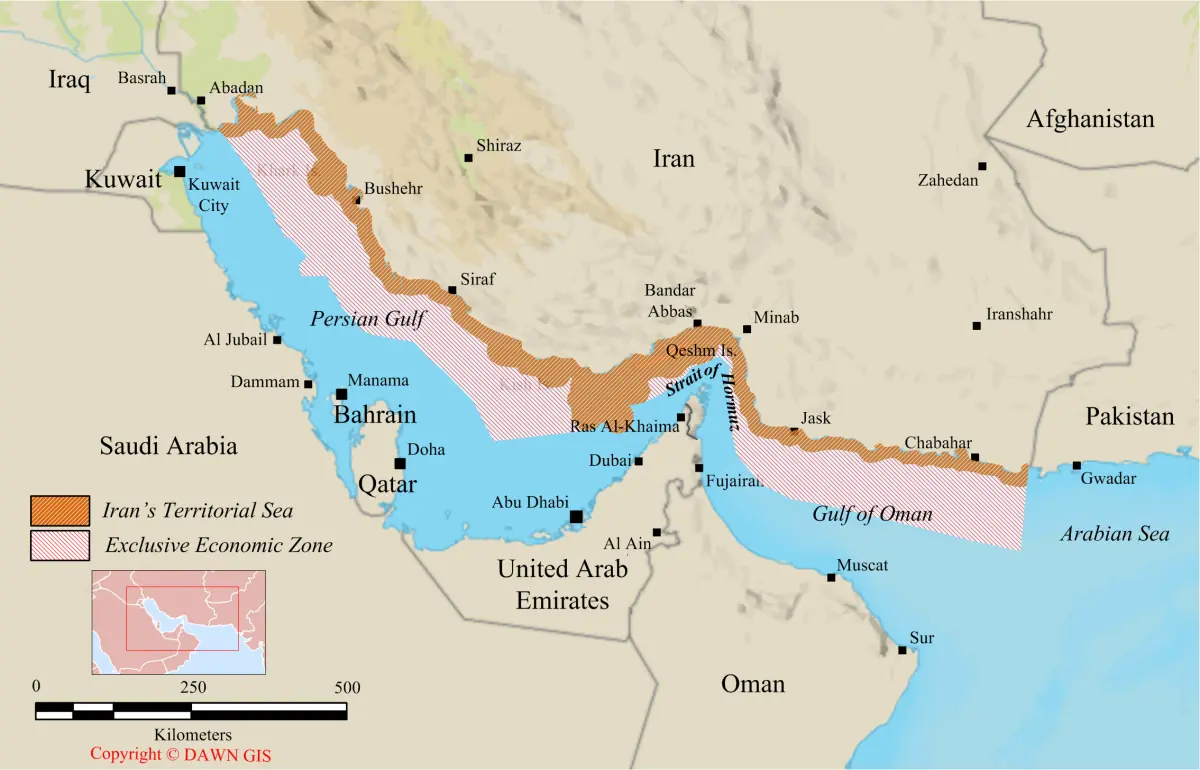
A map showing the coastal sovereignty of Iran with respect to the Straight of Hormuz. Map: Dawn GIS
“States exercise full sovereignty over the first 12 nautical miles of sea adjacent to their coast which is termed as the territorial sea,” he explained, adding that beyond that stretches the 200-nautical-mile exclusive economic zone (EEZ), and further still, in some cases, the continental shelf that can extend up to 350 nautical miles. Each layer, as he described it, is a negotiated gradient of sovereignty and must be treated as that.
The Strait of Hormuz problem
Shah, also a former legal adviser to Pakistan’s foreign ministry, addressed the question of navigation rights that govern who can move through the territorial sea and under what conditions.
He said that every ship, vessel, submarine or even a military ship, has a right of innocent passage in the territorial sea. But this right is not unlimited and comes with strict behavioural conditions: “the passage must be non-threatening, continuous, and with no belligerent intention,” he underlined.
He acknowledged, however, that states retain the ability to restrict it in exceptional circumstances. “Innocent passage can be suspended by a country whose territorial waters it is if they are in a war,” he said, adding that if framed in this context, “Iran can disrupt it.”
In the case of EEZs, which can extend up to 200 nautical miles, the rules become more permissive but differently structured. Here, foreign vessels and aircraft enjoy the freedom of navigation and overflight, which includes the right to transit.
This layered legal geography becomes most sensitive in strategic waterways such as the Strait of Hormuz.
Here, Shah explained, geography and law collide. “The complication arises because the strait sits between coastal states — Iran on one side and Oman on the other — each entitled to territorial seas extending 12 nautical miles from their baselines (the starting point from which a state’s maritime zone is measured),” he said.
But, he stressed, the Strait is not just a simple geometric space divided evenly between two coasts. Its legal character is shaped by a fragmented geography, particularly on the Iranian side, where islands complicate how maritime boundaries are drawn. In international law, he said, “not all land is equal in legal weight.”
“The point of this is to understand that a lot of the water that is in the Strait of Hormuz might be considered Iran’s internal water,” he observed.
Iran, he added, would likely argue that its baseline should be drawn in a way that incorporates the offshore islands as part of its territorial framework, effectively treating them as extensions of Iran’s land territory. If such an interpretation were accepted, it would dramatically alter the legal framework governing the Strait, suggesting that the usual rights of navigation would cease to apply altogether.
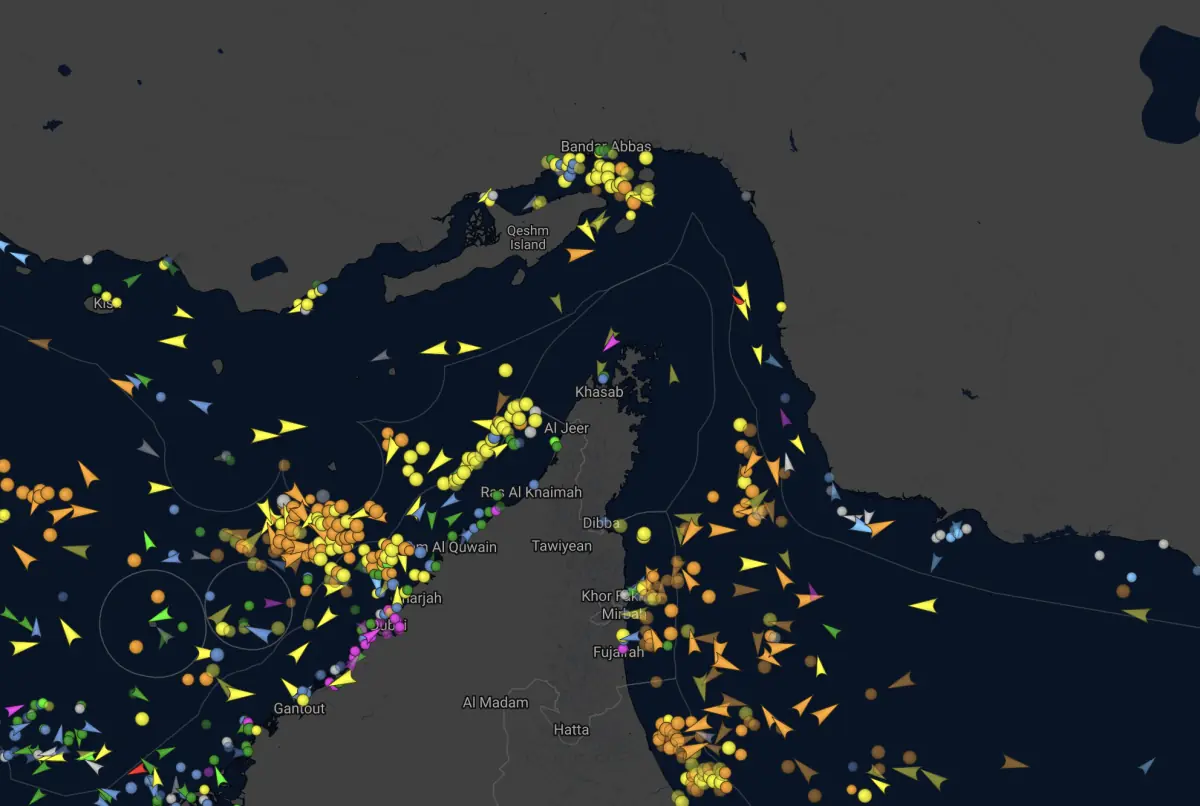
A screenshot from a vessel tracker showing the marine traffic around the Strait of Hormuz at 2am (PST). Screengrab via VesselFinder
Building on a similar premise, public international law practitioner Ahmer Bilal Soofi said that “a blockade is a historic practice that may be exercised by any party to an armed conflict as a belligerent right, but only during a situation of armed conflict and subject to certain legal conditions.”
“In the specific case of the Strait of Hormuz, there is an added complexity because Oman and Iran have overlapping jurisdiction in adjacent waters, and under Part III of the UNCLOS, they can regulate transit passage by designating sea lanes and setting certain navigational arrangements,” he told Dawn.
In his view, against this legal backdrop, the US announcement of a blockade would constitute a belligerent act, suggesting that a ceasefire may have ended unless the involved parties act otherwise. “This is a development that would need close observation in the coming days,” he said.
An act of aggression or self-defence?
According to Ayesha Malik, director of the War Law Institute, a US blockade of the Strait of Hormuz may amount to a serious breach of international legal norms and could be classified as an act of aggression under established frameworks of international law.
She pointed specifically to Article 3(c) of the United Nations General Assembly’s Definition of Aggression and Article 8bis(2)(c) of the Rome Statute of the International Criminal Court, both of which identify maritime blockades as a prohibited form of force when carried out by one state against another.
She argued that such an action would fail to meet the legal threshold of self-defence and would lack the necessary authorisation from the UN Security Council.
In the same vein, Shah, questioned Washington’s imagined role in the Strait of Hormuz. “In what context is America planning to block the strait? It doesn’t have a coast there,” he said.
He warned that if naval assets are used to physically prevent Iranian ships from moving, the act begins to resemble something far more serious than navigation enforcement.
“In that sense, what is being discussed edges into the language of war. Naval blockade can be seen as an act of violence,” he said, adding that the justification being floated under Article 51 — the right to self-defence — is, per his judgment, legally stretched.
At the same time, Malik drew a distinction between hypothetical blockade scenarios and the current situation involving Iran.
“Iran has not currently blockaded the Strait of Hormuz because a blockade is defined as an effective prevention of access of vessels and aircraft of all states to and from specific coastal areas that are part of or under the control of an enemy state,” she observed.
She stated that Iran is allowing neutral vessels to transit the state and blocking access to enemy warships as it is required to do under the UNCLOS legal framework.
In the rare chance that Trump pulls a Trump
Malik outlined the four criteria that any US blockade must satisfy under the law of naval warfare (these requirements apply regardless of whether the blockade itself constitutes an unlawful act of aggression).
Notification — a blockade must be notified by the US which includes the following details given through Notices to Mariners (NTM) and Notices to Airmen (NOTAM):
The date the blockade begins,
Its geographical limits, and
The general scope of measures employed, including a grace period for neutral vessels and aircraft to leave the blockaded area
The blockade must be effective in that sufficient military assets are deployed to implement it and prevent access to the enemy’s coast.
It must be impartial in that it is enforced against all vessels, regardless of flag or status.
The blockade must comply with humanitarian concerns, including that it cannot be intended to starve the civilian population or deprive it of objects essential to its survival.
As a result of this requirement, the blockading party must provide free passage of foodstuffs and other essential supplies, including medical supplies.
She further said that in enforcing the blockade, if a neutral ship resists capture, it may be “attacked”, but the level of force must be proportionate to the level necessary to achieve the military objective and “warnings must be given to the vessel prior to any attack”.
Malik added that the military advantage of the attack needs to be weighed against the collateral casualties. If the latter are excessive, the attack would be illegal.
“If the American blockade does not comply with these conditions, it will also fall afoul of the law of naval warfare as well as the law relating to the use of force,” she explained.
A blow to world economy
Shah remained sceptical of the practicality of such a move. “If a full blockade is imposed, it would be a sweeping economic shock, he said.
“If Trump were to completely halt the transport of oil so that no ship could enter or leave, it could only be enforced from outside. The American navy cannot enter the Strait of Hormuz,” he said, suggesting that enforcement would have to occur at the margins of the waterway.
In his telling, the strategy is more about pressure politics. “The intention might be to stop Iranian ships from entering and exiting its port but this will antagonise the international community,” he observed.
He widened the frame beyond Iran-US confrontation to the global system that depends on uninterrupted maritime trade. “Commercial activity is not dependent on what America wants or not, they are market driven,” he said.
The consequences, he warned, would not remain contained in the Strait. “American inflation will increase and the global economy will worsen,” he said, adding bluntly: “I don’t think he is in the financial position to do this; it would backfire and create more pressure on him and the local populus.”
He pointed to the wider geopolitical fallout the move could unleash, stressing that China relies on Iran for more than 80 per cent of its shipped oil. Any interruption in those supplies could therefore be seen as, even unintentionally, the US inflicting economic pressure on China.
Currency, he pointed out, is part of the contest. “The toll that Iran is charging is in Yuan; they’re not using US dollars,” he said. “Any disruption would interfere with an emerging monetary realignment — one that benefits China as its currency gains traction in energy trade, but would also be curtailed if such flows were interrupted,” he asserted.
Ultimately, Shah returned to a broader critique of the idea that any single state can meaningfully orchestrate global trade flows through coercion at sea.
“While Trump’s plan is framed as a way to squeeze Iran by targeting its shipping, the irony is that most of the vessels in question aren’t even Iranian. In practice, the fallout would likely travel much farther than its intended target, unsettling global trade and sending ripples through the wider economy,” he said.
“They’re trying to hurt Iran’s ability to decide everything. From an international law perspective, that is undoubtedly problematic. You can’t control how the economy or capital works,” he concluded.
Empty vessels make the most noise?
Oves Anwar, Director of the Research Society of International Law, said that although the Islamabad talks were not as fruitful as hoped, only this round of negotiations has ended. “The ceasefire is still in place and dialogue can still continue. At the moment, both sides are likely using this pause to reassess their next steps,” he put forth.
Per Anwar, within this period, Trump appears to be purposefully “lighting a fire” under the situation. “By imposing this blockade, he’s trying to get things moving in typical Trump fashion. But it’s akin to having a siege around a siege outside a castle. It doesn’t make sense,” he added plainly.
He said that while this move functions as a provocation that could potentially undermine the ceasefire, it is primarily a pressure tactic. “In fact, given that both sides are experienced in brinkmanship, they are capable of manoeuvering without immediate escalation.”
“On realistic grounds, a blockade would take time to fully implement, especially if it involves assembling a multinational coalition of naval forces as Trump claims. That process could take days, if not weeks. In the meantime, there remains a window during which active hostilities can still be paused,” Anwar said.
He added that, from both a legal and strategic perspective, a blockade is often characterised as a defensive rather than an offensive measure. “It could therefore be argued to fall within the scope of a ceasefire arrangement,” he claimed.
The illusion of control
And so we arrive at the modern paradox of Hormuz: the more loudly someone claims to control it, the more obvious it becomes that nobody really does. Not fully. Not cleanly. Not without consequences ricocheting far beyond the Strait itself, into inflation curves, oil prices, and political talking points.
It is in this gap between claimed control and actual fragility that a newer logic of power has emerged. Perhaps this is the real madman theory update for the 21st century: it is no longer just erratic behaviour that passes for strategy, but the weaponisation of forewarned chaos. Instability is designed to be anticipated, unfolding in the shadow of international laws that, on paper, remain fairly unambiguous.
Yet, those with disproportionate power keep redrawing the boundaries of possibility with offhand threats, while the rest of us are left trying to square the circle, unsure whether we are witnessing an escalation, a plot twist, or simply another Monday in global politics.
On February 27, about 42 days before the Islamabad Talks, Oman’s Foreign Minister Badr Al-Busaidi appeared on CBS’ Face the Nation and told the world that peace was “within reach”, that Iran had agreed to never stockpile enriched uranium, full verification by the International Atomic Energy Agency (IAEA), and degradation of existing stockpiles to the lowest possible level.
The Omanis are famously cautious. Al-Busaidi is not a man given to theatrics; he would be the diplomatic equivalent of the family accountant. And here he was on national television, telling the American public that Iran had agreed to pretty much everything the Americans had wanted. This, Al-Busaidi said, went beyond anything achieved in the 2015 Joint Comprehensive Plan of Action nuclear deal (which limited Iran’s nuclear activities in exchange for sanctions relief).
Watching this unfold, Trita Parsi of the Quincy Institute wrote that the Omanis going public like this was “quite unprecedented” and suspected that he knew why they were doing it: so that the American people would know peace was within reach when Trump instead opted for war.
It was Saturday, a working day in Iran, and the strikes began at the hour parents drop their children off to school. It was at that time that a US Tomahawk missile struck the Shajareh Tayyebeh girls’ elementary school in the southern city of Minab, collapsing the roof onto classrooms full of children between the ages of seven and 12.
A hundred and seventy-five people, mostly schoolgirls, were killed.
In the first week alone, important buildings in Iran were struck: the parliament, the state broadcaster’s headquarters, the Assembly of Experts, 13 health facilities, over 120 historical sites, and residential neighbourhoods in Tehran. All of these were civilian targets that are protected under international law.
Then the Iranians did something that, heretofore, had been just a scenario to war planners in Washington and Tel Aviv debated in their tabletop war games and their classified briefings.
It was the closure of the Strait, coupled with Iran’s willingness to expand the theatre to regional Gulf countries and the respective US bases they hosted, that turned this conflict from a one-sided bloodletting into a real war. Something neither the Americans nor the Israelis had fought in quite some time.
This is when all the old assumptions died.
Before this war, everything about Iran’s capabilities and America’s vulnerabilities existed in the realm of the hypothetical. Could Iran actually shut the Strait? Nobody knew. Would the global economy absorb the shock? Nobody knew. Could the regime survive a full decapitation strike? Nobody knew. Could the US sustain a bombing campaign without boots on the ground? Nobody knew. Could Mossad deliver the regime change it promised? Again, nobody knew.
Now, everyone knows.
As soon as Iran closed the Strait, oil surged past $100, which, according to the International Energy Agency, was the largest disruption in the history of the global oil market. Hundreds of millions of barrels were released from emergency reserves worldwide.
Consequently, Pakistan called for austerity. A four-day work week was announced in the Philippines. Gas prices in America jumped fifty cents a gallon, and more.
The global economy was hit and reeling. Iran had discovered something powerful: itself.
Meanwhile, the full might of the United States military was brought to bear on a country of 90 million people … and it was not enough. An F-15E was shot down over Iran. An F-35 — the crown jewel of American air superiority — took damage from Iranian fire and made an emergency landing. The USS Gerald R. Ford, the largest aircraft carrier on Earth, had to pause operations and limp to Crete for repairs. At least 13 American service members were killed. US bases across the Gulf, in Bahrain, Kuwait, Saudi Arabia, Qatar, turned out to be sitting ducks for cheap Iranian drones and missiles.
Within a short span of time, Iran turned the Middle East into a target-rich environment for itself.
And the regime did not fall. That was supposed to be the big play. Reports emerged that it was Netanyahu himself who had pushed Trump into the war, with Mossad’s assurances that once the top leadership was eliminated, the street would rise and the Islamic republic would go the way of Humpty Dumpty. Alas, that was not to be.
The regime did not change; instead, the Iranian street rallied around it. Minab was their Army Public School, and they stood firm just as we did all those years ago.
Great power, glass jaw
Trump, Hegseth, Netanyahu and his Mossad chief Barnea, all forgot the US military’s most fundamental axiom — the enemy gets a vote.
Hegseth had prosecuted a war without planning for what happens when the enemy votes. He had executed the strikes, ticked the boxes, held his slam-poetry press conferences with the appropriate MAGA-branded bravado, all bluster and body language, reminiscent of Comical Ali (Iraq’s spokesperson during the second Gulf War), telling the world that everything was going according to plan.
But there was no Phase Two. There was no plan for a Strait that would not reopen on command. There was no plan for an enemy that absorbed the blows and hit back across the entire region. There was no plan for the political consequences at home.
Because the American political establishment, it turns out, has a glass jaw.
Wars produce a rally-around-the-flag effect. This is one of the iron laws of American politics. Except this war produced the opposite. Trump’s approval rating on Iran dropped to 33 per cent. Among independents, 74pc disapproved. Pew found that 59pc of Americans believed the decision to use force was wrong.
No rally, just questions about whose war this really was?
David vs Goliath David & Goliath
Amid all this, the US administration couldn’t mask the distinct Israeli flavour of the war. Netanyahu’s press conferences didn’t help either. What was becoming abundantly clear was that the only meaningful way to escalate against Iran would require thousands of troops on the ground, and Israel would not be supplying any of them.
It is no wonder then that only 12pc of the war-fatigued and pain-averse American public supported a ground campaign. But perhaps what proved to be the unkindest cut of all for Trump was that not one of the many, many, many ‘allies’ he had around the world, who had only recently bent the knee and sworn fealty to the Master of Tariffs, came when he called. Not even Nato.
And then, on April 7, Trump posted the thing that told the world everything.
“A whole civilisation will die tonight,” he wrote, if Iran did not reopen the Strait by 8pm. It was the language of a man who had run out of options and was reaching for the biggest, most apocalyptic threat he could find.
Ninety minutes before the deadline, he accepted a two-week ceasefire brokered by Pakistan. Trump TACO’d again, as he has done so many times before, what we in Pakistan would call a U-turn. It was, perhaps, the most glaring sign of how impotent he felt and how desperately he needed to save face.
The price of perfidy
Is anyone surprised that the terms Iran offered before the war are different from what it brought to Islamabad on Saturday?
Iran had agreed to zero stockpiling, full verification, and degradation of stockpiles. More than the JCPOA ever achieved. And in return, it was attacked, mid-negotiation, for the second time in less than a year. Over 3,000 of its citizens are dead. Its infrastructure is in ruins. Its supreme leader is buried. The man who led the negotiations, Larijani, is buried alongside Khamenei.
From Tehran’s perspective, this is not a moment for generosity. This is a moment for establishing that perfidy has a price. Some deterrence must be re-established. Some cost must be exacted. Walking into a room and handing over your strongest cards at the first sitting is not diplomacy. It is capitulation. And the Iranians did not endure six weeks of bombardment to capitulate at a conference table in the Serena Hotel.
In Islamabad, the United States came to the table with a smaller gun. Iran came with a straitjacket. The calculus had fundamentally changed, and 21 hours of talks, however intense and however many (fantastic) cups of tea were consumed, were never going to change it back.
Brinksmanship, not the brink
The negotiations are not over. Only this round is. Iran’s foreign ministry said no one should have expected a deal in a single session, and they are right. Pakistan’s Foreign Minister Ishaq Dar pledged to keep facilitating. Trump himself, on Truth Social, acknowledged that much had been agreed to. Even Vance, for all his talk of a “final and best offer”, stopped short of declaring the process dead.
The ceasefire, fragile and imperfect, holds for now.
The Iranians are masters of brinksmanship and, contrary to popular belief, are not suicidal. Trump, too, is trying to push it as far as he can without killing the power grid in the entire Middle East. His latest threat to send the US Navy to “BLOCKADE” the Strait is the equivalent of laying siege to a siege, a provocation inviting Iran to react. It leads to death — political, economic, and human.
Here is my prediction, for what it is worth. America’s red lines will blur. They will accept Iran’s hypothetical ‘right to enrich’ without allowing it the means to actually do so. Iran will open the Strait in exchange for sanctions relief. Everyone wins, and we wake up from the dystopia we found ourselves in.
So have faith. Have faith in the ugly, grinding, exhausting, caffeine-fuelled machinery of diplomacy. Because the alternative is quite dark.
Header image:The national flag of Iran flies in the wind as debris lies scattered in the aftermath of an Israeli and US strike on a police station, amid the US-Israeli conflict with Iran. — Reuters
All eyes are on Islamabad this weekend as the city braces to mediate one of the most consequential, high-stakes peace negotiations since the culmination of the Second World War.
Starting today, American emissaries, led by Vice President JD Vance, will sit across the table from Iranian diplomats to negotiate a lasting settlement to a war that has rattled global power structures and stock markets alike.
On the face of it, it is a welcome development from where the world found itself on Tuesday. As daylight drew to a close, the world watched in anticipation as Washington backed itself into an impossible corner, promising to annihilate “a whole civilisation” if Tehran did not give a safe passageway to traffic through the Strait of Hormuz.
But a last-ditch diplomatic breakthrough by Pakistan managed to pull both sides from the brink of a potentially catastrophic escalation of unknowable consequences.
For now, Islamabad seems to have bought both sides some time to turn a fragile truce into something akin to a durable agreement. It is, to put it mildly, a fraught endeavour.
A new Iran?
For one, the United States must reckon with the fact that the Iran that sits across the table in Islamabad on Saturday is not the Iran that walked into Geneva in February.
When the US last met Iranian representatives in Switzerland two months ago, the Islamic regime in Tehran was uniquely exposed, perhaps for the first time in its 46-year history. It had barely weathered years of crippling sanctions, a cratered currency, and deafening international isolation. The Twelve Day War had laid bare the vulnerabilities in its ground and air defenses, and had set its nuclear programme back by decades.
The Axis of Resistance, the crown jewel of Iran’s deterrence capability, had been debilitated beyond repair, with supply lines to Lebanon and Gaza severed with the fall of the Assad regime in Syria. And in January, nationwide protests had enfeebled the Ayatollah’s hold on power; the protests were suppressed eventually, but only by the skin of their teeth.
Over the past six weeks, the US and Israel amped up attacks across military installations and civilian infrastructure, expanded targets, and incrementally struck deeper into Iranian mainland, hoping they could batter Tehran into compliance. What they found instead was a country willing to stare the military might of Empire in the face, standing steadfast in its wake, and living to tell the tale.
For all its military bluster, it’s hard to shy away from the fact that the US has remained incapable of translating its wins on the battlefield to achieving its strategic objectives, whatever they may have been. Iran has managed to retain its nuclear infrastructure and enriched uranium stockpiles, thereby securing a compressed timeline to weapons capability should it make the political choice to cross that threshold. More consequentially, however, Tehran has credibly demonstrated its ability to choke global energy flows and hold the world economy hostage, altering the strategic calculus of its adversaries.
In an increasingly globalised world economy, the demonstrated capability to secure and disrupt the flow of commerce is a credible form of political power. According to Professor Robert Pape of the University of Chicago, actors in the international system are able to anticipate disruption, and are forced to adapt in advance, hedging risk and tweaking policy to advance concessions to the party (in this case, Iran) that is generating the risk of disruption. This is a critical shift in the balance of power, which is likely to contort global political response in Tehran’s favor for years to come.
If the core currency of power in international politics is the ability to shape the behaviour of others, it would seem that Iran has skewed the balance of regional power in its favour, and it knows it. Iran’s 10-point proposal, which President Donald Trump has accepted as a “workable” framework upon which the negotiations are to be held, is a statement of what Tehran now believes it’s now entitled to demand.
Calls for enrichment rights, complete sanctions relief, American military withdrawal, and most notably, control over the Strait of Hormuz, point to a country that has recalibrated its sense of its own leverage upward from where it stood less than two months ago in Geneva.
Hence, the US will arrive at the capital militarily undefeated, but it will be Iran that will boast the stronger hand to dictate the terms of peace. It is ultimately this paradox that will loom largest over the mediation process in Islamabad. The outcome of the summit will hinge on Pakistan’s ability to tactfully navigate the twists and turns of this diplomatic quagmire and create a meaningful exit ramp it can credibly package and sell to both sides.
Empire on the table
But the White House is no easy sell. For a war that started without a clear strategy or identifiable metric with which to gauge success, the formula for peace is just as murky.
Political patience for America’s excursion into Iran is wearing thin, and the Trump administration has found itself walking a tightrope in trying to hold its political coalition at home. With the midterms slated for November, the administration knows it’s on the clock.
This makes it tough for Washington to read its hand for what it really is. Beyond the blaring war drums and the noise of strikes and counter-strikes, threats and truces, the war has exposed the erosion of something far more fundamental than a kinetic advantage on the battlefield.
For decades, American primacy had anchored itself on one important pillar: the unrivaled ability of the United States to guarantee the stability of critical economic flows. It was this guarantee that underwrote alliances, anchored markets, and ensured American credibility across the world. It was, in a meaningful sense, the infrastructure underlying American power in the world.
In failing to coerce Iran to reopen transit through the Strait of Hormuz, the US has inadvertently cracked the infrastructure wide open, exposing the limitations of its promise. Despite overwhelming conventional military superiority over Iran, allies watched on as the US struggled to unclog one of the most critical energy chokepoints in the world.
The Gulf states were neither consulted before the war nor adequately defended during it. Trump’s continued pressure on NATO has deepened existing fractures in the transatlantic relationship. And Europe, conspicuously, has not responded to American calls for assistance in securing the Strait.
It’s clear that allies are quietly diversifying relationships, and recalibrating their reliance on a security architecture that has suddenly appeared less certain than it once did.
This erosion of credibility will walk alongside the American delegation into the negotiating room, diminishing their leverage to force Iran into accepting a settlement that the Trump administration can sell at home.
What makes this particularly consequential is that the fundamental sticking points have not moved meaningfully. American officials, including Vice President Vance, have sought to revive the push for zero enrichment, a demand Iran has consistently treated as an assault on its sovereignty and its right to technological self-determination. Tehran did not concede that point when it was on its knees in February. It is unlikely to concede it now that it knows it’s negotiating from a position of considerably greater strength.
The result is a zone of possible agreement that is, at best, dangerously narrow. Washington needs an off-ramp it can frame as Iranian capitulation on nuclear ambitions, but lacks the diplomatic maneuverability to actually deliver it. With the US constrained in its diplomatic capital, short on time, and saddled with demands it cannot abandon and Iran will not accept, Pakistani mediators will have a gruelling task ahead of themselves.
The elephant (not) in the room
Even if Islamabad is able to resolve these seemingly irreconcilable differences, any step towards a lasting settlement will hinge on Washington’s ability to balance its strategic interests with those of the Israelis.
When Netanyahu finally addressed the Israeli public 18 hours after the ceasefire came into effect, his speech was a declaration of unfinished business. “We still have goals to complete,” he told the nation. “We will achieve them either by agreement or by the resumption of fighting.” It was a remarkable thing to say on the first night of a ceasefire — an unambiguous signal to Washington about the limits of Israeli buy-in.
Washington may be foggy on the details of why it went to war, but Jerusalem has had its eye on the ball from the very first day. For Israel, the calculus was as straightforward as it gets: Iran represents the last serious obstacle to an era of unchallenged Israeli regional hegemony in the region, and the window to remove it is closing. American support for Israeli military operations has never been thinner, and Netanyahu, for whom a war with Iran has been the animating obsession of a decades-long political career [Read: ‘What is Netanyahu’s endgame?’], understands that opportunities of this magnitude do not present themselves twice. A negotiated agreement that leaves Iran with any residual enrichment capacity falls categorically short of that objective.
The divergence was clear as soon as the ceasefire took effect. Within hours of Prime Minister Shehbaz Sharif announcing an agreement to pause all hostilities “including Lebanon”, the IDF bombarded Beirut, striking over a hundred targets and killing more than 200 people. Trump was eventually forced to call Netanyahu directly, pressing him to “low-key it” in Lebanon. That a sitting American president had to call his closest regional ally to ask him not to blow up his own ceasefire on its first day is, by any reasonable measure, an extraordinary state of affairs.
This creates a structural fault line underlying the proceedings in Islamabad. Even if an agreement is produced, there will be no real guarantee that Israeli non-compliance will not unravel it. The US will have to answer the overarching question of whether it is negotiating on behalf of itself, or Israel.
The final goals for both have started to diverge.
For Trump, the priority is to reopen the Strait of Hormuz and secure a political win before November. Netanyahu won’t rest until there is a permanent neutralisation of Iran’s power, including its proxies, its missiles, and its nuclear programme. Until Washington resolves which principal it is actually representing at the table, any agreement it reaches will rest on a foundation out of its complete control.
The art of the deal
This is not to say that the off-ramp doesn’t exist. But approaching it would require Washington to enter Islamabad with an accurate read of what the past six weeks have produced — a new balance of power in the region.
The US need not surrender its core interests in Islamabad. Within the frameworks that Iran has proposed, the US can still credibly push for a non-weaponisation commitment, verifiable IAEA access, and a durable arrangement to regulate the Strait of Hormuz, wrapping it up in semantics that would register as a win back home.
But achieving this would require the US to stop negotiating toward the deal it wanted before the war and start accepting the deal made possible by the war. The outcome of the peace talks will hinge on whether the parties are able to close the gap between those two positions.
If the talks collapse, the resumption of conflict will arrive in a system where both sides now understand the pressure points better than they did six weeks ago, and where the costs of escalation will be transmitted faster, wider, and further than before.
The ceasefire has revealed a new structure of power, in which the United States can no longer assume control over outcomes through military might alone, and in which even limited disruption via asymmetrical capabilities can reshape the behaviour of the international system.
Islamabad is the first real test of whether diplomacy can operate within the new structure. Whether the parties in that room are up to that task remains to be seen.
“The optics of the [US-Iran] ceasefire are significant for Pakistan on the world stage.”
This is what TheIndependent wrote in its analysis after Islamabad brokered a ceasefire between the United States and Iran in the early morning hours of Wednesday.
On Tuesday, US President Donald Trump warned that a “whole civilisation will die” and gave Iran an ultimatum to make a deal. Barely an hour before his deadline was set to expire, both Washington and Tehran agreed to a two-week pause in hostilities along with a temporary reopening of the Strait of Hormuz.
The development came after PM Shehbaz urged Trump to extend his deadline for two weeks to allow diplomacy a chance, which was ultimately accepted by the latter.
Islamabad will host talks between both the countries in the upcoming days to reach a long-term solution to the conflict. While the ceasefire has brought relief for almost every country on the planet, many say it has also pushed Pakistan into the role of a “peacemaker”.
The Independent
In its analysis, The Independent noted that Pakistan’s role in pulling the Gulf back from the brink “could mark one of its most significant diplomatic achievements in years, and it is one that has been welcomed throughout the region”, even among commentators in archrival India.
“Pakistan’s involvement was at least partly driven by self-interest. The South Asian nation is heavily dependent on energy imports and has faced severe fuel shortages due to the war, as well as disruptions to remittances from its sizeable population working in the Middle East.
“Even so, the optics of the ceasefire are significant for Pakistan on the world stage,” it said.
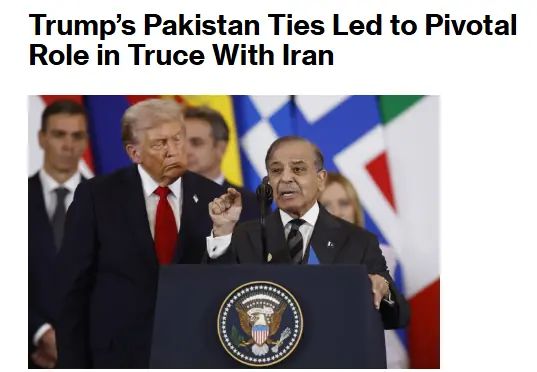
The analysis also attributed the feat to the “importance of Trump’s personal relationship” with the Pakistani military.
CNN
While Trump has agreed to the ceasefire, he earlier derided the 10-point plan by Iran’s Supreme National Security Council in which Tehran demanded the right to coordinate all cross-Strait of Hormuz traffic.
And here is where Pakistan steps in with its newfound role.
“It will be up to Pakistan, which brokered an agreement for the US and Iran to hold talks starting Friday, to clear this up — if the deal lasts that long.
“The Islamabad government, which has shrewdly used its friendships in Tehran and Washington, must fashion off-ramps neither Trump nor Iran could find themselves,” Stephen Collinson of the CNN wrote in his analysis of the latest developments.
Bloomberg
Even though clarity on the ceasefire is yet to emerge, “Pakistan nevertheless deserves a tremendous amount of credit for having the guts to stick out its neck and offer its diplomatic services”, reportedBloomberg.
“Pakistan’s success as a mediator in the Iran conflict stems in large part from its increasingly close ties with the Trump administration,” it noted, adding that Islamabad, at the same time, also has “warm ties” with Iran and other Gulf states which motivated the country to “find a resolution to the fighting to avoid being dragged into the conflict itself”.
“Besides enhancing its geopolitical clout, Pakistan also has economic reasons to get involved. Iran’s blockade of the Strait of Hormuz has jammed up energy supplies globally, leaving Pakistan vulnerable given its sizeable imports of oil and liquefied natural gas that pass through the waterway.
“Now, with the ceasefire, Pakistan is seeking to ease economic pressure while also capitalising on its newfound geopolitical standing,” it said.
The report concluded: “What stands out is Pakistan’s repositioning from a peripheral actor to a credible intermediary capable of convening adversaries.”
France 24
Neutrality makes “economic sense” for Pakistan, reportedFrance 24. The country relies on oil and gas imports through the Strait of Hormuz and “wants to avoid getting dragged into further conflict on its doorstep”.
“Continued disruption would have worsened fuel supplies, driven up prices and forced further austerity measures for the cash-strapped government.
“A permanent end to the war would not only boost regional stability but also Pakistan’s international standing at a time when it is locked in armed conflict with neighbouring Afghanistan and less than a year after it traded strikes with archrival India,” the media outlet wrote.
Gulf News
Meanwhile, Pakistan’s ties with both Washington and Tehran — countries that do not have direct diplomatic relations — leveraged Islamabad a “unique position” to open lines of communication that otherwise remained shut, notedGulf News.
“The strategy was deliberate: stay publicly neutral, but privately engage all sides. Pakistan’s role representing Iranian interests in Washington gave it rare institutional access, while its long-standing ties with the US ensured credibility with American leadership.”
The report further noted that even though the high-level meeting of foreign ministers that was held in Islamabad last month did not visibly appear to be a success, “Pakistan quietly intensified its outreach in the days that followed”.
It added that while challenges still remain, for now, “the ceasefire marks a significant diplomatic win for Islamabad, underscoring how sustained, quiet engagement can influence the trajectory of a fast-moving and high-stakes conflict, even as the human and economic costs of the war continue to mount”.
The Diplomat
It is striking that a role one might have expected India to play — given its strong relations with all parties involved — was instead assumed by Pakistan, reportedThe Diplomat in its analysis.
It noted that the world has a “newly prominent diplomatic actor in Pakistan”, adding that the development yields two benefits for the country.
“First, its stature as a diplomatic actor has risen considerably […] Pakistan’s role in brokering this ceasefire has brought it to the centre of international diplomacy rather than its margins.
“Second, the ceasefire has spared Pakistan a serious strategic dilemma. Considering Iran’s recent strike on Saudi Arabia, any Saudi decision to escalate and invoke its mutual defense understanding with Pakistan could have forced Islamabad to choose between abandoning its neutrality toward Iran or undermining its longstanding relationship with Saudi Arabia. The timing of this ceasefire has spared Pakistan from having to make that choice,” the analysis said.
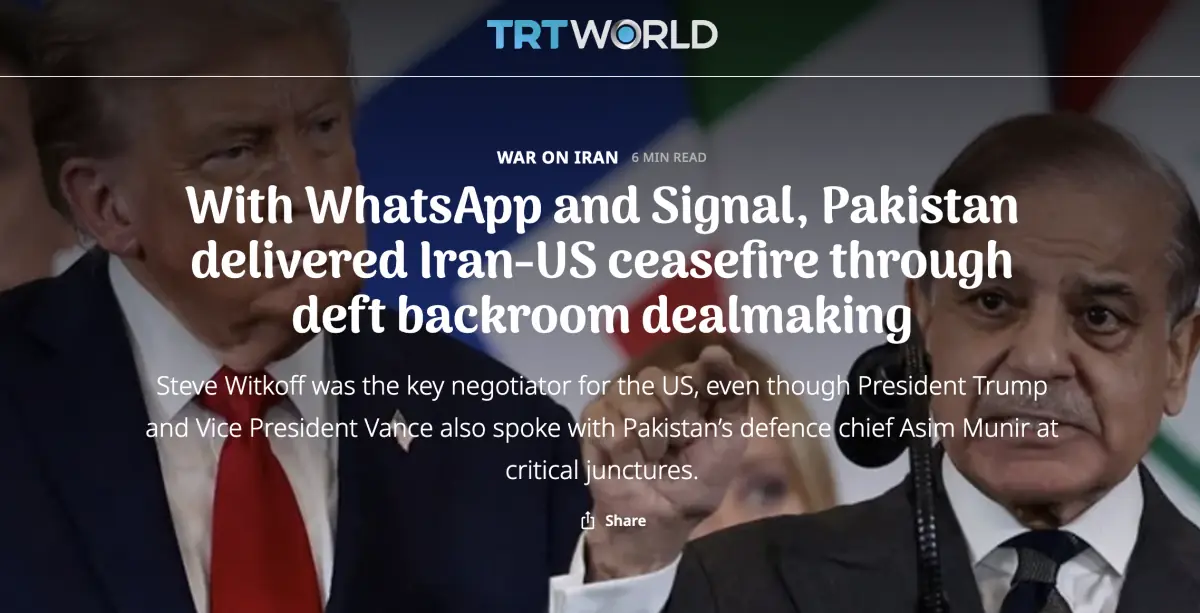
TRT World
Elaborating on how the “breakthrough” was reached, an analysis by TRT World said what made it possible “was not multilateral summits of public statements”.
“Rather, it was old-fashioned shuttle diplomacy by Pakistan, conducted through encrypted messaging apps,” it reported, adding that the field marshal spearheaded the effort. At the same time, PM Shehbaz provided “political cover” and Deputy Prime Minister Ishaq Dar “coordinated regional backing from countries such as Turkiye, Saudi Arabia, and Egypt”.
It further stated that “Pakistan’s role remains very much central and is likely to remain so till a final negotiation and a deal is confirmed, accepted and signed”.
In contemporary international politics, the language of gender equality has increasingly appeared within the moral vocabulary of war over the past few decades. Western governments and political commentators have framed military interventions as necessary not only for security but also for the protection of women and girls in societies portrayed as oppressive or patriarchal.
This discourse presents intervention as a form of humanitarian responsibility. Yet when the material consequences of such interventions are examined, a profound contradiction emerges.
The recent bombing of a girls’ elementary school in Tehran during the US and Israeli strikes demonstrates this contradiction with stark clarity. When schoolchildren become casualties of imperial wars rhetorically justified through the language of women’s liberation, the ethical foundations of such claims demand serious scrutiny.
The politics of ‘saving’ Muslim women
The use of women’s rights as a moral justification for military intervention is not new. Since the early 2000s, Western foreign policy discourse has repeatedly invoked the condition of Muslim women as evidence of the necessity of external intervention.
The invasion of Afghanistan in 2001 remains one of the most prominent examples. Political leaders and media narratives consistently emphasised the oppression of Afghan women under Taliban rule as a central rationale for war. Images of veiled women circulated widely in Western media. Such representations reduced Afghan women to passive victims awaiting rescue and helped frame the invasion as a humanitarian project.Yet the outcomes of this intervention exposed the limits of that narrative.
Despite two decades of military presence, the structural transformation of Afghan society remained fragile and uneven. When the Afghan government collapsed in 2021 and the Taliban returned to power, the promise of liberation that had accompanied the invasion appeared increasingly hollow. Many Afghan women themselves emphasised that meaningful empowerment could not be delivered through foreign military intervention, but required sustained social, economic, and political change within Afghan society.
Scholars in feminist international relations have critically examined this phenomenon. American anthropologist Lila Abu-Lughod famously questioned the assumption deeply rooted in such discourse by asking whether Muslim women genuinely need saving. Her critique was not a denial of gender inequality in particular societies, but rather a challenge to the idea that military intervention by foreign powers could serve as a credible path toward women’s emancipation.
According to Abu-Lughod, framing war as a rescue mission reproduces colonial patterns of thinking in which Western societies imagine themselves as civilising agents tasked with reforming supposedly backward cultures. The language of liberation thus becomes deeply entangled with geopolitical power.
Chandra Talpade Mohanty, a distinguished professor of women’s and gender studies, similarly argued that Western feminist discourse has historically constructed the “Third World Woman” as a singular, passive figure defined primarily by victimhood. Such representations erase the political agency of women in non-Western societies and obscure the diverse forms of activism and resistance that exist within those communities.
When the suffering of women is mobilised to justify military action, the result is a paradoxical form of advocacy in which feminist language is used to legitimise violence that ultimately harms the very populations it claims to defend.
The rise of militarised feminism
The ethical contradiction becomes even sharper when such events occur within a discourse that celebrates military action as a defence of women’s rights.
Recently, a Spanish politician criticised the celebration of strikes against Iran through feminist rhetoric, remarking that those who claim to defend Iranian women cannot simultaneously applaud the killing of schoolgirls. The statement resonated widely because it exposed the moral incoherence in the language of militarised feminism. If the stated objective is the protection of women and girls, the killing of those very girls cannot simply be dismissed as collateral damage.
Critical scholarship increasingly describes this phenomenon as the instrumentalisation of feminism. British sociologist Sara Farris has referred to similar dynamics in European politics as “femonationalism” — a process through which gender equality is invoked selectively to advance nationalist or neoliberalism agendas. While her work focuses primarily on immigration debates in Europe, the underlying logic extends to foreign policy as well.
Gender equality becomes a symbolic resource that states deploy when it strengthens their political position, but it rarely serves as a consistent guiding principle across all contexts.
This pattern of imperial or militarised feminism extends to the current strikes on Iran, where the role of female Israeli Air Force pilots has been highlighted in celebratory narratives. Posts and media coverage underscore that dozens of Israeli women pilots and navigators took part in the bombing campaign, presenting their participation as empowerment while obscuring the fact that these strikes constituted a direct military intervention against a sovereign state.
The bombings are framed as a form of feminist justice against a regime accused of oppressing women, turning military violence into a spectacle of liberation. A recent cartoon circulating on social media depicts an Israeli female fighter pilot bombing bearded men in Iran, visually reinforcing this rhetoric.
Such imagery demonises Muslim men as archetypal oppressors; portrayed as bearded, patriarchal figures deserving of violent retribution, while positioning Western-aligned (or Israeli) women as empowered liberators.
The caricature exemplifies how imperial feminism is weaponised to racialise and dehumanise Muslim men, casting military violence as a gendered civilisational clash rather than a geopolitical conflict. It perpetuates orientalist tropes that reduce complex societies to stereotypes of backward masculinity in need of forceful correction by “enlightened” female agents from the West or its allies.
The selective deployment of feminist rhetoric
An example of this instrumentalisation also occurred in the aftermath of the October 7, 2023, attacks. Israeli officials and supporters amplified unverified allegations of widespread and systematic sexual violence, including rape, allegedly committed by Hamas forces during the attacks. Despite a lack of independent evidence or conclusions from international investigators such as those affiliated with Amnesty International or even UN experts, these claims were used to frame the subsequent military aggression in Gaza as a necessary defence of women’s rights and a response to gender-based atrocities.
At the same time, a number of human rights organisations and UN experts have raised serious concerns about sexual violence perpetrated by Israeli forces against Palestinian detainees during the Gaza war. Reports by organisations such as Human Rights Watch, B’Tselem, and the United Nations Independent International Commission of Inquiry (COI) on the Occupied Palestinian Territory, including East Jerusalem, and Israel have documented evidence of sexual abuse, humiliation, and rape against Palestinian detainees held in Israeli custody, including in detention facilities such as Sde Teiman.
More broadly, the pattern of invoking humanitarian and feminist rhetoric to justify war has appeared in multiple interventions across the Middle East. The invasion of Iraq in 2003, the Nato intervention in Libya in 2011, and ongoing debates around Iran have all included arguments that frame military aggression as necessary to defend human rights.
Yet the conduct of intervening forces has often contradicted these claims. The abuses uncovered at Abu Ghraib prison during the Iraq War remain one of the most notorious examples. Investigations by organisations such as the Amnesty International documented detainees being subjected to forced nudity, sexual humiliation, threats of rape, and other degrading treatment by US personnel.
From a normative perspective, the idea that liberation can be achieved through aerial bombardment is deeply problematic. Political freedom and social reform cannot emerge from environments defined by destruction and insecurity.
If gender equality is invoked as a universal value, then its defence must remain consistent regardless of geopolitical alignment. Yet the selective deployment of feminist rhetoric suggests that states frequently condemn gender oppression in “adversarial” societies while remaining relatively silent about similar issues among allies. Such inconsistency risks transforming feminism from a universal ethical commitment into a geopolitical instrument.
Rethinking feminism in an age of war
In the face of endless wars, the myth of imperial salvation crumbles under the weight of its own hypocrisy.
Women in the Global South do not owe gratitude to a version of liberal feminism that appears in the language of liberation while bombs fall on their societies. Veiled women in Tehran, Kabul, or Gaza do not need to thank distant advocates in pantsuits for military campaigns that destroy their schools, homes, and communities.
The idea that war can be presented as a gift of emancipation reflects a deeply paternalistic assumption that these women lack agency and must be rescued by outsiders. Genuine solidarity with women across the world requires consistency, humility, and a commitment to peace rather than the destructive promise of liberation delivered from the sky.
The Ministry of Information and Broadcasting has rejected claims circulating on social media alleging that Pakistan is being used as a base or launch corridor to support the United States for a possible military strike on Iran, which has been rocked by protests in recent weeks.
The ministry’s fact check account on X attributed the claims to “propaganda machineries in Afghanistan“ and Indian accounts, particularly identifying three handles — Khurasan Media Urdu, Baba Banaras and Afghan Defense.
Among them, a post by Khurasan Media Urdu claimed that “special American aircraft have reached Pakistan for an attack on Iran”. The post also mentioned “unusual” flight activity of US aerial refuelling and surveillance aircraft between Pakistan and Iran.
Baba Banaras’ post made a similar claim, stating: “Multiple US reconnaissance aircraft and cargo planes with weapons landed at Dalbandin Airbase and Pasni Airbase of Pakistan. Looks like the game has been set for Iran.”
The ministry’s fact check account said false claims had been made “that the US has moved aerial refuelling (KC-135R) and surveillance aircraft to Pakistan, that these aircraft are conducting unusual flights towards or into Iranian airspace, and that Pakistan is being used as a base or launch corridor to support US stealth fighters (F-35/F-22) for a possible imminent military strike on Iran”.
The post added that while it was true that the activity of US aerial refuelling aircraft had increased, it was not from Pakistan. “Reutersreported the US moved a large number of refuelling aircraft to Europe as Middle East tensions rose,” the ministry clarified, referring to a June 2025 report.
It also referred to a June 2025 report by The Washington Post, which it said mentioned Pentagon dispatching “refuelling aircraft to European bases as posture expanded”.
The ministry’s post further stated: “No credible outlet confirms that US KC-135R/ISR (intelligence, surveillance and reconnaissance) aircraft are operating in Pakistan.”
It reiterated that “US refuelling aircraft movements have been reported, but mostly linked to Europe”.
“No credible proof that US aircraft/ISR are based in Pakistan. No credible proof of Pakistan-to-Iran operational flights for strikes,” it added.
It recalled that Pakistan had “publicly condemned US strikes on Iran” — ostensibly a reference to Islamabad’s stance during a 12-day war between Iran and Israel, during which the US also carried strikes in Iran.
“This clearly denied the ‘Pakistan is facilitating strikes’ story,” the information ministry said. “This is a reckless, blame-pushing narrative that tries to drag Pakistan into a US-Iran conflict without any verifiable evidence.”
It said that the claim that “US aircraft arrived in Pakistan for Iran strikes’ is purely disinformation”.
The claims have surfaced as tensions are growing between Iran and the US, with US President Donald Trump warning Tehran of strikes over the crackdown on ongoing protests in the Middle Eastern country. Iran subsequently issued stern statements in response.
On Sunday, the Iranian government — which blames Washington and Tel Aviv for fomenting the unrest — warned the US of retaliation against its military bases and Israel if the Trump administration attacked the country over a crackdown on protesters.
The same day, Trump said he was weighing a range of strong responses, including military options, to action against the protests. He also said, “The leaders of Iran called [yesterday], … a meeting is being set up… They want to negotiate.”
A subsequent statement by Iranian Foreign Minister Abbas Araghchi said “the Islamic Republic of Iran is not seeking war but is fully prepared for war“.
“We are also ready for negotiations, but these negotiations should be fair, with equal rights and based on mutual respect,“ he added.
For Komeil Soheili, an Iranian filmmaker, the latest protests in the Islamic Republic did not come as a surprise.
“People are exhausted after the 12-day war with Israel,” he said over the phone. “It’s the uncertainty. You can’t even plan for the near future because things keep changing.”
Iran is buckling under mounting economic pressure. Inflation has exceeded 36 per cent since March. The rial has lost roughly half its value, trading at around 1,390,000 to the US dollar. Sanctions linked to Iran’s nuclear programme have returned, utilities remain strained, and global financial bodies are forecasting a recession in 2026.
Unrest, at the worst possible time
Iran’s most significant protests since 2022 erupted around two weeks ago among traders and shopkeepers in downtown Tehran, triggered by the rapid collapse of the rial, which has driven up prices and left traders unable to restock goods.
Isolated market shutdowns in Tehran’s commercial districts quickly escalated into street demonstrations, drawing in wider sections of the public and prompting security deployments. Like falling dominoes, the unrest spread to other cities, claiming dozens of lives, according to rights groups.
Last week, major Iranian cities were gripped overnight by new mass rallies denouncing the Islamic Republic, as activists expressed fear that authorities were intensifying their suppression of the demonstrations under the cover of an internet blackout.
The crackdown follows what was initially a relatively soft response, with Iranian President Masoud Pezeshkian calling for a kind and responsible” approach, acknowledging public frustration. The government had also announced cash handouts to ease economic woes.
The regime appears to have shifted its tone since, accusing the US and Israel of orchestrating the protests. “The enemy has infiltrated trained terrorists into the country. Rioters and saboteurs are not the protesting people. We listen to the protesters and have made our utmost efforts to solve their problems,” Pezeshkian said.
The US, meanwhile, has offered to “help” the Iranian people, and the Trump administration also reportedly discussed the possibility of strikes targeting Iran.
Posting on social media on Saturday, US President Trump said: “Iran is looking at FREEDOM, perhaps like never before. The USA stands ready to help!!!”
In a phone call on Saturday, Israeli Prime Minister Benjamin Netanyahu and US Secretary of State Marco Rubio discussed the possibility of US intervention in Iran, according to Reuters.
Meanwhile, addressing parliament on Sunday, Iran’s speaker Mohammad Bagher Ghalibaf warned the US against any miscalculation. If the US attacked, “both the occupied territory and centres of the US military and shipping will be our legitimate targets,” he told lawmakers. The warning came hours before Trump disclosed that Iran’s leadership had called seeking “to negotiate”.
“The leaders of Iran called yesterday,“ Trump told reporters aboard Air Force One, adding that “a meeting is being set up … They want to negotiate.”
However, Trump added that “we may have to act before a meeting“.
The timing could have hardly been worse.
US jets had just flown into Venezuela and captured President Nicolas Maduro and his wife. Maduro was taken to New York, and footage posted online showed him blindfolded in a grey tracksuit — an unsettling image, regardless of one’s politics.
A cat-and-mouse relationship
Miles away, in Tehran, Venezuela’s anti-American ally felt the pressure.
Could Trump pull a Venezuela on Iran, its longest adversary?
“We know that Donald Trump is not a reliable president, and he doesn’t care about international law,” said Soheili.
Iran and the US have long shared a cat-and-mouse relationship. Washington has consistently viewed Iran’s nuclear programme and its network of regional proxies with suspicion.
In 2020, an American strike killed Iran’s most revered military commander and foreign policy architect, Gen Qasem Soleimani. In June 2025, US jets struck key Iranian nuclear sites as Iran, shaken but defiant, fought a brief war with Israel.
Iran is a signatory to the Nuclear Non-Proliferation Treaty (NPT), which allows non-nuclear states to pursue civilian nuclear energy under international inspections. Tehran insists its programme remains peaceful, a claim disputed by the United States and its allies, who argue that Iran’s enrichment levels exceed civilian requirements. Iran, for its part, has repeatedly accused Washington of selectively enforcing the treaty while ignoring violations by its partners, including Israel.
Following the Iran-Israel war, sweeping UN sanctions lifted under the 2015 nuclear deal were reimposed, while Tehran suspended nuclear inspections, effectively freezing its remaining commitments under the agreement.
Trump’s oil gambit
Iran, no stranger to the consequences of foreign intervention, was quick to condemn Washington’s actions in Venezuela as a “clear violation” of sovereignty and international law.
“In past decades, interventions were justified under slogans such as democracy and human rights,” Iran’s foreign ministry spokesman Esmail Baghaei said on Monday. “Today, they openly say the issue is Venezuela’s oil.”
After Maduro’s capture, Trump promised that American companies would gain access to Venezuela’s vast oil reserves. “We’re going to be taking out a tremendous amount of wealth out of the ground,” he told reporters.
After vowing to “run” Venezuela, Trump later softened his tone, saying the United States would not deploy troops if the country “does what we want.”
Venezuela holds the world’s largest proven oil reserves, accounting for roughly 17pc of the global total, according to the US Energy Information Administration.
That is another point of comparison with Iran.
As the United Nations and states around the world debate the legality of Trump’s move, one thing is clear: the US president has moved on from peacemaker to interventionist. And that shift is making Tehran uneasy.
Iran on edge
Inside the country, the debate has already begun.
Pro-Iran outlets have quietly explored the implications.
“Following the US military attack on Venezuela and … Donald Trump’s threatening remarks … a serious question has emerged: could Tehran be the next target of Washington’s adventurism …,” wroteNournews, an Iran-based digital news outlet.
Tehran-based foreign policy expert Mohammad Khatibi agrees that there is cause for concern.
“Yes, in light of what has occurred in Venezuela, there is clear reason for concern. Threats of intervention and open advocacy for regime change raise serious questions under international law and established norms,” he told Dawn.
That said, he cautioned against drawing direct parallels.
“From a geopolitical perspective, Iran is a central regional power in the Middle East with deep strategic depth, strong state institutions, and significant influence across multiple regional theatres,” he added.
Khatibi asserted that any attempt to replicate the Venezuelan model in Iran would therefore carry far greater risks of regional escalation and international confrontation.
Iran’s leverage in the Middle East has rested not only on its military capabilities but also on its network of allies and proxies, including Hamas, Hezbollah, and the Houthis. An attack on Iran could create ripples through the region.
Apples and oranges?
Syed M. Ali, a security studies lecturer at Johns Hopkins University, cautioned against overstating the comparison.
“It is somewhat like comparing apples and oranges,” he said. “While the Venezuelan action will be tough for the US to justify internationally, this intervention is motivated by Trump’s desire to reassert hemispheric hegemony, which resonates with the historical Monroe Doctrine (a policy opposing European colonialism in the Americas, asserting that any foreign interference in the Western Hemisphere would be seen as a threat to US interests).”
Iran’s regional position, he added, makes any direct intervention far more complicated. And with the events happening in Gaza, the public perception not just in the Muslim world but also in the West has moved against the nexus between the US deep state and Israel, which act in tandem.
“After Iraq and Afghanistan, there has been little appetite for that kind of operation. Iran is not as isolated as it once was. There has been a rapprochement with Saudi Arabia. These are the reasons why I say Trump’s statement is more rhetorical — intended to increase pressure for change within Iran.”
While comparisons with Venezuela fuel anxiety, Tehran’s regional influence makes any direct foreign intervention unlikely — at least for now.
In turbulent times, hope often becomes a strategy.
Amid internal frustrations, a faltering economy, and the shadow of international pressure, ordinary Iranians are left clinging to the hope that cautious diplomacy, rather than confrontation, will chart the path forward.
Iran, which has accused the US and Israel of fomenting the ongoing unrest in the Middle Eastern country, said on Monday it strongly condemned “interventionist statements” by US President Donald Trump and other officials regarding its internal affairs.
Trump has warned Tehran of strikes over the crackdown on the protests and also said on Sunday that he was weighing a range of strong responses, including military options, to action against protesters.
Iran’s latest condemnation of his statements came in a press release titled “Fact Sheet on Recent Protests in Iran”, which was shared by the Iranian embassy in Islamabad on the social media platform X.
In the statement, Tehran expressed “deep concern regarding overt and increasing foreign interference in the country’s internal affairs and recent protests”.
“The Islamic Republic of Iran strongly condemns the interventionist statements made by the president of the United States of America and other American officials,” it said.
“Such coercive and unlawful positions constitute a flagrant violation of the fundamental principles of UN Charter and international law, particularly the principle of sovereignty and non-intervention, and effectively amount to encouragement of violence and terrorism against Iranian citizens. These reckless statements are not unprecedented.“
It was recalled that days earlier, the US president had “publicly threatened the Islamic Republic of Iran with the use of force, including the prospect of renewed military attacks against Iran’s peaceful nuclear facilities and its defensive capabilities“.
The press release also mentioned economic pressures on Iran, resulting from universal coercive measures.
“The extensive imposition of unilateral coercive measures had a direct and adverse impact on the Iranian people’s livelihood and economic situation, severely restricting the country’s financial resources, disrupting trade and investment, impeding access to essential goods and services, and consequently intensifying economic pressure on ordinary citizens,” it said.
In a reference to Israeli Prime Minister Benjamin Netanyahu, the statement said: “The prime minister of the Zionist regime has made blatantly interventionist statements regarding Iran’s internal developments and has portrayed himself as sympathetic to the Iranian people.
“Such claims are profoundly deceptive, particularly considering the aggressive actions of this regime against Iran, which have resulted in the killing of more than 1,100 Iranian citizens.“
It further stated: “Decades of criminal actions by the Zionist regime against the Iranian people cannot be concealed by rhetorical manoeuvres and or hypocritical behaviour. It is evident that the Zionist seeks to exploit every opportunity to sow division within Iranian society and undermine national cohesion.
“Statements by him and certain hardline American officials amount to incitement to violence, terrorism and criminal acts,” it added.
The statement also recalled that on December 28, 2025, following an increase in foreign exchange rates, sector-based protest gatherings were formed by some traders in the Tehran Bazaar, motivated by economic concerns.
The escalating protests in Iran, which began in December last year in response to soaring prices, now pose one of the biggest challenges to the government since the 1979 Islamic Revolution.
“The Islamic Republic of Iran reaffirm its commitment to its obligation under international human rights law regarding respecting and protecting the rights to freedom of expression and peaceful assembly guaranteed under the Constitution.
“Government recognised the lawful demands of peaceful protesters and started utilising all available capacities to address the demands,” the statement added.
However, it continued, a distinction should be made between peaceful protests and riots or violent acts.
“Just as Iran considers itself fully committed to supporting and protecting the right of its citizens to peaceful and lawful protest, it is equally obliged to prevent threats to public security.
“Accordingly, it must adopt necessary legal and preventive measures to confront any form of violence that endangers the lives, property, or psychological well-being” of its citizens and society. Within this framework, the rights of millions of peace-seeking Iranians will not be compromised due to the actions of a very limited number of violent individuals,” it said.
It further stated that no international official, mechanism, or human rights body “expect law-enforcement forces to remain indifferent to armed or violent acts occurring simultaneously with or alongside peaceful assemblies, or to allow perpetrators of violence free rein to impose damage, harm, or costs on society and peaceful protesters”.
“Nevertheless, a significant portion of the peaceful and fully lawful protests by some bazaar merchants and members of the public, held in protest of the country’s economic conditions, were exploited — due to foreign interference — by a very small group, and in some cases escalated into violent and even armed clashes with law enforcement forces at protest sites.
“These acts bore no connection to the legitimate demands of the protesters nor endorsed by most of the population.”
At the same time, the statement said, Iranian authorities observed instances of violent unrest perpetrated by a limited number of individuals, including attacks on police stations, the use of incendiary devices such as Molotov cocktails against law enforcement officers and, in some cases, the use of firearms.
“Such actions constitute serious crimes involving violence against people and destruction of public property and fall outside the protective scope of peaceful assemblies under international human rights law.
“It is evident that such violent acts, including the use of weapons and various types of hand-made explosive devices by terrorist groups, not only harm public security and endanger the lives and property of citizens, but also undermine the peaceful nature of protests and give rise to public concern as explicitly underscored in the remarks of the supreme leader on January 3, 2026.”
The statement further added: “Despite the occurrence of violence by some individuals, law enforcement forces have acted with restraint and in accordance with applicable laws, exercising utmost care to restore public order and security while minimising harm and observing human rights principles, including necessity and proportionality.“
Meanwhile, Deputy Prime Minister and Foreign Minister Ishaq Dar discussed “current developments in Iran” with his Iranian counterpart, Abbas Araghchi during a phone call, the Foreign Office (FO) said.
“[The] DPM/FM reaffirmed the importance of sustained dialogue and engagement. Both sides agreed to continue to maintain close contact,” the FO said.
Trump weighing tough options
Speaking to reporters aboard Air Force One on Sunday night, Trump said the US may meet Iranian officials and was in contact with the opposition, as he weighed a range of strong responses, including military options, to the protests.
He said Iran called to negotiate its nuclear programme, which Israel and the US bombed in a 12-day war in June.
“The leaders of Iran called” yesterday, Trump told reporters, adding that “a meeting is being set up… They want to negotiate.”
However, Trump added that “we may have to act before a meeting“.
Trump was to meet with senior advisers on Tuesday to discuss options for Iran, a US official told Reuters on Sunday.
The Wall Street Journal has reported that options included military strikes, using secret cyber weapons, widening sanctions and providing online help to anti-government sources.
“The military is looking at it, and we’re looking at some very strong options,” Trump told reporters.
Trump also said that he plans to speak with billionaire Elon Musk about restoring internet in Iran, where authorities have blacked out services for four days.
“He’s very good at that kind of thing, he’s got a very good company,” Trump told reporters in response to a question about whether he would engage with Musk’s SpaceX company, which offers a satellite internet service called Starlink that has been used in Iran.
Musk and SpaceX did not immediately respond to a request for comment.
The flow of information from Iran has been hampered by an internet blackout since Thursday.
‘Not seeking war but fully prepared’
Following Trump’s statement, Iranian Foreign Minister Abbas Araghchi told a conference of foreign ambassadors in Tehran on Monday that “the Islamic Republic of Iran is not seeking war but is fully prepared for war“.
“We are also ready for negotiations, but these negotiations should be fair, with equal rights and based on mutual respect,“ he said.
Iranian Parliament Speaker Mohammad Baqer Qalibaf earlier warned Washington against “a miscalculation.”
“Let us be clear: in the case of an attack on Iran, the occupied territories (Israel) as well as all US bases and ships will be our legitimate target,” said Qalibaf, a former commander in Iran’s elite Revolutionary Guards.
Near paralysis
In Tehran, an AFP journalist described a city in a state of near paralysis.
The price of meat has nearly doubled since the start of the protests, and many shops are closed. Those that do open must close at around 4:00 or 5:00pm, when security forces deploy en masse.
There were fewer videos showing protests on social media Sunday, but it was not clear to what extent that was due to the internet shutdown.
One widely shared video showed protesters again gathering in the Pounak district of Tehran shouting slogans in favour of the ousted monarchy.
The protests have become one of the biggest challenges to the rule of supreme leader Ayatollah Ali Khamenei, 86, coming in the wake of Israel’s 12-day war against the Islamic republic in June, which was backed by the United States.
State TV has aired images of burning buildings, including a mosque, as well as funeral processions for security personnel.
Iran has not given an official casualty toll for the protests.
After three days of mass actions, state outlets were at pains to present a picture of calm returning, broadcasting images of smooth-flowing traffic on Sunday.
Tehran Governor Mohammad-Sadegh Motamedian insisted in televised comments that “the number of protests is decreasing”.
The Iranian government on Sunday declared three days of national mourning for “martyrs” including members of the security forces killed.
President Masoud Pezeshkian also urged Iranians to join a “national resistance march” Monday to denounce the violence.
Son of ousted Iran shah urges security forces to ‘stand with the people’
The US-based son of Iran’s ousted shah urged Iranian government workers and security forces to join the swelling protest movement in the Islamic Republic.
“Employees of state institutions, as well as members of the armed and security forces, have a choice: stand with the people and become allies of the nation, or choose complicity with the murderers of the people,” Reza Pahlavi posted on social media.
Pahlavi, who has emerged as an opposition figurehead, also called for replacing the flags outside of Iranian embassies with the pre-Islamic revolution flag.
“The time has come for them to be adorned with Iran’s national flag, in place of the disgraceful banner of the Islamic Republic,” he said.
In London, protesters managed to swap out the Iranian embassy flag over the weekend, hoisting in its place the tri-coloured banner used under the last Shah.
The ceremonial, pre-revolution flag has become an emblem of the global rallies that have mushroomed in support of Iran’s demonstrations.
The Iranian Foreign Ministry summoned the British ambassador in Tehran on Sunday over the flag swapping, according to the official IRNA outlet.
Iranian Parliament Speaker Mohammad Baqer Qalibaf, speaking in parliament on Sunday, warned the United States and Israel against “a miscalculation”, saying that Tehran will retaliate if it is attacked.
“Let us be clear: in the case of an attack on Iran, the occupied territories (Israel) as well as all US bases and ships will be our legitimate target,” said Qalibaf, a former commander in Iran’s elite Revolutionary Guards.
With the country’s government facing the biggest demonstrations since 2022, Trump has repeatedly threatened to intervene if force is used on protesters.
Authorities intensify crackdown
The protests began on December 28 in response to soaring prices. Authorities accuse the US and Israel of fomenting unrest. Iran’s police chief Ahmad-Reza Radan said security forces had stepped up efforts to confront “rioters”.
The flow of information from Iran has been hampered by an internet blackout since Thursday.
Footage posted on social media on Saturday from Tehran showed large crowds marching along a street at night, clapping and chanting. The crowd “has no end nor beginning,” a man is heard saying.
In footage from the northeastern city of Mashhad, smoke can be seen billowing into the night sky from fires in the street, masked protesters, and a road strewn with debris, another video posted on Saturday showed. Explosions could be heard.
Reuters verified the locations.
State TV aired footage of dozens of body bags on the ground at the Tehran coroner’s office on Sunday, saying the dead were victims of events caused by “armed terrorists”.
Three Israeli sources, who were present for Israeli security consultations over the weekend, said Israel was on a high-alert footing for the possibility of any US intervention.
An Israeli military official said the protests were an internal Iranian matter, but Israel’s military was monitoring developments and was ready to respond “with power if need be”.
An Israeli government spokesperson declined to comment. Israel and Iran fought a 12-day war in June last year, which the United States briefly joined by attacking key nuclear installations.
Iran retaliated by firing missiles at Israel and an American air base in Qatar.
Iran denounces ‘rioters and terrorists’
Iranian President Masoud Pezeshkian, in a TV interview, said Israel and the US were masterminding destabilisation and that Iran’s enemies had brought in “terrorists … who set mosques on fire …. attack banks, and public properties”.
“Families, I ask you: do not allow your young children to join rioters and terrorists who behead people and kill others,” he said, adding that the government was ready to listen to the people and to resolve economic problems.
Alan Eyre, a former US diplomat and Iran expert, thought it unlikely the protests would topple Iran’s ruling establishment.
“I think it is more likely that it puts these protests down eventually, but emerges from the process far weaker,” he told Reuters, noting that Iran’s ruling elite still appeared cohesive and there was no organised opposition.
Iranian state TV broadcast funeral processions in western cities such as Gachsaran and Yasuj for security personnel killed in protests.
State TV said 30 members of the security forces would be buried in the central city of Isfahan and that six more were killed by “rioters” in Kermanshah in the west.
Us ready to help, says Trump
Trump, posting on social media on Saturday, said: “Iran is looking at FREEDOM, perhaps like never before. The USA stands ready to help!!!”
In a phone call on Saturday, Israeli Prime Minister Benjamin Netanyahu and US Secretary of State Marco Rubio discussed the possibility of US intervention in Iran, according to an Israeli source present for the conversation.
Reza Pahlavi, the exiled son of Iran’s last shah and a prominent voice in the fragmented opposition, said Trump had observed Iranians’ “indescribable bravery”. “Do not abandon the streets,” Pahlavi, who is based in the US, wrote on X.
Netanyahu, speaking during a cabinet meeting, said Israel was closely monitoring developments. “We all hope that the Persian nation will soon be freed from the yoke of tyranny,” he said.
Pakistan embassy in Tehran establishes crisis cell
The Pakistan embassy in Tehran has established a crisis management unit to facilitate its citizens, Pakistan’s envoy to Iran Mudassir Tipu said on X.
The post had a list of contact numbers that may be “maybe reached round the clock for assistance”.
Farhan Ali: 00989107648298
Faizan Taimor: 00923343558000
Kashif Ali: 00923313415284 Landline ( For All those in Iran): 00982166941388/ 00982166944888
WASHINGTON: US President Donald Trump said on Saturday that Iranians were “looking at freedom, perhaps like never before” and that Washington was ready to offer support as protests continued to spread across the Middle Eastern country.
“Iran is looking at FREEDOM, perhaps like never before,” Trump wrote on his social media platform, Truth Social. “The USA stands ready to help!!!”
The president later repeated the message in other posts as well while US media reported that Washington was mulling potential strikes against Iran.
Iran has witnessed waves of protests since late December, triggered largely by a sharp decline in the value of the Iranian rial and worsening economic conditions. The demonstrations began on Dec 28 near Tehran’s Grand Bazaar and later spread to several other cities.
On Friday, Trump said Iran was “in big trouble” as unrest grew, adding that the United States was “watching very closely” and warning Iranian authorities against using lethal force against protesters.
Iranian officials have accused the United States and Israel of fomenting the unrest, warning that security forces and the judiciary “will show no tolerance whatsoever toward saboteurs“.
On Saturday, Trump also reposted comments by US Senator Lindsey Graham on his Truth Social platform. In the post on X, the South Carolina lawmaker warned Tehran that its actions against protesters would not go unanswered.
Trump also reposted a Fox Newsreport claiming that a protester had climbed the Iranian embassy in London on Saturday, torn down the current regime’s flag and hoisted a pre-revolutionary symbol.
Meanwhile, US media reports suggested the Trump administration was weighing tougher options. The Wall Street Journalreported that the Trump administration had held initial discussions on potential strikes against Iran.
The New York Post separately reported that Washington may carry out preliminary strikes on selected targets, though it did not specify when or which targets could be involved.
Separately, a retired US Navy officer urged the administration to expand support for Iranian protesters in cyberspace. Vice Admiral Robert Harward, a former deputy commander of US Central Command, called on Washington to establish new State Department initiatives to help Iranians gain access to secure virtual private networks (VPNs).
“Approximately 86 per cent of Iranians use VPNs to bypass government restrictions and online surveillance,” Harward wrote in an opinion piece for Fox News, arguing that expanded access to secure VPNs during internet disruptions would allow protesters to organise and communicate “more safely.”
Harward also urged the administration to draw up a target list of Iranian government entities involved in repressing free speech and violating human rights, including military command-and-control centres, cyber police headquarters and morality police facilities.
DARKNESS has descended over next-door Iran, where widespread, violent protests refuse to abate, posing the most serious governance and security challenges to the government in recent memory. With a nearly complete communications blackout in place, it has been difficult to obtain verifiable information from the country, and with various global powers taking increasingly assertive positions in the ongoing unrest, it is almost impossible to discern facts from propaganda in international reportage on Iran’s unfolding crisis.
We do know that, on Saturday, the Iranian army issued a statement saying it would safeguard strategic infrastructure and public property, while urging Iranians to “thwart the enemy’s plots”. Clearly, things have reached a point where the protests are being seen as a national security threat.
Inflammatory rhetoric from American leaders, including the US president, has not helped and, indeed, may have put Iranians in greater jeopardy by fanning paranoia.
There have been concerning reports of state buildings being set on fire, and both protesters and security forces being killed in clashes. Educational institutions have reportedly been closed in the worst-affected areas.
The current situation represents a dramatic escalation from about two weeks ago, when the protests had begun in response to soaring inflation. The agitation gradually turned political, with the protesters calling for the leadership to step down, expressing dissatisfaction in violent ways.
It bears remembering that Iran has been subjected to crippling sanctions for decades, most recently over its nuclear programme. Yet, despite facing extreme adversity, the Iranian leadership and, indeed, its people, have clung to their sense of national pride and refused to let others dictate terms to them.
It seems that the war with Israel last year left the country weakened. How this challenge is navigated will be a test for the Iranian people.
There is, of course, much for Pakistan to be concerned about, given that Iran is an adjacent neighbour and also a ‘brotherly’ nation. The uprising there cannot simply be considered an internal matter. Given the actors involved and the global forces seeking an opening, Pakistan must remain wary of how things unfold, as it will want to avoid any situation that brings another global conflict to its doorstep.
That said, this remains a matter for the Iranian people to resolve. The ruling class must identify and accept its mistakes, and move to address them decisively and transparently. It must win back the trust of those protesting or accommodate their demands to avoid a further meltdown. Meanwhile, the Iranian people must remain wary of those exploiting their divisions while posing as friends. Ultimately, a nation must decide what is best for it by itself.
The United Nations has reinstated an arms embargo and other sanctions on Iran over its nuclear programme following a process triggered by European powers that Tehran has warned will be met with a harsh response.
Britain, France and Germany initiated the return of sanctions on Iran at the UN Security Council over accusations it had violated a 2015 deal that aimed to stop it from developing a nuclear bomb. Iran denies seeking nuclear weapons.
The end of the decade-long nuclear deal originally agreed by Iran, Britain, Germany, France, the United States, Russia and China is likely to exacerbate tensions in the Middle East, just months after Israel and the US bombed Iranian nuclear sites.
UN sanctions imposed by the Security Council in resolutions adopted between 2006 and 2010 were reinstated at 8pm EDT on Saturday. Attempts to delay the return of all sanctions on Iran failed on the sidelines of the annual gathering of world leaders at the UN this week.
“We urge Iran and all states to abide fully by these resolutions,” the foreign ministers of France, Britain and Germany said in a joint statement after the deadline passed.
European Union (EU) foreign policy chief Kaja Kallas confirmed in a statement on Sunday that the bloc would “now proceed to implement the re-imposition of all previously lifted UN and EU nuclear-related sanctions without delay”.
Israel hailed the reimposition of sanctions on its arch foe as a “major development”, citing what it called Tehran’s ongoing violations over the nuclear programme.
“The goal is clear: prevent a nuclear-armed Iran. The world must use every tool to achieve this goal,” the Israeli Foreign Ministry said in a post on X.
Tehran denounces ‘unjustifiable’ return of sanctions
Iran on Sunday condemned as “unjustifiable” the reinstatement of United Nations sanctions over its nuclear programme, after the collapse of talks with Western powers and Israeli and US strikes on its nuclear sites.
“The reactivation of annulled resolutions is legally baseless and unjustifiable… all countries must refrain from recognising this illegal situation,” the Iranian foreign ministry said in a statement.
“The Islamic Republic of Iran will firmly defend its national rights and interests, and any action aimed at undermining the rights and interests of its people will face a firm and appropriate response.“
Tehran had allowed UN inspectors to return to its nuclear sites, but Iranian President Masoud Pezeshkian said the United States had offered only a short reprieve in return for handing over its whole stockpile of enriched uranium, a proposal he described as unacceptable.
An 11th-hour effort by Iran allies Russia and China to postpone the sanctions until April failed to win enough votes in the Security Council on Friday, leading to the measures taking effect at 3:30 am in Tehran (5am PKT) on Sunday.
Germany, which triggered the return of sanctions alongside Britain and France, had “no choice” as Iran was not complying with its obligations, Foreign Minister Johann Wadephul said.
“For us, it is imperative: Iran must never acquire a nuclear weapon,” he told the UN General Assembly.“But let me emphasise: we remain open to negotiations on a new agreement. Diplomacy can and should continue.”
Iran calls in ambassadors
Tehran has warned of a harsh response to the reimposition of sanctions. Iran said on Saturday it was recalling its ambassadors to Britain, France and Germany for consultations. But Iranian President Pezeshkian said on Friday Iran had no intention of leaving the nuclear Non-Proliferation Treaty.
Russia has disputed the return of UN sanctions on Iran.
“It is unlawful, and it cannot be implemented,” Russian Foreign Minister Sergei Lavrov told reporters at the UN earlier on Saturday, adding that he had written to UN Secretary General Antonio Guterres warning that it would be “a major mistake” for him to acknowledge a return of UN sanctions on Iran.
The European powers had offered to delay reinstating sanctions for up to six months to allow space for talks on a long-term deal if Iran restored access for UN nuclear inspectors, addressed concerns about its stock of enriched uranium, and engaged in talks with the United States.
“Our countries will continue to pursue diplomatic routes and negotiations. The reimposition of UN sanctions is not the end of diplomacy,” the foreign ministers of Britain, France and Germany said, urging Iran to “return to compliance”.
US Secretary of State Marco Rubio said in a statement that President Donald Trump has been clear that diplomacy is still an option for Iran and a deal remains the best outcome for the Iranian people and the world.
“For that to happen, Iran must accept direct talks, held in good faith, without stalling or obfuscation,” Rubio said, adding that until there was a new deal it was important for countries to implement sanctions “immediately in order to pressure Iran’s leaders”.
Rial falls to record low
Iran’s economy is already struggling with crippling US sanctions reimposed since 2018 after Trump ditched the pact during his first term.
Iran’s rial currency continued to weaken over fears of new sanctions. The rial fell to 1,123,000 per US dollar, a new record low, on Saturday, from about 1,085,000 on Friday, according to foreign exchange websites, including Bon-bast.com.
With the return of UN sanctions, Iran will again be subjected to an arms embargo and a ban on all uranium enrichment and reprocessing activities, as well as any activity related to ballistic missiles capable of delivering nuclear weapons.
Other sanctions to be reimposed include a travel ban on dozens of Iranian citizens, asset freezes on dozens of people and entities and a ban on the supply of anything that could be used in the nation’s nuclear programme.
All countries are authorised to seize and dispose of any items banned under UN sanctions and Iran will be prohibited from acquiring an interest in any commercial activity in another country involving uranium mining, production or use of nuclear materials and technology.
Iran’s Foreign Minister Abbas Araghchi said on Friday that he put forward a “fair and balanced” nuclear proposal to European powers to prevent the return of United Nations sanctions on the Islamic republic.
Iran is “introducing a creative, fair, and balanced proposal which addresses genuine concerns and is mutually beneficial,” Araghchi said on X.
He added that the proposal was made on Thursday to Britain, France and Germany — known collectively as the E3 — as well as the European Union.
“Turning this idea into action can be prompt and resolve the respective bottom lines to avert a crisis,” Araghchi said, arguing that “Iran cannot be the sole responsible actor”.
The comments were made as the United Nations Security Council was set to vote on Friday on reimposing biting economic sanctions on Tehran over its contested nuclear programme.
Diplomatic sources expect that Iran does not have the nine votes needed to maintain the status quo and prevent the punitive measures from being reimposed by the end of the month.
The E3, signatories to a landmark 2015 nuclear agreement that lifted international sanctions on Iran in exchange for curbs on its nuclear programme, claim Tehran has reneged on its commitments under the deal.
The accord was intended to stop Iran from obtaining nuclear weapons, a goal that Western powers and Iran’s arch-enemy Israel have long accused it of harbouring, but which it has consistently denied.
Formally known as the Joint Comprehensive Plan of Action (JCPOA), the deal has been hanging by a thread ever since the United States withdrew from it in 2018 during President Donald Trump’s first term and reimposed sanctions on Tehran.
The withdrawal prompted Iran in 2019 to begin rolling back on its own commitments, including limiting access to its facilities by inspectors from the UN’s nuclear watchdog.
In June, Israel launched an unprecedented attack on Iran targeting nuclear and military sites, as well as residential areas, and killing more than 1,000 people, including senior commanders and nuclear scientists. Iran retaliated with missile and drone attacks that killed dozens in Israel.
The US briefly joined Israel’s campaign for a series of strikes on key nuclear facilities before a ceasefire was reached after 12 days of war.
Last week, Iran agreed on a new framework for working with the UN’s International Atomic Energy Agency (IAEA) after it suspended cooperation following the Israeli and US strikes.
The IAEA has warned that Iran is the only non-nuclear-armed country that enriches uranium to 60 per cent — far beyond the 3.67pc cap set by the 2015 deal, and a short step from the 90pc required for a weapon.
In April, President Trump told journalists in the Oval Office that he was pretty confident there would be a deal with Iran “without having to start dropping bombs all over the place”. A little more than a month later, Israel is doing exactly that — dropping bombs all over the place.
It is now clear that the bait for surprising the Persians was dialogue with the US; talks that were cancelled and rescheduled to allow the Israelis to attack, and that Trump was playing his role in this deception.
Meanwhile, the West offers pathetic platitudes to de-escalation but sends jets to Israel, the glorified petrol stations of the Gulf look on with feigned concern as Israel does their bidding, and non-Arab states like Pakistan avert their gaze haplessly as Tehran is ravaged by bombs battle-tested on Palestinians. It is only Iran that stands against Israel, and it stands completely alone.
Cast in the same mould
Iran and Israel are surprisingly alike. Both countries are nestled among neighbours they believe are hostile to them, both are religiously distinct, and both believe themselves to be culturally and intellectually superior to the Arabs. In his brilliant book, Treacherous Alliance, political analyst Trita Parsi notes that theirs is a nemesis born of affinity. The Iranians and Israelis, he says, often think as they go about their daily lives that “the Arabs are out to get us.” The hate it seems is returned; the title of a book by Khairallah Tulfah, Saddam Hussein’s maternal uncle is, ‘Three Whom God Should Not Have Created: Persians, Jews and Flies’.
The Israeli disdain for the Arabs is evident, “we know what the Arabs can do, and it isn’t much,” an Israeli analyst told Parsi, but while Israeli officials saw themselves as culturally superior to their Arab neighbours, they saw Iran as an equal. And this view, it seems, was shared by the Persians, leading them into an unlikely alliance with Israel during the Iran-Iraq war, where Israel helped the Iranians, ironically bombing the Osirak nuclear reactor in Iraq in 1981 in collaboration with Iran. It was only after Iran defeated Iraq (in a war in which almost the whole international community, including the US, sided with Iraq), that both states, in their aspiration for regional hegemony in the Middle East, turned from allies to enemies.
The most important similarity between both nations is their fundamental belief that they can’t rely on anybody but themselves. While this is true for the Iranians, it is less true for Israel which is the golden calf of the only superpower in the world.
In spite of this, its persecution complex after the Holocaust means Israelis inherently still believe they must stand on their own. It is this mindset that has led each to pursue its own military and economic development, a pursuit most difficult for Iran which has been strangled by sanctions that have left it out in the cold.
It is this formidable rivalry which leads to the two states being at war today. The animosity between them is not born out of enmity, but competition. Israel sees in Iran a state it aims to destroy, not because it is worried that its ‘black-turbaned fundamental clerics’ will get the bomb, but because it sees in Iran a worthy adversary.
A nuclear Iran
Under international law, of course, Israel’s actions are completely unlawful. While some attempt has been made to pay lip service to the notion of self-defence, this is against a far-fetched threat which may materialise if Iran were to get nuclear weapons.
It was in fact Israel’s strike on the Osirak reactor that solidified opposition to this form of self-defence in the international community. Preventive self-defence, against threats which are not imminent, are illegal acts of aggression, though Israel remains protected by America’s veto from a Security Council resolution calling for an end to its strikes.
Moreover, the targeted assassinations of Iran’s nuclear scientists are indeed war crimes, as they are civilians who cannot be made the object of attack. If the laws of war were enlarged to include scientists working on nuclear programmes, every scientist or engineer working on the Manhattan Project would have been targetable.
While it is an open secret that Israel has nuclear weapons even though it cries wolf over Iran’s attempt to enrich uranium, the old joke in diplomatic circles is that Iran has supposedly been weeks away from getting the bomb for the last 30 years.
This time was no different; the acquisition of nuclear weapons was imminent, said Netanyahu, waving around a resolution from the International Atomic Energy Agency (IAEA) which holds Iran in breach of its obligations. This is despite the fact that Iran strategically has always desired a Middle East free of nuclear weapons, as it would enjoy conventional supremacy as one of the largest states in the region. However, the failure of the Iranians has been their ever willingness to talk.
In 2003, after the Americans occupied Baghdad and fearing they were next, the Iranians sent the most compromising proposal possible to the United States in which they put everything on the table. They offered to end their support for the Palestinian resistance and pursue the Pakistan/ Malaysian model, under which they would not recognise Israel but would stop arming the non-state groups fighting against the occupation. They also offered to disarm Hezbollah and make it a political party, and most importantly, they offered to give up entirely their nuclear programme and open it up to intrusive international scrutiny.
In return, there would be an end to sanctions that had crippled the country’s economy and stymied its development. It should have been a no-brainer but it wasn’t. US Vice President, Dick Cheney, and Secretary of Defence, Donald Rumsfeld, shut it down saying “we don’t speak to evil”. Compared to America’s neo-conservative war hawks, the Ayatollahs are more flexible.
As a result, Iran had to ideologically commit to confronting the US-led order and it did so by championing the Palestinian cause, arming armed groups directly, with few strings attached. It also continued to enrich uranium, as it is allowed to do, to meet its energy needs.
Two years after Iran’s proposal to the US, when asked how far Israel would go to stop Iran’s nuclear programme, Dan Halutz, Israel’s Chief of General Staff, said “two thousand kilometres”, the distance between Israel and Iran.
If it wasn’t clear then, it should be now. Iran absolutely must have nuclear weapons if it is to ward off any future Israeli threats. While it can quote international law by the yard, the UN Charter cannot do what nuclear warheads can. Iran must have the bomb.
How does this end?
Regime change in Iran has been on the cards for decades. General Wesley Clark, former commander of Nato and US presidential hopeful in 2003, claimed that he had met with a senior military officer in 2001 who told him that the Bush administration was planning to attack seven Muslim majority countries: Iraq, Syria, Lebanon, Libya, Iran, Somalia and Sudan. Almost all of those countries have either had their leaders toppled in direct or indirect military intervention by the West, all except Iran.
Almost two decades ago, Netanyahu believed the US didn’t even need a military incursion to achieve this goal. In 2002, he told a US congressional committee meeting that regime change in Iran could be affected through transmitting US TV shows into Iran’s satellite TV network, “because that is subversive stuff … the young kids watch it.. they wanna have nice clothes and the same houses and swimming pools …”
Today, as bombs rain on Tehran, there are two ways this conflict can go. Iran can continue to send its missiles to Israel for long enough that the war becomes unpopular with the Israeli public and Russian and Chinese diplomats intervene to bring both sides to the negotiating table. Or, the Iranian regime cannot hold and it will fall.
If it does, Israel will install itself in Iran, allowing a puppet regime that offers no resistance to itself or the Saudis. The Gulf states and Israel may then allow there to be an emasculated, demilitarised, and supervised Palestinian state which will be a state only in name, with Israel controlling its borders and foreign policy, and continuing its military presence in the country. They will say this is a victory for peace, a victory for the Middle East, a victory for Muslims.
In the meantime, Iran, as of now unbowed and undefeated, fights on.
“Indeed, Pharaoh elevated himself in the land, and made its people into factions, persecuting a sect, slaughtering its sons and sparing its women. Indeed, he was one of the corrupters. But We willed that We would favor those who were downtrodden in the land, making them leaders and heirs.” — Qur’an 28:4-5
Header image: Smoke billows for the second day from the Shahran oil depot, northwest of Tehran, on June 16, 2025. — AFP
Several powerful militia groups in Iraq are prepared to disarm for the first time to avert the threat of an escalating conflict with the US Trump administration, 10 senior commanders and Iraqi officials told Reuters.
The move to defuse tensions follows repeated warnings issued privately by US officials to the Iraqi government since Trump took power in January, according to the sources, which include six local commanders of four major militias.
The officials told Baghdad that unless it acted to disband the militias operating on its soil, America could target the groups with airstrikes.
Izzat al-Shahbndar, a senior politician close to Iraq’s governing alliance, told Reuters that discussions between Prime Minister Mohammed Shia al-Sudani and several militia leaders were “very advanced”, and the groups were inclined to comply with US calls for disarmament.
“The factions are not acting stubbornly or insisting on continuing in their current form,” he said, adding that the groups were “fully aware” they could be targeted by the US.
The six militia commanders interviewed in Baghdad and a southern province, who requested anonymity to discuss the sensitive situation, are from the Kataib Hezbollah, Nujabaa, Kataib Sayyed al-Shuhada and Ansarullah al-Awfiyaa groups.
“Trump is ready to take the war with us to worse levels, we know that, and we want to avoid such a bad scenario,” said a commander of Kataib Hezbollah, the most powerful Shia militia, who spoke from behind a black mask and sunglasses.
The commanders said their main ally, Iran’s elite Revolutionary Guards (IRGC) military force, had given them its blessing to take whatever decisions they deemed necessary to avoid being drawn into a potentially ruinous conflict with the United States and Israel.
The militias are part of the Islamic Resistance in Iraq, an umbrella group of about 10 hardline armed factions that collectively command about 50,000 fighters and arsenals that include long-range missiles and anti-aircraft weapons, according to two security officials who monitor militias’ activities.
The group, a key pillar of Iran’s alleged network of regional proxy forces, have claimed responsibility for dozens of missile and drone attacks on Israel and US forces in Iraq and Syria since Israel’s military offensive on Gaza began about 18 months ago.
Farhad Alaaeldin, Sudani’s foreign affairs adviser, told Reuters in response to queries about disarmament talks that the prime minister was committed to ensuring all weapons in Iraq were under state control through “constructive dialogue with various national actors”.
The two Iraqi security officials said Sudani was pressing for disarmament from all the militias of the Islamic Resistance in Iraq, which declare their allegiance to Iran’s IRGC or Quds Force rather than Baghdad.
Some groups have already largely evacuated their headquarters and reduced their presence in major cities, including Mosul and Anbar, since mid-January for fear of being hit by air attacks, according to officials and commanders.
Many commanders have also stepped up their security measures in that time, changing their mobile phones, vehicles and abodes more frequently, they said.
The US State Department said it continued to urge Baghdad to rein in the militias.
“These forces must respond to Iraq’s commander-in-chief and not to Iran,” it added.
An American official, speaking on the condition of anonymity, cautioned that there had been instances in the past when the militias had ceased their attacks because of US pressure, and was sceptical any disarmament would be long-term.
The IRGC declined to comment while the Iranian and Israeli foreign ministries didn’t respond to queries.
Shaken: Iran’s ‘Axis of Resistance’
Shahbndar, the Shia politician, said the Iraqi government had not yet finalised a deal with militant leaders, with a disarmament mechanism still under discussion. Options being considered include turning the groups into political parties and integrating them into the Iraqi armed forces, he added.
While the fate of any disarmament process remains uncertain, the discussions nonetheless mark the first time the militias have been prepared to give ground to longstanding Western pressure to demilitarise.
The shift comes at a precarious time for Tehran’s regional “Axis of Resistance” which it has established at great cost over decades to oppose Israel and US influence, but has seen severely weakened since Hamas’ attack on Israel on October 7, 2023 tipped the Middle East into conflict.
Hamas in Gaza and Hezbollah in Lebanon have been hammered by Israel since its military offensive on Gaza began, while the Houthi movement in Yemen has been targeted by US airstrikes since last month.
The fall of Syrian President Bashar al-Assad, another key Iranian ally, has further weakened the Islamic republic’s influence.
Iraq is seeking to balance its alliances with both America and Iran in its dealings with the militias on its soil.
The groups sprang up across the country with Iranian financial and military support in the chaotic wake of the 2003 US invasion that toppled Saddam Hussein and have become formidable forces that can rival the national army in firepower.
US Secretary of Defence Pete Hegseth told Prime Minister Sudani in a phone call on March 16, shortly after the American strikes on the Houthis began, to prevent the militias from carrying out revenge attacks on Israeli and US bases in the region in support of their allies, according to two government officials and two security sources briefed on the exchange.
The Iraqi-based militias had launched dozens of drone and rocket attacks against Israel in solidarity with Hamas since the Gaza conflict began and killed three US soldiers in a drone operation in Jordan near the Syrian border last year.
Ibrahim al-Sumaidaie, a former political adviser to Sudani, told Iraqi state TV that the United States had long pressed Iraq’s leadership to dismantle Shia militias, but this time Washington might not take no for an answer.
“If we do not voluntarily comply, it may be forced upon us from the outside, and by force.”
WASHINGTON: The FBI announced on Tuesday it was investigating the alleged leak of classified US intelligence documents about Israel’s plans for a retaliatory strike on Iran.
Iran has been bracing for a response since it unleashed a wave of close to 200 ballistic missiles on Israel on Oct 1 in retaliation for the killings of Tehran-backed senior figures in Hamas and Hezbollah.
The classified documents, circulated on the Telegram app last week by an account called Middle East Spectator, describe Israeli preparations for a possible strike — but do not identify any actual targets. “The FBI is investigating the alleged leak of classified documents and working closely with our partners in the Department of Defence and Intelligence Community,” the FBI said in a statement.
White House national security spokesman John Kirby told reporters on Monday that US authorities were unaware if the documents had been leaked or hacked.
“We’re not exactly sure how these documents found their way into the public domain,” Kirby said, adding that such a leak would be “unacceptable.” President Joe Biden had indicated last week that his administration was privy to Israel’s plans, answering “yes and yes” to a reporter who asked if he had “a good understanding” of how and when Israel would respond.
Republican presidential candidate Donald Trump seized upon the apparent leak on Tuesday, painting it as an example of government incompetence. “They leaked all the information about the way that Israel is going to fight, and how they’re going to fight, and where they’re going to go,” the former US president said.
“Can you imagine somebody doing that? That’s the enemy, I guess, that maybe is the enemy from within,” Trump said — using a formula for describing political opponents that has become a persistent refrain at his campaign events.
MUSCAT/LONDON: Iranian Foreign Minister Abbas Araghchi met a senior official from Yemen’s Houthi movement in Muscat on Monday, according to his office, the latest stop in a wide-ranging diplomatic tour of the region.
The Iranian foreign ministry released pictures of the talks with Mohammed Abdelsalam in the Omani capital as Araghchi consults with allies and other Middle East powers following Israel’s vow to retaliate against an Iranian missile attack.
Araghchi held a “meeting and discussion with Mohammad Abdelsalam, the spokesman and chief negotiator of the Yemen National Salvation Government”, read the photo caption, referring to the Houthi administration. The Houthi-run Al Masirah television also reported the meeting without providing any details on the talks.
Araghchi also met with his Omani counterpart Badr Albusaidi to discuss developments in Lebanon and the Gaza Strip where Israel is fighting Hezbollah and Hamas.
UK govt sanctions Iranian military chiefs after Israel attack
They “urged an immediate end to the Israeli regime’s genocide and aggression in Gaza and Lebanon,” said Iran’s foreign ministry spokesman Esmail Baghaei.
Oman’s foreign ministry said the two officials agreed on “harnessing diplomacy as an essential tool for resolving disputes and conflicts” in the region. Araghchi’s visit to Muscat came after a trip to Baghdad. Last week, he visited Qatar and Saudi Arabia where talks mainly revolved around establishing a ceasefire in Lebanon and Gaza as well as ways to contain the conflict from spreading across the region. On Sunday, Araghchi reiterated that Iran was “fully prepared for a war situation… but we do not want war, we want peace.”
Sanctions
Britain on Monday ordered sanctions against top Iranian military figures after the Islamic republic’s Oct 1 ballistic missile attack on Israel.
Foreign Secretary David Lammy said Iran had ignored repeated warnings that its “dangerous actions” — and those of its proxies — were fuelling conflict in the Middle East.
Among the individuals subject to a travel ban and assets freeze are the commander-in-chief of the Iranian army, Abdolrahim Mousavi, and the head of the air force Hamid Vahedi.
DUBAI/BAGHDAD: Iran’s top diplomat said on Sunday there would be “no red lines” in defending the country’s people and interests, but efforts would continue to “contain an all-out war in our region”.
Israel has vowed a response to Iran’s Oct 1 missile attack which Tehran said was in retaliation for the killing of leaders in the region and a general in its Revolutionary Guards.
“While we have made tremendous efforts in recent days to contain an all-out war in our region, I say it clearly that we have no red lines in defending our people and interests,” Foreign Minister Abbas Araghchi posted on X.
He arrived in Baghdad on Sunday for talks with Iraqi officials in Iran’s latest high-level diplomatic efforts ahead of Israel’s anticipated attack.
At a joint news conference with his Iraqi counterpart, Araghchi said Iran was “fully prepared for a war situation … but we do not want war, we want peace.” He said Iran would continue consultations “to prevent the escalation of tension in the region and to work for peace and ceasefire” in Gaza and Lebanon.
Iraqi Foreign Minister Fuad Hussein said Baghdad was against a regional war spreading to Iran. “The continuation of the war and its expansion towards the Islamic Republic of Iran and (Israel’s) exploitation of Iraqi airspace as a corridor is completely unacceptable and rejected,” Hussein said.
Israeli Defence Minister Yoav Gallant has vowed that his country’s response will be “deadly, precise, and surprising”.
After Baghdad, Araghchi will head to Oman, the Iranian ISNA news agency reported.
US officials believe Israel has narrowed down targets in its potential response to Iran’s attack this month to military and energy infrastructure, NBC reported on Saturday.
The Middle East remains on high alert for further escalation in a year of conflict as Israel battles Hezbollah in Lebanon and Hamas in Gaza.
Israel has repeatedly said it will respond to Iran’s missile barrage on Oct 1, which was launched in retaliation for Israel’s military operations in Gaza and Lebanon and the killings of a string of Hamas and Hezbollah leaders.
There is no indication that Israel will target nuclear facilities or carry out assassinations, the NBC report said, citing unnamed US officials and adding that Israel has not made final decisions about how and when to act.
US and Israeli officials said a response could come during the current Yom Kippur holiday, according to the report. The holiday ended on Saturday evening without an Israeli strike.
The Islamic Resistance in Iraq said in a statement on Sunday it had targeted a military site in the Israeli-occupied Golan Heights with drones as part of its support of the Palestinian people and Lebanon. It said it would continue escalating attacks against Israeli strongholds.
TEHRAN: Iran’s military has built a wall along more than 10 kilometres of its eastern border with Afghanistan, the main entry point for immigrants, local media reported on Monday.
“More than 10 kilometres of walls have been built on the border and another 50 kilometres are ready to be walled off,” ISNA news agency said, citing General Nozar Nemati, deputy commander of army ground forces.
Iran shares a more than 900-kilometre border with Afghanistan, and the Islamic republic hosts one of the largest refugee populations in the world. This comprises mostly well-integrated Afghans who arrived over the past 40 years after fleeing conflict in their home country. The flow of Afghan immigrants has increased since the Taliban took over in Aug 2021 after US forces withdrew.
Tehran has not given official figures for the number of Afghan immigrants, but member of parliament Abolfazl Torabi has estimated their number at “between six and seven million”.
The authorities have recently increased pressure on “illegal” refugees, regularly announcing expulsions through the eastern border. “By blocking the border, we want to control the country’s entries and exits” and “better increase the security of border areas”, General Nemati said.
In September, Interior Minister Eskandar Momeni said Iran will employ other methods including barbed wire and water-filled ditches in addition to the wall to block the border.
On Sept 13, the spokesman for the parliamentary National Security Committee, Ebrahim Rezaei, said police plan to “expel more than two million illegal citizens in the near future”. According to the official IRNA news agency, Afghanis represent “more than 90 per cent of foreign nationals” in Iran, and “most of them enter the country without identity papers”.
TEHRAN: Iran on Sunday sealed contracts worth billions of dollars with domestic companies to boost its oil production in the face of Western sanctions.
In a ceremony broadcast on state TV, the oil ministry and Iranian businesses signed deals worth $13 billion to increase daily oil production in six major fields.
Shana, the official news agency for the oil industry, labelled the deals as Iran’s biggest oil contracts in the past decade and said they aimed to add 350,000 barrels per day to the country’s daily production.
In October, Iranian Oil Minister Javad Owji promised the country’s oil production would reach 3.6 million barrels per day by the end of the Persian year on March 19.
In the new year under the Persian calendar, “production will reach four million barrels per day”, he added.
Iran’s oil sector suffered a blow in 2018 when Western sanctions were re-imposed, forcing foreign companies to leave the country, after the United States withdrew from a landmark deal designed to curb Tehran’s nuclear programme.
According to the oil ministry, Iran will be relying on domestic expertise to help boost the production in its western and southwestern fields, including Azadegan in Khuzestan province, on the border with Iraq.
Development contracts for Iran’s oldest oil field, Masjed Soleyman in Khuzestan, were also signed. First drilled in 1908, well No. 1 in Masjed Soleyman is the oldest in the Middle East.
The oil ministry signed the contracts two days before the 73rd anniversary of the nationalisation of the Iranian oil industry, then run by the British-controlled Anglo-Iranian Oil Company.
Last week, Iran said it has given $20 billion in contracts to domestic firms to ramp up production from the offshore South Pars gas field in the Gulf, which is shared with Qatar.
According to United States Energy Information Administration (EIA), Iran was the world’s seventh-largest crude oil producer in 2022. It also holds the world’s third-largest proven oil reserves, behind Venezuela and Saudi Arabia, according to the EIA.
WASHINGTON: The United States announced on Friday it was easing export restrictions on Iran to expand access to internet services, which have been curbed by the government amid a crackdown on protesters.
In the aftermath of a woman’s death in custody of the country’s “morality police”, Tehran moved to cut off the internet in what the US Treasury said was a bid “to prevent the world from watching its violent crackdown on peaceful protesters”.
The new US measure will allow technology companies to “expand the range of internet services available to Iranians”, Deputy Treasury Secretary Wally Adeyemo said in a statement.
“As courageous Iranians take to the streets to protest the death of Mahsa Amini, the United States is redoubling its support for the free flow of information to the Iranian people,” he said.
The US Treasury said it was taking action to allow access to software, including anti-virus and malware tools, as well as video conferencing services to support “access to fact-based information to the Iranian people”.
Iran’s army warned on Friday that it would “confront the enemies” to ensure security and peace in the country, according to a statement, as protests rage over the death of a woman in the morality police’s custody.
Iranians have staged nationwide demonstrations over the case of Mahsa Amini, 22, who died last week after being arrested for wearing “unsuitable attire”.
The army said “these desperate actions are part of the evil strategy of the enemy to weaken the Islamic regime”.
Pro-government protests were planned for Friday, Iranian media said.
Meanwhile, a New York-based human rights group has said that at least 36 people have been killed in an Iranian crackdown on protests.
The official death toll rose to at least 17 on Thursday, including five security personnel, but the New York-based Center for Human Rights in Iran said its sources put the figure much higher.
“On the 7th day of #IranProtest, officials admit to at least 17 deaths w/ independent sources say 36,” the CHRI said in a Twitter post late Thursday.
“Expect the number to rise. World leaders must press Iranian officials to allow protest without lethal force.”
“The government has responded with live ammunition, pellet guns and tear gas, according to videos shared on social media that have also shown protesters bleeding profusely,” CHRI said in a statement.
Unprecedented images have shown protesters defacing or burning images of supreme leader Ayatollah Ali Khamenei and late Revolutionary Guards commander Qasem Soleimani.
In response, security forces have fired at crowds with birdshot and metal pellets, and deployed tear gas and water cannon, said Amnesty International and other human rights groups.
Demonstrators have hurled stones at them, set fire to police cars and chanted anti-government slogans, the official IRNA news agency said.
Protesters in Tehran and other cities have torched police stations and vehicles as outrage over Amini’s death showed no signs of abating, with reports of security forces coming under attack.
Amini’s death has reignited anger over issues including restrictions on personal freedoms in Iran — including strict dress codes for women and an economy reeling from sanctions.
Iran’s clerical rulers fear a revival of the 2019 protests that erupted over gasoline price rises, the bloodiest in the Islamic Republic’s history.
TEHRAN: Iran said on Wednesday a sabotage team detained by its security forces were Kurdish militants working for Israel who planned to blow up a “sensitive” defence industry centre in the city of Isfahan, state media reported.
Iran’s Intelligence Ministry had announced the arrests on Saturday amid heightening tensions with arch-enemy Israel over Tehran’s nuclear programme, without giving the nationality of those detained.
The ministry said in a statement carried by state media that those detained belonged to the Iranian Kurdish opposition group Komala who had been recruited by Israel’s spy agency, Mossad, and given high explosives for the attack. The Israeli prime minister’s office, which oversees Mossad, declined to comment on the ministry’s first announcement on the arrests on Saturday.
Iran, which often voices concern over the alleged presence of Mossad in the autonomous Iraqi Kurdish region, attacked the area with ballistic missiles in March saying it targeted Israeli “strategic centres.” Tehran suggested it was revenge for Israeli air strikes that killed Iranian military personnel in Syria.
The Iraqi Kurdish regional government said the attack targeted civilian residential areas, not sites belonging to foreign countries, and called for an international probe.
Earlier this month, US President Joe Biden and Israeli Prime Minister Yair Lapid signed a joint pledge to deny Iran nuclear arms. Tehran says its nuclear programme is peaceful and denies seeking nuclear weapons.
Separately, an Iranian news agency close to the hardline Revolutionary Guards suggested on Wednesday that Iran should target the Albania-based Mujahedin-e Khalq (MEK) exiled opposition group with drones and missiles.
“(Using) Iran’s offensive drones and ballistic missiles to hit the MEK headquarters in Albania faces no legal prohibition, and Tehran’s authorities should put military action on the agenda after issuing the necessary warning to the Albanian government,” Fars news agency said.