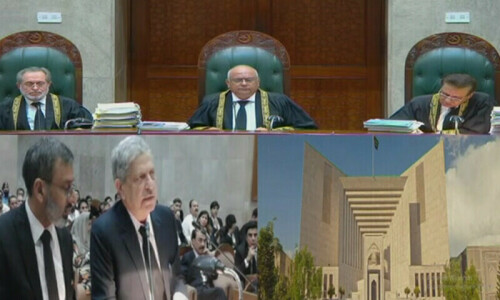
Reserved seats case: Why the Constitutional Bench’s verdict undermines the very essence of democracy
The Supreme Court’s Constitutional Bench (CB) has issued detailed reasons in the reserved seats review, and it’s easily among the most unwittingly comical decisions in our legal history. This distinction is notable in itself, given that Justice Qazi Faez Isa is no longer authoring judgments.
To recap, Justice Isa had stripped the country’s largest party, the Pakistan Tehreek-i-Insaf (PTI), of its symbol right before the polls in 2024; the Election Commission of Pakistan (ECP) then made sure no symbol meant no party, and wrongly forced the PTI nominees to contest as independents.
When the independents ended up winning in historic numbers anyway, it followed that they’d be entitled to the most reserved seats. But the rules say that a lack of symbol precludes parties from such seats — the 80 independents in the assembly were thus forced to park themselves under the canopy of Sunni Ittehad Council (symbol: horse) to claim their share.
Still unimpressed, the ECP not only continued freezing out the PTI, it even doled out their haul of reserves to the loser parties. It took a 13-member judgment of the Supreme Court to put things right, and — in Sunni Ittehad vs Election Commission — hold that the 80 independents were either already PTI or could write in that they were PTI, and thus bag their rightful seats.
No sooner had democracy breathed a rare sigh of relief than the Supreme Court’s brand-new Constitutional Bench reviewed its own verdict and set it aside: the PTI’s reserved seats dropped back from 22 to 0. While this writer has already put down that whole sordid saga here, the detailed reasons released earlier this week merit a look of their own.
The reasoning
Armed, in the main, with a single unconvincing technicality — that the SIC was before the Court and not the PTI — the review bench has reversed a decision that was superior in reasoning, broader in scope, and far truer to the spirit of the law.
Amazingly, it hasn’t devoted even a single sentence to its most glaring inadequacy: the fact that a 12-member bench is in no position to review the decision of 13 members. The moment one of the judges recused themselves from hearing the matter in the middle of proceedings, the bench became incomplete.
All we hear of this in the verdict is a stray fact, from when the judge stepped down: “Mr. Hamid Khan, Sr. ASC, requested that the Bench should not hear the case any further. This request was declined. The Bench continued to hear the case.”
And that hearing’s conclusions are par for the course: from Tamizuddin on, Pakistan’s history is littered with verdicts that prize commas and contortions over justice, over federalism, over democracy.
Consider: the original decision had taken pains to correct an all-out fraud on the electorate. “For democracy to endure, political parties must be supported and strengthened, not eliminated,” Justice Mansoor Ali Shah had held. “A democracy without political parties is unlikely to sustain itself for long … The judiciary, tasked with ensuring electoral justice, must foremost preserve the will of the people.”
A third category
Yet, the review verdict marks a proud return to form: far from their votes being respected, the public gets pages and pages of bean-counting. As for the people’s will, the review actually holds that the voter knew full well that, when casting a ballot for an independent candidate, the winner would not secure any reserved seats.
Left out of this remarkable observation is any mention of the ECP’s disastrous missteps or Justice Isa’s ludicrous party symbol verdict, which disenfranchised the voter in the first place. Major miscarriages of justice are wiped from the story in favour of procedural detours: the review bench has skipped past the elephant in the room by cross-examining each mouse.
It then tops this off by holding that the original verdict actually ignored the rights of the returned candidates, “such as some of the review petitioners, who were elected on reserved seats in National Assembly and notified as such. These returned candidates had also taken oath.”
This is the first judgment in Pakistan’s history that seeks to elicit sympathy for losing candidates occupying seats their party never won. As for how these phantom members have themselves honoured their oath, the lesser said the better.
Interestingly, the review bench does seem to understand that seats should be held by parties that, well, won them. “The results of the general election,” it holds, “and the measure and extent of the success of a political party in the general elections has a direct bearing on the number of persons who get elected from that political party to a reserved seat.”
But it then chooses to upend this formula — a formula that can only ever be the essence of any democracy — by awarding all the reserved seats to the parties that lost. As this writer said previously, apart from women and minorities, the Constitutional Bench seems to have created a third category: losers that serve democracy’s latest derailment.
The review also takes issue with the original majority having continued to issue clarifications of its verdict. “The order whereby the majority had converted itself into a special bench to the exclusion of the minority members,” the review holds, “was both unprecedented and illegal.”
Whether the election commission brazenly disobeying court orders — hence the need for a special bench’s reminders — was unprecedented or illegal, is not discussed; whether a review could exclude five of the eight majority judges from the original decision is also left for others to discern.
Given these fundamentals are still unanswered, it may be too much to ask why the Constitutional Bench itself has been on the books for an entire year without the challenge to its own validity being heard. It nonetheless continues to achieve, through its judgments, what the authors of the 26th Amendment had always dreamed of.
And that amendment, it must be remembered, was passed without the original verdict having been implemented. That film has reached its squalid climax.