What we get wrong about the Taliban’s ‘gender apartheid’
A few months ago, I was standing in New York’s Times Square, and I thought to myself, this is how it must have felt to stand in Rome at the height of the Roman Empire. I was looking at screens upon screens of celluloid across every inch of scaffolding — all vying for my choppy attention. Every glittering skyscraper boasted wealth, excess, and ambition.
This was, after all, America’s colosseum: a playground of consumerism that invited onlookers to revel in their host’s ability to enthrall and entertain them. As I walked around, I noticed that in the middle of this Ayn Randian fever dream was a recruiting centre for the US armed forces. As if they believed that their fellow countrymen arriving here would look around at this citadel of capital and think it was worth defending — that it was worth dying for.
Perhaps there is no congenital contradiction there; the free hand of the market cannot flourish without the hidden fist of the military and the military recruits to protect the market. So, what better place for an army recruiting station if not Times Square?
But the strangest thought I had while looking up at this strut of status in the heart of the world’s only superpower was that they had lost a war to a tribal force which had no tanks or an air force and was using the most rudimentary of weapons. In this citadel of capital, the Taliban had staged a palace coup.
A war of care
In 1958, President Nixon welcomed Afghan Prime Minister Mohammad Daoud to Washington and remarked that his country was ‘unconquered and unconquerable,’ perhaps not realising just how prescient this statement was to be. On August 30, 2021, the longest war in American history came to an end with the withdrawal of troops from Afghanistan. The capital fell to the Taliban without a single shot fired.
There were many reasons for the failure of the conflict, which will likely preoccupy military strategists for years to come, but what is clear is that America’s hubris had reached Olympian heights. Cofer Black, the head of counterterrorism for the CIA, had said in the lead up to the war: “when we’re through with them, they will have flies walking across their eyeballs”. But this was almost something ‘they’ should be saying, and so it had to be countered.
For that, Laura Bush was dusted off and pulled out of anonymity to lay the groundwork for the first ‘feminist war in all of history’ and pay lip service to the rhetoric of women’s liberation. “The fight against terrorism is also a fight for the rights and dignity of women,” she lied. The invasion was not only an act of militaristic revenge against those who had nothing to do with the 9/11 attacks — it was also framed as an act of care.
If Laura Bush could close her eyes and tap her red slippers three times, she’d wish for all Afghan women a life of unveiled freedom where they could shop in Kabul’s version of Times Square while drones hunted their men like the flies who would one day walk across their eyeballs. Unfortunately, it did not take long for the Bushes to realise they weren’t in Kansas anymore.
A ‘feminist’ failure
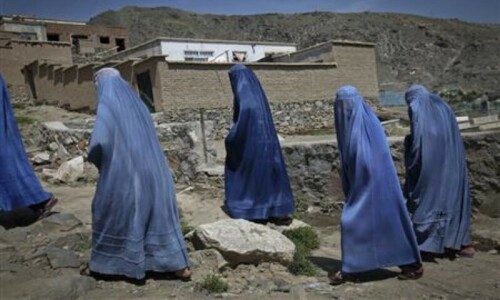
The earliest pictures of the invasion showed the predictable colonial exercise of Afghan women removing their veils and smiling at American forces. “Because of our recent military gains,” Laura Bush declared, “in much of Afghanistan, women are no longer imprisoned in their homes. They can listen to music and teach their daughters without fear of punishment”. The problem was that this portrayal did not reflect the reality in ‘much of Afghanistan’ despite media reports, which seemed to indicate that all Afghan women were being fed grapes to the sound of ukuleles. Journalist Anand Gopal was one of the few who ventured out of the ‘Kabubble’ of aid agencies and think tanks to other parts of the country. He reported on those he called “The Other Afghan Women”:
In Sangin, whenever I brought up the question of gender, village women reacted with derision. “They are giving rights to Kabul women, and they are killing women here,” Pazaro said. “Is this justice?” Marzia, from Pan Killay, told me, “This is not ‘women’s rights’ when you are killing us, killing our brothers, killing our fathers.” Khalida, from a nearby village, said, “The Americans did not bring us any rights. They just came, fought, killed, and left.”
It is undeniable that the Taliban were (and remain) oppressive to urban, middle-class, and educated women, to whom their edicts are nothing short of abhorrent. Women are not allowed to attend secondary school, work or even walk in public, which is unjustifiable under any tenet of law and religion.
However, it is also true that the Taliban enjoyed significant support among rural women for ending exploitation in the form of forced marriages and granting them inheritance rights, often denied to them by cultural norms. This aligns with the fact that the Taliban’s return came not only from their resilience and strategy but also mass public support from the populace, especially from the countryside, including women. In the Western imagination, the pro-Taliban Afghan woman does not exist but in reality she very much does.
During the war, the women’s NGO machine was corrupt, nepotistic, and elitist but more importantly it ended up being a spear carrier for the military industrial complex. This was pretty much admitted by Secretary of State Colin Powell in a speech on October 26, 2001. “The NGOs,” he said, “are such a force multiplier for us, such an important part of our combat team”. The enduring image of this vampiric vanguard for the occupation would be aid workers teaching Pashtun tribeswomen abstract art as a form of emancipation, while the US armed forces were bribing warlords with Viagra, knowing they were using it to rape young boys. Hardly a golden era of human rights.
Fear and debt
The two most powerful tools of empire are fear and debt. Traumatised by its loss to the Taliban, the Americans have leveraged both through a calculated scheme of international isolation and theft.
Over 20 years, the US spent an average of $50,000 per Afghan per year on the war — a staggering figure. Yet in 2020, half the population lived below the poverty line, with most living on an average of $2.15 a day. The occupation fattened the Kabul elite and NGO class while starving the poor. Is it any wonder they refused to fight for their invaders? To ease the sting off the trillions wasted, after the loss of Kabul, the Americans immediately blocked the Afghan central bank’s international reserves, amounting to $7 billion, while imposing sanctions on the Taliban.
This prompted 71 economists, including Nobel laureate Joseph Stiglitz, to write a letter to President Biden in August 2022, to allow Afghanistan to reclaim its international reserves — its own money — saying:
“Without access to its foreign reserves, the central bank of Afghanistan cannot carry out its normal, essential functions. Without a functioning central bank, the economy of Afghanistan has, predictably, collapsed … by all rights, the full $7 billion belong to the Afghan people … and returning anything less than the full amount, undermines the recovery of a devastated economy, where millions of people are starving … it is both morally condemnable and politically and economically reckless to impose collective punishment on an entire people for the actions of a government they did not choose.”
I would argue it is also morally condemnable to punish a people for the actions of a government they may have chosen, especially when the punishment takes the form of theft. Biden eventually allowed half of this amount to be released to help address critical needs in Afghanistan, but the other half remains in the hands of the invader. While the guys in uniform have left, the guys in pinstripes are using bills instead of bombs to control the country.
Gender apartheid
As part of the policy of isolation, women’s rights activists continue to be secular sidekicks to the failed military intervention. They have been busy drumming up international support for the Taliban to be convicted of a new crime under international law; gender apartheid. The fact that the Taliban may already be guilty of a crime under international law (gender persecution as a crime against humanity) is apparently not enough to deal with the ‘seriousness’ of what is going on. Instead, a new crime must be concocted, with the criminals already identified (Afghanistan and perhaps later Iran), and against which the international community must act. This sense of urgency did not exist for the women and girls of Gaza who were left to die at the hands of a feminist foreign policy that starved, mutilated, and murdered them.
The countries which plan to file a case at the International Court of Justice against Afghanistan’s ‘gender apartheid’ are Australia, Canada, Germany, and the Netherlands — all notorious supporters of Israel’s actual apartheid. The terminology is also too clunky to be workable; co-opting racial apartheid onto gender roles does not fit, weakening both the claims of racial apartheid and the ways in which we conceive a crime that inherently hinges on race, not gender.
UN Women has admitted that the term is meant to be ‘triggering’, to spur shock and galvanise action by states as well as banks, and sporting entities. England has since said it wants to put pressure on the International Cricket Council to intervene in matches with Afghanistan. Meryl Streep meanwhile has insisted that “a squirrel has more rights” than an Afghan girl under the current Taliban regime. Out of curiosity, I googled ‘Meryl Streep’ and ‘Gaza’ — nothing came up.
Let me be clear, the Taliban’s edicts are horrific, notwithstanding the international community’s hypocrisy over Gaza. But any organisation lamenting the condition of Afghan women which does not lay at the feet of the US the condition that they return to the country the money that has been stolen is not a coherent one in my books.
Perhaps I feel so strongly about the NGO and think tank class which formulates policy on Afghanistan because I was once one of them. I started my career as a policy wonk working on the country and in the ‘Kabubble’ on pointless research which helped the invader to better occupy. I regret this hugely. But it allowed me to see first hand the ways in which these ‘thinkers’ massaged their words to nudge policy in the direction they wanted. This was regardless of the fact that they rarely ventured out of their gated compounds where they met in Brooklyn-style cafés to discuss their Columbia PhDs while the city slowly sleepwalked into turmoil outside. These are the people who would currently be arguing for a military intervention of the country if one hadn’t already happened.
This is why I have a visceral reaction to the notion of women’s groups speaking for all Afghan women while working hand in glove with the military to pursue their braided aims. I am not surprised that the earliest gender apartheid campaigns started from women’s groups in 1997 which went on to wave their pom poms for the invasion of Afghanistan in 2001 celebrating it as a liberation for women and girls. I cannot support a movement with such a chequered history, where vehicles of empire masquerade as gooey hearted humanists.
A policy of engagement
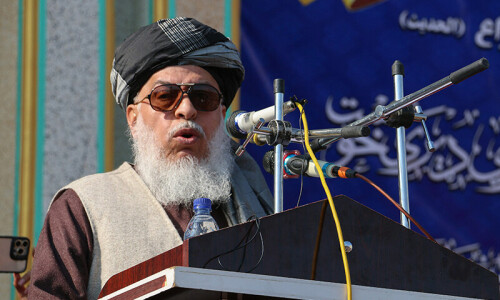
Currently, the Taliban itself is not cohesive in its policies. There is a battle of ideas going on within the group itself between the Kabul moderates and the Kandahar hardliners about all of these issues. The moderates strongly oppose the decisions taken on women’s education in particular. It is for this reason that Hassan Abbas, in his book, The Return of the Taliban, advocates for a policy of engagement:
My recommendation — knowing full well this is going to be controversial — is to increase engagement with the Taliban. In fact, engaging in conversations with them on what is required by the international community for them to be formally recognised is perhaps the only way forward in the muddled reality we have now. My argument is that any effective, sustained and meaningful engagement with them has the real capacity to empower the relatively pragmatic and moderate elements among them. Not engaging is going to support the view of hardliners that the world is against them — and consequently they will rise further within the organisation
He supports a carrot rather than stick approach as the best way to empower moderates in the Taliban, for a country against whom the world’s superpower has used a stick for a long twenty years. I think it is time we listen.
The Taliban, in crossing the Rubicon and defeating Caesar, have proven they must be allowed to rule anew. Not all roads after all lead to Rome.
The writer was previously working for an NGO in Islamabad and is currently based in Juba, South Sudan.
She tweets @AyeshaAMalik