


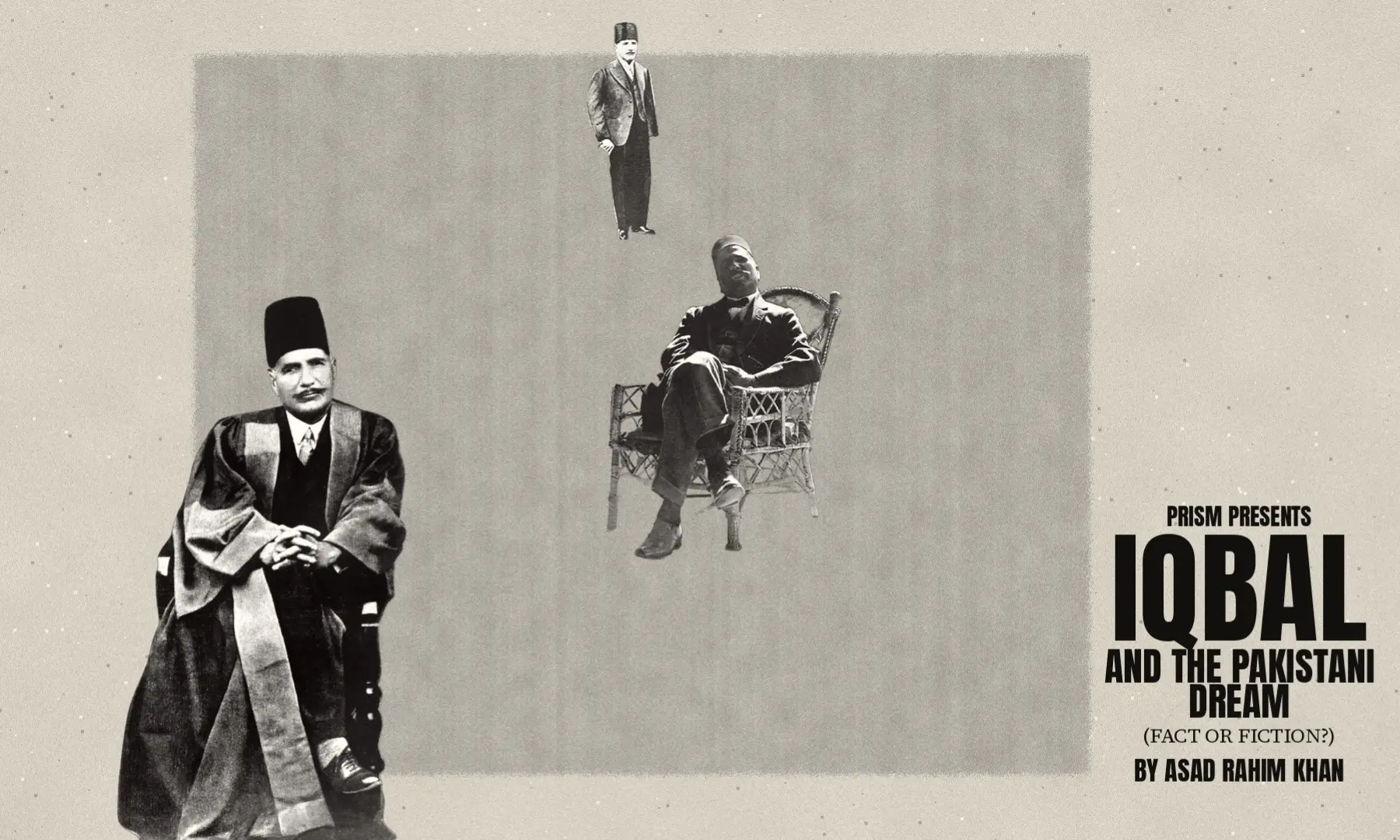
Iqbal and the Pakistani dream: fact or fiction?
Visiting Srinagar once, Indian essayist Pankaj Mishra found Iqbal in a rather unexpected place. Or, at least, in an unlikely heart.
For most Indians, Mishra notes, Iqbal was simply the “misguided instigator of the movement for Pakistan.” But then Mishra met Mohammad Ishaq Khan, a historian of Islam in Kashmir. By his very nature, Dr. Khan held politics at arm’s length; his writing focused on faith’s quieter, more contemplative hues.
And yet when this gentle scholar found himself at Iqbal’s tomb in Lahore, he was overcome. “I couldn’t control myself. Tears started pouring from my eyes.”
Concluded Mishra, “The idea of Iqbal as the man who had brought a hope of redemption to the Muslims of the subcontinent survived, and—this is what struck me—still had the power, many decades later, of moving even someone like Dr. Khan, committed to the intellectual life, to tears.”
That is, perhaps, the starting point: the debate over what Iqbal proposed in terms of Muslim statehood, reignited recently by social media, is secondary to how he made those Muslims actually feel—that after such protracted loss, there could yet be salvation. Or, as the poet himself put it, Sabaq phir parh sadaqat ka, adalat ka, shujaat ka / Liya jaye ga tujh se kaam dunya ki imamat ka.
But while most already know Iqbal to be the answer to something inwards—to a crisis of the spirit—the material world stakes as much of a claim. Because, for the authors of the Pakistan project, it wasn’t quite enough that he set the youth’s hearts on fire; it was also necessary that the prestige of his name attach itself to the idea of Pakistan. An intellectual genesis requires, well, intellectuals, and few were more moving than the Allama.
Nor did it hurt that the man was born, raised, and closely tied to the Punjab, a land both vital to, and late to join, the country’s creation. Geniuses were needed in Pakistan proper; otherwise it would be just too unbearably ironic that firebrands in UP, a place still stuck in India, would get to monopolise the origin story.
Dreams of Pakistan: misreading Iqbal’s Allahabad address
This is why Iqbal’s famous Muslim League presidential address, delivered in Allahabad in 1930, is a gift to Pakistan Studies. His core statement is as follows:
“I would like to see Punjab, North-West Frontier Province, Sindh and Baluchistan amalgamated into a single state. Self-government within the British Empire, or without the British Empire, the formation of a consolidated North-West Indian Muslim state appears to me to be the final destiny of the Muslims, at least of North-West India.”
For most nationalist histories, this is a watershed: the dream of Pakistan, put forward by the poet of the east for the first time—separate statehood from India (and, even more convenient, no awkward references to a Bengal that would require excising after 1971).
But none of this is borne out by the record. For starters, separate statehood was not floated by Iqbal first: right-wing activist Murtaza Ahmad Khan Maikash wrote it up in a four-part-series in Lahore’s daily Inqilab in 1928, premised on the same four provinces that make up Pakistan today. A similar proposal by Patiala nawab Zulfiqar Ali Khan followed a year later.
Second, a separate country wasn’t, in fact, floated by Iqbal at all—at least, not in 1930. He did wish for ‘Punjab, North-West Frontier Province, Sindh, and Balochistan’ to be ‘amalgamated into a single state,’ but, as he mentioned elsewhere in the same speech, the plan was to work “within the body-politic of India.”
When Iqbal said “state”, it was in the lowercase Indian fashion, as a province. Son Javid Iqbal confirms in his book Islam and Pakistan’s Identity that this was for a “Muslim India within India, as the word ‘state’ used by Iqbal, only implied the grant of full autonomy…”
The poet clarified as much in his letter published in The Times on 12 October 1931: “I do not put forward a demand for a Moslem State outside the British Empire.” His view was that “Muslim provinces…would be the bulwark of India…against the hungry generations of the Asiatic highlands.” He wrote again of Hindu-Muslim ties in 1931, “…I cannot allow myself to believe…that all human efforts directed to uniting the two communities are doomed to failure.”
For those still unconvinced, Iqbal put all doubts to rest in 1934, writing to friend Edward John Thompson his refusal to own “the scheme called Pakistan”:
“You have made one mistake which I hasten to point as I consider it rather serious. You call me a protagonist of the scheme called Pakistan. Now Pakistan is not my scheme. The one that I suggested in my address is the creation of a Muslim Province i.e.; a province having an overwhelming population of Muslims in the North-West of India. This new province will be, according to my scheme, a part of the proposed Indian Federation. Pakistan scheme proposes a separate federation of Muslim Provinces directly related to England as a separate dominion. This scheme originated in Cambridge.”
Iqbal signed off, “The authors of this scheme believe that we Muslim Round Tablers have sacrificed the Muslim nation on the altar of the Hindu or so-called Indian Nationalism.”
Denying the Allama outright
To those wary of state myths, a close reading of Iqbal’s address in 1930, and his own denials in 1931 and 1934, are enough to knock him off the pedestal of pro-Pakistan visionary.
To be fair to the sceptics, the version taught in state textbooks is indeed wrong: Iqbal did not mean separate statehood in 1930; we know this because he literally said, over the next three years, that he meant nothing of the sort. His Allahabad address did not spell the dream of Pakistan; that we teach schoolchildren otherwise is a distortion of history.
After all, as Iqbal himself implied, the seasoned politicians that found themselves at the Round Table had little in common with their critics. While Rahmat Ali and the angry young men of Cambridge were calling for a Pakistan that stood severed, the Round Tablers—Iqbal, Jinnah, and Zafrulla Khan—wanted Muslim security inside a federal India, secured by strong provinces and a weak centre.
That’s why, at least up to 1934, Iqbal kept a safe distance from ‘the scheme of Pakistan’. Future foreign minister Zafrulla Khan went further and scoffed that it was “chimerical and impracticable”; that it was “a student’s scheme” with “nothing in it”. Jinnah was more generous, telling Rahmat and his friends, “My dear boys, don’t be in a hurry; let the waters flow and they will find their own level.”
To say Iqbal thereby doesn’t figure in Pakistan’s genesis, however, is unkind. Firstly, because the waters did find their level: the Iqbal-sceptics play up his early denials without ever mentioning how his thoughts evolved on the subject: his final stance is best measured by his letter to Jinnah in 1937, which we will come to in a moment.
Second, the Iqbal-sceptics also skip over the context: Muslim nationalist thought had not breached the frontier of separate statehood in 1930; not to any serious reception anyway. Jinnah himself was a decade out from calling for another country. When that did happen in Lahore in 1940, it was because two years of humiliation under Congress rule had offered a preview to formerly pro-union Muslims of what lay in store. They responded accordingly.
Journey to separation: Iqbal’s 1937 letter to Jinnah
By the time of the Lahore Resolution, however, Iqbal was gone. Pakistan’s national poet died in 1938—all of two years before the Muslim League’s major bid for separation, and before a hostile press helped dub that bid ‘Pakistan’.
But not before the Allama’s remarkable mind had grasped the nature of the change; it’s why his politics would travel quite some distance from his initial Round Table position of the early 1930s. Hence, also, the irony: where he ultimately landed was far closer to the same Cambridge kids he had once distinguished himself from not too long ago.
That Iqbal’s ideas underwent a slow-burn radicalisation in the last years of his life—as opposed to a sudden Damascus moment—is plain. “It is obvious,” he wrote of the rising Nehru, “that the Indian nationalist whose political idealism has practically killed his sense for fact, is intolerant of the birth of a desire for self-determination in the heart of North-West Indian Islam.”
The resulting nationalism, wrote Iqbal, “can mean nothing but mutual bitterness and even oppression.” This lends a certain tenor to his crucial letter of 21 June 1937. “We are actually living in a state of civil war which, but for the police and military, would become universal in no time,” he warned Jinnah.
But if a “storm” was coming to northwest India, Iqbal wrote, Jinnah was the only Muslim “to whom the community has a right to look up for safe guidance.” And, in a big departure from his Allahabad address, Iqbal now declared that the “idea of a single Indian federation is completely hopeless.”
What, then, was the cure? As he wrote to Jinnah, “A separate federation of Muslim provinces…is the only course by which we can secure a peaceful India and save Muslims from the domination of non-Muslims. Why should not the Muslims…be considered a nation entitled to self-determination…?”
Over seven years, Iqbal the federalist had become Iqbal the separatist. Three years later, Muhammad Ali Jinnah stood before an exultant crowd in Lahore and joined him.
A reason to fight
Like the lawyer he placed his dying hopes in, Iqbal is too often painted in absolute shades. Yet as we have seen, he was neither the first-ever-dreamer of Pakistan in 1930, nor was he its rejectionist by the close of his life in 1938.
But then, at the risk of repetition, the whole debate is secondary. Because, compared to the common sense of the Quaid, Iqbal stirred something visceral in the young Muslim. No dense political theory, including Iqbal’s own, could replicate the primal forces his poetry unleashed: a gasp for dignity that could only ever find its most cogent expression in the birth of Pakistan. Perhaps it was the waters finding their level again.
Nor did they ebb, even after 1947. “What Iqbal means to me”—and it can only ever be the ‘me’—Nietzschean, confessional, boundless—is a subculture of its own in this country. Iqbal didn’t dream up Pakistan so much as he provided a basis for the Pakistani dream: a voyage of self-discovery; a reason to fight. Without him, Muslim nationalism would have remained a pair of broken wings.
And most everyone knew it. Jinnah said he would take Iqbal’s works over “the rulership of the Muslim state”. Ayatollah Khamenei called his young theocracy “the embodiment of Iqbal’s dream”, and anguished that the Iran before it was unfit for the poet to set foot in. Imran Khan, driven to despair by his mother’s death, sought out Iqbal as “a philosophy of action”—”that human beings were the makers of their own destiny.” All told, Iqbal was sui generis: the same sentiment that caused liberal intellectuals like Mohammad Ishaq Khan to weep at his tomb drove doctrinaire radicals like Khadim Hussain Rizvi to rage through police barricades.
Bear in mind, also, that most of the above were inheriting a world that had spun far beyond Iqbal’s. But the poet was, like everyone else, of his time, and the spiritual upheaval he caused can best be gauged by the record of those years. For one contemporary in 1935, the 24-year-old Malik Ghulam Nabi, Iqbal’s masterpiece, Bal-e-Jibreel (Gabriel’s Wing), landed like thunder from the sky; a cry for freedom like none before. “It beat back our holy men…it knocked down the pseudo-socialists, it mocked the colonizers, it inspired the poor to stand on their own feet…those once ashamed of calling themselves Mussalmans now claimed it with heart-bursting pride.”
Ghulam Nabi knew, because he was one of them. “As a student, I called myself G. N. Malik…Hindu friends made this out to be Gopal Narain or, in the Sikh tarang, Guru Nanak…it was Iqbal’s aihsaan that we were able to do away with this inferiority complex, and openly announce we were Muslims.” (Malik Ghulam Nabi would go on to join the freedom movement; his daughter-in-law, Dr. Yasmin Rashid, remains in prison.)
That is, at its simplest, what Iqbal meant to so many. “The fate of the world has been principally decided by minorities,” he said once. “…Character is the invisible force which determines the destinies of nations, and an intense character is not possible in a majority.”
And as the anxieties of a minority became those of a civilisation, it could only fall to Iqbal—a man of extraordinary contradictions—to become its poet-saint.


