The all-men court rolling back women's rights in Pakistan
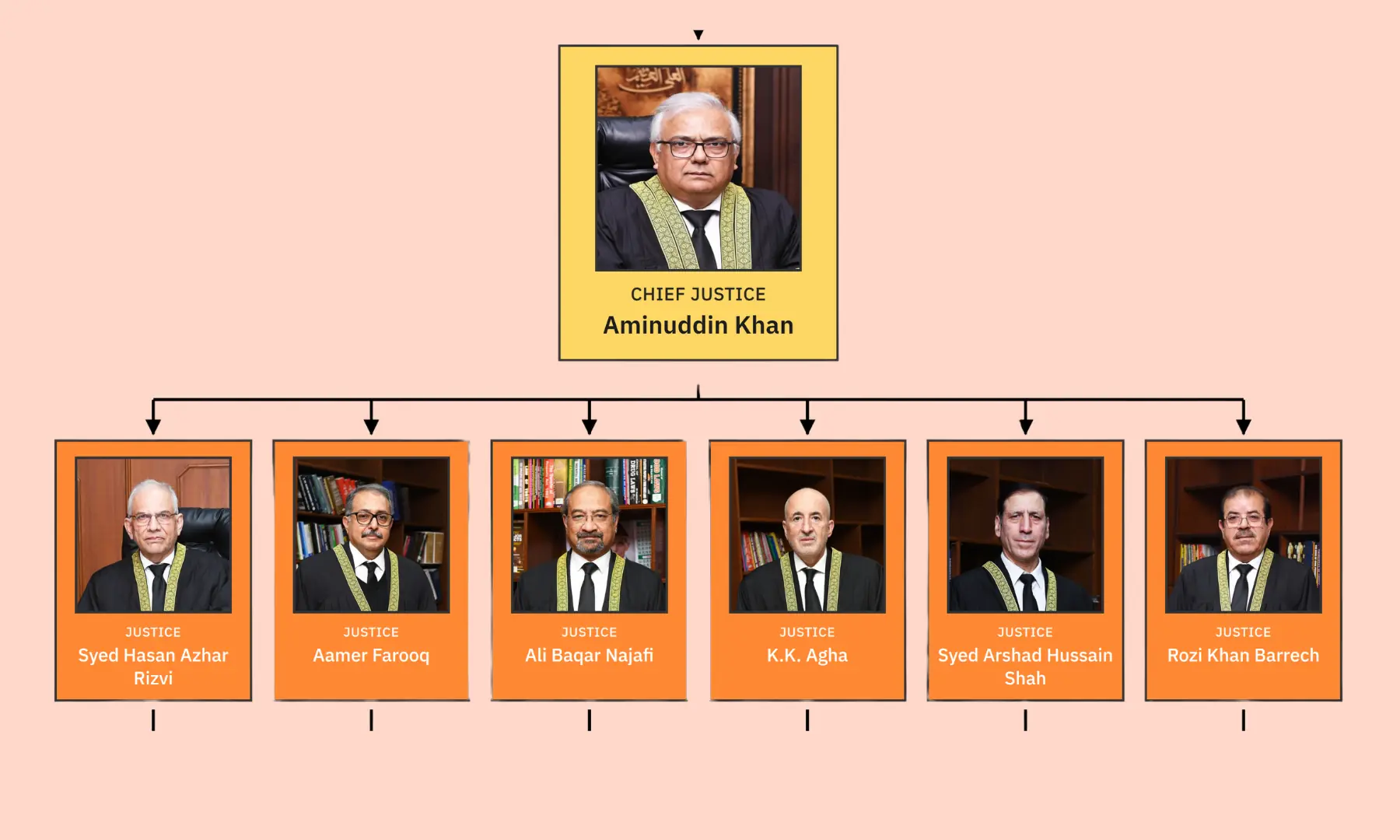
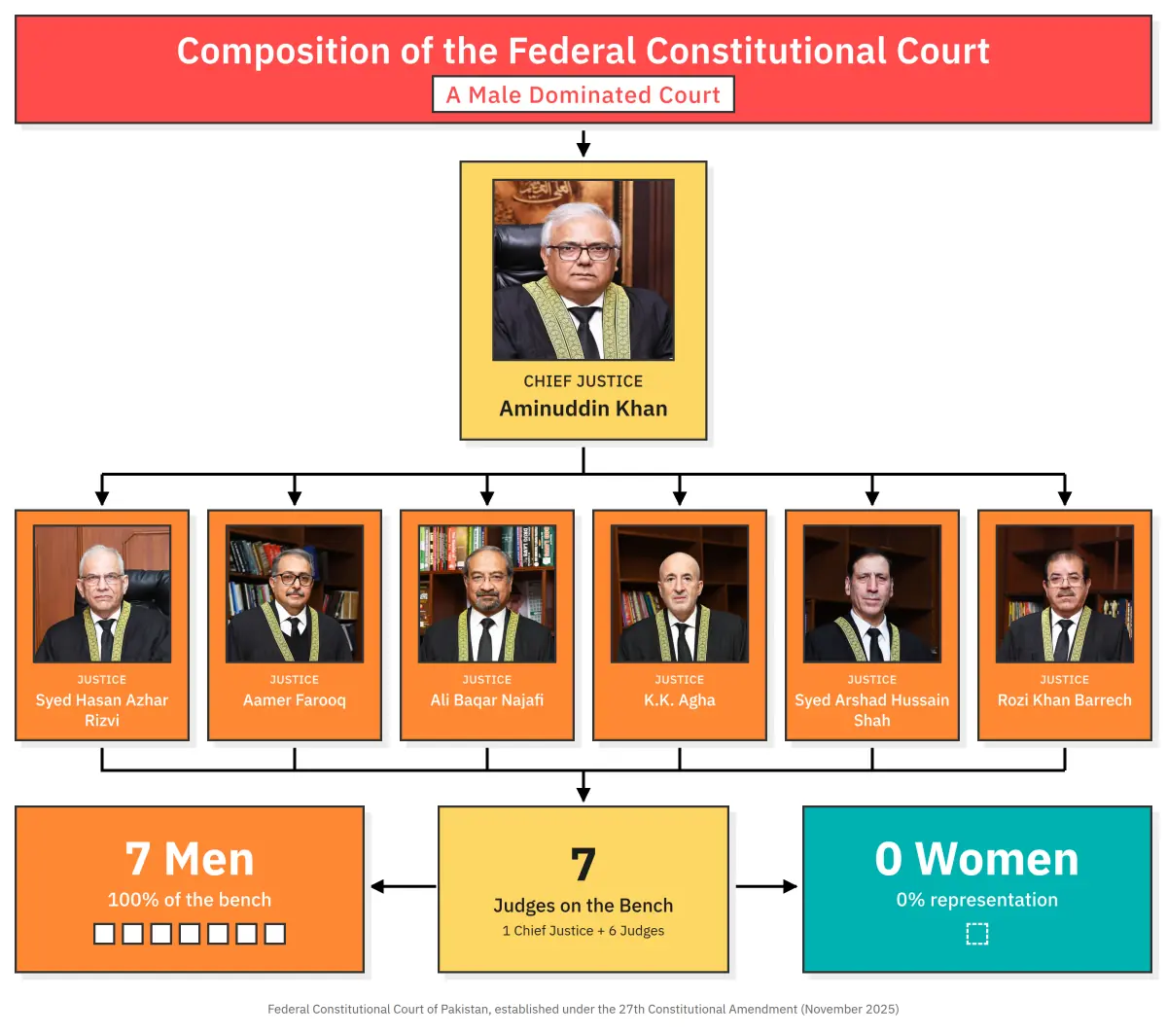
There is not a single woman judge on the Federal Constitutional Court. It is a court composed entirely of men.
At the time of the 27th Amendment, various unconvincing justifications were presented: the amendments would reduce pendency of cases; “activist” judges had brought these changes upon themselves; the FCC would hear important cases of constitutional interpretation that consumed too much of the Supreme Court’s time. But it was clear then, and it is clear now. The courts were being stripped of their independence. This threatens far more than political cases. Once judicial independence is destroyed, no fundamental right is insulated from the consequences.
Decades of legal advocacy have sought to strengthen protections for women. Regressive jurisprudence is undoing that work. The rollback of hard-won protections for women should concern everyone. Protections that took years to build are being dismantled.
In its latest judgment, the FCC has restricted the scope of the workplace harassment law. The judgment was authored by Justice Ali Baqir Najafi. Justice Najafi is the same judge who wrote an additional note in Noor Mukadam’s case, stating that the murder is a result of a “living [sic] relationships”, and that “the young generation must note its horrible consequences”.
A judge who brought victim-blaming reasoning into the judicial treatment of a brutal murder has now authored a judgment that restricts the protections available under the workplace harassment law.
Restricting the definition of ‘harassment’
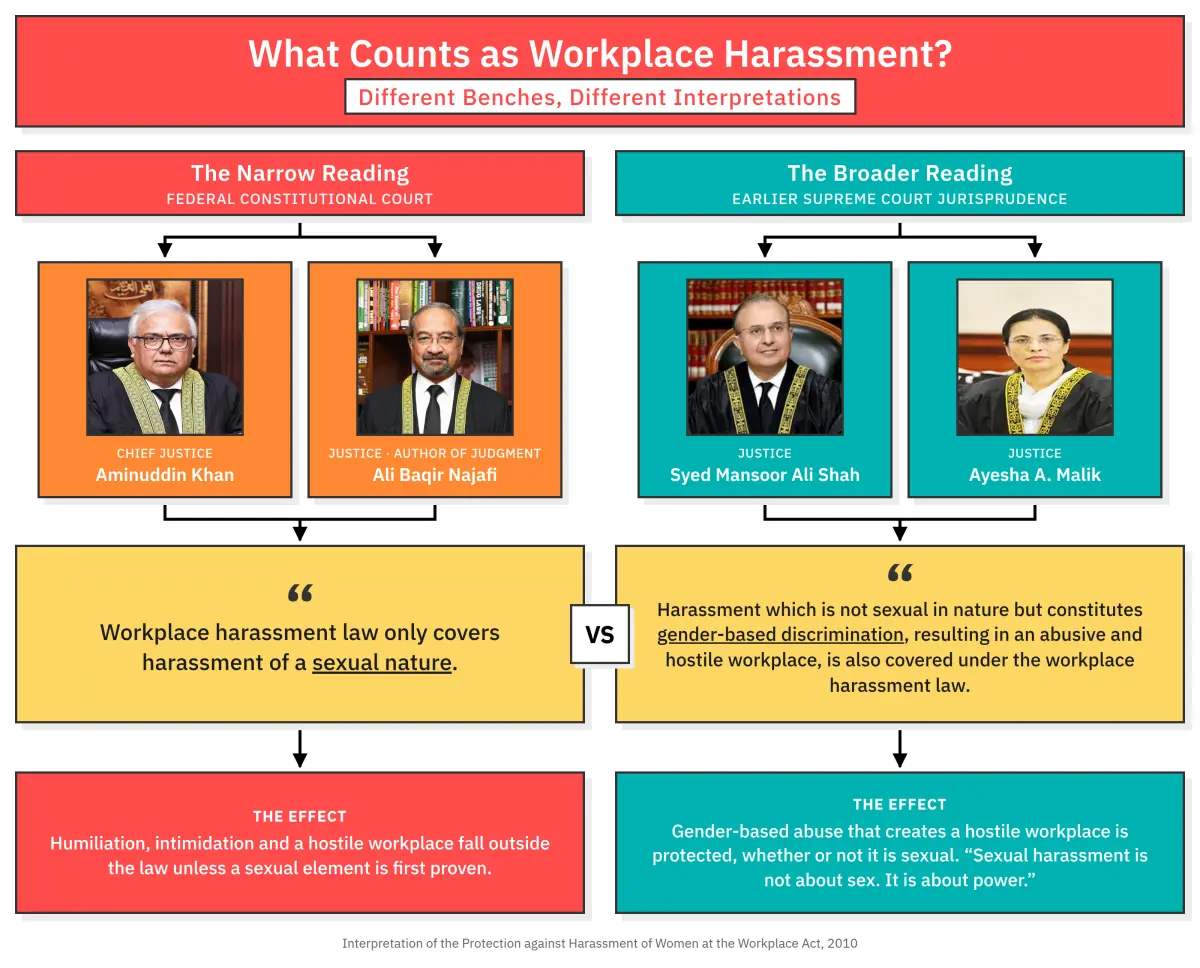
The FCC has adopted an interpretation of the workplace harassment law that undoes its very purpose. The FCC has held that only harassment that is “sexual in nature” is covered. The immediate consequence is that unless it can be shown that the conduct had a sexual element, it falls outside the protection of the law. This interpretation removes an important category of protection expressly included by parliament. The definition of harassment includes “sexually demeaning attitudes” when it interferes with work performance or creates an intimidating, hostile or offensive work environment.
By reducing harassment to conduct that is “sexual in nature”, a wide range of gender-based abuse is placed outside the protection of the law. Humiliation, degrading treatment, intimidation, and a hostile work environment will no longer be recognised as harassment unless a sexual element can first be established.
Justice Ayesha Malik previously held that reducing harassment to conduct that is sexual in nature “takes away the essence” of the harassment law, and ignores that harassment is often less about sexual interest and more about reinforcing existing power dynamics. Justice Ayesha held that the very “purpose of harassment laws is to address gender-based discrimination at the workplace and not to limit it to sexual forms of harassment”.
Separately, Justice Mansoor Ali Shah, in Muhammad Din’s Case, made clear that harassment is not confined to conduct that is overtly sexual in nature. Speaking for the Court, Justice Shah held that “sexual harassment is not about sex. It is about power”, and recognised that discrimination on the basis of gender (whether sexual or non-sexual in nature) may constitute harassment where it reflects a discriminatory mindset and results in a hostile workplace.
After the FCC judgment, however, a victim may be humiliated, degraded, intimidated or subjected to a hostile and discriminatory workplace, and yet be left without the protection of the workplace harassment law simply because the conduct cannot be characterised as sexual.
In 2022, parliament amended the federal law, expressly broadening the definition of harassment to include, “discrimination on the basis of gender, which may or may not be sexual in nature”. Sindh has adopted the federal law. To the extent the amendments apply, the judgment will only impact claims arising from conduct that occurred before the amendments came into force.
The practical consequences of the FCC judgment will be most significant in Punjab, Khyber Pakhtunkhwa, and Balochistan where the 2022 amendments do not apply. The responsibility now vests with the provincial legislatures to act without delay, and amend their respective workplace harassment laws to ensure that the protections parliament has recognised cannot be narrowed through regressive judicial interpretation.
A legal framework that tells victims that gender-based abuse falls outside the harassment law unless it has a “sexual element” reinforces the culture of silence and impunity that the law was enacted to overcome. In a society where there is already severe underreporting, this judgment will deepen the silence.
Increasing the evidentiary burden for victims
The FCC held that to prove a sexual harassment, “a bare minimum requirement” is that “it must be reinforced with convincing/independent evidence”. The FCC seeks to impose a standard of proof that is detached from the realities of how harassment occurs. Workplace harassment often takes place in private settings through verbal comments, gestures, intimidation, or patterns of conduct that may not leave behind documentary or independent evidence. The reasoning suggests that a complainant’s own testimony is insufficient unless reinforced by independent material.
The FCC’s approach creates an unjust hierarchy of evidence in which the direct testimony of a victim of harassment is treated as insufficient unless validated by independent evidence. Requiring independent corroboration sends a dangerous message that conduct behind closed doors may escape accountability.
In our jurisprudence, in cases of gender-based violence, the courts have held that the sole testimony of a victim is sufficient if it is confidence-inspiring and consistent. A victim experiencing harassment or coercive behaviour is often operating under conditions of shock, fear, and self-preservation. Expecting a victim to immediately assume the role of an investigator by recording conversations, collecting physical evidence, and preserving documents fundamentally misunderstands the realities of trauma and human behaviour.
There is a fundamental distinction between assessing the credibility of a complainant’s testimony, and requiring the testimony to be corroborated by independent evidence. A court must assess whether a complaint is consistent, coherent, credible and to consider any surrounding circumstances. This is fundamentally different from treating independent evidence as a “bare minimum requirement” in harassment cases.
Even under the FCC’s narrow test, the allegations were sexual in character
In the case before the FCC, the allegations were sexual, degrading, and coercive in character. In particular, it was alleged that the respondents:
(i) Drew representations of female private parts with a marker on the glass of the desk, directed the complainant to identify them, and, when she refused, summoned male colleagues and asked them to explain the drawings to her in her presence.
(ii) When the complainant wore loose clothing, one of the respondents threatened that he would tear off her clothes if she wore loose clothing again (a direct and explicit threat of physical and sexual violation).
(iii) Compelled the complainant to remain in the office after working hours against her will (using his position and the workplace environment to exercise coercive control over her)
(iv) Questioned the complainant about her marital status and whether she had a boyfriend (intruding into her private and intimate life in a manner directly relevant to the sexualised nature of the conduct alleged).
These allegations include explicit depictions of female sexual anatomy, sexualised humiliation, a threat to forcibly remove the complainant’s clothing, intrusive questioning about her intimate relationships, and coercive conduct directed at her in the workplace. The question therefore bears asking: if alleged conduct of this nature is not “sexual in nature,” then what conduct is?
The relevant question is one of legal characterisation. Whether the allegations were ultimately proved is a matter for the competent fact-finding forums to determine on the evidence.
However, to frame the alleged conduct as non-sexual in nature is fundamentally flawed.
Moreover, a substantial part of the FCC’s judgment rests on the principle that the High Court, in its constitutional jurisdiction, could not have interfered with or set aside the president’s order of censure. The decisive point was the limited scope of judicial review. To the extent the FCC’s observations were unnecessary for the disposal of the case, they ought to carry a different status.
A legacy of regression
The legacy the FCC is leaving behind is a legacy of regression. This is not just about one case. In the Shahbaz Masih (2026) case, the FCC held that although child marriage is a criminal offence, the marriage itself would remain legally valid. The reasoning is deeply troubling particularly in its treatment of evidence concerning the child’s age. The Court disregarded documentary evidence and held: “these documents cannot be relied upon as the sole basis for concluding that Mst. Maria Bibi was born on 07.10.2012 as alleged by her father particularly when she is physically present in this court”, and “appears to be of a more advanced age”.
The approach adopted by the FCC treats the apparent physical maturity of a girl as relevant to whether she should receive the legal protections afforded to a child.
The FCC disregarded NADRA’s record and the birth certificate establishing the girl’s age as 12 years at the time of the alleged marriage, and instead placed reliance on her physical appearance. Rather than relying on documentary evidence, male judges were making their own subjective assessments about a minor girl’s age and maturity.
The FCC’s jurisprudence reveals a clear unravelling of legal protections. Protections that took decades of legislative reform and advocacy to establish are being weakened by an all-male, executive-appointed court.
The FCC is imposing a doctrine of regression across the entire judicial hierarchy.
The writer is a barrister. She tweets @RidaHosain