PM takes notice of future after ordering it cancelled
I have spent the better part of two decades trying to persuade Pakistan’s institutions to think in decades rather than in news cycles. I built the Pakistan State of Future Index (PK-SOFI) to measure where the country stood against its own long-range indicators. I have sat in rooms with the National Intelligence Council, the OECD, the UK Cabinet Office’s Horizon Scanning unit, and South Korea’s Parliamentary Caucus on Foresight, watching how seriously other systems take the discipline of anticipation.
And I keep coming back to Pakistan with the same question: why does foresight refuse to take root here, no matter how many divisions we build, how many scenarios we run, or how many white papers we write?
The honest answer is not that Pakistan lacks talent or awareness. It is that foresight is not something Pakistan does in public policy. It is not a step in how a budget is drafted, a plan is approved, or a ministry decides what to prioritise. There is no standing government body mandated to scan horizons, run scenarios, and feed the results into policy on a continuing basis. What exists instead is a series of one-off exercises, personality-driven units, and donor-funded pilots that surface, produce a report, and disappear without ever touching an actual decision.
We are organised for emergencies, not trajectories. Pakistan has taken 25 IMF bailouts since 1958, meaning a state agency has spent a meaningful share of nearly every decade since Independence negotiating short-term fiscal survival rather than long-term fiscal design.
Layer onto that a security environment that has run hot almost continuously (three wars with India, the loss of East Pakistan in 1971, a three-decade counterinsurgency, a live conflict on the western border), floods on a roughly generational cycle, most recently in 2010 and 2022, and governments that rarely complete a full term.
Together, these have made firefighting the default posture, not because officials lack the capacity to think ahead, but because the in-tray never empties long enough to look past it.
Foresight rewards sitting with uncertainty long enough to map plausible futures before committing to one. In a system permanently in triage, that patience reads as indulgence.
Foresight exercises are compressed into single-scenario “national vision” documents because nobody upstream had the appetite for ambiguity. The tool survives; the method dies.
Bureaucratic incentives punish the very posture foresight requires. To do this work honestly, you have to say, “here are four ways this could go” instead of, “here is the plan.” Elsewhere, that kind of honesty signals rigour. Here, it reads as weakness. A civil servant who hedges looks unsure of themself in a system that promotes certainty, even manufactured certainty. So departments flatten their outputs into single forecasts dressed up as inevitabilities, because that is what survives a briefing.
Devolution without capacity is devolution in name only. After the 18th Amendment, the provinces formally inherited planning authority that used to sit with the Centre. But there is no actual infrastructure of foresight in Pakistan to devolve: no standing data systems, no trained analyst cadre, no dedicated budget lines, no institutional continuity anywhere in the federation.
Devolution handed provinces a mandate without a matching capability, because the capability was never built centrally either. I see this starkly in how differently Punjab, Sindh, Khyber Pakhtunkhwa, and Balochistan engage with long-range planning, and how peripheral AJK and Gilgit-Baltistan remain from almost non-existent national foresight conversations altogether.
Institutional memory resets with every change of government. Foresight is cumulative; its value compounds the longer a system tracks its own indicators and holds itself accountable to earlier projections. Pakistan’s governance cycle does not allow for that.
Between civilian transitions, military oversight periods, and constant cabinet reshuffling, every vision-focused initiative I have watched get built has been tied to a specific champion rather than a standing function. When that person moves on, the initiative is orphaned.
I have seen strategy divisions quietly stop meeting within eighteen months of a leadership change, not because anyone canceled them, but because nobody remembered to keep them alive.
Other systems show it can be done differently. Singapore’s Centre for Strategic Futures sits inside the Prime Minister’s Office, government-budgeted, training civil servants across ministries. Finland’s Committee for the Future has sat inside Parliament since the early 1990s and became a permanent standing committee in 2000; by law, every government must present its view of the country’s long-term future, giving foresight a fixed calendar slot regardless of who is in power.
The UK runs a standing Horizon Scanning Programme feeding Cabinet-level planning; South Korea’s National Assembly has its own futures institute; the UAE folded foresight into a cabinet-level portfolio in 2016; Wales created a statutory Future Generations Commissioner in 2015 with legal power over public bodies.
Even China and the US, opposite in ideology, share the discipline: China’s Five-Year Plans, coordinated by the National Development and Reform Commission since 1953, form a standing apparatus surviving every leadership transition, while the US National Intelligence Council has delivered its Global Trends report to every incoming administration since 1997, produced by a standing unit rather than a sympathetic official’s pet project.
None of these systems runs on champions or grant cycles. They run on statute, budget, and a permanent seat inside government, which is exactly the combination Pakistan has never assembled.
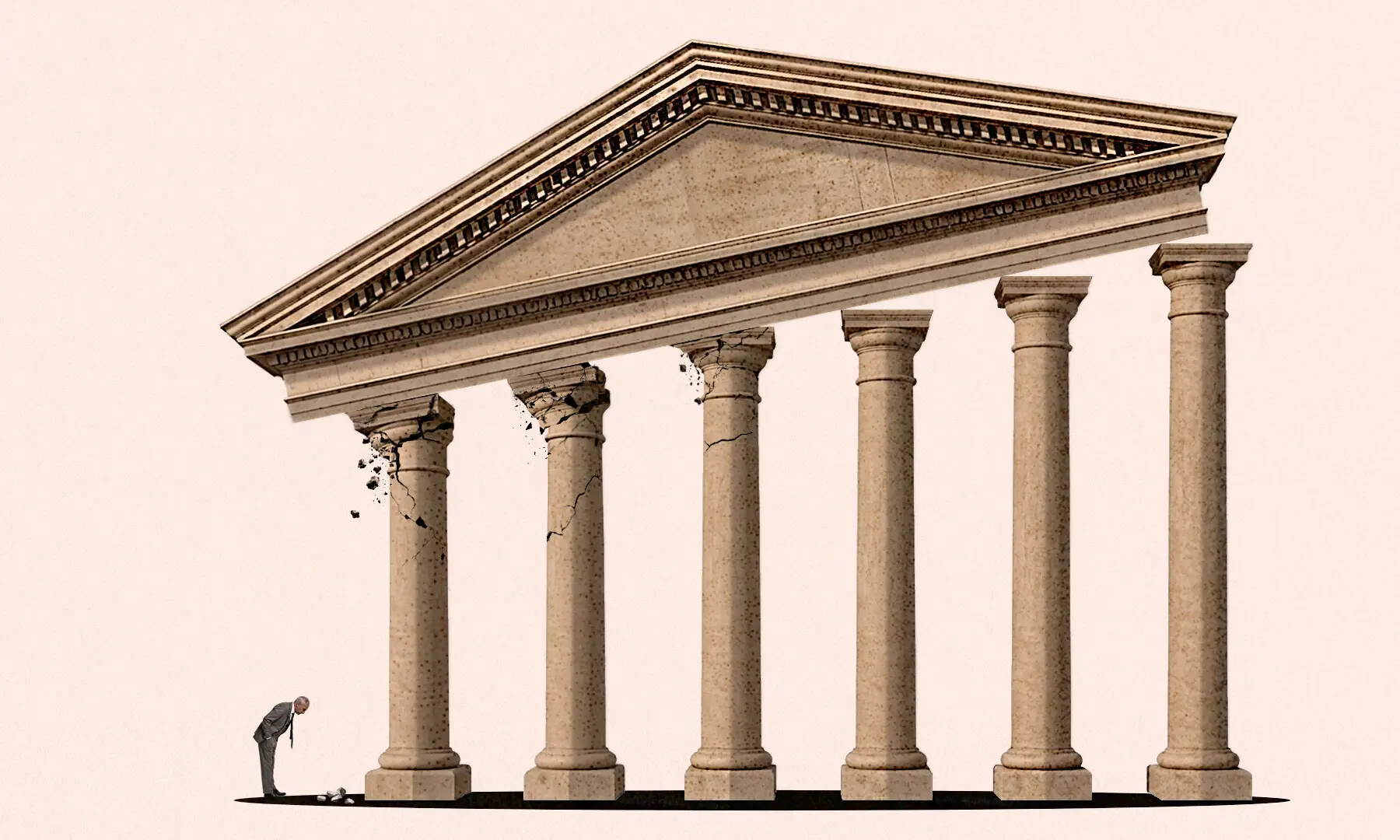
What ties all of this together, through a systems lens, is a single pathology: Pakistan’s governance architecture has almost none of the feedback loops that let a system self-organise around long-term signals. Self-organising systems need memory, actors with a stake in outcomes beyond their own tenure, and a mechanism that rewards anticipation over reaction.
We have built none of those into the state’s core operating logic. So foresight keeps arriving from the outside, as a consultancy, a donor project, a personal initiative, and keeps failing to fuse with the host, the way a graft fails when the underlying tissue can’t support it.
An institutionalised foresight function would not eliminate the crises that keep Pakistan in triage; floods, currency shocks, and security shocks are not going away. What it would change is the state’s posture going into them.
An IMF program negotiated against standing 10-year fiscal scenarios looks different from one negotiated cycle to cycle, with each finance ministry relearning lessons the last already paid for. A flood response planned against decade-tracked climate projections looks different from one improvised after the water reaches the villages, as in 2010 and 2022. A federation with shared foresight infrastructure would let all six administrative units argue about the future on the same data and time horizon, instead of improvising six separate responses to the same pressures.
And a state whose institutional memory did not reset with every government could finally hold itself accountable to its own past projections, the only way this work compounds instead of restarting from zero.
None of that requires inventing something new; it requires borrowing the discipline that Singapore, Finland, the UAE, Wales, China, and the United States have each built, and giving foresight the one thing it has never had here: a fixed, funded, legally protected place inside how decisions actually get made.
Until then, Pakistan will remain a country that occasionally produces foresight but never practices it as policy: excellent forecasts, run by dedicated individuals, inside departments with no legal footing and no guaranteed tomorrow, that no ministry is obligated to read and no budget is obligated to reflect.