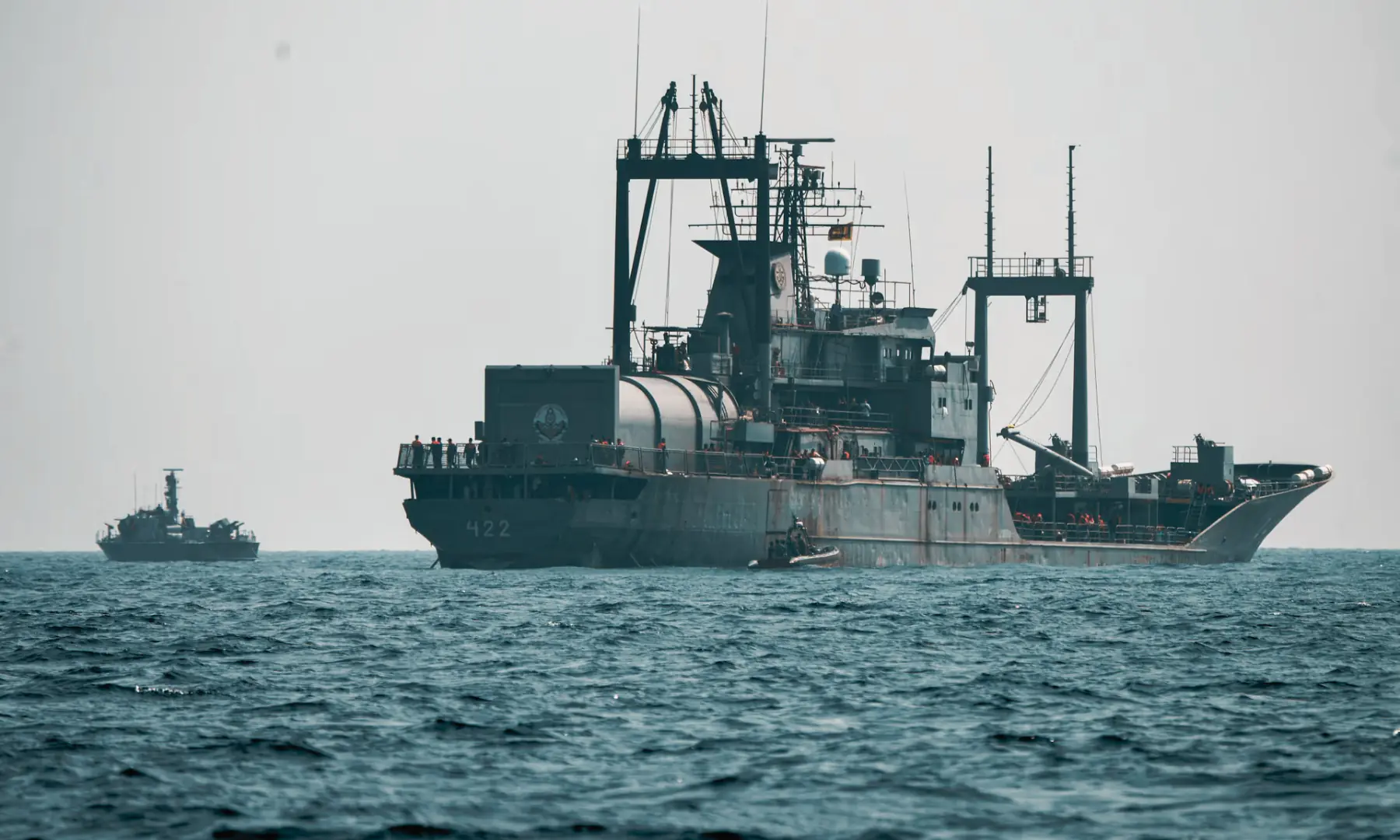
The sinking of IRIS Dena: A quiet death of the rules-based order
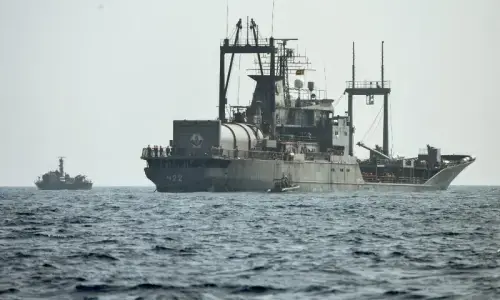
At 05:08 local time, in international waters 40 nautical miles south of Galle, Sri Lanka, a Mark 48 heavyweight torpedo — one of two fired, with the first missing its mark — struck the IRIS Dena beneath her keel. She was returning from India’s MILAN 2026 multinational naval exercise at Visakhapatnam as an officially invited guest, and was unarmed in accordance with the exercise’s return-voyage protocol.
She had 180 crew members aboard. At least 87 are now confirmed dead, another 32 were rescued and about 60 people were likely unaccounted for, Sri Lankan authorities said. The vessel was approximately 1,700 nautical miles from Iran’s nearest coastline and over 1,350 nautical miles from the nearest active theatre of Operation Epic Fury.
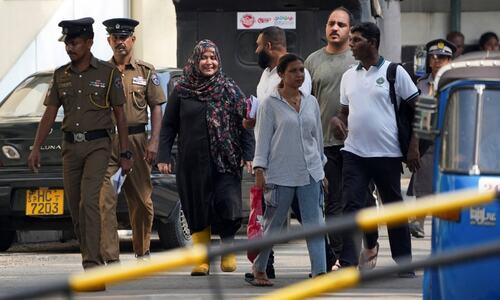
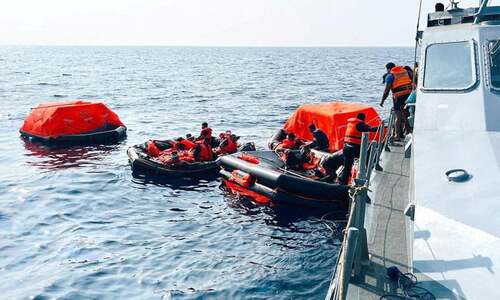
The submarine that sank her — identified by CBS News, citing multiple officials, as USS Charlotte, a Los Angeles-class attack submarine — left the area without conducting search and rescue operations. The Sri Lankan Navy recovered survivors and bodies from the water alone.
A quiet death
Pete Hegseth called it a “quiet death.” He was describing a torpedo strike. Without realising it, he was also eulogising something larger — the rules-based international order that the United States and its partners spent 80 years constructing and now appear, with evident satisfaction, to be dismantling.
What “quiet death” reveals is not a military assessment but a doctrine: we can do this, anywhere, to anyone, and frame it as dominance rather than law.
Across independent polls conducted after the strikes on Iran, roughly 60 per cent of Americans opposed the campaign. Support was concentrated almost entirely among self-identified MAGA Republicans, whose fragile enthusiasm Donald Trump acknowledged by invoking the “silent majority.”
This operation was not calibrated for America. It was not calibrated for the world. It was calibrated for a base. And when a Secretary of Defence crafts press-conference language as a loyalty signal rather than a legal or strategic communication to the international community, something has gone quietly wrong with the function of government itself.
One doctrine, three expressions
The pattern did not begin with IRIS Dena. On Thursday, February 26 — two days before the bombs fell — Iranian and American negotiators concluded what Iran’s foreign minister, Abbas Araghchi, described as the most intense round of talks yet, and agreed to reconvene in Vienna the following week. Both sides said progress had been made.
The bombs fell on Saturday.
Ayatollah Ali Khamenei — 86 years old, the spiritual authority of 85 million people — was announced dead by nightfall. Omani Foreign Minister Sayyid Badr bin Hamad Albusaid, who had brokered months of diplomatic architecture, said he was dismayed that “active and serious negotiations” had been destroyed. The Member of International Atomic Energy Agency’s (IAEA) director-general had stated publicly, and on the record, that the agency had found no proof of an active Iranian nuclear weapons programme — a position consistent with US intelligence assessments.
Iran was negotiating. Then it was bombed.
Hours later, that same Saturday, a missile struck the Shajareh Tayyebeh girls’ elementary school in Minab, in Hormozgan province. Between 165 and 180 people were killed — the majority girls aged seven to twelve, sitting in class on a Saturday morning. Planet Labs satellite imagery, analysed by three independent experts, including Professor Jeffrey Lewis of the Middlebury Institute, showed precision detonation centroids consistent with a US strike, given the geographic location and munition type.
The school had been separated from an adjacent Islamic Revolutionary Guard Corps (IRGC) base by a wall built between 2013 and 2016. Al Jazeera’s independent investigation concluded that only two explanations are consistent with the evidence: either the coalition relied on a targeting database more than a decade out of date — constituting grave negligence and reckless disregard for civilian life — or the strike was deliberate, intended to inflict maximum societal shock.
Unesco condemned it. The UN Secretary-General condemned it. The Pentagon did not respond to requests for comment.
Five days later: IRIS Dena.
Khamenei killed during diplomacy. Schoolgirls killed in their classroom. Sailors killed on an unarmed transit. These are not three separate incidents. They are three expressions of the same doctrine — that when rules become inconvenient, they are set aside, and the press conference follows.
The law that died with the Dena
The San Remo Manual on the laws of naval warfare — the same framework the United States cited for four decades against Iranian conduct in the Persian Gulf — requires neutral state notification, precaution before attack, and verified military necessity. Sri Lanka received no warning. The IRIS Dena reportedly carried no ordnance. No alternative to sinking her was attempted or explained.
When the USS Charlotte fired and departed without conducting search and rescue operations, it added a second violation to the first: the Second Geneva Convention requires parties to a maritime engagement to search for and collect the wounded, sick, and shipwrecked. The Sri Lanka Navy, which bore no responsibility for the engagement, carried out those operations alone. The US did not attempt to argue that the conditions for lawful conduct had been met. It did not need to. Impunity does not require justification. It simply acts, and then describes what it has done as winning.
That is the tell. For 80 years, the rules-based order rested on a claim: that powerful states had accepted constraints on their behaviour and would enforce those same constraints on others. What the past 10 days suggest is that the claim was always conditional. When the most powerful actor in the system decides those constraints no longer apply to itself, there is no enforcement mechanism, no appeal, no remedy. There is only the press conference.
Theatre vs discipline
A nuclear-powered attack submarine hunting a frigate in the Indian Ocean and firing two Cold War-era torpedoes — one missing, one killing — at an unarmed vessel on a transit passage is not military efficiency. It is theatre: a display of capability masquerading as necessity, calibrated for the same domestic audience as Hegseth’s press conference and perfectly aligned with the instincts of an administration that consistently mistakes spectacle for strategy.
The contrast with Iran’s own conduct is instructive, and ought to disturb those who assume the United States holds every strategic advantage. Iran has absorbed the killing of its Supreme Leader, the destruction of its nuclear facilities, and the decimation of its navy. Its military responses have been a disciplined integration of precision and volume that has confounded Western expectations.
Where the United States reached for expensive legacy platforms, Iran deployed a calibrated mix of ballistic missiles and cheap drones that achieved what no formal naval blockade managed in 40 years: the effective closure of the Strait of Hormuz.
The Joint Maritime Information Centre now assesses it as a critical-risk environment. Maersk, Hapag-Lloyd, CMA CGM, and MSC have all suspended passage. Traffic is down by more than 80pc. Helima Croft of RBC Capital Markets described it as “about as wrong as things could go at any single point of failure” in global energy markets. Iran closed the world’s most critical energy chokepoint with cheap drones. Its adversary responded with a $1.5 million torpedo fired at an unarmed vessel 1,700 nautical miles from the conflict zone.
The asymmetry is not merely financial. Each Iranian response has been calculated to impose cost without unnecessarily triggering the next threshold — a doctrine of economy and discipline from a state that has studied asymmetric warfare for four decades. When a vastly superior force responds to that kind of disciplined resistance by escalating theatrically rather than strategically, it is not winning. It is revealing that it does not know how to win.
And at the end of that logic sits the USS Gerald R. Ford, repositioned progressively forward in the Eastern Mediterranean and into range of Iran’s longer-reach ballistic arsenal. Whether that forward positioning reflects thinning interceptor stocks or a calculated attempt to bait Iran into providing a casus belli that would rewrite the rules of this conflict entirely, the result is the same: a nuclear-armed superpower manoeuvring its most visible asset into an adversary’s kill envelope. That is not escalation control. That is escalation gambling.
The cost to partners
On Friday morning, Prime Minister Anthony Albanese confirmed what his foreign minister had declined to say two days earlier: three Royal Australian Navy personnel were aboard USS Charlotte when it fired. “We wouldn’t normally confirm such an issue,” Albanese told Sky News, “but given our National Security Committee meetings and the public interest, I can confirm that there were three Australian personnel on board that vessel.” He added, in the same breath, that “no Australian personnel have participated in any offensive action against Iran.”
That distinction collapsed within hours. Professor Don Rothwell of the Australian National University, one of the country’s foremost international law experts, stated plainly that Australians under the command of an American submarine captain would have had very little choice but to be involved. “Literally every person on board a submarine is engaged in active duty,” Rothwell said, “unlike, say, the vast numbers of persons who would be on board an aircraft carrier.”
A submarine has no bystanders. The question of whether Australian personnel participated in offensive action is not one the prime minister can answer with a prepared statement. It is a question of operational reality that the laws of armed conflict, not Canberra’s communications team, will ultimately determine.
Senator Shoebridge, who drew this thread in parliament, put it with characteristic precision: every future US war, under the current AUKUS (a trilateral security partnership between Australia, the UK, and the US) architecture, will have Australia dragged into it “without ever a decision being made by the Australian cabinet.” The Albanese government spent two days stonewalling. When it finally confirmed, it confirmed more than it intended.
India’s position is more exposed, and more silent. On February 25, Prime Minister Narendra Modi stood in the Israeli Knesset — the first Indian leader ever to do so — and declared India’s solidarity with Israel “firmly, with full conviction.” Two days later, Operation Epic Fury began. Eight days later, a vessel India had officially invited to its exercise was sunk in India’s strategic maritime neighbourhood by India’s partner, without any consultation with New Delhi.
India’s senior strategic analyst Brahma Chellaney raised a question that has since become the sharpest edge of New Delhi’s discomfort: under the Communication Compatibility and Security Agreement (Comcasa) and Logistics Exchange Memorandum of Agreement (LEMOA), India and the United States share sensitive maritime data.
If USS Charlotte used that shared data to locate IRIS Dena — a vessel that had just departed an Indian port after an Indian-hosted exercise — it would represent, in Professor Brahma Chellaney’s words, “a foundational breach of the defence partnership.” The Indian government denied it categorically, calling the suggestion “preposterous.” But the mere existence of the question — raised not by Iran but by India’s own strategic community — is itself an indictment. “In one torpedo strike,” Chellaney wrote, “American hard power has punctured India’s carefully cultivated soft power.”
The Information Fusion Centre – Indian Ocean Region almost certainly tracked IRIS Dena throughout her transit. India knew where she was. India watched. India said nothing. Former Naval Chief Admiral Arun Prakash called the sinking “senseless and inflammatory.” Former Foreign Secretary Kanwal Sibal said the US had “ignored India’s sensitivities, as the ship was in these waters because of India’s invitation.” Not a serving minister has spoken. That silence is the loudest statement in the Indian Ocean.
Whose quiet death
India’s International Fleet Review (IFR) 2026 drew warships from 74 nations. Every one of their navies must now ask whether participation in an Indian-hosted exercise could expose them to US submarine operations if their flag state happens to be at war with Washington. The answer, established by precedent on March 4, 2026, is: possibly, depending on whether Washington decides you are worth stopping. Chellaney noted it clearly: “The message to participating navies is stark: attending India’s exercises may not guarantee safety once they sail away.”
This is not a rules-based order. It is a power order: unilateral, unaccountable, and now openly acknowledged as such by the people running it. The Second Geneva Convention, the San Remo Manual, the UN Charter, and the diplomatic conventions that protect negotiations in progress all applied, clearly, to the events of the past 10 days. None of them were observed. None of them were argued against. They were simply set aside — and a press conference was held.
Pete Hegseth called it a “quiet death.”
He was right. He just didn’t say whose.
Header image: A Sri Lanka Navy vessel approaches an Iranian vessel during a rescue operation, a day after the crew of a distressed Iranian military ship, IRIS Dena were assisted in waters south of Sri Lanka, off the coast of Colombo, Sri Lanka March 5, 2026. Sri Lanka Navy/Handout via Reuters/File Photo
The author is a Melbourne-based combat veteran and former Pakistan Army officer with a background in psychology.