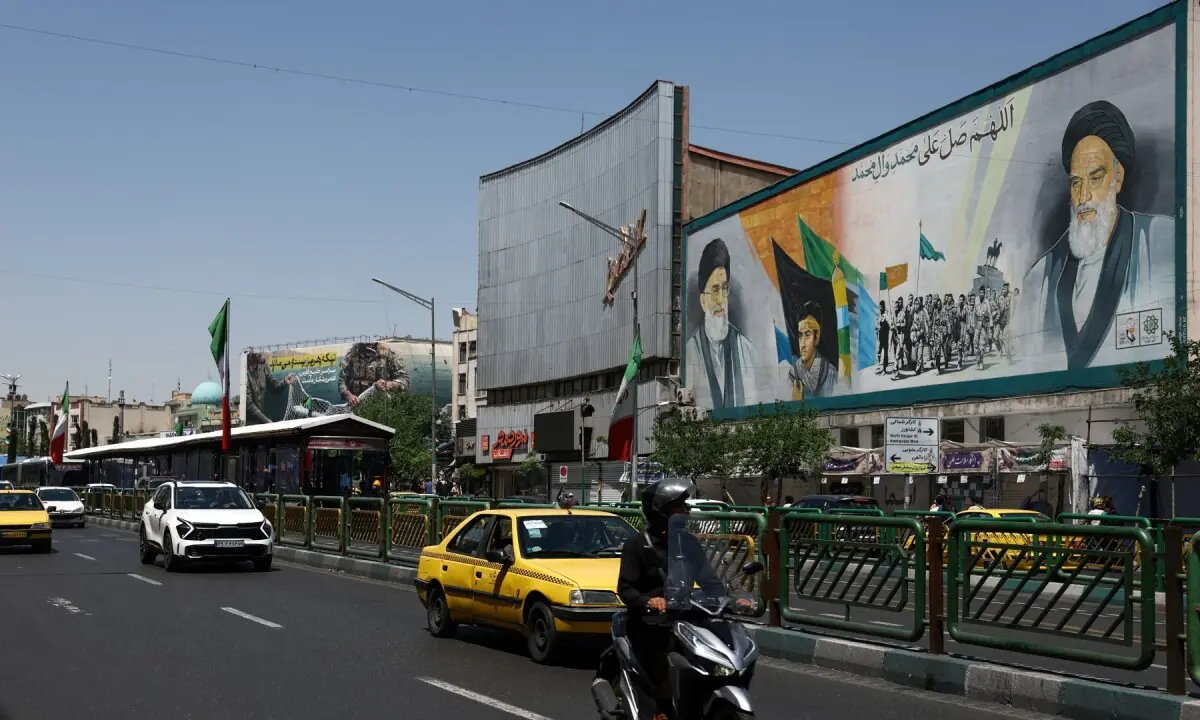
The US and Israel on Feb 28 launched what they described as a “pre-emptive” joint strike against Iranian targets, with Trump announcing start of “major combat operations”
Pakistan hosted the first round of face-to-face talks between the US and Iran in 47 years in April; the talks ended without a breakthrough, but also without a breakdown
US allies in Gulf reportdrone attacks as IRGC warns against attacks on Iranian ships
Trump rejects Iran’s response to latest US proposal that would stop the fighting but leave the most contentious issues unresolved for now
Saudi Arabia has condemned the “infiltration carried out by an armed group from the Islamic Revolutionary Guard Corps of the Islamic Republic of Iran into Kuwait’s Bubiyan Island”.
In a statement, the Ministry of Foreign Affairs stressed the kingdom’s categorical rejection of hostilities that violate Kuwait’s sovereignty.
Oil prices fell after rising in three consecutive sessions, as investors awaited developments around the fragile ceasefire in the Iran war and US President Donald Trump headed to China for a high-stakes summit with President Xi Jinping, Reuters reports.
Brent crude futures lost 82 cents, or 0.76 per cent, to trade at $106.95 a barrel at 0051 GMT, and US West Texas Intermediate futures fell 66 cents, or 0.65pc, to $101.52.
Both benchmarks have largely hovered around or above the $100 per barrel mark since the US and Israel began attacks on Iran at the end of February and Tehran effectively shut the Strait of Hormuz.
Global suffering continues as uncertainty over the fate of the war in the Middle East refuses to dissipate. Market analysts and decision-makers have repeatedly warned that the economic damage already wrought — and worsening daily as vital shipping routes through the Strait of Hormuz remain closed — could take months, in some cases years, to reverse.
Every day that passes without clarity on how and when the war will end introduces fresh intensity to the uncertainty roiling global markets and adds to the economic turmoil the world must bear because of it. Iran may have been pummelled militarily but refuses to accept defeat.
The consensus in foreign intelligence circles is that it may be able to endure for a lot longer before economic pressure forces it to reconsider its position. The US, for its part, seems to be losing the endgame, with its leadership’s obduracy drawing it deeper into a quagmire which is not easy to exit.
India’s travel industry fears that an appeal by Prime Minister Narendra Modi to avoid unnecessary foreign travel will squeeze new bookings after inflationary pressure knocked down summer overseas inquiries by as much as 15 per cent, industry and analysts say, according to Reuters.
The pullback is set to hit the peak season for outbound tourism, when affluent families seek cooler locations in Europe and Australia, during school holidays that run from April to June.
“The prime minister has a great following, and people sometimes take his advice very seriously … they may postpone it to next year,” said Ravi Gosain, president of the Indian Association of Tour Operators, with more than 2,000 members.
Esmaeil Baghaei has released a lengthy statement on X, warning that the US-Israel war on Iran “will determine the very meaning of ‘good’ and ‘evil’ in our time and for future”, Al Jazeera reports.
“This is a war between professional liars who fabricate justifications for atrocity, and a proud people who defend their homeland and human dignity relying solely on their own strength and resolve,” the Iranian foreign ministry spokesman wrote.
“This is a war between those whose decisions are shadowed by moral compromise, and those who act with a clear conscience.
“This is a defining struggle for the future of humankind. It will decide whether civilization’s hard-won achievements—human rights, the rule of law, and basic morality—will survive or be swept away.”
He ended by urging those who “reject the path of barbarism and domination” to “find the moral courage to speak, to act, and to stand on the right side of history”.
US PRESIDENT Donald Trump is doing what he does best: keeping the world guessing with his puzzling declarations. He has rejected Iran’s latest proposal for peace talks, stating, “I don’t like it”. He has also threatened Iran with more strikes. He claims the ceasefire is now on “massive life support”. At the same time, he has asserted that he has achieved all his war objectives. What are we to make of such, often conflicting, statements? One thing that can be deduced from Trump’s declarations is that there is not going to be an end to one of the most consequential conflicts in recent history anytime soon.
Interestingly, Trump’s public rejection of Iran’s peace proposal reportedly followed a telephone call with Israeli Prime Minister Benjamin Netanyahu. Speaking to an American TV channel, Netanyahu warned that the war was not over and nuclear material still had to be taken out of Iran. According to him, “If necessary, we [the US and Israel] can re-engage them [Iran] militarily”. This reinforces suspicions that Israel is not in favour of any peace talks with Iran and is pushing the American president to end the ceasefire, just as it pressed him to launch the war. The ceasefire meant to facilitate peace talks came into effect in April and has been largely observed despite exchanges of fire and reports of strikes in the strategic Strait of Hormuz, which Iran has effectively continued to block.
US President Donald Trump said that Americans’ financial struggles are not a factor in his decision-making as he seeks to negotiate an end to the Iran war, saying that preventing Tehran from acquiring a nuclear weapon is his top priority, Reuters reports.
Asked by a reporter to what extent Americans’ financial situations were motivating him to strike a deal, Trump said: “Not even a little bit.”
“The only thing that matters, when I’m talking about Iran, they can’t have a nuclear weapon,” Trump said before departing the White House for a trip to China.
“I don’t think about America’s financial situation. I don’t think about anybody. I think about one thing: We cannot let Iran have a nuclear weapon. That’s all. That’s the only thing that motivates me.”
China’s top diplomat urged Pakistan to step up mediation efforts between Iran and the United States, and help to “properly” address the reopening of the Hormuz strait, Chinese state media said, according to AFP.
Foreign Minister Wang Yi spoke to his Deputy Prime Minister and Foreign Minister Ishaq Dar on a call, state news agency Xinhua reported, ahead of US President Donald Trump’s visit to Beijing.
US President Donald Trump has repeated that Iran cannot have nuclear weapons, Al Jazeera reports.
“If Iran has a nuclear weapon, the whole world would be in trouble because they happen to be crazy. They’re not going to have a nuclear weapon,” Trump tells reporters gathered at the White House before heading on his trip to China.
Qatar has condemned the “infiltration” by an armed group consisting of members of Iran’s Islamic Revolutionary Guard Corps (IRGC) onto a nearby island to carry out “hostile acts” against Kuwait.
This “infiltration” and the group’s “clash with the Kuwait Armed Forces before being apprehended [are] a blatant aggression against Kuwait’s sovereignty and a dangerous development that threatens the security and stability of the region”, Qatar’s foreign ministry said in a statement shared on social media.
The foreign ministry also emphasised “the necessity of stopping Iran’s unjustified aggressions against brotherly countries, viewing them as a blatant violation of international law and a serious threat to regional security”, adding that it hoped those injured in the attacks would “recover swiftly”.
US President Donald Trump has again promised that fuel prices will rapidly decrease once the conflict ends, Al Jazeera reports.
“As soon as this war is over, which will not be long, you’re going to see oil prices drop and you’re going to see a stock market … go through the roof,” he tells reporters.
“You have hundreds of ships that are loaded up with oil that want to come out. As soon as they come out, we’re going to have a gusher of oil and you’re going to have inflation that goes way down.”
US President Donald Trump has stated that the naval blockade has been completely effective, but has skirted a question from a reporter about whether he has a “red line” that would end the ceasefire with Iran.
“Well, we’re going to see, and we’ll be thinking about it on the flight [to China], and we’ll be thinking about it for the next little while,” the US president has said ahead of his departure from Washington, DC.
He has reiterated his claim that the US has defeated Iran’s military “very soundly”, adding that the blockade of Iranian ports has been “100 per cent effective”.
“One way or another, it’s going to work out very well,” he adds.
The US Energy Information Administration (EIA) says that it expects Iran to be forced to reduce its oil output, partly due to the US blockade on its ports, Al Jazeera reports.
In a statement, it expects oil output and trade patterns will not return to prewar levels until late this year or early next year, even once shipping resumes through the Strait of Hormuz.
It adds that if the strait remains closed through late June, then crude oil prices will be $20 per barrel higher, as the current forecast is based on projections that the strait will reopen late this month.
Iran’s Deputy Foreign Minister Kazem Gharaibabadi has said that peace “cannot be built through the language of humiliation, threats, and coercive demands for concessions”.
“When a party that itself has played a direct role in war, blockade, sanctions, and threats of force rejects Iran’s response simply because it is not a document of surrender, it becomes clear that the real issue is not peace, but the imposition of political will through intimidation and pressure,” he writes on X.
“The Islamic Republic of Iran has emphasised clear principles: a permanent end to the war and guarantees against its recurrence, compensation for damages, lifting the blockade, removal of unlawful sanctions, and respect for Iran’s rights,” he adds.
Gharibabadi notes that these are not maximalist demands but prerequisites for any serious, sustainable peace arrangement consistent with the UN Charter to end a crisis started by the illegal use of force.
“One cannot simultaneously speak of a ceasefire while continuing the blockade; speak of diplomacy while intensifying sanctions; or speak of regional stability while providing political and military support to a regime that is the source of aggression and instability,” he adds.
“Such an approach is not negotiation; it is the continuation of a policy of coercion through diplomatic language.”
The trading arm of Vietnam’s state oil company has urged the US Navy to allow a crude oil tanker laden with Iraqi oil to sail through its blockade in the Middle East Gulf and provide a Vietnamese refinery with critical supplies, Reuters reports quoting a letter from the Petrovietnam Oil Corporation (PV OIL).
“This cargo is of extreme importance to Nghi Son Refinery (NSRP), to the Socialist Republic of Vietnam, and to the Vietnamese people,” PV OIL Vice President Hoang Dinh Tung has said in a May 12 letter seen by Reuters and sent to US military and diplomatic missions.
“NSRP’s feedstock inventories are critically low; any further delay risks halting refinery throughput, with cascading consequences for millions of Vietnamese consumers, businesses, public services and industries.”
US President Donald Trump has said Washington will “see what happens” when it comes to negotiating with Iran.
“We’re going to see what happens. We’re only making a good deal,” he tells reporters. “I believe that one way or the other, it’s going to be very good for the American people and I think, actually, very good for the Iranian people.
When asked if the US is reconsidering Pakistan as a mediator, Trump replies, “No, they’re great. I think the Pakistanis have been great. The field marshal and the prime minister of Pakistan have been absolutely great.”
The Lebanese government’s Disaster Risk Management Unit says that at least 2,883 people have been killed and 8,787 wounded since Israel escalated its attacks on Lebanon on March 2, Al Jazeera reports.
“The total number of displaced persons in shelters reached 127,721 and the total number of displaced families in shelters reached 33,125″, the organisation adds.
US President Donald Trump says he will have a long talk with Chinese President Xi Jinping about the war in Iran during his upcoming trip to China, but adds that he does not think he needs Xi’s help, Reuters reports.
India has launched a $1.5bn guarantee for a maritime insurance pool to shield its shipping sector from disruptions linked to tensions in the Middle East, AFP reports.
The so-called ‘Bharat Maritime Insurance Pool’ will “facilitate continuous maritime insurance coverages”, amid the risk of wars and sanctions, the finance ministry says in a statement.
The pool will cover “war risk for Indian flagged or controlled vessels destined to or starting from India in the context of the current Middle East tensions,” it adds.
Several major reinsurers, who provide vital support to insurers by helping them spread risk, have either withdrawn coverage or sharply raised premiums recently, according to local media reports. Under the latest initiative, policies will be issued by member insurers using the combined underwriting capacity of the pool.
Claims up to $100 million will be met from the pool’s own resources. For larger claims, the sovereign guarantee will serve as a backstop after reserves and reinsurance are exhausted.
“The pool will enable the country to strengthen sovereign control over maritime trade and ensure continuity of trade even in the event of withdrawal of reinsurance coverage due to sanctions or geopolitical tension,” the government says.
The Turkish foreign minister says he believes it will be possible to rework US-Iran peace proposals and find an “acceptable wording” that both sides can agree to, Al Jazeera reports.
Hakan Fidan says Turkiye and other regional countries, including Qatar, are working to support key mediator Pakistan.
“Sometimes during the mediation, the most difficult thing is [that] when you get stuck, you are in search of creative ideas. Sometimes, the parties cannot provide these ideas, sometimes the mediator cannot come up with a creative idea,” he tells Al Jazeera in an exclusive interview.
“So you need some outside partners, trusted partners,” he says, adding, “The regional countries are doing their best, actually, to provide some support to the ongoing process.”
Turkish Foreign Minister Hakan Fidan, in an interview with Al Jazeera’s Resul Serdar, says that Ankara wants to see the ceasefire between the US and Iran maintained.
“Our most urgent concern is to see that the ceasefire is holding, this is what we care about at the moment,” he says.
Fidan adds that “nobody would like to see” a return to war, because the global economy and the world’s energy security are “suffering” enough as it is.
The Turkish foreign minister has urged Iran and the US to “find a real solution to this problem, which is affecting not only two respective countries but also the entire world”.
“I think there is enough will now… on both sides to stop the war,” Hakan Fidan tells Al Jazeera.
“It is prone to escalation, it is prone to further tragedy and drama, and negative effects for both the world’s economy and regional stability. All in all, we think that both sides can succeed in reaching a permanent settlement.”