Pakistan hosts the first round of face-to-face talks between the US and Iran in 47 years in April; the talks end without a breakthrough, but also without a breakdown
US, Iran hold high-level talks in Switzerland on June 20 after signingpreliminary agreement to end the war; hold talks in Doha on July 1, with mediators citing “positive progress”
US launches strikes on Iran on July 8 in response to attacks on ships in Hormuz, Tehran retaliates as strait heats up again
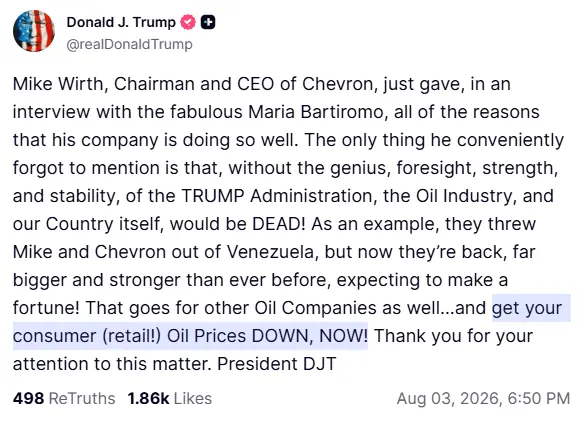
US President Donald Trump says major oil companies are making “too much money” due to high prices stemming from the crude shortage caused by the Iran war, AFP reports.
“I don’t like it. They’re making too much money, okay? Based on a shortage, they’re making too much money,” Trump tells journalists at the White House.
Asked if Iran would be willing to return to fully free navigation through the Strait of Hormuz, US President Donald Trump has insisted that Iran will not charge vessels passing through the waterway.
“I’m not going to let them charge,” he tells reporters. “If anybody’s going to charge, we’re going to charge, we have total control.
“We’re not talking about charging at all,” Trump adds.
US President Donald Trump has said the Iran talks will “go quickly” and that the Strait of Hormuz will be open by tomorrow.
“It’s not very complex. We’re talking about the opening of the Strait [of Hormuz] and having it open, literally, by tomorrow, completely open. And that’s phase one,” he tells reporters in the Oval Office.
“Phase two is we’ll then talk about the nuclear capacity … basically the denuclearisation of Iran,” he adds, noting that it “has to happen”.
Trump adds that negotiating denuclearisation will “take a little while”.
Addressing reporters in the Oval Office, US President Donald Trump says, “This is the last chance for them to sign a good document,” referring to Iran.
US President Donald Trump has said talks with Iran are “going on right now”.
“We have many talks … they deny it. But they’re not denying it now,” Trump tells reporters at the Oval Office. “When they’re talking, they don’t like saying that we’re talking.
“The talks are going along. We were to hit them very hard yesterday … and they called … Iran did not want to be hit. They said ‘we want to talk’,” he says of Iran, adding that he received calls from Saudi Arabia, the United Arab Emirates and Qatar.
US President Donald Trump has said that the conflict in Iran is “working out very well”, as he signs executive orders in the Oval Office in the White House.
US Central Command (Centcom) says that as part of the US naval blockade on Iran, American forces have redirected 44 commercial vessels, disabled two and boarded two others.
During a phone call, Iranian Foreign Minister Abbas Araghchi has spoken to his Omani counterpart, Badr AlBusaidi, and discussed the latest regional developments, Al Jazeera reports citing a Telegram post by Araghchi.
Oman and Iran have been negotiating over a new maritime route through the Strait of Hormuz, which borders both of their territorial waters.
Mohammad Karami, ground forces commander of the Islamic Revolutionary Guard Corps (IRGC), says that in northwestern Iran, fighters are standing ready for any “miscalculation by extra-regional enemies or terrorist groups”, Al Jazeera reports.
In a post on X, the commander says fighters of the Hamzeh Seyyed al-Shohada Headquarters, who are backed with intelligence, “operational readiness, and leveraging faith, technology, and modern sciences, are prepared to deliver a decisive response to any threat”.
Oil prices have further slid on hopes of a peace deal between the US and Iran, according to AFP.
As of 1540 GMT (8:40pm PKT), West Texas Intermediate is down 6.1 per cent at $79.5 per barrel, while Brent North Sea Crude is down 4.7pc at $83.84 per barrel.
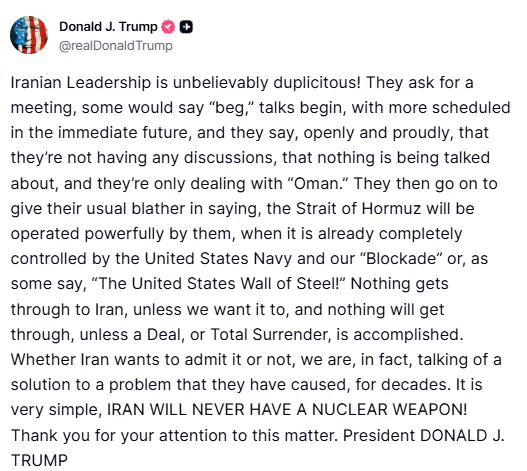
US President Donald Trump has blasted Iranian leadership as “unbelievably duplicitous” after Tehran announced that there are no talks with Washington.
“They ask for a meeting, some would say ‘beg”, talks begin, with more scheduled in the immediate future, and they say, openly and proudly, that they’re not having any discussions, that nothing is being talked about, and they’re only dealing with ‘Oman’,” he writes on Truth Social.
Trump also reiterates that the Strait of Hormuz is under American control, not Iranian, due to the US’ naval blockade and military presence in the region.
“Nothing gets through to Iran, unless we want it to, and nothing will get through, unless a deal, or total surrender, is accomplished,” he adds. “Whether Iran wants to admit it or not, we are, in fact, talking of a solution to a problem that they have caused, for decades.”
United States Central Command (Centcom) says it has helped more than 1,000 ships cross the Strait of Hormuz since early May.
Speaking to Al Jazeera, a spokesperson adds that Centcom’s forces remain on high alert and are ready to support commercial ships wishing to cross the strategic waterway, through which about 20 per cent of the world’s oil passes in peacetime.
In a phone conversation, Deputy Prime Minister and Foreign Minister Ishaq Dar invites Iran’s Foreign Minister Abbas Araghchi to visit Pakistan at his earliest convenience, FO has said in a post on X.
Dar and Araghchi have also “exchanged views on regional and international developments, including the deteriorating situation in Occupied East Jerusalem”.
Turkish Foreign Minister Hakan Fidan and his Kuwaiti counterpart, Jarrah Jaber Al Ahmad Al Sabah, have discussed the latest developments, Al Jazeera reports citing Turkish diplomatic sources.
No further details of the phone call have been provided.
Six Saudi-flagged supertankers have changed course in the Gulf of Aden in recent days and are heading to southern Africa, following threats by Yemen’s Houthi movement to target Saudi shipping, Reuters reports, citing tracking data.
The tankers, which were empty of cargo after returning from destinations in Asia, were sailing in formation towards southern Africa, rather than opting to transit the southern Red Sea via the Bab el-Mandeb chokepoint, according to AIS ship-tracking on LSEG and MarineTraffic.
One of the tankers, Dilam, had Gibraltar as its destination, ship tracking shows.
The vessel’s Saudi-based operator, Bahri, and other Saudi officials have not immediately responded to requests for comment.
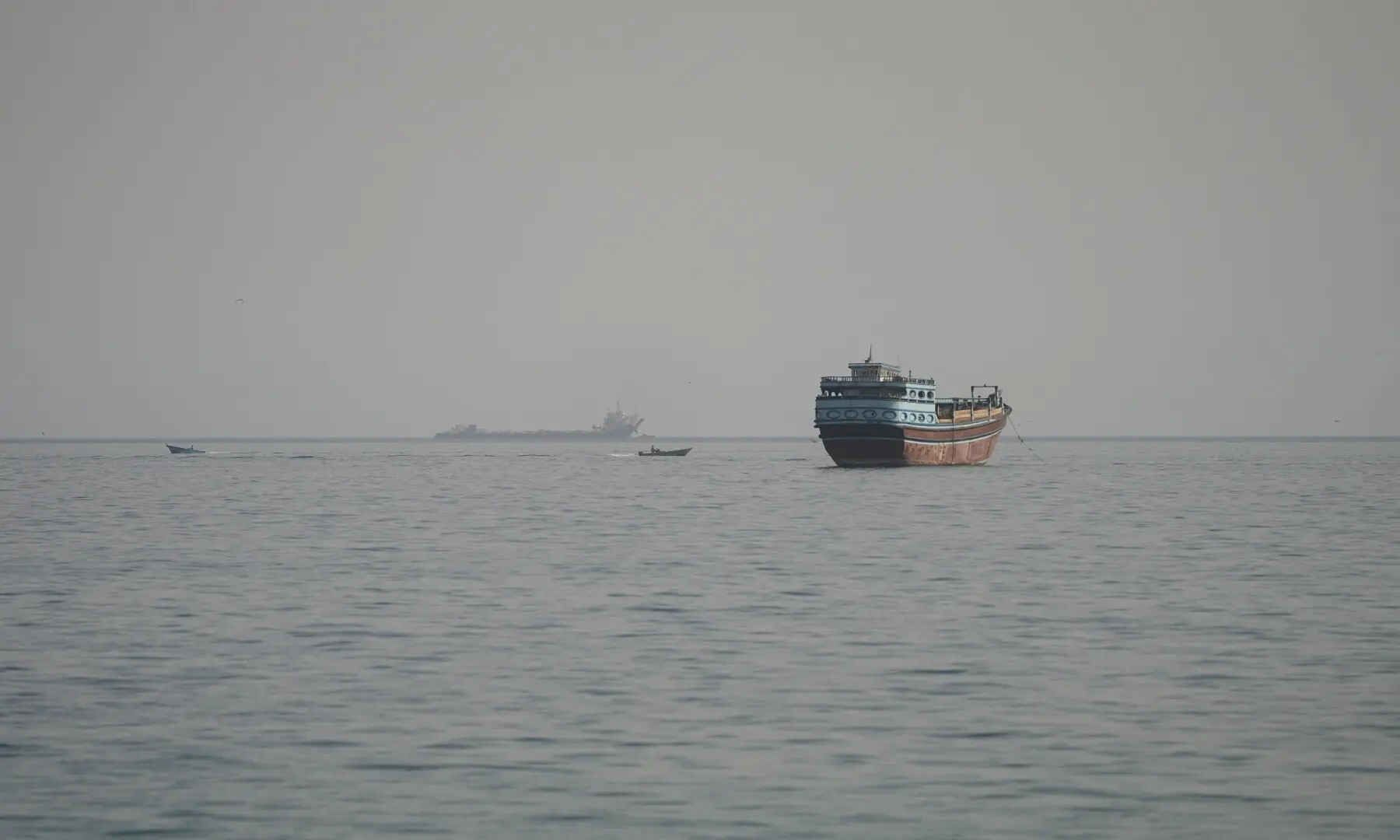
Only nine vessels crossed the Strait of Hormuz while 30 others transited the Red Sea from July 31 to August 2, according to shipping monitor Kpler, which notes that both waterways present “distinct risk profiles”.
“[The Strait of] Hormuz recorded nine confirmed transits, including two sanctioned and two shadow fleet vessels. Seven crossings used the Iranian Unilateral Scheme, while none followed the established traffic separation scheme, underscoring continued route concentration,” Kpler writes on X.
It notes that while 20 vessels exited the Red Sea, only 10 entered it, despite “Houthi-related exposure” remaining a risk.
“The diplomatic outlook is still unsettled. Until US, Iranian and Omani signals converge into clear navigation arrangements, operators should treat both chokepoints as contested rather than normalised,” Kpler adds.
The US Department of War says it has signed a framework deal with Lockheed Martin and Northrop Grumman to expand the production capacity of missile-interceptor components, Reuters reports, adding that the department did not say how much the deal was worth.
The US-Israel war on Iran is not just a war against one country, Al Jazeera reports citing the Iranian foreign ministry spokesman.
“It is a war against the entire region and against the security of all countries in the region,” Esmaeil Baqaei tells reporters.
“In these five months, we have seen firsthand that the US military presence in the region and the use of the territory and facilities of the countries on the southern edge of the Persian Gulf have exacerbated insecurity and instability for all countries in the region,” he adds.
“Therefore, it is natural that the countries in the region want to make efforts to prevent this situation from escalating.”
Signs that US-Iran tensions are easing again have caused oil prices to fall very sharply, according to Reuters.
Brent crude futures have sunk $4.40, more than five per cent, to $83.52 a barrel after US President Donald Trump said talks with Iran would take place today, after he called off an attack on Iran to pursue a deal to reopen the Strait of Hormuz.
US Ambassador to Lebanon Michel Issa says he is “encouraged” by ongoing Israel-Lebanon talks in Rome, but that both sides “must agree” on a clear process before proceeding, Al Jazeera reports.
Issa adds there is still a lot of technical work to be done and that moving “too quickly” could jeopardise civilian safety.
“There is a meaningful difference between drafting an agreement on paper and implementing it responsibly — moving too quickly risks jeopardising the very civilians this process is meant to protect,” he said.
“We believe it is better to take the time needed to get this right the first time. Doing so will allow subsequent pilot zones to move forward more efficiently.”