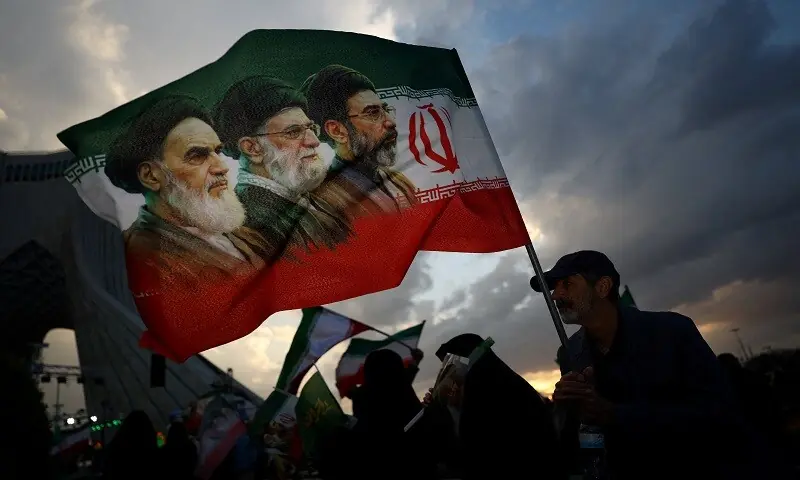
The US and Israel on Feb 28 launched what they described as a “pre-emptive” joint strike against Iranian targets, with Trump announcing start of “major combat operations”
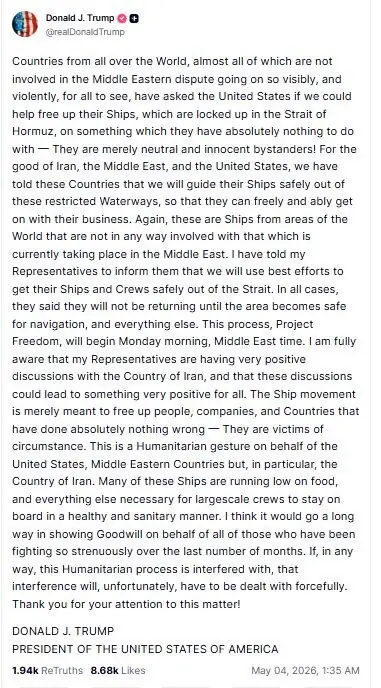
US President Donald Trump has announced that “Project Freedom” will begin on Monday morning, Middle East time, guide ships stuck in the Strait of Hormuz out of the waterway.
He made the announcement in a Truth Social post, stating: “ Countries from all over the World, almost all of which are not involved in the Middle Eastern dispute going on so visibly, and violently, for all to see, have asked the United States if we could help free up their Ships, which are locked up in the Strait of Hormuz, on something which they have absolutely nothing to do with — They are merely neutral and innocent bystanders!
“For the good of Iran, the Middle East, and the United States, we have told these Countries that we will guide their Ships safely out of these restricted Waterways, so that they can freely and ably get on with their business.”
He said “these are Ships from areas of the World that are not in any way involved with that which is currently taking place in the Middle East”.
Hence, “I have told my Representatives to inform them that we will use best efforts to get their Ships and Crews safely out of the Strait. In all cases, they said they will not be returning until the area becomes safe for navigation, and everything else”.
he said this process, Project Freedom, “will begin Monday morning, Middle East time”.
“I am fully aware that my Representatives are having very positive discussions with the Country of Iran, and that these discussions could lead to something very positive for all.
“The Ship movement is merely meant to free up people, companies, and Countries that have done absolutely nothing wrong — They are victims of circumstance. This is a Humanitarian gesture on behalf of the United States, Middle Eastern Countries but, in particular, the Country of Iran.
“Many of these Ships are running low on food, and everything else necessary for largescale crews to stay on board in a healthy and sanitary manner. I think it would go a long way in showing Goodwill on behalf of all of those who have been fighting so strenuously over the last number of months. If, in any way, this Humanitarian process is interfered with, that interference will, unfortunately, have to be dealt with forcefully,” he added.
The foreign ministers of Iran and Spain have discussed developments related to the war in a phone call, as well as bilateral relations, Al Jazeera reports, citing a statement released by Iran’s Abbas Araghchi.
The Iranian FM reportedly briefed his Spanish counterpart on Iran’s strategic efforts to end the war through diplomatic efforts, aimed at bringing lasting security to the region.
The head of Iran’s Food and Drug Administration, Mahdi Pirsalehi, explains that drug prices have increased due to the impact of the war on the country’s petrochemical and steel sectors, Al Jazeera reports.
“We are certainly following up to ensure that insurance budgets are revised. We are inevitably required to adjust some drug prices,” Pirsalehi said.
“We have held negotiations with Parliament and the Planning and Budget Organisation in order to secure an increase in insurance funding so that out-of-pocket payments by the public can be reduced,” he added.
Alongside the price increase, Pirsalehi said the country is also experiencing shortages of medicines, but added that there are no supply problems with “essential and life-saving drugs”.
“Regarding the supply of certain brand‑name medicines that used to come from Western countries, we are facing difficulties, which we are currently working to resolve,” he said, adding that consumption needed to be “directed towards domestically produced medicines”.
German Chancellor Friedrich Merz has said that he must accept that President Donald Trump does not share his opinions in order to work with the United States within NATO, but stressed there is no link between their rift and a planned troop drawdown
“I have to accept that the American president has a different view on these issues than we do. But that does not change the fact that I remain convinced that the Americans are important partners for us,” Merz told public broadcaster ARD in an interview due to be aired later on Sunday.
Asked whether US plans to reduce its troop presence in Germany had anything to do with the spat between the two leaders, Merz said, “There is no connection.” Trump called for a reduced U.S. military presence in Germany already during his first term and has repeatedly called on Europeans to take greater responsibility for their own security.
Merz said Trump had never committed to this plan and that it was unlikely the US would give up such weapons systems, adding, “If I’m not mistaken, the Americans don’t have enough themselves at the moment.”
Iran says that the United States has responded to its 14-point proposal via Pakistan and that it is reviewing the response, Reuters reports, citing state media.
“At this stage, we do not have nuclear negotiations,” an Iranian foreign ministry spokesperson said, according to state media.
US Treasury Secretary Scott Bessent has claimed that the United States is “suffocating” Iran’s leadership through an “economic blockade” launched alongside the US military offensive, reports AFP.
“This began with the order last March from President Trump on max pressure, and three weeks ago the president gave the order to Treasury … to begin Economic Fury,” Bessent said in a Fox News interview, referring to his department’s initiative to supplement the Pentagon’s “Operation Epic Fury.”
“We are suffocating the regime, and they are not able to pay their soldiers. This is a real economic blockade, and it is in all parts of government — all hands on deck,” he told the ‘Sunday Morning Futures’ programme.
According to Al Jazeera, the Iranian plan, submitted to the US via Pakistan, has three main stages and aims to transform the ceasefire into an end to the war within 30 days.
It envisions a pledge of nonaggression, including from Israel, to ensure there’s no return to war and an end to fighting throughout the Middle East, Al Jazeera said, citing sources. The first phase would gradually open the Strait of Hormuz and lift the US siege on Iranian ports. Tehran would take charge of dealing with sea mines.
It also shared further details about the proposal as follows:
The second phase of the proposal stipulates Iran’s return to enrichment after the time limit at 3.6 per cent in accordance with the “zero-storage principle”.
The plan includes the US and Israel refraining from attacking Iran and its allies in exchange for Iran refraining from launching strikes.
The proposal rejects dismantling nuclear infrastructure or destroying Iran’s facilities.
Lifting sanctions includes the gradual release of frozen funds.
In the third phase, Tehran proposed entering into a strategic dialogue with Arab neighbours and building a security system that includes the entire Middle East.
Deputy Prime Minister and Foreign Minister Ishaq Dar has a telephonic call with Jordanian Deputy Prime Minister and Foreign Minister Ayman Safadi, the Foreign Office (FO) says.
“FM Safadi conveyed Jordan’s deep appreciation of Pakistan’s constructive role and continued efforts for peace, dialogue, and regional stability in the context of ongoing tensions in the region,” the FO said.
“FM Dar reaffirmed Pakistan’s commitment to promoting constructive engagement among all parties to support stability and peaceful resolution of conflicts through dialogue and diplomacy,” it stated.
The FO said that the two leaders also “reaffirmed the strong bilateral relations between Pakistan and Jordan, and underscored the importance of continued cooperation at bilateral and multilateral forums” and agreed to remain in close contact.
A bulk carrier reported being attacked by multiple small craft while transiting north about 11 nautical miles west of Iran’s Sirik on Sunday, the United Kingdom Maritime Trade Operations (UKMTO) agency has said, adding that all crew were safe and no environmental impact was reported.
Federal Reserve Bank of Minneapolis President Neel Kashkari says the longer the US-Israeli war with Iran goes on, the greater the risks of higher inflation and economic damage, Reuters reports.
I’m very focused on the Iran war and its impacts and when it comes to the Strait of Hormuz closure, the longer it’s closed, the more it will lead to higher energy and fertiliser prices, Kashkari said in an interview with CBS.
US Treasury Secretary Scott Bessent has said that energy prices, which are currently surging amid the U.S.-Israel war with Iran, should decline later this year, Reuters reports.
Oil prices on the other side of this conflict are going to be much lower, Bessent said on Fox Business Network’s “Sunday Morning Futures” program.
German Foreign Minister Johann Wadephul has demanded that Iran reopen the Strait of Hormuz and give up its nuclear weapons programme in a telephone call with Iranian counterpart Abbas Araghchi, AFP reports.
“I emphasised that Germany supports a negotiated solution,” Wadephul said in a post on X about the call. “As a close US ally, we share the same goal: Iran must completely and verifiably renounce nuclear weapons and immediately open the Strait of Hormuz, as also demanded by” US Secretary of State Marco Rubio.
Prime Minister Shehbaz Sharif has called on PML-N supremo Nawaz Sharif at their Jati Umra residence in Lahore, a statement issued by the PM’s Office (PMO) says, adding that the Middle East conflict and the political situation in the country were discussed during the meeting.
The PMO statement said the premier briefed Nawaz on the “situation in the country” and exchanged views on the political situation.
He further informed him about the situation in the Middle East and Pakistan’s efforts for the restoration of peace in the region, the statement added.
Iranian Foreign Minister Abbas Araghchi has briefed his German counterpart, Johann Wadephul, on Iran’s diplomatic initiatives to end the US-Israeli war on Iran, says an official statement.
Opec+ has agreed on a modest oil output hike for June, an increase that will remain largely on paper as long as the US-Israeli war on Iran continues to disrupt Gulf oil supplies through the Strait of Hormuz.
Seven Opec+ countries will raise oil output targets by 188,000 barrels per day in June, the third consecutive monthly increase, Opec+ said in a statement after an online meeting. The increase is the same as that agreed for May minus the share of the United Arab Emirates (UAE), which left the group on May 1.
The move is designed to show the group is ready to raise supplies once the war stops and signals that Opec+ is pressing on with a business-as-usual approach despite the departure of the UAE from Opec+, sources associated with the alliance and analysts said.
Israeli strikes on southern Lebanon have killed at least one person and wounded four rescuers, reports AFP, citing the Lebanese health ministry.
In separate statements, the ministry said a strike on Arabsalim killed at least one person and wounded three, including a child, and another strike on Srifa wounded five people, including four rescuers from the Hezbollah-affiliated Islamic Health Committee, as the strike hit near one of their centres.
“The Ministry reiterates its condemnation of these repeated attacks and recalls what is included in Article 19 of the Geneva Convention regarding the need to verify that medical facilities are safe from any danger caused by attacks in conflict zones, while what is happening is exactly the opposite.”
The Saudi Arabia’s Ministry of Foreign Affairs has expressed the Kingdom’s support for the sovereign measures taken by the leadership of Bahrain to safeguard its security and preserve its sovereignty.
Seven Opec+ countries are set to agree on Sunday a modest oil output hike of about 188,000 barrels per day in June, sources said, but the increase will remain largely on paper as long as the US-Iran war continues to disrupt Gulf oil supplies.
The move is designed to show the group is ready to raise supplies once the war stops. It is also pressing on with plans to raise output targets despite the departure of the United Arab Emirates from the group this week, sources said.
The output hike will remain largely symbolic until shipping through the Strait of Hormuz reopens and even then it will take several weeks if not months for flows to normalise, oil executives from the Gulf and global oil traders have said.
Iran Foreign Minister Abbas Araghchi has spoken with his Omani counterpart Albusaidi to discuss the latest regional developments, Press TV reports.
“Araghchi also briefed him on Iran’s diplomatic efforts to end the US-Israeli-imposed war and tensions against Iran, aiming to restore regional peace,” the outlet added.
Iranian envoy to Pakistan, Reza Amiri Moghaddam, stressed that a behavioural shift by Washington was key to the continuation of US-Iran talks, IRNA reported.
Moghaddam in an exclusive interview on Sunday in Islamabad stated that Iran had presented a comprehensive plan aimed at ending US-Israeli aggression, and clarified its position openly.
However, he underlined that progress in talks relies on US sincerity and willingness to resolve issues through genuine diplomatic efforts.
Moghaddam also confirmed that Tehran had shared its latest proposal with Pakistan, who had then conveyed it to Washington.
The Iranian Revolutionary Guard Corps’ intelligence unit on Sunday claimed that recent developments relating to the conflict show narrowing space for US decision-making.
In a post on X, the agency pointed towards Iran’s setting a blockade deadline for the Pentagon; an apparent shift in tone from China, Russia, and Europe with Washington, and US acceptance of Iran’s negotiating terms, adding:
“There is only one way to read this: Trump must choose between ‘an impossible military operation or a bad deal with the Islamic Republic of Iran’.