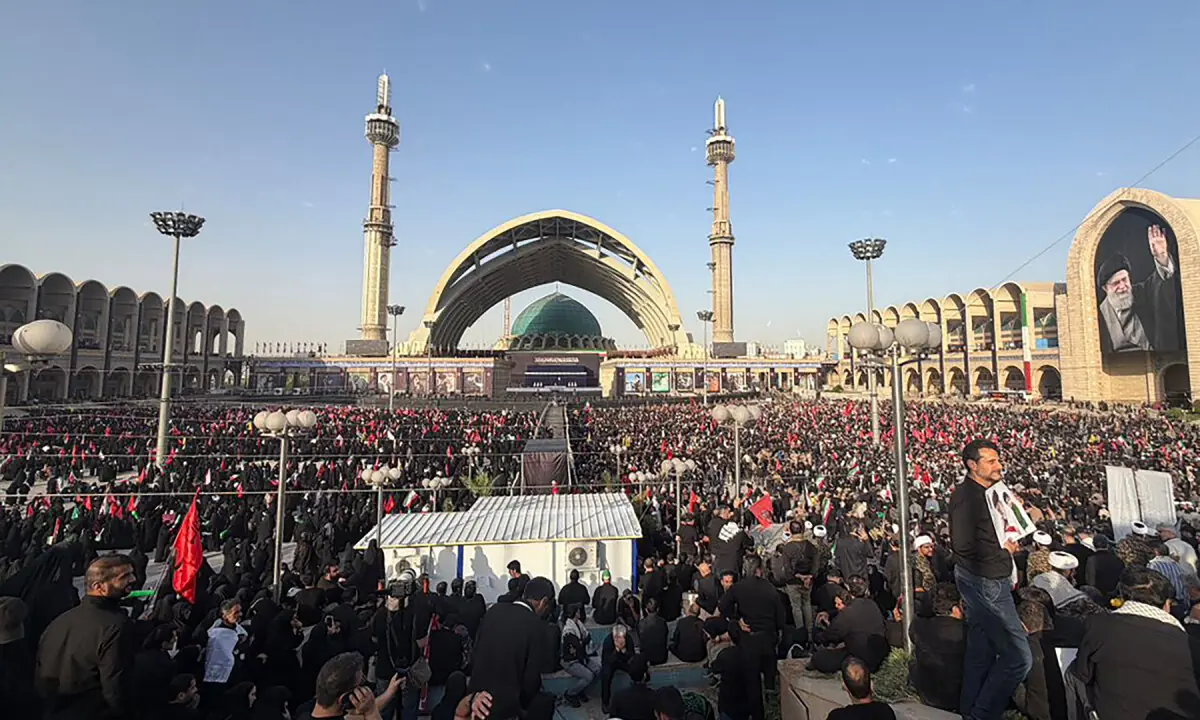
The US and Israel on Feb 28 launched what they described as a “pre-emptive” joint strike against Iranian targets, with Trump announcing start of “major combat operations”
Pakistan hosted the first round of face-to-face talks between the US and Iran in 47 years in April; the talks ended without a breakthrough, but also without a breakdown
US, Iran hold high-level talks in Switzerland after signingpreliminary agreement to end the war; hold talks in Doha, with mediators citing “positive progress”
Israel continues to violate the ceasefire agreement with Lebanon in light of Beirut’s complete silence and inaction, says a Lebanese lawmaker, urging the government to take a firm stance against recurrent Israeli acts of aggression, Press TV reports.
QatarEnergy has halved its scheduled deliveries of liquefied natural gas to Bangladesh for this year, Petrobangla’s acting chairman said, as Iran war fallout continues to curb shipments of the super-chilled fuel through the Strait of Hormuz, Reuters reports.
“All these problems stem from the war,” Abdul Mannan told Reuters, adding that Bangladesh’s state-owned energy company was exploring alternative LNG sourcing including more spot-market purchases and government-to-government deals with other suppliers.
Lebanese Christians have rejected Israeli claims that residents of Christian border villages in southern Lebanon have asked to join Israel or obtain Israeli citizenship, Al Jazeera reports.
Maroun el-Khouli, head of Lebanon’s General Confederation of Labour Unions, said Netanyahu’s remarks are “false” and are aimed at stirring up tensions between Christians and Shia Muslims in Lebanon.
He described the comments as part of a psychological and media campaign targeting Lebanon’s social fabric, saying Israel is trying to weaken the country’s internal unity after failing to achieve its military objectives.
President Masoud Pezeshkian says Iran will continue on the path of the country’s “dignity, progress and prosperity” through “solidarity, national cohesion and sincere service to people”.
In a social media post on X, he said the martyred supreme leader Ayatollah Ali Khamenei “taught us all that the greatest asset of Iran is its people and their unity”.
“Today, too, by acting upon the divine command … and through solidarity, national cohesion, and sincere service to the people, we will continue on the path of Iran’s dignity, progress, and prosperity,” he adds.
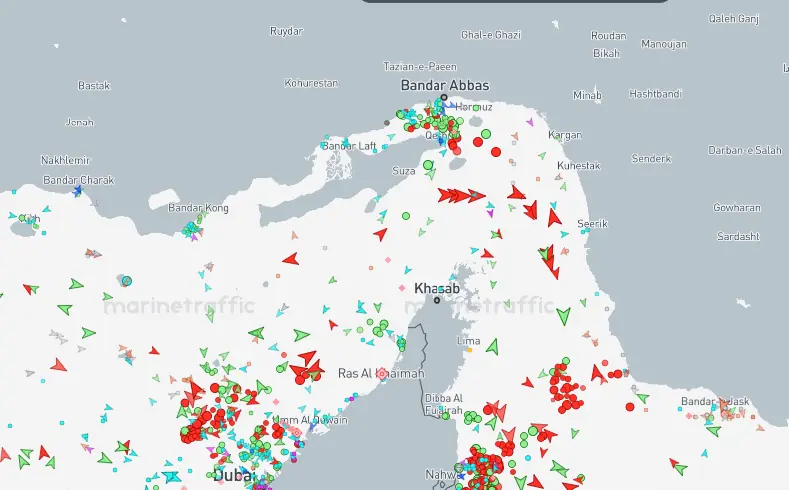
A fleet of 10 Japan-linked vessels is exiting the Strait of Hormuz today while a supertanker carrying Saudi crude for South Korea left over the weekend, shipping data on LSEG showed, after the ships were stranded in the Gulf for months because of the Iran war, Reutersreports.
The Japan-linked ships include six very large crude carriers loaded with 12 million barrels of Middle Eastern crude, two chemical tankers, a vehicle carrier and a container ship, the data showed.
The tankers are carrying crudes from Saudi Arabia, the UAE and Qatar that were loaded in late February to early March.
Most of the vessels are managed by Japanese shipper Mitsui O.S.K. Lines (MOL) which had said it would prioritise the safety of its seafarers, cargo and vessels when traversing the strait. Mitsui OSK declined to comment.
The world has absorbed with surprising ease the loss of over a billion barrels of oil supply since the Iran war began, but, with long-term peace elusive and buffer reserves now drained, it still faces the looming risk of future price spikes, Reuters notes.
The ensuing four-month conflict did, indeed, create the biggest energy disruption in history, according to the International Energy Agency. At its worst, the headline supply loss was 14 million barrels per day.
But worries that Asia and Europe would run out of gasoline, diesel or jet fuel never materialised. And after peaking around $126 per barrel in April, still some $20 below the 2008 record benchmark Brent oil prices are now lower than they were when the conflict began.
“This suggests traders viewed the disruption as serious but manageable, reflecting confidence in today’s more resilient energy and economic systems,” said John Baffes, senior economist at the World Bank.
Tugboats guide the crude oil tanker Odessa, carrying UAE crude after passing through the Strait of Hormuz with its Automatic Identification System transponder turned off, navigates the waters at Daesan port, where it is expected to discharge crude oil, in Seosan, South Korea, on May 8, 2026. — Reuters/File
Israel’s defence minister has claimed that his country assassinated late supreme leader Ayatollah Ali Khamenei for allegedly leading a “plan to destroy” Israel and again threatened to “eliminate” any Iranian leader who tries to promote such actions, Al Jazeera reports, citing Israel’s Channel 13.
Israel Katz made the comments in response to the ongoing funeral procession in Tehran, the Israeli broadcaster reported.
Katz added that Israel remains prepared to defend itself at any time and against any threat.
Iran’s parliament speaker Bagher Ghalibaf says peace in Lebanon cannot hold unless Iran plays what he describes as its stabilising role in the region, Al Jazeera reports.
Iran’s top negotiator made the remarks during a meeting in Tehran with Muhammad Fneish, a senior Hezbollah official who travelled to Iran to attend Khamenei’s funeral ceremonies.
He said Tehran had made Lebanon a central issue in negotiations that led to the signing of the Iran-US MoU, according to Iranian media.
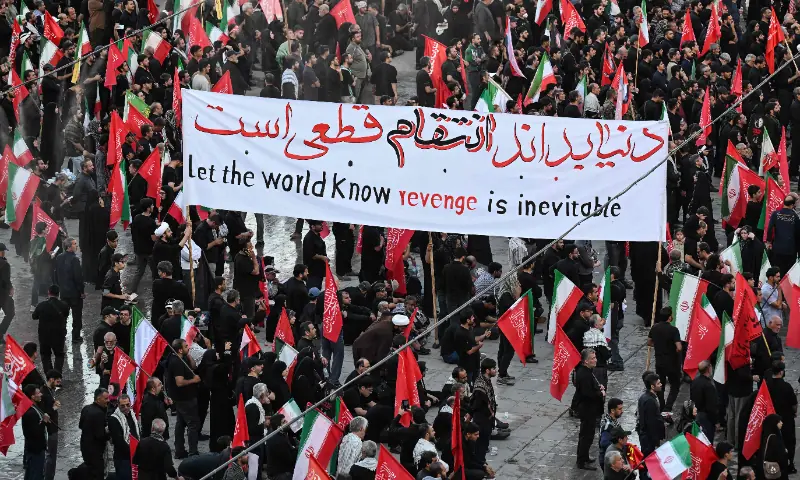
Iranian officials and mourners at Ayatollah Khamenei’s weeklong funeral procession call for revenge over his assassination, blaming the US and Israel, Al Jazeera reports.
Iranian Army Chief Major General Amir Hatami vows to pursue justice, saying those responsible “must know that the nation of Iran and all of us will never cease in our pursuit of and demand for justice,” according to Press TV.
“We will not let go of them, and this is a definitive decision that we will follow through until we achieve results,” he said.
The funeral procession carrying the coffin of Iran’s slain supreme leader Ali Khamenei began making its way through the streets of Tehran, AFP reports.
“We ask the public to go peacefully to Azadi Square,” where the procession is expected to pass, said General Hassan Hassanzadeh, a senior commander in Iran’s Revolutionary Guards.
Authorities fear deadly crowd crushes like those that occurred in 1989 during the funeral of Ayatollah Ruhollah Khomeini, Khamenei’s predecessor.
India’s appetite for electric, hybrid and compressed natural gas vehicles accelerated after the Iran war triggered fuel price hikes, the president of the country’s auto dealers’ body said, with such models reaching a record share of passenger vehicle sales in June, Reuters reports.
Alternative-fuel vehicles accounted for 40.35 per cent of PV retail sales in June, up from about 38pc a month earlier, as consumers increasingly sought cheaper running costs after petrol and diesel prices were raised several times in May.
Iran’s supreme leader has reappointed Gholam-Hossein Mohseni-Ejei as head of the country’s judiciary, Al Jazeera reports.
In a decree, Mojtaba Khamenei praised Mohseni-Ejei’s “valuable and sincere efforts” as judiciary chief.
In January, Mohseni-Ejei pledged to fast-track trials for those arrested during weeks of antigovernment protests that began in December and continued into the new year.
Khamenei’s funeral procession in Tehran saw mourners carrying a banner reading “Kill Trump,” with a bullet depicted passing through the word “Trump,” according to Al Jazeera.
Other mourners carried placards featuring images of US Vice President JD Vance, US Defense Secretary Pete Hegseth and Israeli Prime Minister Benjamin Netanyahu alongside the words, “There will be blood.”
Mourners hold an anti-Trump banner as people gather for a funeral procession for Iran’s supreme leader, Ayatollah Ali Khamenei, in Tehran, Iran, July 6, 2026. —Reuters
The funeral procession for Iran’s assassinated supreme leader Ali Khamenei and three family members began in Tehran, state television reported, AFP reports.
“The funeral procession for the revered body of the martyred Imam and leader began a few moments ago in the capital,” Islamic Republic of Iran Broadcasting posted on Telegram, adding that it was attended by a “massive crowd” of mourners.
Khamenei was assassinated on the first day of the US-Israeli war with Iran on February 28.
Mohammed al-Bukhaiti, a spokesman for Yemen’s Houthis, has told Iranian media that the US and Israel killed Iran’s supreme leader because of his efforts to support the liberation of Palestine, Al Jazeera reports.
Al-Bukhaiti described Khamenei as a symbol of resistance and freedom for nations seeking independence from the US and Israel’s domination, according to Iran’s Press TV.
“His intellectual and political vision across the Islamic world, together with his efforts to liberate Palestine, were among the main reasons the West became determined to assassinate him,” al-Bukhaiti said.
Iran’s parliament speaker Bagher Ghalibaf says the US and Israel were “forced to practically” acknowledge Iran’s regional allies in the recently signed memorandum of understanding (MoU), AlJazeera reports.
He made the comments during a meeting with Yemen’s Vice President Mohammed Al-Nuaimi.
“The United States and Israel were forced to practically recognise Iran’s allies in the Axis of Resistance, and this is one of the achievements of this memorandum,” Ghalibaf said.
He added that the memorandum was a “defeat for the United States and an achievement for the Axis of Resistance, both militarily and politically”.
Ghalibaf warned that the US and Israel would “resort to war” if they perceived any Iranian weakness.
Oil prices inches lower after OPEC+ agreed to further increase its output targets from August while exports from key producers via the Strait of Hormuz are recovering, potentially adding to global supplies, according to Reuters.
Brent crude futures slid 24 cents, or 0.33 per cent, to $71.88 a barrel by 0010 GMT after settling 0.45pc higher on Friday. US West Texas Intermediate crude was at $68.58 a barrel, down 11 cents, or 0.16pc.
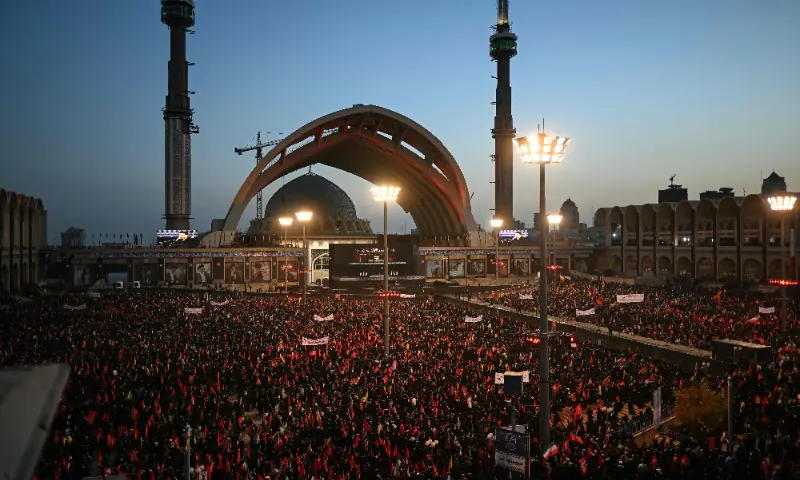
Mourners gather to pay tribute to Iran’s assassinated supreme leader Ayatollah Ali Khamenei at the Grand Mosalla on the second day of funeral ceremonies in Tehran on July 5, 2026. — AFP
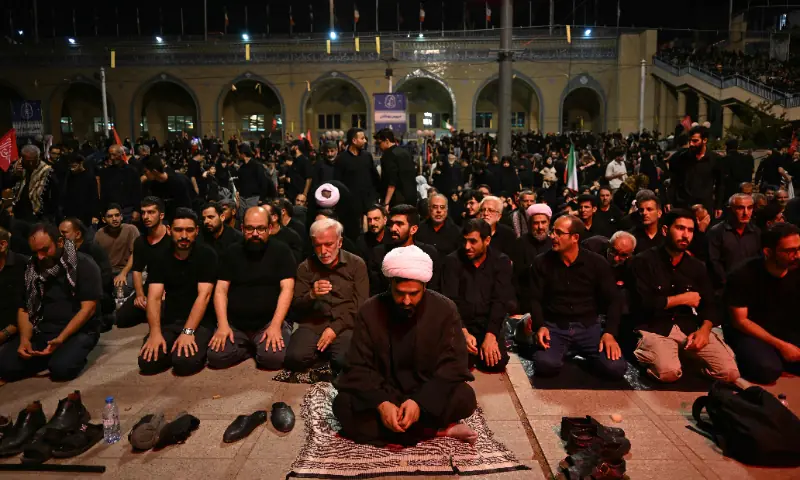
Mourners pray as the gather to pay tribute to Iran’s assassinated supreme leader Ayatollah Ali Khamenei at the Grand Mosalla on the second day of funeral ceremonies in Tehran on July 5, 2026. — AFP
People hold up a revenge banner as they gather to mourn Iran’s assassinated supreme leader Ayatollah Ali Khamenei at the Grand Mosalla on the second day of funeral ceremonies in Tehran on July 5, 2026. — AFP
Iran’s top negotiator Bagher Ghalibaf, in a meeting with a Hezbollah delegation, said Iran was “negotiating honestly and with a fighting spirit”, according to Tasnim.
“And we tell the countries of the region that America and the Zionist entity will not bring security and strength,” he said.
“The enemy realises that establishing peace in the region, Lebanon, and the Middle East is impossible except through the Iranian path,” the parliament speaker said.
Parliament Speaker Mohammad Bagher Ghalibaf has said that diplomacy should be used to preserve military gains and must be backed by defence capabilities, IRNAreports.
In a meeting with Hamas political leader Mohammad Darwish, Ghalibaf said negotiations should be capable of resolving military conflicts while safeguarding the achievements of fighters.
He added that diplomacy could succeed only if the country remained prepared to defend itself.
He said that during negotiations with the United States, which he headed on Iran’s behalf, Tehran insisted that respect for the territorial integrity of regional countries and an end to military action against Iran’s allies in the resistance front be included in any agreement.
He said that those provisions were incorporated into the MoU with Washington.
Ghalibaf said Iran would continue supporting Muslim nations and allied resistance groups in line with the guidance of the country’s leadership, adding that such support could take military or political forms, including negotiations.
Iran’s Ambassador to Pakistan Reza Amiri Moghadam extends gratitude to the people and government of Pakistan for participating in the funeral ceremony of the assassinated supreme leader Ali Khamenei.
“I wish to convey my profound gratitude to Prime Minister Shehbaz Sharif, Deputy Prime Minister and Foreign Minister Ishaq Dar, Field Marshal Syed Asim Munir, Senate Chairman Syed Yousaf Raza Gilani, National Assembly Speaker Ayaz Sadiq, Interior Minister Mohsin Naqvi, Information Minister Attaullah Tarar, and all other distinguished officials, as well as eminent religious scholars, political figures and cultural personalities for their valuable presence at this historic occasion and for expressing their solidarity with the Government and People of Iran,” he said.
“This meaningful and historical gesture reflects the depth of the historic ties and shared values that have united Iran and Pakistan through the trials and triumphs of history.”
The envoy said the two countries “have consistently shared one another’s joys and sorrows, standing shoulder to shoulder in a spirit of solidarity, brotherhood, and mutual support”.
Iran’s Parliament Speaker Mohammad Bagher Ghalibaf has said that the “countries of the region now know that achieving security and economic growth depends on cooperation among their states”, Tasnim reports.
“We sincerely believe that Islamic countries must stand by each other’s side and renounce their differences,” he was quoted as saying.
He made the remarks in a meeting with a Hezbollah delegation.