Pakistan hosts the first round of face-to-face talks between the US and Iran in 47 years in April; the talks end without a breakthrough, but also without a breakdown
US, Iran hold high-level talks in Switzerland on June 20 after signingpreliminary agreement to end the war; hold talks in Doha on July 1, with mediators citing “positive progress”
US launches strikes on Iran on July 8 in response to attacks on ships in Hormuz, Tehran retaliates as strait heats up again
Yemen’s civil war flares up after Saudi-backed government attacks Sanaa airport
UAE national airline Etihad has extended until Nov 5 its suspension of flights to Riyadh and Dammam in Saudi Arabia, targeted by strikes from Yemen’s Houthis, AFP reports.
Etihad had suspended its service to Riyadh on Oct 12, two days after a deadly attack on a passenger terminal killed 13 people.
In a statement on Thursday, Etihad specified that flights to and from Riyadh and Dammam would remain suspended due to “operational disruptions”.
Etihad added that it would operate only daytime flights to the western city of Jeddah, with night flights cancelled until Nov 5.
Iranian Foreign Ministry spokesperson Esmaeil Baqaei has criticised the use of the term “Iran conflict” to describe the war involving Tehran, the US and Israel, saying it obscures responsibility for the hostilities and portrays the country under attack as the aggressor, IRNA reports.
In a statement posted X, Baqaei described the military campaign against Iran as an unlawful “war of aggression” waged by Washington and Israel.
Oil prices rose, with Brent crude touching a more than five-month high, after Houthi attacks in Saudi Arabia stoked concern over further disruption to energy supplies from the Middle East, Reuters reports.
Brent crude futures gained 79 cents, or 0.7 per cent, to $113.96 a barrel by 0810 GMT, having earlier reached $114.72 for the highest level since May 4. US West Texas Intermediate crude gained $1.10, or 1.1pc, to $100.57.
The Brent benchmark is on track for a third consecutive weekly gain, of almost 4pc, while WTI is poised to finish 0.8pc down on the week.
Oil prices rose on Friday after Houthi attacks in Saudi Arabia stoked concerns of further disruption to energy supplies from the Middle East, Reuters reports.
Brent crude futures climbed 58 cents, or 0.5 per cent, to $113.75 a barrel as of 0439 GMT, while US West Texas Intermediate crude futures rose 66 cents, or 0.7pc, to $100.13.
On a weekly basis, Brent, which settled at its highest since May 4 on Thursday, is set to close higher for a third successive week, while WTI is on track to finish lower, following two weeks of gains.
The Yemeni Women Empowerment Foundation (YWEF) says it has documented 491 violations by Houthi forces in Yemen’s Taiz governorate between October 14 and 22, Al Jazeera reports.
Iran’s Foreign Minister Abbas Araghchi says Israel shares a “parasitic” relationship with the United States, citing the latter’s defence support to Tel Aviv.
In a post on X, Araghchi said, “The US has over the past three years spent $11 billion in taxpayer money on missile defence for Israel. It has fired more interceptors defending Israel than Israel has.”
He added, “That is not a symbiotic relationship. It is a parasitic one.”
US President Donald Trump has signalled possible further military action against Iran, saying the US has knocked the “hell out” of the country, Al Jazeera reports.
The United Arab Emirates’ Ministry of Climate Change and Environment said its technical monitoring and environmental assessment system detected an oil spill from a tanker affecting beaches in Umm Al Quwain, Anadolu reports.
The ministry said that odors reported in Sharjah, Ajman and Umm Al Quwain pose no health risks to residents.
Containment, cleanup and remediation operations began immediately in coordination with local and federal authorities to limit environmental impacts.
Houthi-affiliated media is reporting that Yemeni forces launched two air strikes on the Harf Sufyan district and two air strikes targeting the Bani Suraim district in the Amran governorate, in northwestern Yemen, Al Jazeera reports.
Three air attacks were also reported in the At-Taiziyah district in the southwestern governorate of Taiz.
Saudi Arabia’s General Authority for Statistics has postponed the United Nations Global Data Forum and the Second Saudi Statistical Forum, previously scheduled for November 9 to 12, 2026, in Riyadh, to 2027, the authority said in a statement, Reuters reports.
Air defence systems have intercepted and destroyed a ballistic missile launched by the Houthi militia toward Riyadh, spokesperson for the Saudi-led coalition, Turki al-Maliki says.
US Senators Elizabeth Warren and Chris Murphy criticise President Donald Trump over the US-Israel war on Iran in separate posts on X, Al Jazeera reports.
Warren said at least 23 US service members have been killed and more than $45bn in “taxpayer dollars” has been spent during the war.
“Nobody can seem to explain what this war has accomplished or when it will end,” Warren said, adding that the conflict is nearing the eight-month mark.
Murphy condemned the administration’s strategy, writing that “Trump started a war with Iran with no workable plan to protect our troops, diplomats or billion dollar bases. Every citizen should be furious about this. Just total, utter incompetence.”
Saudi Arabia’s Civil Defence has said the danger has passed in the southern city of Abha and nearby Khamis Mushait after emergency warnings were issued in both locations, Al Jazeera reports.
In separate posts on X, the agency announced the alerts through the National Early Warning Platform before issuing further notices declaring that the danger had passed.
The Secretary of Iran’s Supreme National Security Council, Major General Mohsen Rezaei, says that while Tehran backs the Houthi-led “resistance”, it is not responsible for Houthi actions in Yemen’s Bab al-Mandab Strait, Al Jazeera reports.
“The Houthis are not an Iranian military unit, and decisions concerning Yemeni territory are made by the Yemenis themselves,” Rezaei tells US news publication DropSite.
“Regarding [the] Bab al-Mandab, you should not automatically assume that what Iran does in Hormuz will be repeated there in exactly the same way. These are two different straits, two different political situations and two different actors.”
Rezaei adds that there is no joint Iranian-Yemeni decision to completely close the Bab al-Mandeb to commercial shipping, noting that the Houthis don’t need “Iranian instructions to understand the strategic importance” of the waterway.
“Anyone planning for a prolonged regional war should understand that stability in Hormuz, the Red Sea, and Bab al-Mandab cannot be separated indefinitely from the region’s overall security situation,” he adds.
Pilgrims (zaireen) have been instructed by the Ministry of Religious Affairs and Interfaith Harmony to either use Iranian carriers or verify “every Iran-Iraq air sector before departure” when travelling between Iran and Iraq for their pilgrimage.
In a notice, the ministry says it received guidance from the Foreign Office and urges travellers to “use Iranian airlines or plan onward travel between Tehran/Mashad and Najaf” and “verify every Iran-Iraq air sector before departure”.
Zaireen group organisers have been instructed to “avoid relying on unconfirmed Iranian connections and to maintain alternative land routes or air arrangements, sufficient contingency funds and accommodation plans in case of cancellations”.
Oil prices have climbed about three per cent to a five-month high after Houthi attacks in Saudi Arabia stoke concerns of further disruption to energy supplies from the key exporting region, Reuters reports.
Brent futures rose $3.51, or 3.2pc, to $112.33 a barrel at 1705 GMT (10:05pm PKT), while US West Texas Intermediate crude rose $2.14, or 2.2pc, to $99.29.
US Treasury Secretary Scott Bessent has posted a video on X that he claims contains evidence that Washington’s economic campaign against Iran is working, Al Jazeera reports.
The video purportedly shows satellite imagery of Kharg Island before and after Bessent announced “Operation Economic Outcast” — Washington’s economic campaign against Tehran — two months ago.
At the beginning of the video, several oil tankers can be seen near the island. But after the introduction of additional US sanctions on Iran, no tankers are observed nearby.
“Kharg Island is now nothing more than a monument to the one thing the Iranian regime can still produce: failure,” Bessent writes. “‘Operation Economic Outcast’ is cutting off the regime’s oil lifeline, denying it resources to fund terrorism, nuclear procurement, and the lavish lifestyles of the IRGC elite.”
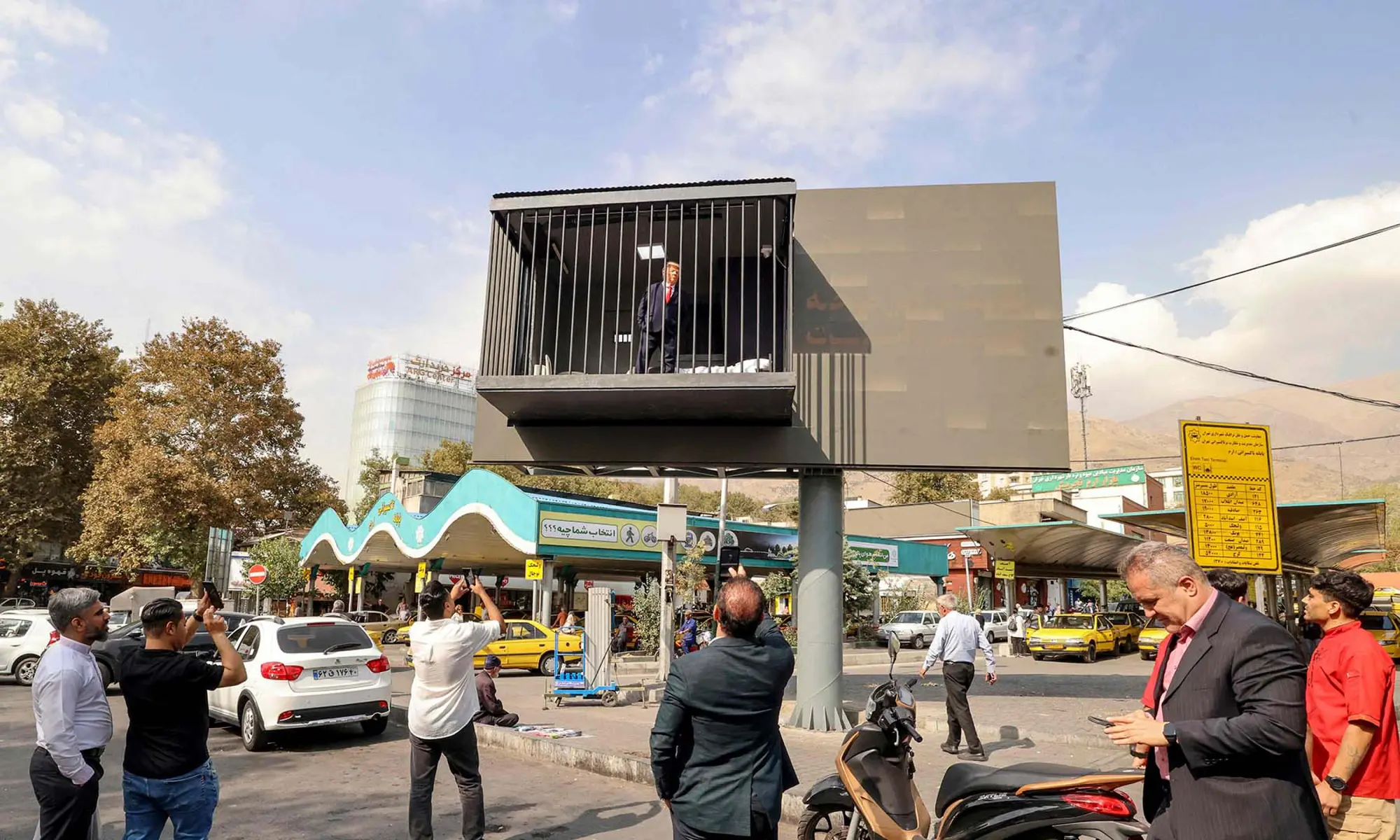
Anti-American displays are a common sight on the streets of the Iranian capital, but authorities have gone a step further with their latest effort — a life-size jail cell with an actor playing US President Donald Trump languishing inside.
The 3D art installation is proving a hit with locals, who have been stopping to take selfies as well as hurl abuse at Trump, who is accused by Tehran of war crimes during the Middle East war.
A prison cell is suspended several stories high in Tajrish Square in an upscale neighbourhood of north Tehran. Inside is an actor dressed in a dark suit and red tie and wearing a prosthetic mask to look like the US president, as he paces around the cell or clutches its bars.
A screen set up nearby shows messages denouncing US “war crimes”.
Some locals are having fun with the installation, with one passerby jokingly telling Trump, “Don’t worry, we’ll pay your bail and get you out!”
Others have used it as a target for their anger, with one teenager shouting, “Trump, this time we’re going to kill you!”
Tehran’s municipal authorities, which are behind the campaign, say they want to remind the capital’s residents of Iran’s demands for justice.
Pedestrians take pictures of an Iranian actor wearing a mask depicting US President Donald Trump as he poses inside a mock prison cell installed onto a street billboard at Tajrish Square in Tehran, Iran on October 21, 2026. — AFP
Qatari Prime Minister and Foreign Minister Sheikh Mohammed bin Abdulrahman bin Jassim Al Thani has had a phone call with US Secretary of State Marco Rubio, with both sides discussing strategic ties and regional developments, according to the Qatari foreign ministry.
The pair “exchanged views on the latest regional developments, particularly ongoing diplomatic efforts and joint coordination to de-escalate tensions and enhance security and stability in the region”, a statement reads.
“During the conversation, the prime minister and minister of foreign affairs reaffirmed Qatar’s support for all diplomatic efforts and initiatives aimed at reaching a solution that guarantees freedom of maritime navigation and paves the way for a comprehensive agreement that achieves lasting peace in the region,” it adds.
Major General Amir Hatami, Commander-in-Chief of the Iranian armed forces, says Tehran is ready for any form of asymmetric warfare and has “reached a significant level of maturity” in developing drones and other unmanned weapons, according to Press TV.
While visiting a facility manufacturing combat and attack drones, Hatami reiterates that the military is prepared and that it had previously used equipment that caught the enemy off guard.
“We have assessed the enemy and are aware of its considerable capabilities but taking all these factors into account, we have prepared ourselves for asymmetric warfare and acquired the equipment required for it,” he says. “We know how the enemy will operate and have prepared ourselves to respond from the very same areas it uses.”
Houthi attacks on Saudi Arabia are having only a “limited” economic impact on the kingdom so far, owing to robust domestic demand, the IMF’s regional director tells AFP, though geopolitical uncertainty remains a threat.
The world’s largest oil exporter, Saudi Arabia, has had its crude shipments squeezed by Iran’s blockade of the Strait of Hormuz and the Houthis’ declaration of a maritime blockade.
But shipments continue to move despite the conflicts, Jihad Azour told AFP.
The Gulf kingdom also has “strong internal demand and a robust public sector, so the impact is limited”, he said of the Houthi attacks.
In its regional report released on Thursday, the IMF said that every Gulf state bar Oman had suffered reductions in its hydrocarbon production.
The economy of the region as a whole is expected to shrink 4.8 per cent in 2026.
Still, the IMF expects a strong rebound of around 9.1pc growth next year, albeit with deep uncertainty amid the ongoing geopolitical tensions and stalled diplomacy between Washington and Tehran.
UN Secretary General Antonio Guterres says that escalating hostilities in Yemen and “unacceptable” Houthi attacks on Saudi Arabia are “inflicting immense suffering on civilians & adding to regional tensions”.
“We need restraint … and Yemen needs a political horizon,” he writes on X.