CJP Yahya Afridi — a year in review, or not
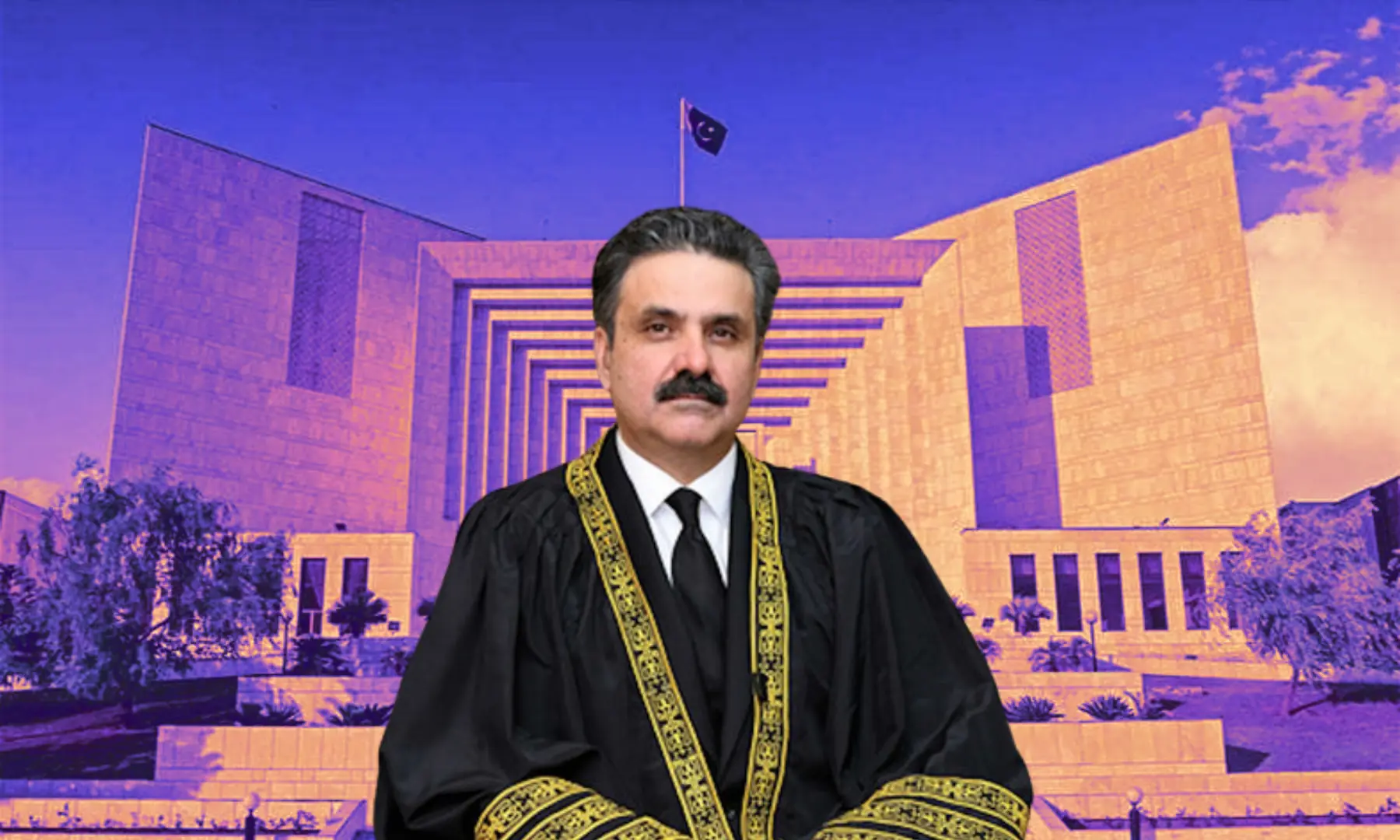
Eighteen years ago, Justice Yahya Afridi, the incumbent chief justice of Pakistan, teamed up with his partners and petitioned the Supreme Court (SC) against its capture by the executive. In 2007, then-chief justice Iftikhar Chaudhry, along with nearly 50 judges, was deposed by the Musharraf regime and forcibly prevented from holding court.
It was a first in the country, where a chief justice had been made, in the words of the official handout issued then, “non-functional”. In the chaos that ensued, Justice Afridi teamed up with his partners and petitioned the apex court against its capture by the executive.
What is happening today with the 26th and the now-proposed 27th amendments is a complete and competent challenge to what the incumbent top court judge once swore in the filing.
Even now, the encroachers are the same as they were in 2007; more brazen, though, because their handmaidens all recognise that the sell-by date on their popularity has long passed. The methods are the same; using support from within to divide and fracture the ranks.
The only thing that has changed is that instead of the brilliant lawyer that he was in 2007, Yahya Afridi is now the Chief Justice of Pakistan.
The review
When I was asked to review the first year of CJP Afridi, I thought of saying a lot that has already been said before in these pages. But then, I thought the best way to review a position is to reflect on it against itself from earlier.
In his filing in 2007, this is what Justice Afridi swore on:
On overall independence, his lordship thought: “It is the independence of the judiciary which ensures the protection and safeguard of the fundamental rights of the petitioners and the people of Pakistan.”
On the encroachment of the executive into judicial functioning, such as stopping a particular judge from working, CJP Afridi swore: “If the judiciary is subjected to the fiat of the executive, the very foundation of trichotomy of powers envisaged under the Constitution is brought to a naught.“
On the effect such encroachment has upon general fundamental rights of the citizenry, the CJP believed: “Right to access to justice for all is a well recognised inviolable right enshrined in Article 9 of the Constitution.”
The fundamental right of access to justice and what it meant at its core was explained as follows by Afridi sahab: “Access to justice implies an independent judiciary which can judicially review the illegal orders of the executive.”
What happens when you capture the judiciary? Here is what 2007 Afridi said: “In the absence of an independent judiciary, right to access to justice and the very protection of fundamental rights is brought to a nullity.”
Upon harassment of a judge by those we call the executive, CJP Afridi said: “Where the executive has maligned the independence and the Honour of the judiciary by making its honourable chief Justice of Pakistan non-functional … clearly demonstrates that the petitioners and the ordinary person of Pakistan has no fundamental rights.”
On the fiddling with the working of a judge, Afridi sahab said: “Independence of judiciary is violated by impairing the working of the honourable chief justice of Pakistan illegally and unconstitutionally, which imperils the very enforcement of the fundamental rights of the petitioners and of every citizen of Pakistan.”
And lastly, when summing up the irrelevance of lawyers in a regime where the courts themselves are rigged, the honourable CJP Afridi swore: “In the absence of an independent judiciary, the petitioners’ right to practice in the courts of Pakistan for the enforcement of their fundamental rights would become impossible, hence violating Article 18 of the Constitution.”
The analysis
Some years back, a senior lawyer stepped out of the court within my earshot, frustrated by the treatment he was getting from the bench and by the indulgence being given to the counsels for the opposing side: “I represent the most respected charitable hospital in Pakistan. The opponent runs a petrol pump. Surely there is a difference.”
Although all are indeed equal before the law, the sentiment conveyed was perhaps that your reputation, your past conduct and your standing in society should count for something. The company you keep should also count for something.
The filing quoted above was sworn by Yahya Afridi in 2007. His fellow petitioner was Athar Minallah. His lawyer was Mansoor Ali Shah. All three are now judges of the Supreme Court. Surely, that should count for something. From the decisions rendered, we can safely state that two out of three firmly stand by what they said in 2007.
There was a famous food supply company whose next generation decided to refresh the ageing design of their labels. They sent it out to a celebrated advertising firm, which wrote back declining the commission with the simple comment: We cannot improve upon perfection.
The first year of Chief Justice Afridi need not be analysed with any other lens. The only things one needs to note are the improvements made to the perfection that was 2007, and the people who agree with his conduct today compared to those who agreed with him back then.
The writer used to be a lawyer, but doesn’t really know what to call himself after the 26th amendment.
The author is a lawyer and political analyst, in which capacity he regularly appears on TV shows and has written for various publications such as Dawn, The News andThe Friday Times. He can be reached @Jaferii.