Vehicle emission testing: A step-by-step guide for Punjab's motorists
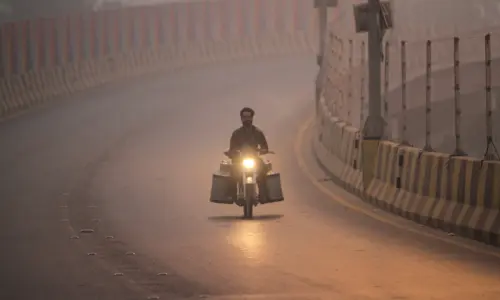
With the end of the year, smog season is back in Punjab in full force. For the past week, the air quality in Lahore, the provincial capital, has consistently been ranked the worst in the world. A recent report also stated that Lahore’s average PM2.5 concentration — the amount of fine particulate matter — was eight times the World Health Organisation’s (WHO) guidelines.
Smog has consistently been a problem in Punjab and the provincial government has cracked down on activities contributing to the phenomenon. One of these steps involves the emission testing certification of vehicles.
Speaking to Dawn, Environment Protection Agency (EPA) spokesperson Sajid Bashir said that last year, the department conducted emission testing of vehicles, under which approximately 300,000 were tested.
“However, since vehicle emission testing falls within the mandate of the transport department, the project has now been referred back to the department, which is operating it through the Private Vehicle Inspection and Certification System (PVICS),” he said.
According to the provincial transport department’s website, the system’s primary purpose is “to ensure road safety by systematically verifying that vehicles meet strict mechanical and environmental fitness standards”.
Here is a guide for ensuring that your vehicle is not contributing to the devastating smog currently descending over Punjab.
Step 1: Check your vehicle, wallet and your documents
First of all, you should check whether you actually need the certificate. Under the information provided by the provincial transport authority, motor car owners are exempt based on their engine capacity and date of manufacture: 1,000cc, exempt for five years from the date of manufacture; 1,001cc to 2,000cc, exempt for six years from the date of manufacture; and above 2,000cc, exempt for seven years from the date of manufacture
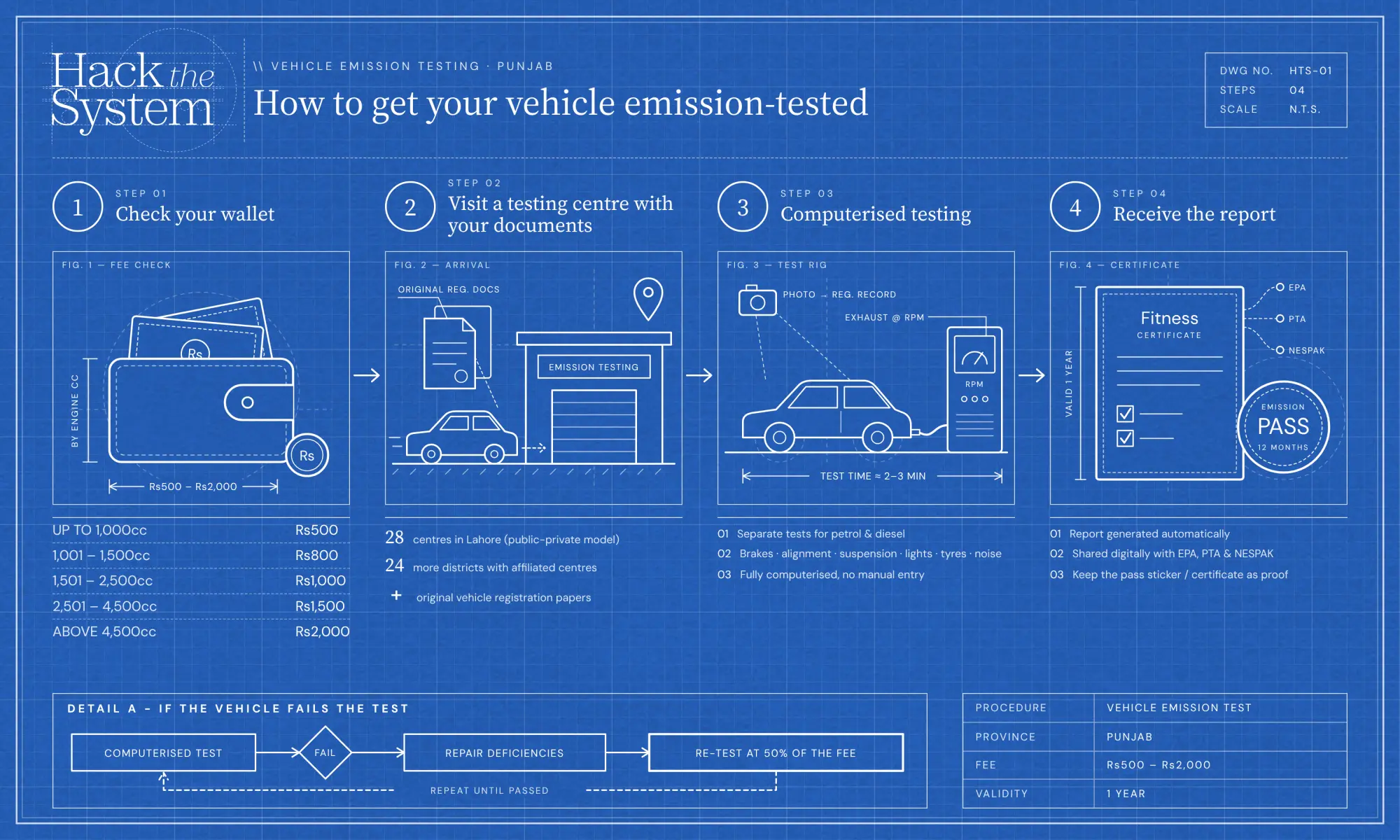
Meanwhile, the remaining vehicle owners in Punjab will have to pay between Rs500 and Rs2,000 for emission testing, with the fee determined by engine capacity.
The notified fee schedule sets Rs500 for vehicles with engines of up to 1,000cc, Rs800 for those above 1,000cc and up to 1,500cc, Rs1,000 for vehicles above 1,500cc and up to 2,500cc, Rs1,500 for those above 2,500cc and up to 4,500cc, and Rs2,000 for vehicles with engines exceeding 4,500cc.
Citizens are also required to bring their vehicle’s original registration documents for the testing process. And it is always a good idea to have your original Computerised National Identity Card (CNIC) with you.
Step 2: Visit an authorised emission-testing centre
Vehicle owners are required to take their vehicles to an authorised testing centre with the necessary documentation.
The Punjab government has established 28 vehicle emission-testing centres in Lahore under a public-private partnership model.
Affiliated centres are also located in Sheikhupura, Rawalpindi, Attock, Bahawalpur, Dera Ghazi Khan, Gujranwala, Rahim Yar Khan, Sahiwal, Sargodha, Gujrat, Mandi Bahauddin, Toba Tek Singh, Mianwali, Vehari, Lodhran, Chiniot, Nankana Sahib, Khanewal, Muzaffargarh, Chakwal, Hafizabad, Pakpattan, Layyah and Jhang.
Step 3: Computerised testing
At the centre, the officials will enter the vehicle’s registration details into the system. A photograph of the vehicle is also taken and linked to the registration record.
The vehicle is then connected to the emission testing equipment. Separate testing procedures are used for petrol and diesel vehicles; the machines measure exhaust emissions at different engine speeds, recorded in revolutions per minute.
The complete testing process takes approximately two to three minutes. The inspection is computerised, with no manual intervention in recording or generating the test results.
The computerised inspection equipment is used to assess the vehicle’s roadworthiness and compliance with applicable safety and environmental standards.
The tests cover braking performance, wheel alignment, suspension, headlights, tyres, mechanical condition, exhaust emissions and noise levels.
A vehicle meeting the prescribed standards is then issued a fitness certificate.
What happens if your vehicle fails the test?
If the vehicle fails the test, the owner must rectify the identified deficiencies. After the necessary repairs, the vehicle must be reassessed.
However, this time, motorists are only required to pay half of the prescribed testing fee.
Step 3: Receive the report
The machine automatically generates a test report once the inspection is completed. The digital report is then shared with the EPA, Punjab Transport Authority and National Engineering Services Pakistan.
Vehicles meeting the prescribed emission standards are issued a pass sticker/certificate. The certificate remains valid for one year, according to the policy information provided.
Owners should retain the certificate or sticker as proof of compliance.
Keep in mind
The Punjab government had initially set Oct 15 as the deadline for vehicle emission testing. However, the deadline was later extended to Nov 15 and has now been pushed to Dec 31.
Remember, vehicles that fail to obtain an emission certificate may face challans and fines for non-compliance after the deadline.
Citizens should also check whether their vehicles require a separate fitness certificate; the emission certificate and vehicle fitness certificate are two separate requirements.
Public service and goods transport vehicles must obtain a statutory fitness certificate under the Punjab Motor Vehicle Ordinance, 1965, and Motor Vehicles Rules, 1969.
Meanwhile, commercial vehicles are required to undergo a fitness inspection every six months; an emission-test pass does not replace the statutory fitness certificate.
Imran Gabol is a Lahore-based reporter for Dawn with over a decade of experience in journalism. He covers politics, climate change, human rights, education, and metropolitan affairs. He can be found on X at @gabolizm.