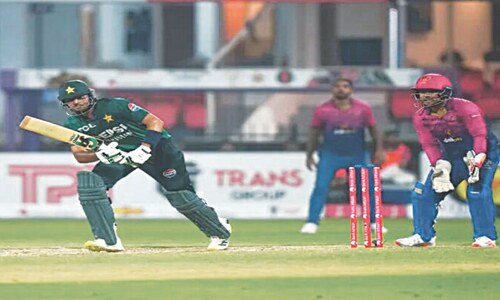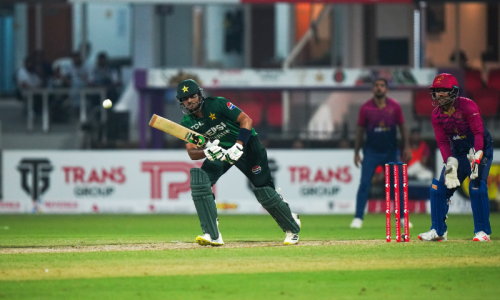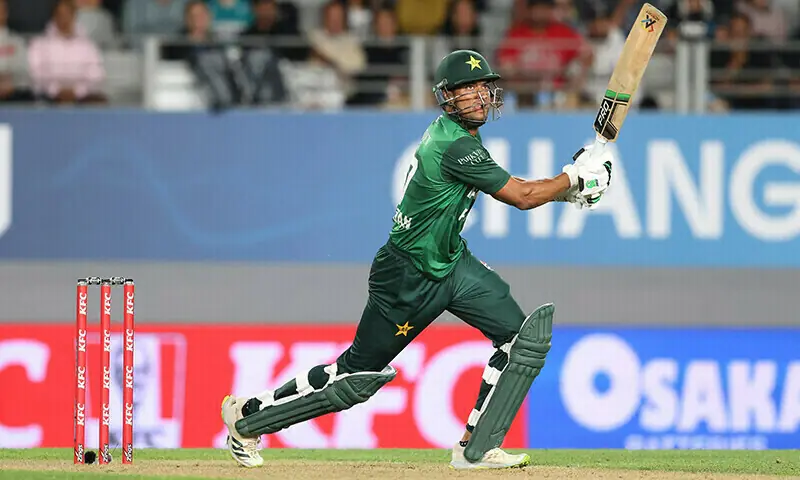
Hasan Nawaz is finding his feet, and Pakistan could reap the rewards
Pakistan have spent much of the past few years searching for stability in their middle order. The problem has been particularly pronounced at number six, where the ability to rebuild an innings must go hand in hand with the capacity to accelerate at short notice. Finding a batter who can do both has proved easier said than done.
Hasan Nawaz may yet provide an answer.
At 81-4, with Pakistan needing to recover from a precarious position during their One-day International tri-series match on Tuesday, few batters would have dared to launch Adil Rashid for a first-ball six.
Hasan did just that. It was a reminder of the natural power and confidence that have made him an exciting prospect, even as questions over his consistency continue to follow him.
His international career, so far, has been a study in contrasts. In only his third Twenty20 International (T20I), Hasan smashed an unbeaten 105 off 45 balls to help Pakistan chase down 205 in Auckland. It was a statement innings from a batter who appeared to have the game to succeed at the highest level. Yet his other four innings at the start of his international career yielded just one run between them.
The promise was unmistakable, but so was the inconsistency.
The contrast between his best and worst returns illustrates the challenge Pakistan have faced in getting the best out of Hasan. The talent was evident, but converting those flashes of brilliance into a sustained run of performances remained a work in progress.
A productive stint in the Pakistan Super League (PSL) followed, with Hasan rediscovering his touch at number four. The team management subsequently tried him in the middle order, but the returns were patchy. A string of low scores towards the end of 2025 eventually cost him his place in the T20I side.
There were, however, encouraging signs in the 50-over format. Hasan made his One-Day International (ODI) debut in October 2025 and announced himself with an unbeaten 63 off 54 balls against the West Indies, earning the player-of-the-match award.
Coming in with Pakistan at 180-5 in pursuit of 285 on a tricky surface, he showed both skill and temperament to guide the chase. He followed that effort with unbeaten scores of 36 and 13, finishing the tour with 113 runs at an average of 56.5.
Despite that promising start, his T20I struggles continued, and he was sidelined after playing just one ODI against South Africa in November 2025.
In hindsight, Pakistan might have benefited from giving him a longer run in ODIs. At the time, however, the decision was understandable.
Hasan appeared to have lost his way, and a spell away from international cricket seemed a reasonable opportunity to rebuild his game.
That process was far from straightforward. During the 2025-26 International League T20 (ILT20), Hasan managed just 124 runs in 10 innings, largely in a role that required him to slog at the death.
The problem was not his ability to clear the boundary; it was his capacity to build an innings before unleashing that power. By then, he had acquired the familiar reputation of a batter who could be devastating on his day but was just as capable of going missing.
A subsequent stint with Sialkot in the National T20 Cup provided a turning point. Rather than relying on his power from the outset, Hasan began to rethink how he approached an innings.
His six-hitting ability was never in doubt. What needed work was the route he took to get there.
The shift was prompted in part by Sialkot head coach Naveed Latif, who advised him to start more cautiously and make up for lost time later in the innings. Hasan took the advice to heart. He finished the tournament as the second-highest run-scorer, striking at an impressive 155.
His most striking performance came against Multan in a virtual quarter-final. At one stage, he had managed only a run-a-ball 21, but then he exploded, scoring 59 off his next 19 deliveries to finish unbeaten on 80 off 40. It was an extraordinary turnaround, and a demonstration of what Hasan could achieve when he married patience with power.
For a batter who had struggled to reconcile the two, it was an encouraging sign that his game was beginning to take shape.
His returns in the last season of the Pakistan Super League were respectable, if hardly spectacular. The adjustment was not without its drawbacks: Hasan could spend too long settling in and then find himself unable to accelerate when the pressure mounted. The approach that had worked in domestic cricket was not necessarily a formula he could replicate at international level.
That distinction matters. T20 cricket offers little room for a batter to recover from a slow start, particularly when the required rate is climbing. Whether Hasan’s new approach will consistently work in T20Is remains an open question, and the sample size since his return is too small to draw firm conclusions.
There have, nevertheless, been glimpses of its potential. Against India at the Asian Games, he scored 96 off 51 balls after initially struggling to get going, reaching six off his first 11 deliveries. India’s sloppy fielding helped his cause, but Hasan deserves credit for capitalising on the opportunities and accelerating when it mattered.
In the recently concluded T20I series against Sri Lanka, he struck an important unbeaten 19 off nine balls in the second match, providing a late boost to the innings. His scratchy 17 off 16 in the third, however, offered a reminder that the method is far from foolproof. A slow start can provide a platform for acceleration, but it can just as easily leave a batter with too much to do in too little time.
For now, Hasan seems willing to take that risk. The challenge is to recognise when the situation demands patience and when it requires him to attack from the outset.
It is in ODIs, though, that Hasan’s development could prove particularly valuable to Pakistan.
For the last couple of years, Salman Ali Agha has been a dependable presence in the middle order, batting primarily at number five. The position below him has been far less settled. Pakistan have tried several options at number six, with little sustained success, and the search for a reliable finisher who can also rebuild an innings has continued.
Salman has occasionally batted at number six, but with him expected to occupy the number five position heading into the World Cup, it makes more sense to assess the alternatives. The chart below illustrates Pakistan’s returns at number six, excluding Salman.
Batting at number six is among the more demanding jobs in white-ball cricket. A batter may have to rescue an innings after a collapse, rotate the strike while wickets are falling, or walk in with only a handful of overs remaining and be expected to score quickly. There is rarely much time to settle in, and the demands can change from one match to the next.
It is also an unforgiving role. A 20-ball 35 might barely register, while a failure to score quickly enough or a dismissal during a rebuild can attract scrutiny. The ideal number six must be adaptable enough to manage both situations, and Pakistan have struggled to find someone who can do so consistently.
Hasan’s recent ODI performances suggest he could be worth backing in that role. Earlier this year, he scored two half-centuries in three outings for his team in the National Champions Cup while batting at number five. His return to the ODI side has been equally encouraging, highlighted by a 79 off 74 balls against England earlier this week.
The innings was significant not merely for the runs it produced, but for the way Hasan appeared to learn from his recent struggles.
In the opening match of the tri-series, against Sri Lanka, he had found it difficult to rotate the strike, reaching 22 not out off 40 balls at one stage before managing a few boundaries and eventually falling for 37 off 49. It was an awkward innings, and one that raised questions about whether his cautious approach was becoming counterproductive.
Against England, the response was immediate. Hasan produced a fluent half-century off 46 balls, showing greater intent and a better grasp of when to attack. The contrast between the two innings was encouraging: he had identified a weakness and appeared to address it without abandoning the patience he had been working to develop.
That willingness to keep learning may be his most valuable quality. Speaking at the post-match press conference, Hasan said: “One should look to improve their game constantly. I believe that one needs to perform against big teams to make their name. I embrace tough challenges and try to give my all.”
His assessment of his dismissal by Jamie Overton was revealing, too. “It was a good ball, but I feel I need to work more on my fitness as my reflexes had gotten slow by then. He had bowled similar deliveries to me prior in the innings, which I was able to dig out.”
There is something refreshing about a young batter acknowledging that a good innings could still have been better. Hasan had scored a valuable 79, but rather than being content with the contribution, he identified a possible shortcoming in his fitness and reflexes. Whether that was the decisive factor in his dismissal is difficult to establish, but the willingness to examine his own performance is a positive sign.
Pakistan should be careful not to read too much into a handful of promising innings. Hasan remains a work in progress, and there will inevitably be periods when his timing deserts him or his attempts to accelerate come at the expense of his wicket.
His relatively small body of work at international level also makes it difficult to know whether the recent improvements will hold up against sustained pressure.
What Pakistan can do, however, is provide him with a settled role and enough opportunities to learn from his mistakes. Repeatedly moving him between formats, positions and batting roles risks undoing the progress he has made.
If the team management believes he has the attributes to succeed at number six, it must be prepared to accept the occasional failure that comes with developing a player for such a demanding position.
Hasan is an intriguing prospect because he has had to reshape his game to meet the requirements of international cricket. A natural opener, he is learning to pace an innings, manage the middle overs and accelerate when the situation demands it.
His power gives him a head start, but it is his progress in the less spectacular aspects of batting that will ultimately determine his value to Pakistan.
The signs are encouraging, particularly in ODIs, where his ability to consolidate and then change gears could address a longstanding weakness. Yet promise is only a starting point. For Hasan to become a dependable number six, he will need to turn these flashes of maturity into a consistent body of work.
Pakistan may have found a diamond in the rough. The challenge now is to give him the time, role and support required to bring out its full value.
The author is a massive sports fan who spends most of his free time following cricket, football and F1. He has previously worked in sports operations and commercial management for Multan Sultans, and is keen to explore the stories that shape cricket.