We toured Karachi's Red Line to bring you this update
Few things test Karachi commuters’ patience like its roads and public transport. For nearly five years, construction of the Red Line has added another obstacle to daily journeys, with traffic diversions, dust and disrupted businesses along the corridor.
We wanted to understand why the project was taking so long. So we travelled the route, documented the work on the ground and spoke to the people living and working beside it.
The idea for the Red Line was born in the early 2010s when it was clear Karachi could not survive its own traffic. The Japan International Cooperation Agency, known globally as the sensei of city surveys, was asked to help. It counted the cars and motorcycles and studied the madness before coming up with a simple plan: Make six Bus Rapid Transit corridors.
BRT, as it is called, is a short form for giving buses their own lane in the middle of the road where no other vehicles can enter. This allows the bus to zoom people up and down a road without being hemmed in by pesky lane-violators.
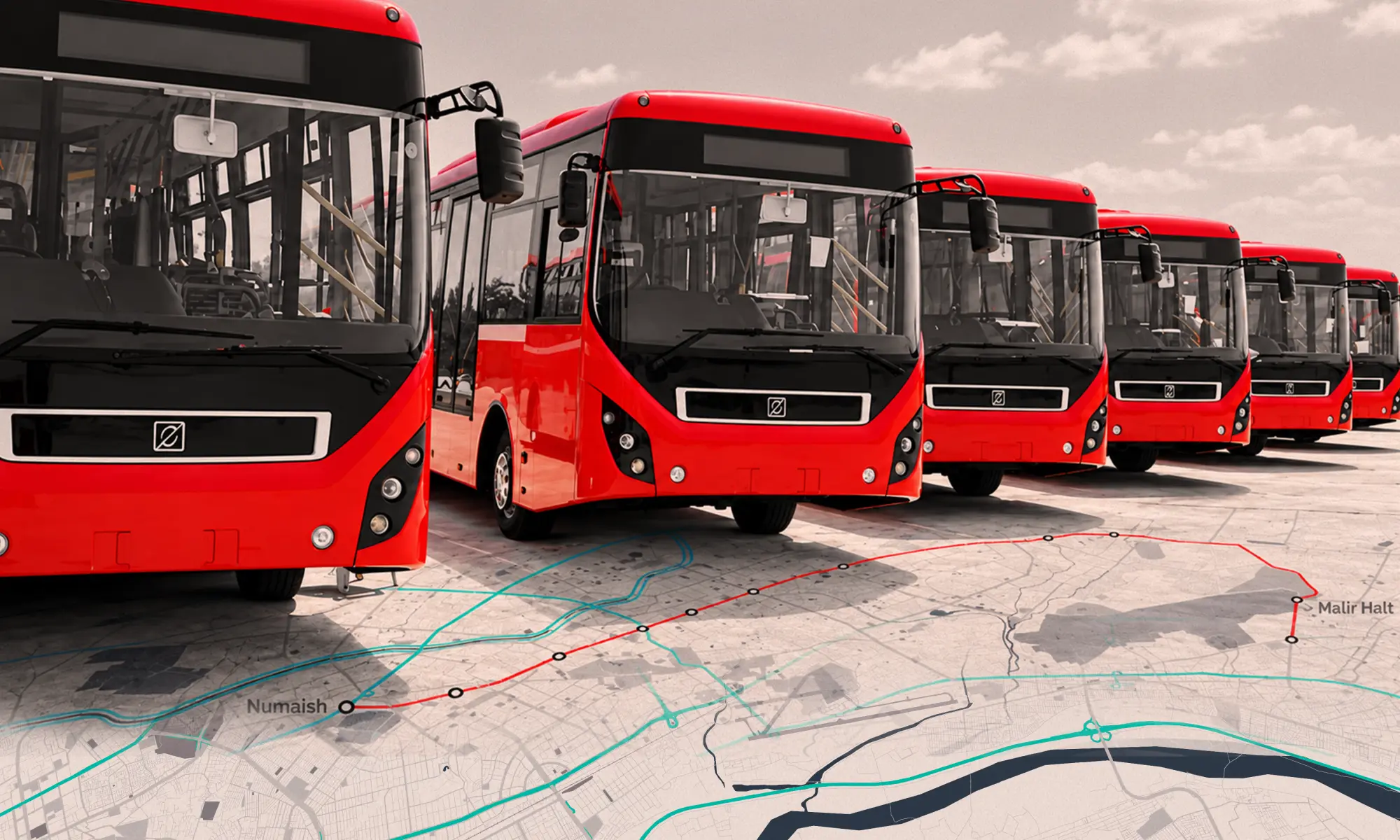
One of the six corridors, the Red Line, ran from Numaish near Quaid-e-Azam’s Mazar to Malir Halt, a little further after the Karachi airport. This 26.6km strip is Karachi’s busiest and includes University Road. The planners gauged that it would need over 260 electric buses for it. “We found that more than 60 per cent of regular commuters cross Numaish every day,” said Zubair Channa, CEO of TransKarachi, a public sector company in charge of the project.
Back in 2011, that looked like up to 166,000 vehicles a day at the busiest intersections surveyed on the corridor. Roughly half to two-thirds of them are motorbikes and rickshaws, with just 5pc buses.
Project timeline
The Red Line work began in March 2022 and is less than half done more than four years later. Documents of the Asian Development Bank (ADB), a major financier, note April 30, 2027, as the loan closing date.
According to the Asian Development Bank’s project data sheet, the four financiers had disbursed approximately $128.93 million by August 20, 2026. ADB had disbursed $87.63m of its $235m loan, while the French Development Agency and the Asian Infrastructure Investment Bank had disbursed $21.38m and $19.92m, respectively, out of $71.8m each. No disbursements had been recorded against the Green Climate Fund’s combined $49m grant and loan commitments.
For a project of such scale, two years of inconvenience is a given, said Channa. TransKarachi estimates the corridor work will be done by December 20, 2026.
It said other components of the project will be completed progressively. The Malir Halt Depot is targeted for completion by April 2027, while the Bagh-e-Karachi Depot is expected to be completed by July 2027. The remaining structural and station works are targeted for completion by June 2028.
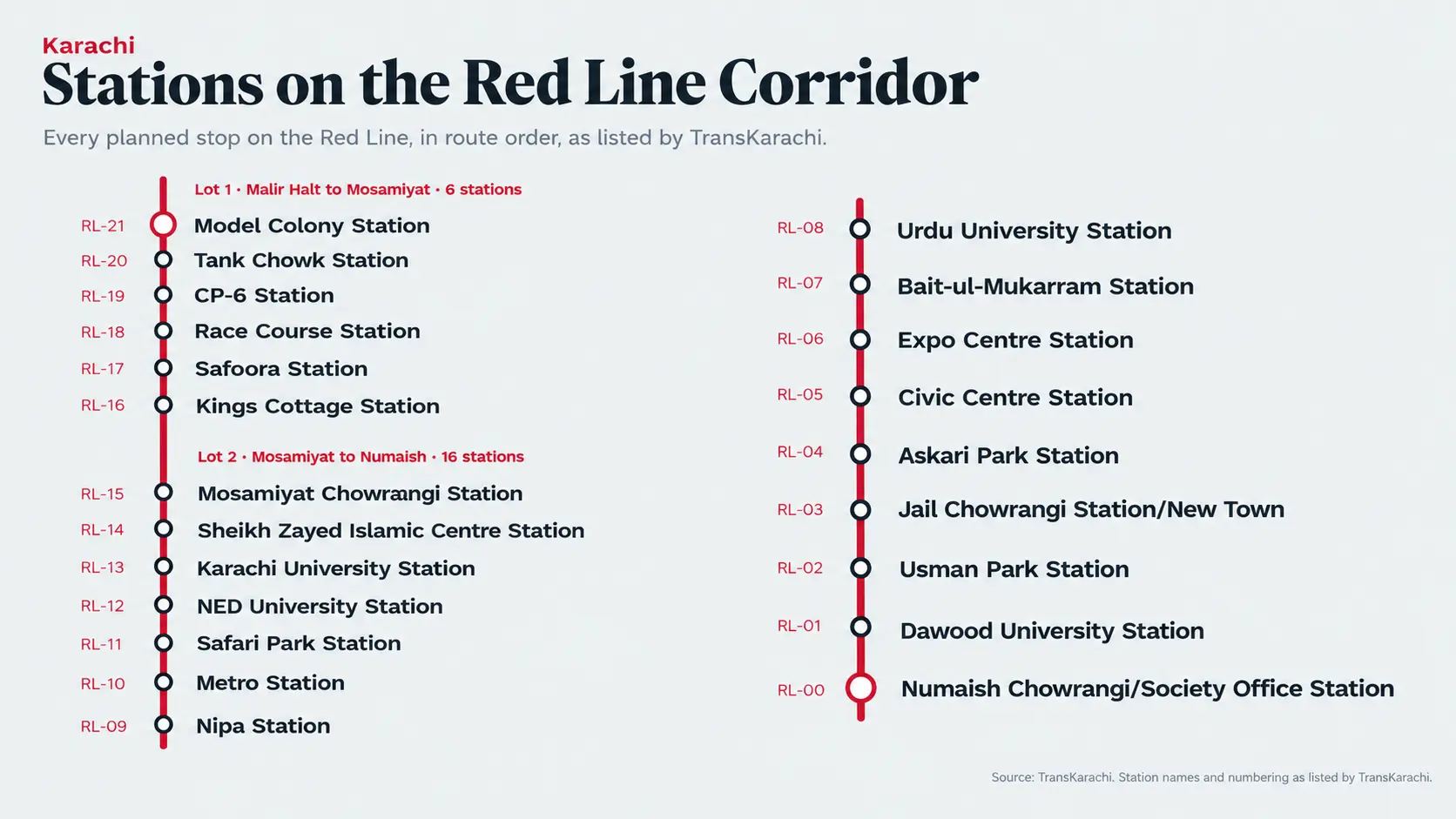
The Red Line has been divided into two lots or batches. The first is a 9.4km stretch from Malir Halt to Mosamiyat with six stations and two bus depots (at Malir Halt and Bagh-e-Karachi). The contract was awarded to Zahir Khan & Brothers (ZKB) for Rs13.8 billion. The company’s key projects include Swat Motorway, Lahore Eastern Bypass, and New Jam Sadiq Bridge in Karachi. The company was also previously involved in the construction of mass transit, such as the Islamabad-Rawalpindi and Multan Metro Bus systems and the Lahore Orange Line Metro and depot. ZKB began work on Red Line’s Lot-1 on May 10, 2022 and had an initial completion deadline of May 9, 2024, which was later extended to June 30, 2026.
The second lot covers a 12.85-kilometre stretch with 16 stations and was awarded to China Railway No. 3 Engineering Group-AM Associates (joint venture) on January 4, 2022, for Rs15.93bn, and construction commenced on August 15 of the same year. The original completion deadline was August 14, 2024, which was later extended to June 30, 2026. Per its website, AM Associates earlier also worked on the 19.21km Hazara Motorway and the Kohala–Muzaffarabad road for the National Highway Authority.
On April 21, 2026, TransKarachi terminated its contract with China Railway No. 3 Engineering Group–AM Associates for Lot-2, citing slow progress, unsatisfactory performance and violations related to health, safety and the environment. The contractor challenged the decision in the Sindh High Court, which referred the matter to the contract’s Dispute Resolution Board.
The board subsequently declared the termination “unlawful and invalid”, finding that it had been hasty and had failed to adequately account for the project’s complexity. It also identified shortcomings on TransKarachi’s part, including its failure to provide complete designs and an unobstructed work site — factors that contributed to delays. The dispute therefore went beyond disagreements over the contractor’s performance: it also raised questions about the project authority’s own contractual obligations and how the stalled works would be completed.
After the termination, the Sindh cabinet approved off-budget emergency funding and directly engaged the Frontier Works Organisation (FWO) under a government-to-government arrangement to stabilise the corridor and restore essential infrastructure, i.e. mixed traffic lanes, service roads, and drainage along Lot-2. FWO took over the site in May 2026 and is scheduled to complete the assigned works by the end of the year.
The contract for the remaining works—structural works and BRT station works—is in the tendering process and procurement will take place through ADB Open Competitive Bidding.
According to the bank, the method “facilitates open competition among all eligible bidders” through advertising to provide an equal opportunity to as many qualified bidders as possible.
“The lowest bidder gets the contract,” said Rehan. Bids for the replacement Lot-2 structural works had been submitted on October 8 and were being evaluated, with a contract award expected within about a month.
Delays
TransKarachi gave a number of reasons for the delay in the project: post-Covid inflation, land acquisition for bus depots, design revisions, and delays in utility line relocation. There is no justification for it, said Channa, but he reiterated the position that inconvenience caused by a project meant to provide long-term respite to Karachiites was meant to be.
The people directly affected by work on the corridor described the ‘inconvenience’.
“This construction work has been going on for more than 3.5 years. Initially, it was very slow but has picked up speed over the last two months. The dust is the worst part … because of the construction, the traffic jams are bad here. The roadwork has affected our work … there is no work.”
— Stallholder, Safoora Chowrangi
“Before the construction work began, my stall would be crowded with customers. Now, there is barely anyone. I used to set up my stall on the main road previously, but now we are down here.”
— stallholder, Mosamiyat
“A project that was supposed to be completed in two years is going on and on and on with no end in sight. Our business has shut down because they have dug up the road right in front of my shop.”
— shop owner, University Road
“My house is at a 20-25 min distance from here but because of the construction I have been missing my morning classes almost every day. In the evening, our rickshaw is usually stuck in the traffic for an hour or so.”
— student, University of Karachi
“It is like 60pc of my day is spent in traffic.”
— commuter, NIPA
According to TransKarachi, people displaced because of the Red Line construction are compensated. The compensation rates vary according to the type and category, from Rs27,500 to Rs302,500. So far, 131 people have been compensated, with payments made during 2022, 2023, 2024 and 2025. Rehan said the displaced people primarily included vendors operating from extended structures and movable pushcarts.
“No permanent structures were affected by the project,” he added.
TransKarachi also has a Grievance Redress Mechanism in place, where all complaints by commuters, affected communities and other stakeholders along the Red Line corridor are registered. During September 2026, a total of 14 complaints were received, of which the highest were concerning traffic, followed by utility, access, and environment.
Depending on the nature of the complaint, Rehan explained, a Corrective Action Plan is prepared, or an appropriate resolution is provided in coordination with the concerned department, project team, or contractor. The relevant stakeholders undertake the necessary actions to address the issue, and progress is monitored through the GRM portal.
Once the issue has been addressed, the complainant is informed via email, along with corresponding photographs where applicable, and requested to provide feedback on the resolution.The complainant is subsequently given three days to respond. If no response is received within this period, the complaint is closed in accordance with the approved procedure. Any feedback received from the complainant is documented in the GRM records.
The author is a staff reporter with an interest in human rights, animal welfare, and the environment. She tweets @NMuzhira

The author is a journalist from Balochistan writing on conflict and humanitarian issues. He can be reached at @zareefrind