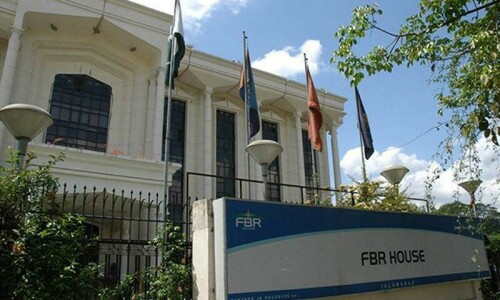
We were ready with our tax filings, was the FBR?
“Wherever law ends, tyranny begins”—John Locke
A few years after my resignation from the Income Tax Service, I happened to visit the offices in Lahore as a representative of a corporate client. A female officer made a remark that left me somewhat bewildered. According to her, laws were binding on taxpayers, not on those administering them. Having spent nineteen years within the department, I had thought I had understood the relationship between law and administration reasonably well. Her statement appeared astonishing then. However, as I watch the annual ritual surrounding income tax returns unfold today, I sometimes wonder whether she was merely articulating an institutional philosophy that the rest of us had failed to recognise.
For individuals and associations of persons (AOPs), the statutory date is on or before 30 September following the end of the tax year. In the case of companies, section 118 of the Income Tax Ordinance, 2001 prescribes 31 December where the tax year ends between 1 January and 30 June, and 30 September in other cases. The words “on or before” are important.
A normal tax year ends on 30 June, which corresponds to the financial year (July to June) adopted by the state. Nothing in the statutory formulation suggests that a taxpayer who is ready to comply should have to wait until September merely because the administration has not yet made its prescribed return operational. It stipulates the last date by which the obligation must be discharged but there is one rather substantial difficulty. While the taxpayer may be ready, the FBR may not.
Income tax returns in Pakistan are now overwhelmingly filed electronically through the online portal named IRIS (Inland Revenue Information System). Taxpayers cannot invent their own return form. They cannot prepare an Excel sheet containing what they consider adequate information and declare that they have complied with section 114. They must use the prescribed electronic return made available by the FBR.
The state, therefore, controls the only doorway through which compliance is possible. Compliance cannot be a one-way street. Once the state makes itself the exclusive gatekeeper of compliance, its own preparedness ceases to be an internal administrative matter. It becomes part of the taxpayer’s ability to obey the law.
This becomes particularly important because every Finance Bill, once passed an Act of Parliament, introduces amendments affecting rates, exemptions, deductions, credits, withholding provisions, declarations and sometimes the very manner in which income is to be reported. Naturally, the return form has to accommodate those changes. Nobody disputes that software requires modification in the light of these amendments. What is difficult to understand is why this annual phenomenon continues to be treated as an unforeseen emergency.
Pakistan does not suddenly discover on 30 June or before, that a Money Bill, presented with the annual federal budget, on approval by the National Assembly, has become a Finance Act, effective from the first day of July. The budgetary exercise begins months earlier. Proposed amendments are available through the Finance Bill. The FBR itself participates intimately in the legislative exercise. Its policy officers know what changes are being contemplated and its information-technology teams should be working simultaneously on alternative versions of the return.
Tax Year 2026 provides a particularly revealing example. The FBR issued draft electronic returns for individuals, SMEs, AOPs and companies on May 6, 2026. Yet the final electronic returns for Tax Year 2026 were notified only at the beginning of September — SRO 1495(I)/2026 dated 2 September. In other words, although the taxpayer’s statutory deadline remained 30 September, the final return itself arrived when nearly two-thirds of the presumed compliance period had already vanished.
Consider what this means. The statutory deadline remained 30 September, but taxpayers and practitioners were effectively given certainty about the final prescribed electronic return only when September had already begun. Millions of returns then had to be prepared, checked, reconciled with wealth statements and submitted through a single electronic system within a dramatically compressed period.
Inevitably, tax bars and trade organisations sought an extension. The original 30 September 2026 deadline was first extended to 15 October 2026 and, on 15 October, the FBR extended it again to 31 October 2026, expressly referring to requests received from trade bodies and tax bar associations. And here lies the irony. The FBR calls this an extension. Taxpayers may reasonably regard part of it as restitution. The extension is presented as a concession to taxpayers but is it really so?
If an authority takes a substantial portion of the statutory filing period to make the final compliance mechanism available, the additional time subsequently granted cannot honestly be regarded entirely as administrative generosity. Part of it merely restores time which taxpayers never effectively possessed. We have somehow reversed the relationship between citizen and state.
The taxpayer is admonished to comply punctually. Failure attracts consequences. Late filing affects status and can invite statutory penalties and other disadvantages. Notices, payments, appeals and responses carry dates. The taxpayer lives by the calendar. Yet the institution that determines whether electronic compliance is even possible appears to face no comparable clock. When it delays, taxpayers must petition that very institution for additional time. Administrative default is thus converted into administrative discretion.
This is not merely an issue of convenience. It raises a basic question of administrative fairness. A government cannot reasonably demand punctual compliance with an obligation while withholding, until late in the prescribed period, the instrument through which that obligation must be performed. Imagine a court requiring an appeal to be filed by 30 September but refusing to provide the prescribed appeal form until 2 September. Would we seriously congratulate the court for subsequently extending the deadline?
Digitalisation was supposed to facilitate compliance. It should not convert administrative preparedness into a condition precedent to the taxpayer’s ability to obey the law. Nor is the answer complicated.
The return for the following tax year should be substantially designed alongside the Finance Bill. Drafts can be programmed and tested before June. Once Parliament enacts the Finance Act, final changes can immediately be incorporated. The electronic form should ordinarily be operational from 1 July, or as close to that date as technically unavoidable.
More importantly, the law itself should guarantee a minimum effective compliance period — say ninety days — beginning only when the final prescribed electronic return is fully operational. Every day of administrative delay should automatically move the statutory deadline by an equivalent period.
If the prescribed electronic return is not available by 1 July, the statutory filing date should automatically move by the corresponding period. Better still, legislation could provide that no taxpayer shall have fewer than, say, ninety days from the date on which the final electronic return becomes fully operational. Then nobody would need to plead for extensions. There would be no annual suspense. No last-minute circulars. No ritual exchanges between FBR and tax bars. In addition, no pretense that restoration of lost compliance time amounts to benevolence.
The FBR rightly expects taxpayers to organise their affairs, maintain records, understand amendments and respect statutory deadlines. Taxpayers are equally entitled to expect their tax administration to anticipate legislation, prepare its systems and provide the prescribed mechanism in good time. The rule of law does not mean that citizens obey while administrators improvise. It requires the State itself to organise its conduct around the law it enforces.
Perhaps that officer’s remark from many years ago deserves to be remembered — but as a warning, not a principle. Laws are not made merely for those upon whom the state imposes obligations. They bind the institutions entrusted with administering them as well. Until that elementary proposition enters our tax culture, the ritual will continue: The FBR will provide the instrument late, taxpayers will plead for more time, and the restoration of lost days will be announced as facilitation. That is not taxpayer facilitation. It is compliance by endurance.
The writer, lawyer and author, is former Adjunct Faculty at Lahore University of Management Sciences (LUMS), a member Advisory Board and Senior Visiting Fellow of Pakistan Institute of Development Economics (PIDE)