Game review: Death and Taxes is a great way to simulate saying no to your boss
TL;DR
Pros:
- An interesting hook that encourages breaking the rules
- Really captures the spirit of corporate hell
- Fun characters given life by great voice acting
- Gives every choice weight and a fascinating ripple effect
- Oddly relaxing, with calm gameplay and a nice jazzy soundtrack
- Short but invites multiple replays, with a helpful New Game+
- No actual taxes (thank God)
Cons:
- Gameplay loop is really monotonous, even though that’s the point
- A couple of continuity breaks and a few slightly confusing elements
Score: 5/7 — Deceptively simple on the surface, but enjoyably challenging
Reviewed on: PC.
Available on: Windows, macOS, Linux; Xbox One and Xbox Series X/S; PlayStation 4, PlayStation 5 (via backward compatibility); Nintendo Switch, and Android.
Price: $6.49 (Steam), $12.99 (GOG, Itch.io, PlayStation Store, Nintendo Store, Microsoft Store); $4.49 (Google Play Store). Free demo available.
It’s spooky season, readers, and it’s also last-minute tax filing season if you’ve waited too long. What could be a more appropriate time to pull out a game that’s been gathering dust in my Steam library for a while, which I already knew I was going to enjoy from my brief time with the demo?
Death and Taxes by Placeholder Gameworks is both a relaxing, low-energy way to unwind, and a game that challenges you to think with empathy and practicality. Its premise is simple: the day-to-day life of a new Grim Reaper in an extremely dull corporate job, signing off on people’s deaths. But its underlying mechanics make for a far less mindless experience than what it says on the tin.
Welcome to (corporate) hell
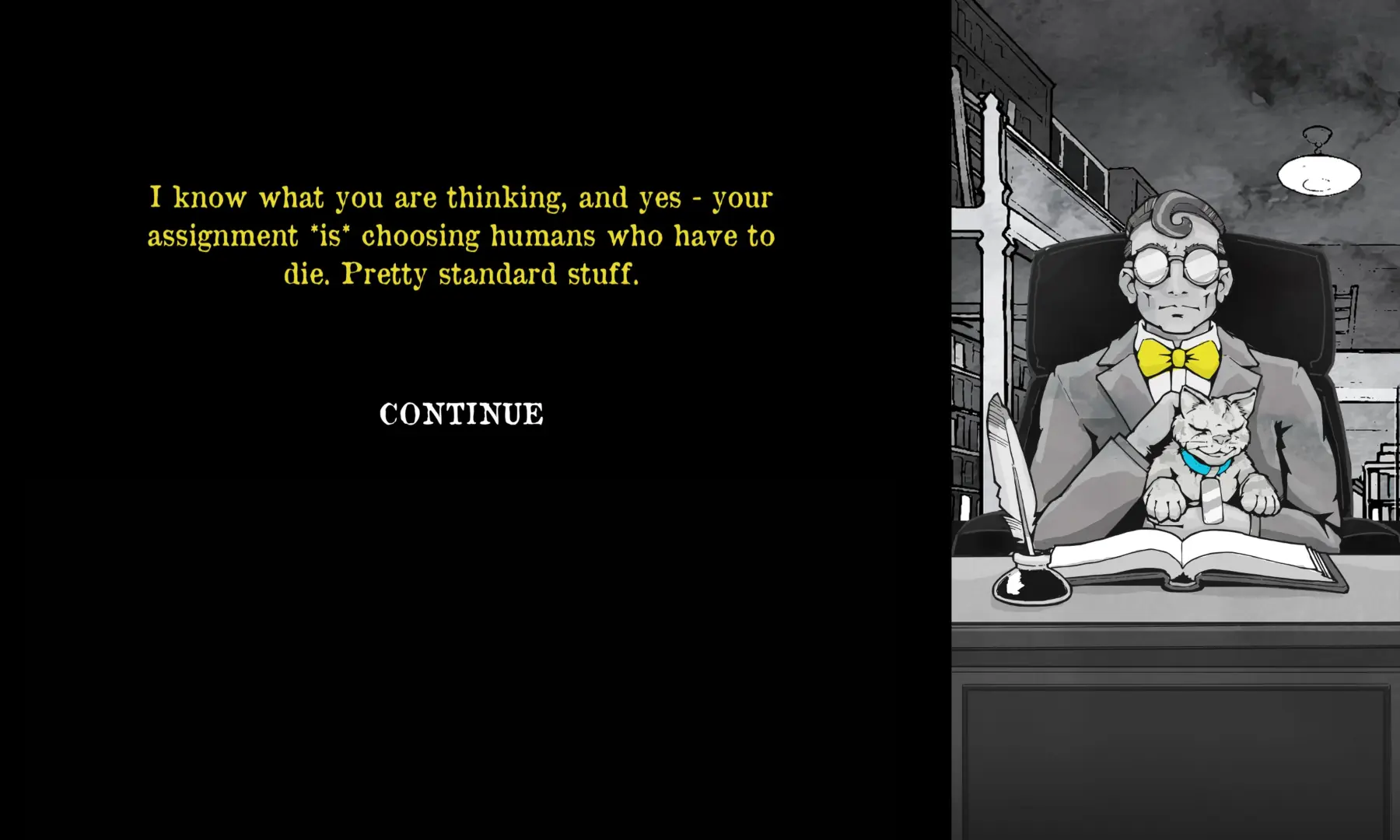
The game begins by sticking you in the shoes of Grim Reaper no. 53, a new hire in the afterlife working for the office of Fate himself.


Your job is, in a nutshell, to kill people. Not with anything cool like a scythe, mind you; every day you’re given a stack of human profiles, a specific quota of deaths to meet, and a very permanent marker.

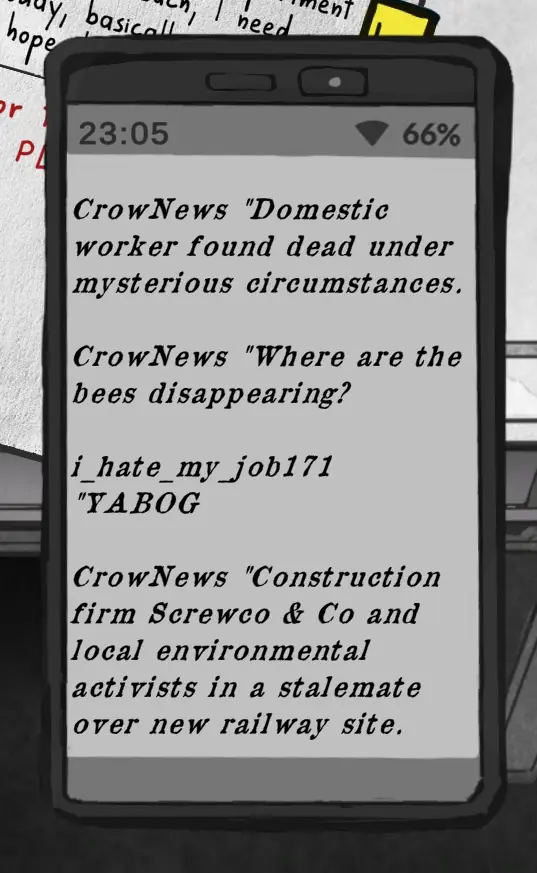
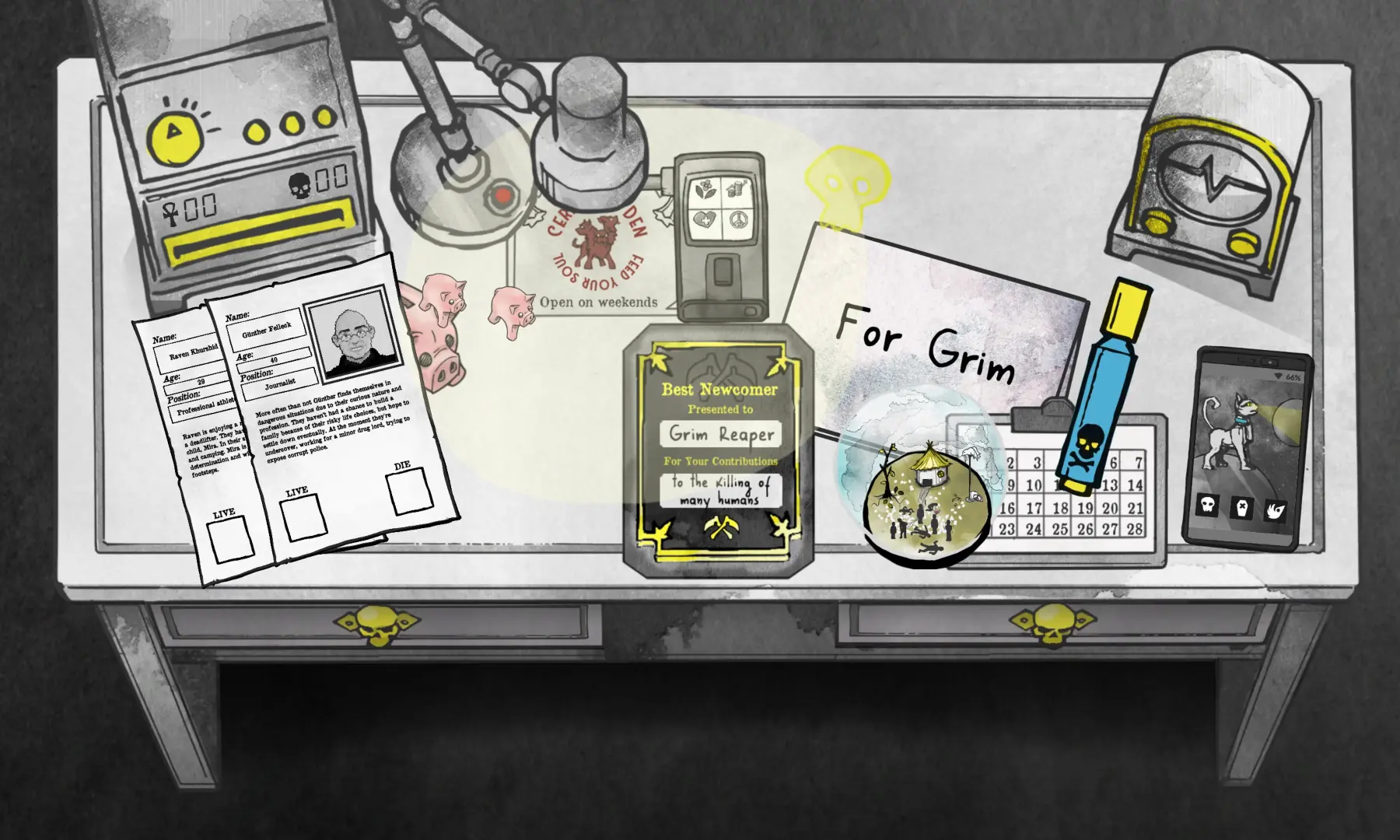
All you have to do is mark each person to live or die, fax the papers to Fate, and report to him at the end of each day. You can monitor the consequences of your actions via news alerts on your phone and various unlockable widgets.
Here’s the catch: if you follow Fate’s exacting instructions, you get your pay, and sometimes mild praise. But the choices you make follow you for your entire playthrough if you’re not careful, affecting different ‘stats’ in the real world such as ecology or peace. And Fate — true to the spirit of the classic corporate boss — expects you to clean up your own mess.

Alternatively, if you flout your quotas or take decisions into your own hands — either by accident or in quiet rebellion — you may help your corner of the world avoid disaster, but at the cost of your daily wage. That said, you might get a better night’s sleep for it.
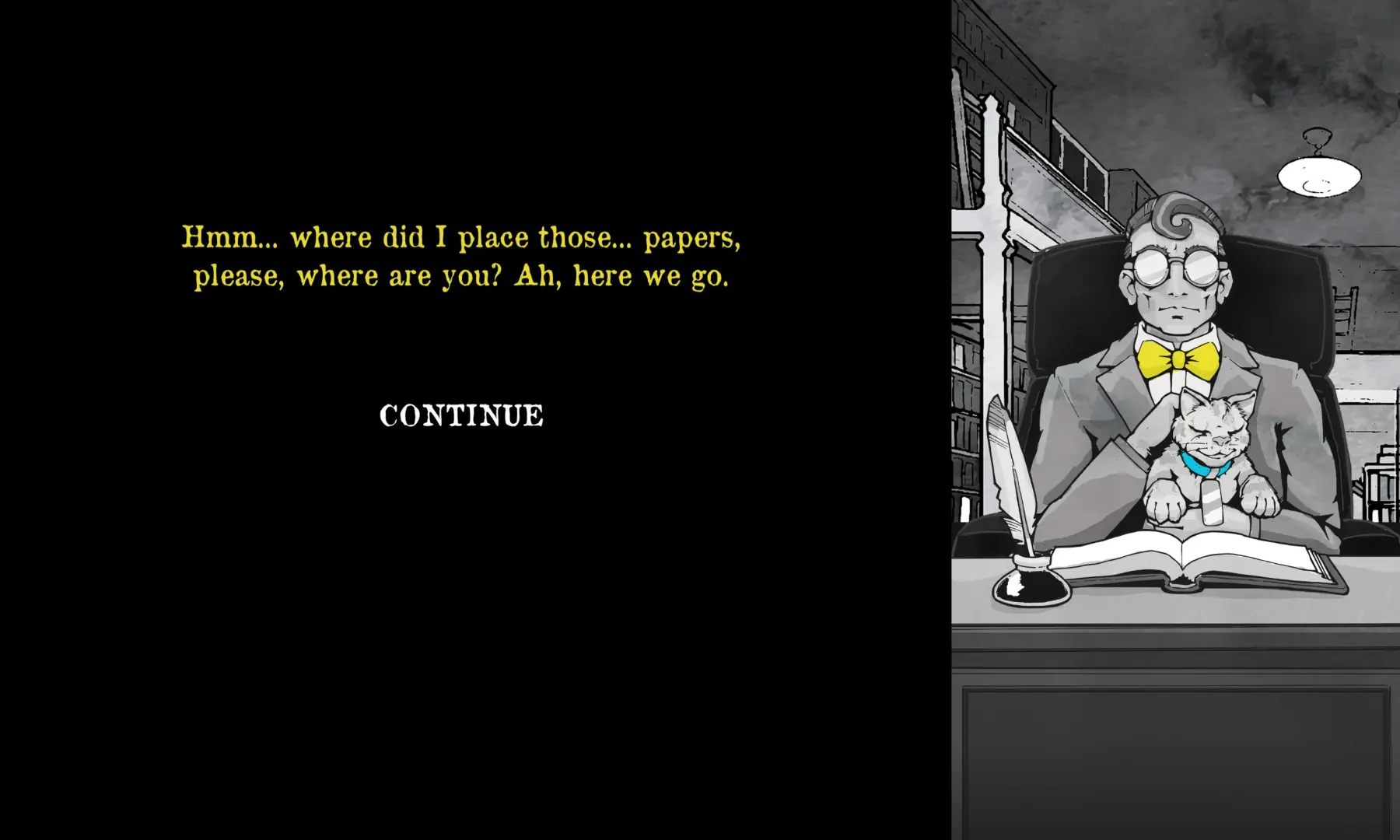
Those who are familiar with the 2013 game Papers, Please may recognise similar themes and mechanics at play. The game is designed so that you can play it whichever way you like, but you’re heavily encouraged to think critically about the choices you’re being asked to make, and often go directly against them.
You can try to be a mindless drone and make bank, but sooner or later you find yourself tasked to make tough calls. Personally, I find this a great way to simulate saying “no” to an authority figure in a safe environment — what’s the worst that can happen? You’re already dead.
Jazz and pizzazz
When you’re not at work, the rest of your time is largely spent shopping for useful items, mingling with fun characters, and making tense small talk with your boss. Although the primary mechanic of the game is reading a lot of text, these parts have enough interest to break the tedium for a few minutes.
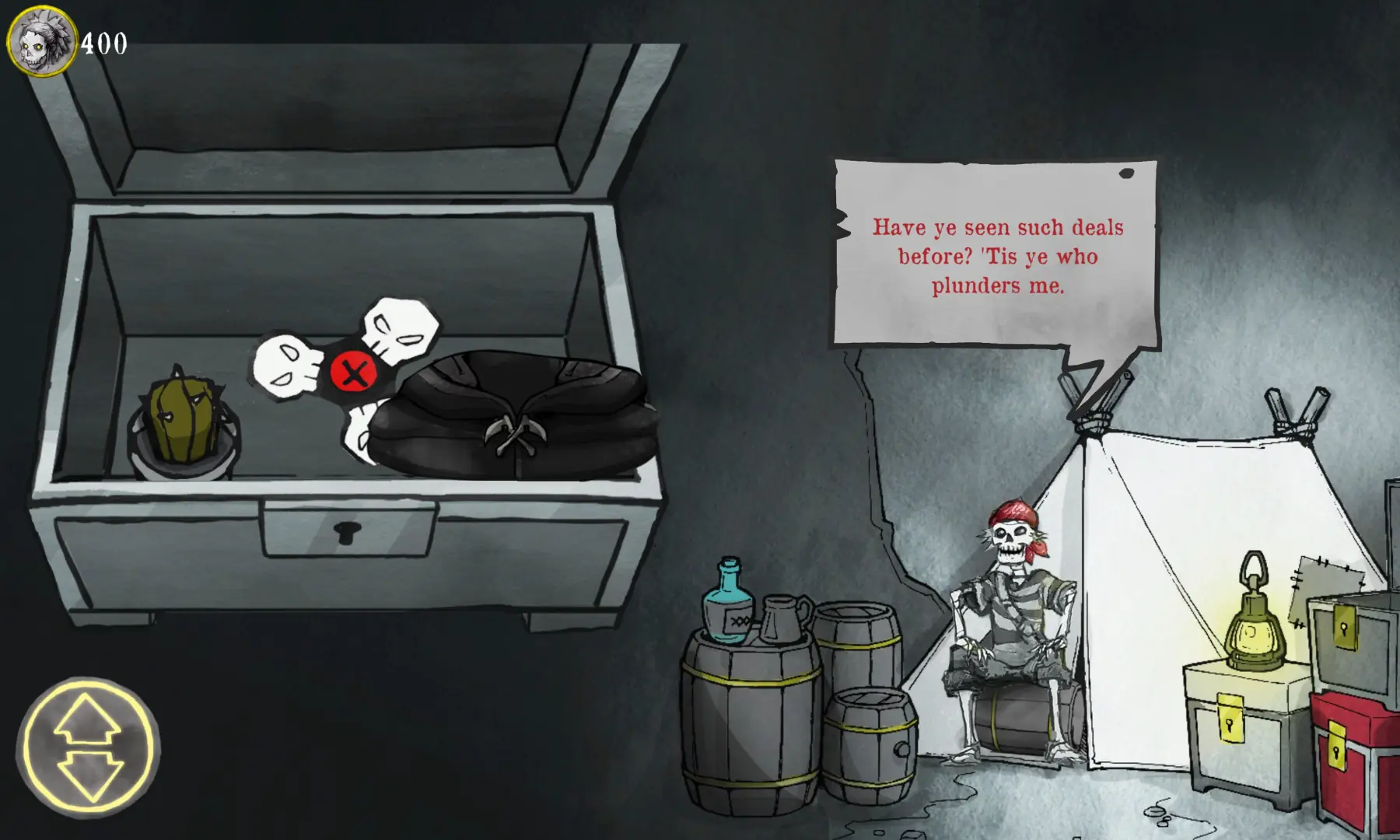

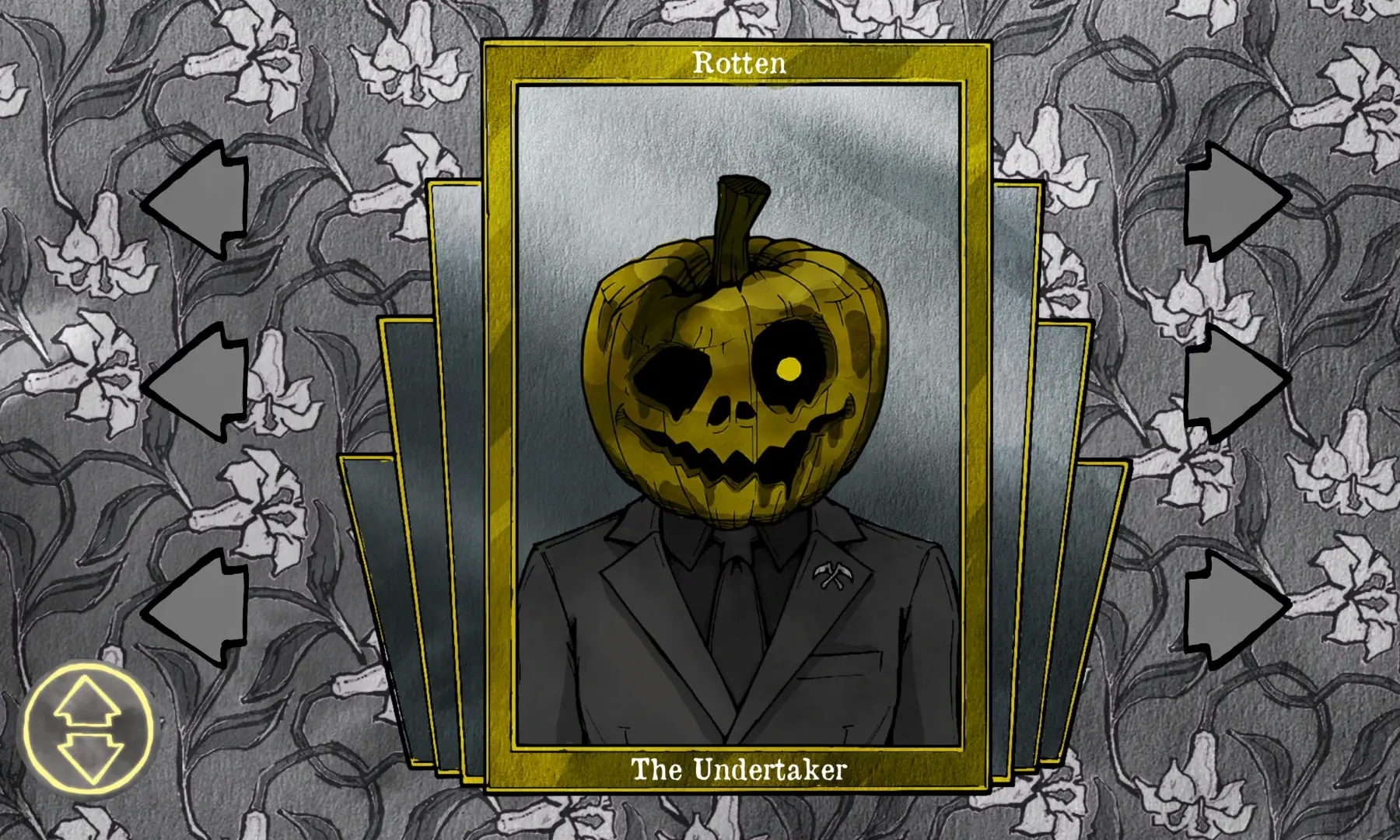
One of the first things you get to do is customise your character, and you can continuously edit your appearance later — although you barely get to enjoy that appearance, outside of your dressing room. That did not stop me from immediately spending all my money on some big ol’ pumpkin heads so that I could really get into the Halloween spirit.
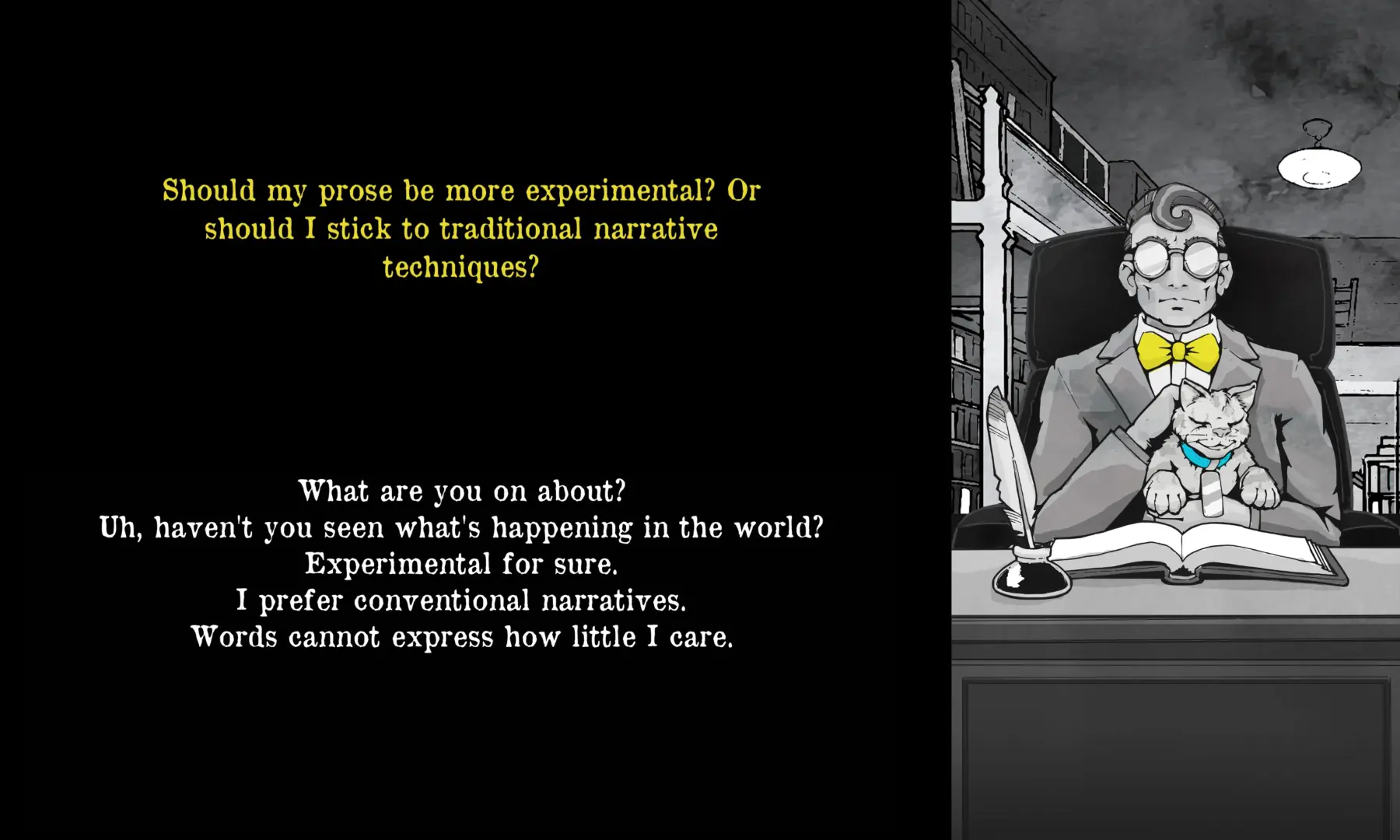
Another thing that jumps out is the voice acting, which immediately shines. If you’re not in a hurry, I recommend taking your time to let each voice line wash over you, especially those of Fate (Doug Pennant). Pennant does a truly fantastic job at what I can only call “butter-wouldn’t-melt corporate”, commanding attention while conveying just enough personality to feel real.
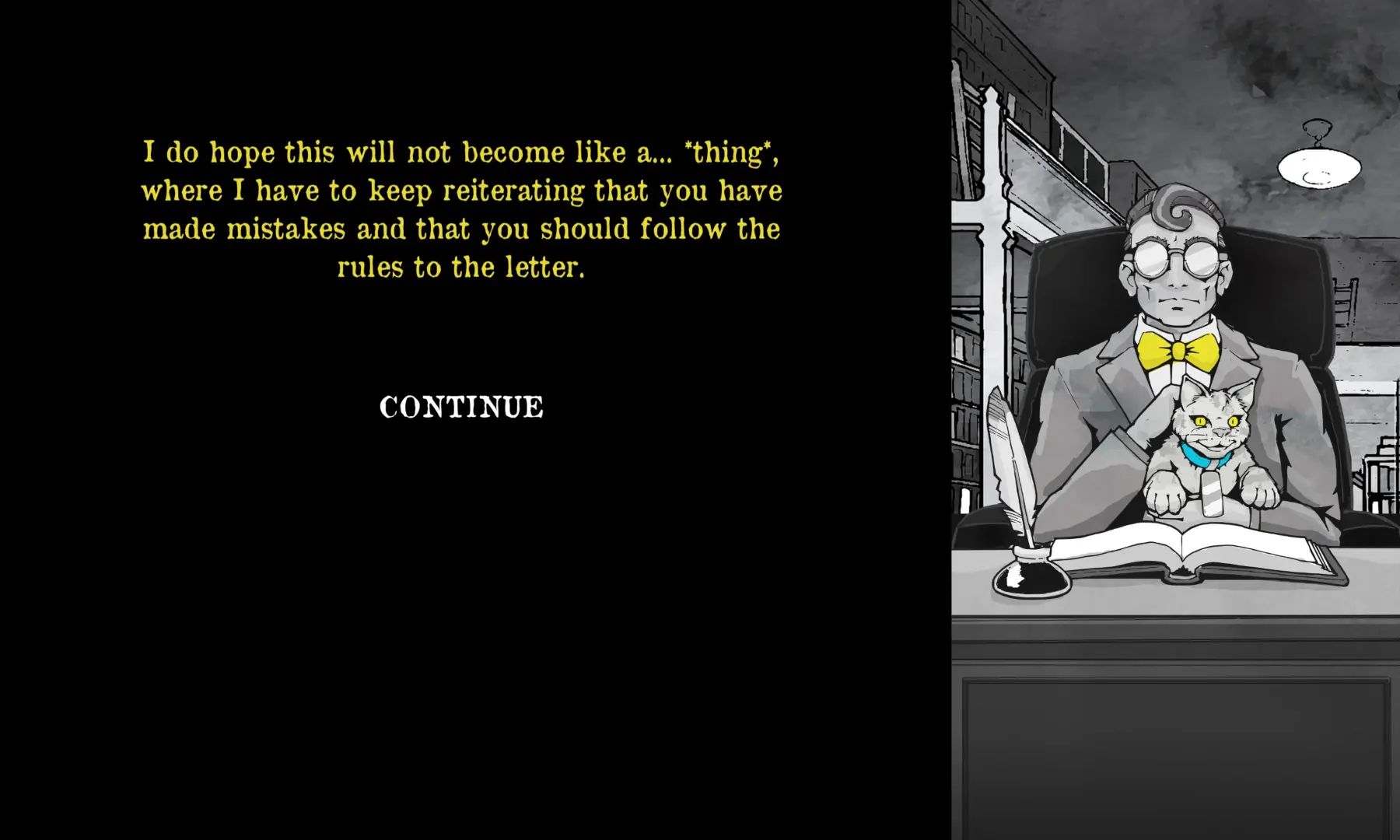
Similarly, other characters’ voices are largely their best tool to convey who they are, and they do so splendidly. Even though the game features a tightly limited cast of characters, all of them are great fun to interact with and leave you looking forward to seeing them again.
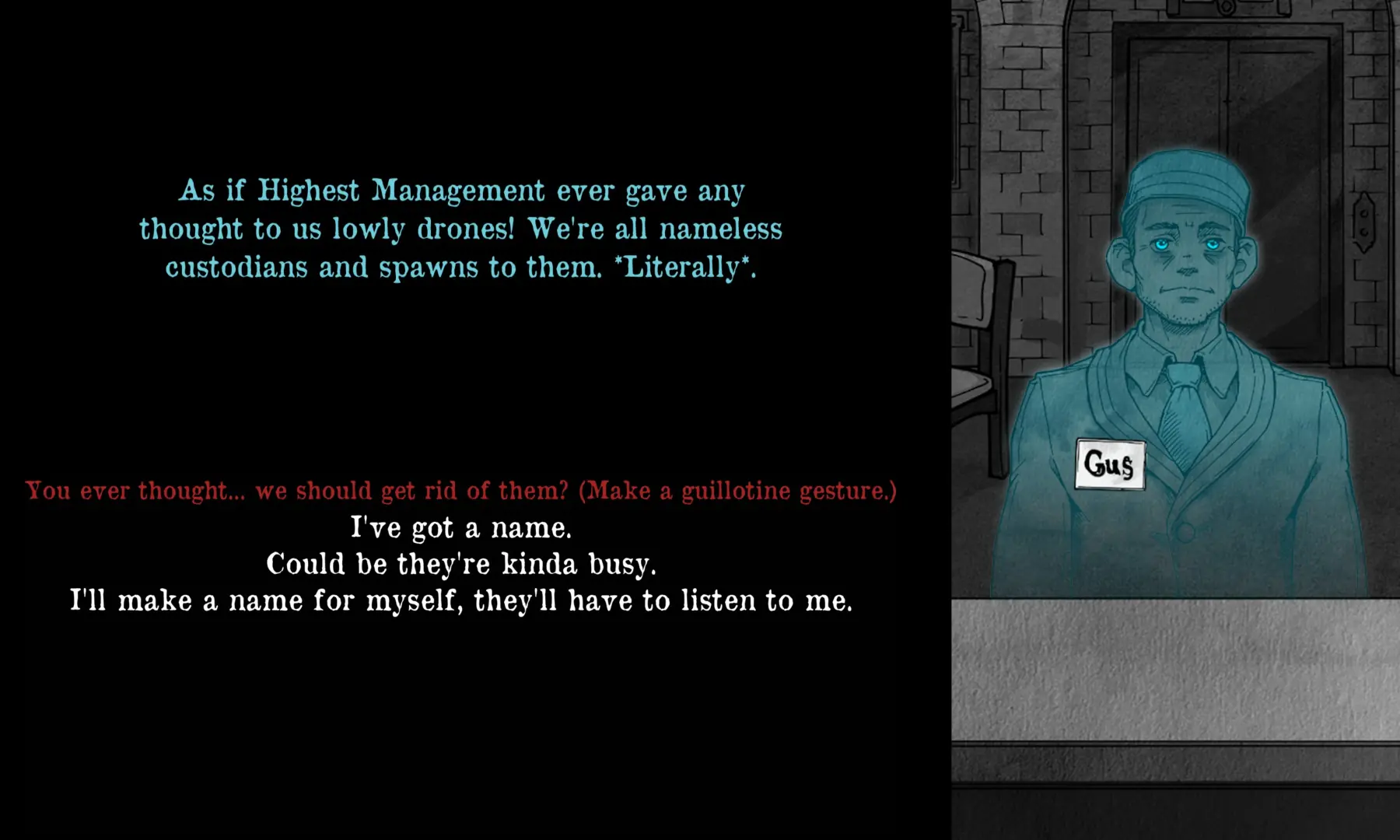
While on the topic of audio, I would be remiss not to mention the music! It’s jazzy, smooth, and easy to leave on in the background, and the entire soundtrack feels enormously cohesive in a way that lends the game its own audio profile. My only complaint is that tracks aren’t looping; they fade out and start over, which just isn’t my style. Still, it’s nice to keep the game running in the background at home and let my room feel like a 1920s speakeasy for a little while.
Simple and clean

Because one of the main themes of the game is mindless, tedious, meaningless corporate bureaucracy, it shouldn’t come as a surprise that the gameplay loop is on the whole pretty monotonous.
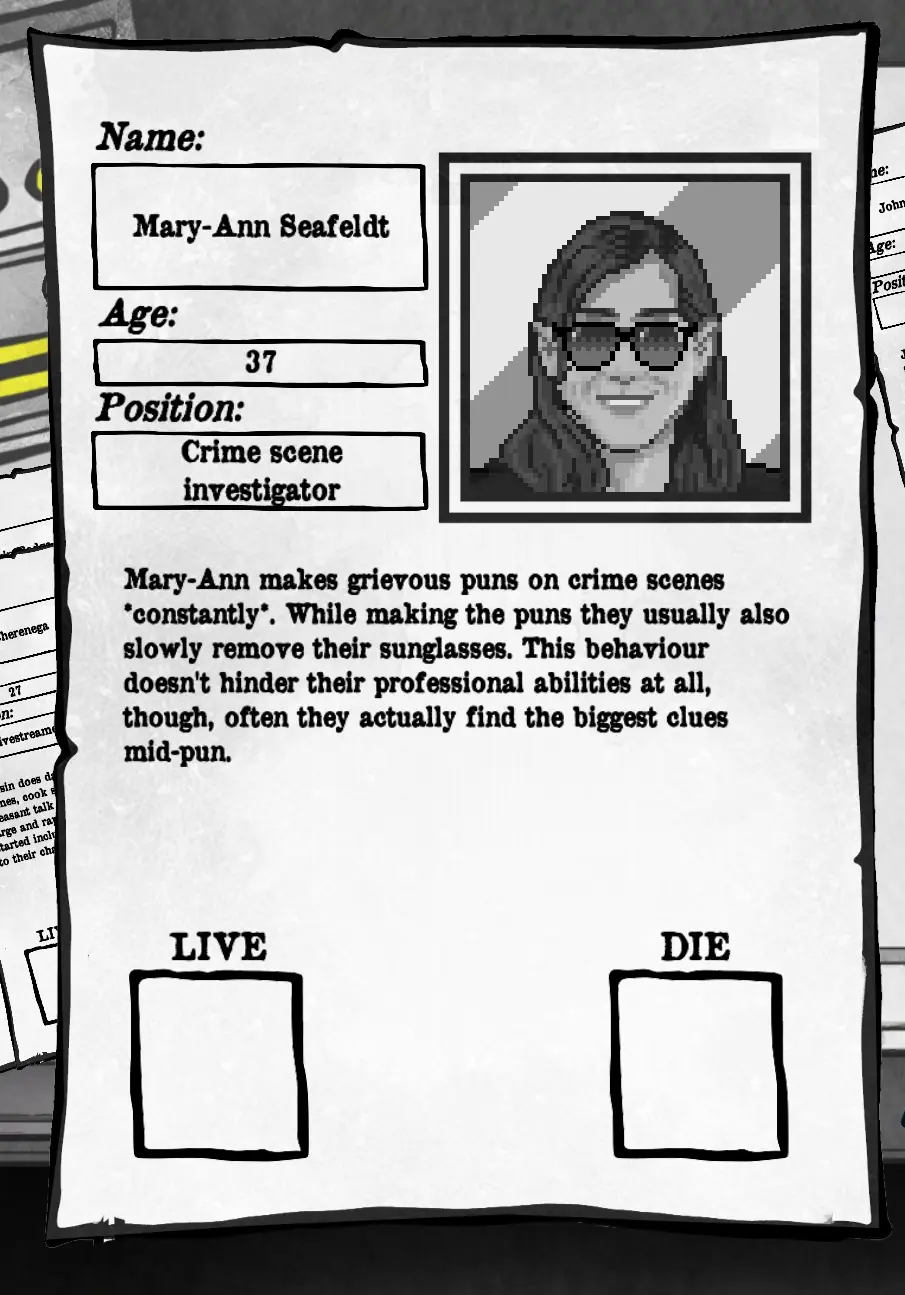
The vast majority of your time is spent staring at your desk, reading profiles and wondering, say, whose untimely death will prevent bees from going extinct, or how to avoid getting told off (whichever you care about more).
Because most of the game is sorting through profiles, a playthrough is about as long as you’re willing to spend doing that. This involves a fair amount of reading, but even the profiles are entertaining enough that I forgive it.
The game also frequently uses its simple interface and text-based mechanics to throw you for a loop, to great effect.
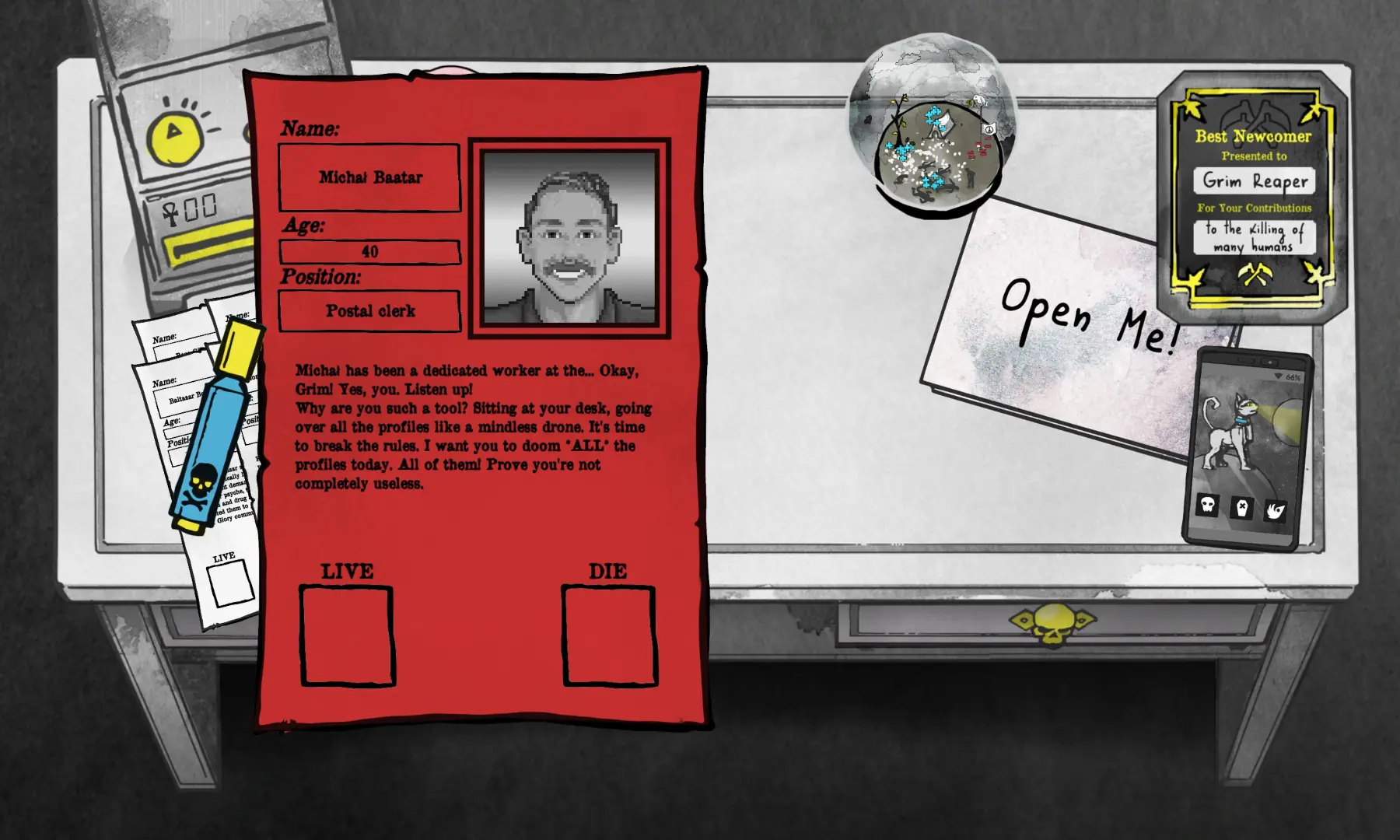
Overall, the interface is unfussy and takes zero time to settle into — mark papers at your desk, report to Fate at his office, buy a crazy funky chunky hat or something, put it on, go to bed, repeat.
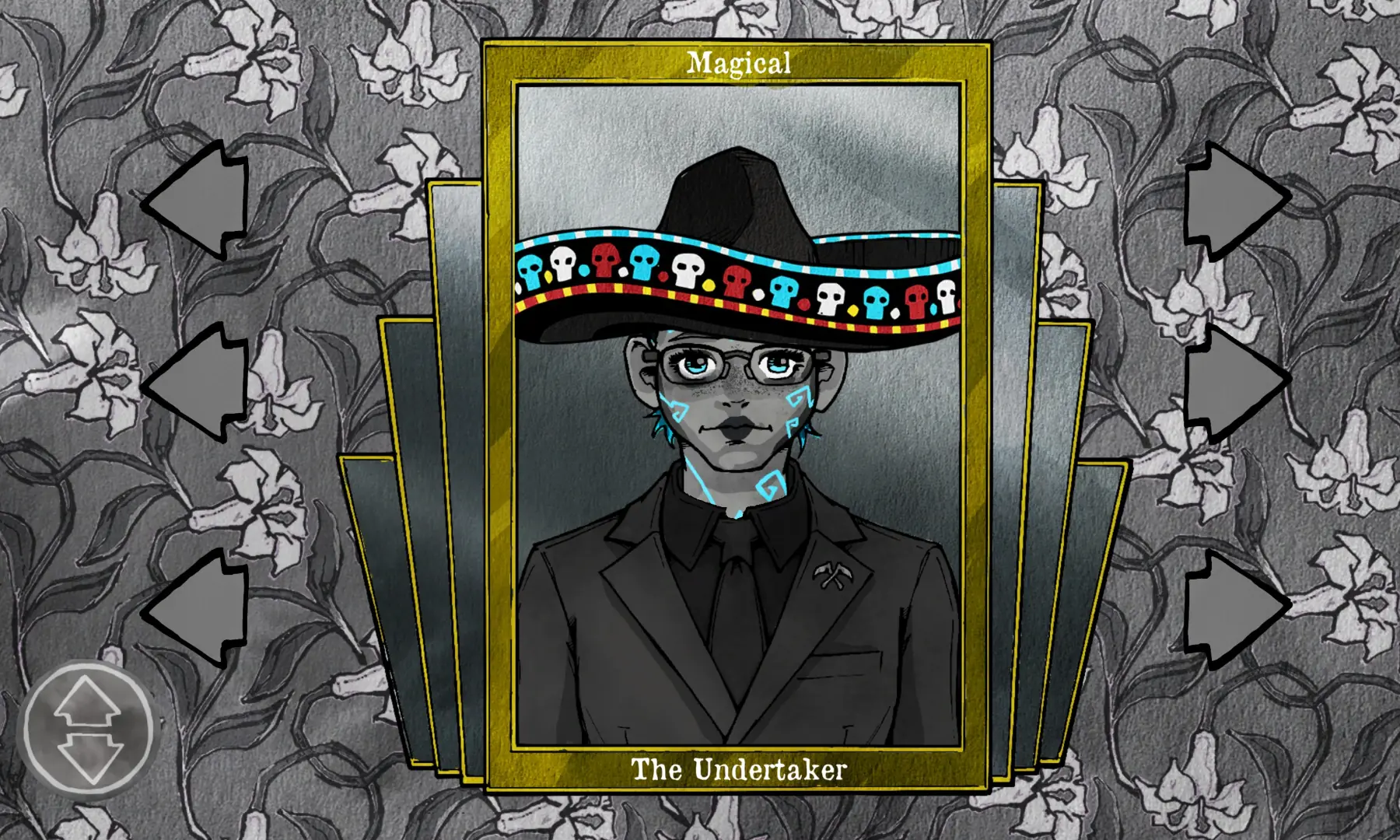
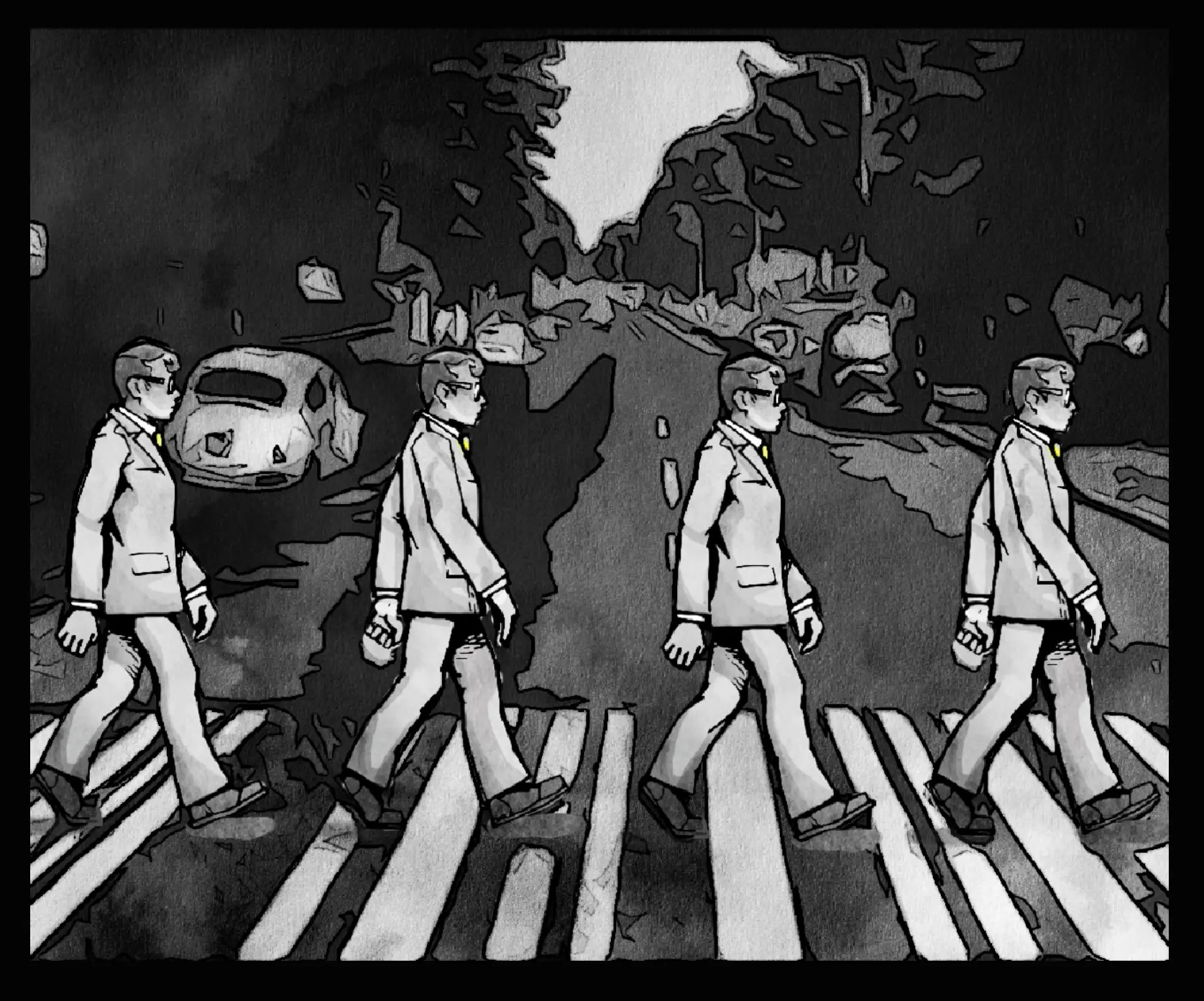
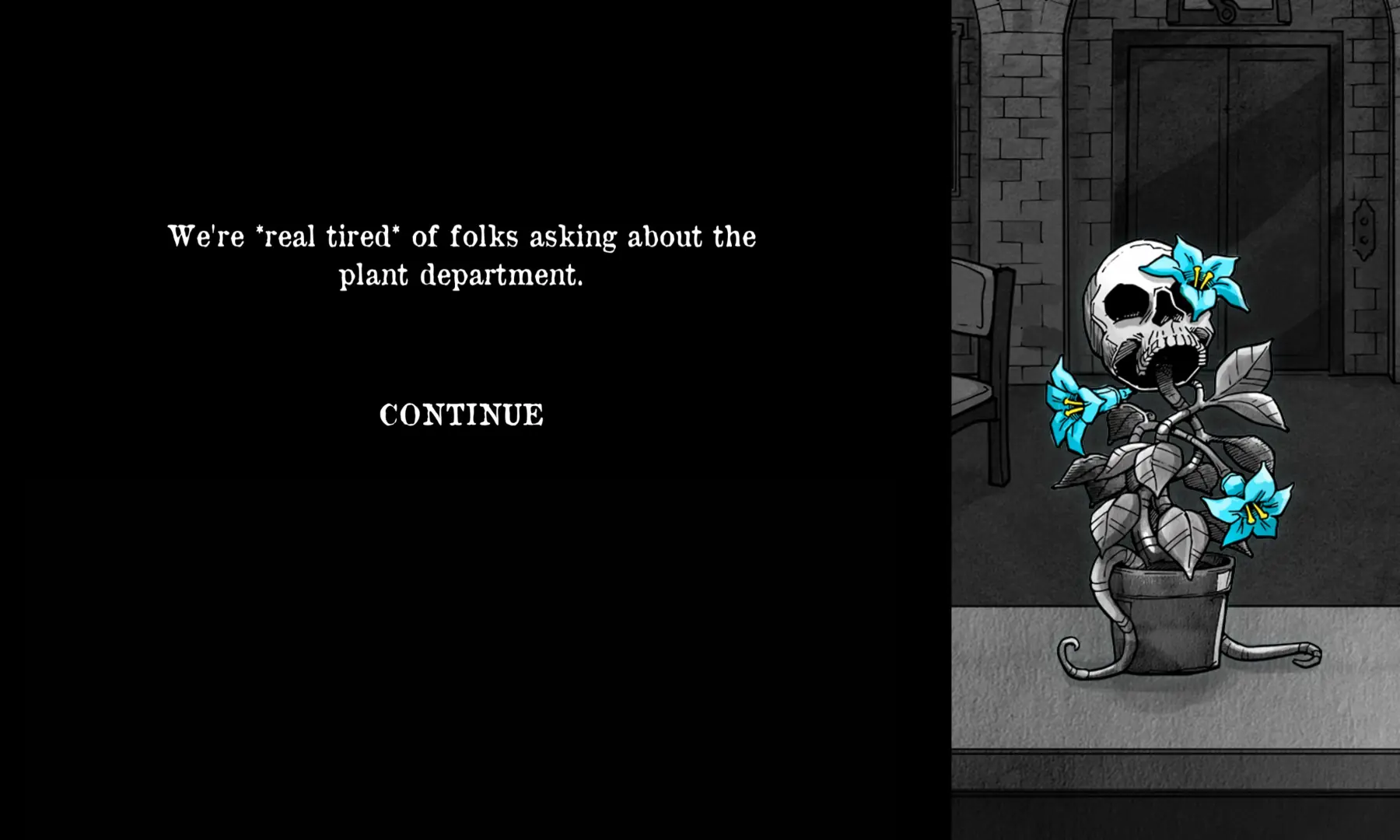
It’s visually and mechanically simple, but not too boring to look at, featuring delightful black-and-white illustrations with striking pops of colour. There are also some entertaining visual references to reward the media-savvy.
An incredible ripple effect
If you don’t love thinking, you could just mark all your profiles at random and speedrun… some sort of conclusion to the matter. But that defeats at least one purpose of the game, which is to give players a sense that even their smallest choices really matter — even if it’s not always clear how.
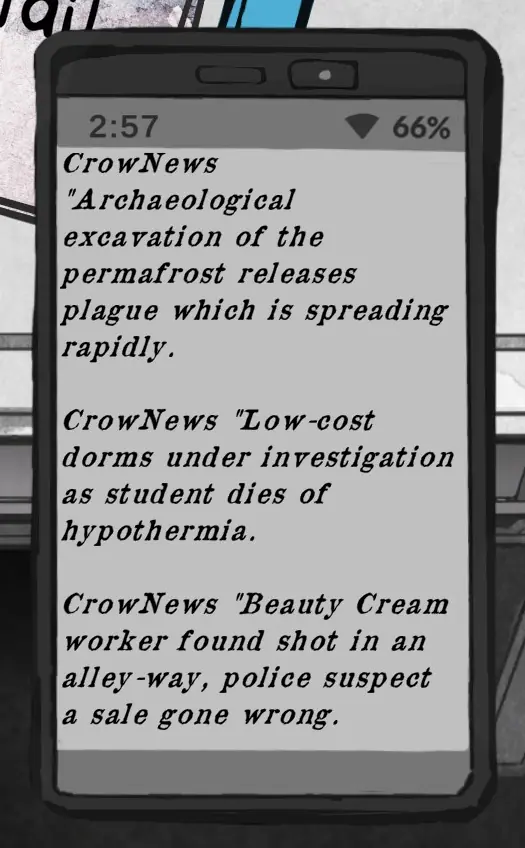
For example, one guy who believes the world is a simulation might gather a full-fledged cult following if left unchecked. A serial killer could end up on the loose if you kill all the investigators on the case. An archaeological expedition may well cause an outbreak of deadly plague. Et cetera.
Obviously, this means multiple endings based on your decisions, and I have yet to discover them all. I will say, without saying too much, that the very first one I got was… terrible and haunting. In a good way. It admittedly had some confusing elements, but made it crystal clear that I had put a little too much trust in things that were not my own personal judgment, and any doubts I had about the game’s themes were swiftly cleared.

This left me more determined than ever to do a much better job of keeping the world balanced on my next time around. That’s honestly the game’s biggest strength: it makes you want to do the best job you can, even when it’s tough and confusing and you have little to no idea how a choice might affect the world. Until it’s far too late and you can’t go back.
Or can you? Enter: New Game+.

Without this feature, I imagine blindly feeling your way towards various endings is much more of a drag. I confess I wasn’t looking forward to getting right back to the daily grind again, but being able to keep your helpful — and expensive — little widgets from the first go is a massive help.
Firstly, because a few of them actually really help you gauge the consequences of your actions — enough to speed up the proceedings a little, without undermining the unpredictability of the game too much. And secondly, because I no longer need to save up for a fancy lamp, it becomes much easier to flout Fate’s instructions in the interest of preventing certain doom.
Verdict: understated but impactful
This game does a lot with very little. While short and generally uneventful, the variety of endings and the sense of weight and impact given to each and every choice makes Death and Taxes feel much bigger than it is, and invites you to spend more and more time with it.
This is a game you can run in the background or give your full attention as you like. The gameplay loop is quite boring, because that only makes sense narratively. But if you find yourself emotionally invested, each choice stays compelling and tugs hard at your empathy, while challenging you to think beyond the surface-level rules. If you play it, I recommend going through it at least a couple of times to really get the intended experience.
File your taxes if you haven’t, and then go give this one a try.
Nazish Talati is a sub-editor on Dawn’s online news desk with a year of experience in communications and teaching. Her work focuses on global culture and entertainment news, particularly Japanese culture. She also reviews video games for the publication.