WHY CASH REFUSES TO DIE IN PAKISTAN
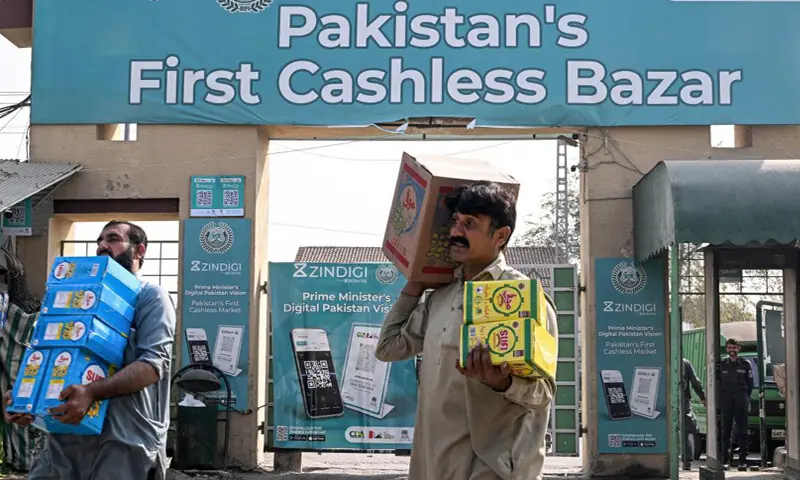
If you took a trip to a livestock market this past Eidul Azha, you could see Pakistan’s cash paradox performing itself live.
On one side, a bank kiosk with a QR code taped to a pole and some digital transactions happening. A few feet away, a bigger deal closing the old way: a purchaser counting out bundles of Rs5,000 notes, folding them into a plastic bag — no camera, no receipt, no trace. Both transactions were real and both continue to grow. This is the puzzle that this article shall attempt to solve.
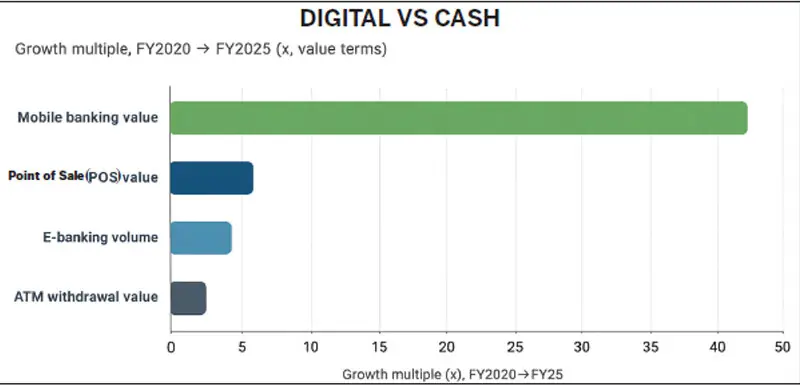
Currency in circulation (CIC) in Pakistan closed in fiscal year (FY) 2026 at roughly Rs 11.94 trillion, an all-time high, up 94 percent from Rs 6.14 trillion in FY2020. This happened in the same six years that mobile-banking transactions value grew 47 times over, active digital merchants quadrupled and the government launched a prime minister-led Cashless Pakistan Initiative, with real, verified results. Pakistan is digitising the transfer of money much faster than it is digitising the final act of spending it, and those are two different problems wearing the same headline.
This isn’t a cashless-transition story, but a cash-conversion story. Money moves through digital rails for a few seconds and then gets pulled back out as paper the moment it needs to actually buy something, pay a supplier or settle a property deal.
Pakistan’s digital payments revolution is real, but so is the country’s stubborn dependence on cash. As money increasingly enters the financial system digitally, only to be withdrawn again for settlements, the real challenge lies not with consumers scanning QR codes but with the wholesalers, distributors and property markets, where the country’s biggest transactions still happen in cash…
THE ARITHMETIC NOBODY READS TOGETHER
Pakistan’s central bank publishes CIC data weekly. Looking at the nominal number alone, the story is alarming, as cash almost doubled in six years, growing at an 11.7 percent compound annual rate, comfortably outpacing most measures of real economic activity.
Looking only at CIC as a share of broad money (M2) — which refers to all cash and coins in circulation, as well as all local currency bank deposits data — and the story flips to reassuring, such that the ratio fell from 30.1 percent in FY2020 to 25.7 percent in FY2026, because deposits and M2 simply grew faster than cash did. Both readings are correct, but neither, read alone, tells one what is actually happening to cash dependence in the country.
The more honest test is currency adjusted for inflation. In FY2020 prices, real CIC fell from Rs 6.14 trillion to about Rs 5.37 trillion by FY2026, a genuine 12.5 percent decline in the purchasing power tied up in banknotes.
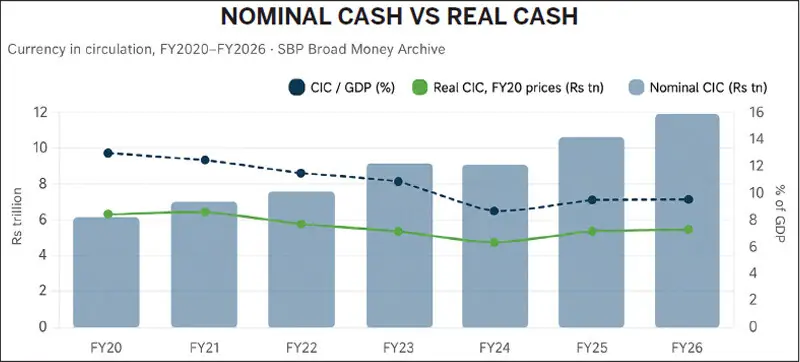
That is the strongest evidence in the entire dataset that Pakistanis are, at the margin, choosing to hold less cash than they used to. But the same series has a second chapter that gets less attention, as real CIC bottomed out in FY2024 and has been climbing back since, up 12.5 percent in FY2025 and a further 1.1 percent in FY2026.
CIC as a share of gross domestic product (GDP) tells an identical story, as it fell from 12.9 percent in FY2020 to a low of 8.7 percent in FY2024, then rebounded to 9.4 percent by FY2026. The long-run decline in cash intensity is real. The recent momentum is not, as it has stalled and, on some measures, gone into reverse.
This matters because most of the headline decline in cash intensity between FY2022 and FY2024 was not digitisation working, it was mostly inflation working its magic. When consumer prices roughly doubled in three years, the real value of every banknote in every pocket shrank with it, mechanically, regardless of anyone’s banking habits. Now that inflation has cooled, that mechanical tailwind has gone and the underlying trend of real cash creeping back up is what is left standing.
CASH GOES OUT FASTER THAN IT EVER COMES BACK
If the stock of cash is only slowly shrinking in real terms, the flow of cash tells an even sharper story.
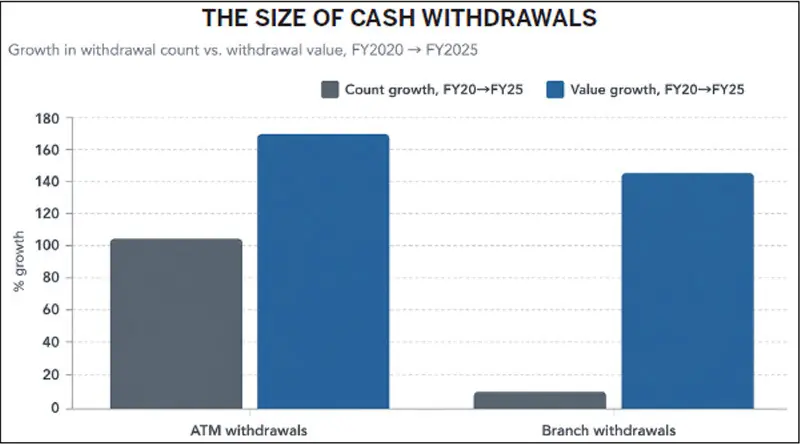
ATM withdrawals rose from 492.7 million transactions in FY2020 to just over 1.015 billion in FY2025, more than doubling. Branch cash withdrawals, the larger, more institutional cousin of the ATM trip, grew in value from Rs 4.46 trillion to Rs 11.08 trillion over the same period, a 148 percent increase, even as the number of branch withdrawal transactions merely plateaued.
Add ATM and branch cash-outs together, and FY2025 alone recorded 1.055 billion withdrawal events worth Rs 26.92 trillion, more than 20 million cash withdrawals every week, or roughly one for every eight adults in the country, on a weekly basis.
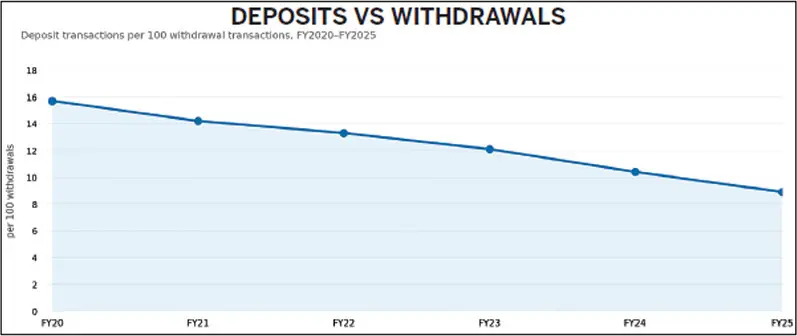
Now compare that to what came back in. Deposit transactions, the mirror image of a withdrawal, rose only 13.7 percent in count over the same five years that withdrawals rose 99.6 percent. The ratio of deposits to withdrawals, a clean proxy for how much cash re-enters the formal system relative to how much leaves it, collapsed from 15.7 deposits per 100 withdrawals in FY2020 to just 8.9 by FY2025.
Roughly 97-98 percent of everything an ATM in Pakistan does in a given month is still dispensing cash, not accepting it. We have built thousands of machines whose only real function is to push currency out of the banking system and almost none of whose function is to pull it back in.
This is the ‘cash-out loop’ and it is the actual mechanism behind the paradox. A salary lands in a bank account digitally, and so does a government subsidy that lands in a mobile wallet digitally. A remittance clears through Raast (Pakistan’s national instant payment system) in seconds. And then, within days if not hours, a meaningful share of that money is walked to an ATM or a bank counter and converted back into paper — because that is still how rent gets paid, how a wedding gets funded, how a shopkeeper gets paid, how a labourer gets his daily wage, or how almost 85 percent of the labour force of the country gets paid, as it largely operates in an informal space.
Digitising the deposit of money means nothing if the withdrawal habit at the other end is left untouched, or if the bridge between the informal and formal economy is non-existent. You have simply built a faster on-ramp to the same cash economy.
Even the size of the average cash transaction is moving the wrong way for a ‘less-cash’ narrative. The average branch cash withdrawal grew from roughly Rs 124,500 in FY2020 to nearly Rs 275,000 in FY2025, more than double, and well ahead of inflation. Cash in Pakistan is not becoming a small-change, low-value residual the way it has in Scandinavia or Brazil.
It is increasingly the instrument of choice for larger, more consequential transactions, property advances, wholesale settlements, big-ticket purchases, precisely the transactions a modern payments system should be capturing first, not last.
THE RS5,000 PROBLEM
Ask which single object is doing the most damage to Pakistan’s cash arithmetic and the answer is not cash in general; it is one banknote in particular.
In the absence of formally published data on the actual quantity in circulation of various currency denominations, we estimated the number through a function of the tonnage of paper produced for those currency notes, the change in currency in circulation and the weight of currency notes.
Through an optimisation function, it is estimated that Pakistan’s currency stock breaks down into roughly 22.4 billion physical notes in FY2025, rising to about 25.1 billion in FY2026. Of that pile, the humble Rs20, Rs50 and Rs100 notes, the ones genuinely used for daily small purchases, account for more than three in five of all notes in circulation, but barely a tenth of their value. The Rs1,000 and Rs5,000 notes, by contrast, are estimated to make up roughly 77 percent of the total face value of currency in circulation, despite representing only about a quarter of the physical note count.
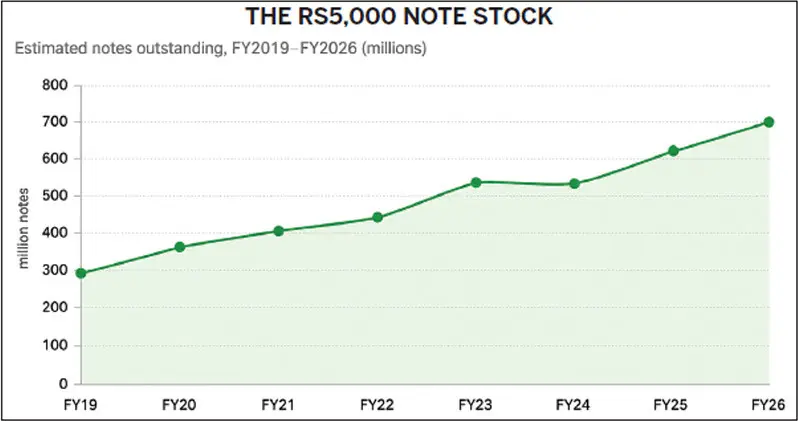
The Rs5,000 note alone is the outlier worth naming. Its estimated stock rose from about 291 million pieces in FY2019 to roughly 701 million by FY2026, more than doubling in seven years and, on these estimates, it now represents close to 30 percent of the entire value of cash in the country, in a single denomination.
These are estimates and, if data is published formally — which it should be — can be further corroborated. This is not the profile of a note used to buy groceries. It is the profile of a store-of-value instrument, something held in a drawer for a property advance, moved in a shopping bag for a wholesale settlement, put in a bank locker (because declaring it for deposits may not be possible), or simply parked in a never-ending supply of housing schemes or to hoard commodities (which also largely operate in cash).
A Rs5,000 note purchased today for the price of the paper and ink it’s printed on can sit outside any bank, any tax return and any GDP estimate indefinitely, and that is precisely what makes it valuable to whoever is holding it and precisely what makes it a policy problem for everyone else.
This is where the human element of the story actually lives, not in the small shopkeeper scanning a QR code, but one floor up, in the wholesale trade that supplies him.
WHERE THE REAL MONEY MOVES AND WHY NOBODY’S TOUCHED IT
Picture a wholesale cloth trader in Karachi’s Boulton Market on a weekday afternoon, closing out the week’s ledger with three mill agents and half a dozen retail buyers from smaller towns.
Almost none of that money will touch a QR code. Bulk orders are settled through post-dated cheques, informal running credit of 30 to 90 days and, for buyers without an established relationship, cash is counted twice and carried out in a shopping bag.
Multiply that single afternoon across every wholesale cloth, cement, steel, tyre, commodity, vegetable and fruits, and grocery market in every major city, and you have the real anatomy of Pakistan’s cash economy. It was never mainly about the man buying a kilogramme of flour, it is about the businesses buying and selling to each other, at a scale that that kilo of flour never gets close to.
This is also where the state has, almost by accident, already built half the solution and stopped short of finishing it. Since 2025, the Federal Board of Revenue’s (FBR) e-invoicing mandate — rolled out first to large taxpayers and importers, then extended through successive statutory regulatory orders (SROs) to essentially every sales-tax-registered business by the end of the year, with penalty enforcement active since January 2026 — requires every qualifying business-to-business (B2B) sale to be reported to FBR’s system in real time and stamped with a unique invoice reference number, before it can be used for input-tax adjustment.
On paper, Pakistan has quietly built one of the more aggressive digital-invoicing regimes in the region. What nobody has closed is the gap between the invoice and the payment, as an invoice records that a sale happened, not how it was settled. A cloth wholesaler can issue a fully compliant, FBR-stamped electronic invoice for a Rs2 million shipment and still be paid for every rupee of it in Rs5,000 notes. Pakistan didn’t fail to digitise business transactions, it digitised the paperwork around them and left the actual settlement exactly where it was.
This is also precisely why B2B deserves more policy attention than another round of consumer QR codes. A person-to-merchant (P2M) push has to win over millions of individual shopkeepers and hundreds of millions of individual buyers, one habit at a time. A B2B push has to win over a few thousand chokepoints, agriculture input providers, cement plants, sugar mills, steel re-rollers, fertiliser companies, flour mills, fast moving consumer goods (FMCG) manufacturers, and oil marketing companies that already sit inside the formal, FBR-integrated economy and already control who gets credit, stock and pricing down their own supply chain. Move the chokepoint, and compliance cascades down through every distributor, wholesaler and retailer that depends on it, without the state having to chase each one individually.
The clusters worth naming are not abstract. In construction and real estate, cash dominates supplier settlement for cement, steel and brick, largely because the property transactions further up the chain are themselves settled partly off the books, and that cash logic travels down to every material purchase beneath it.
In fuel retail, pumps already run card machines for the minority of customers who ask for one, but the bulk of daily receipts is still reconciled and banked as cash, because neither the oil marketing companies nor the dealers have been given a reason to change the default. And there is even more reluctance when smuggled fuel is also being sold and no tax is being paid on that.
In agricultural commodity trade and import-linked domestic distribution, cash remains the currency of the mandi [wholesale marketplace] and the port-side warehouse alike, moving value that Pakistan Customs and FBR can see arriving into the country but lose sight of the moment it changes hands domestically.
Behind every one of these clusters sits a genuinely human problem and it is not simply that businesses want to dodge tax. Talk to a mid-sized distributor almost anywhere in urban Pakistan and a familiar story emerges. His real annual turnover might be Rs 400 million, but his declared, bankable turnover — the number a loan officer is willing to underwrite against — is a fraction of that, because cash sales leave no trail a bank can verify.
Locked out of affordable formal credit, he borrows instead from the same informal network that keeps him cash-based in the first place, which may include commission agents, input suppliers, sometimes the very anchor firm he buys from, at rates well above anything a bank would charge, simply because that lender can already see, informally, what he actually sells.
In the context of agriculture, an effective informal market clearing interest rate can be higher than 80 percent, while a bank may lend at 15-20 percent, provided if it actually wants to lend, given all the information asymmetry. Formalising his payments would, paradoxically, be the very thing that finally makes him bankable on fair terms.
This is exactly where credit guarantee mechanisms, instruments that let a bank lend against a thinner collateral file because a portion of the downside risk is shared with a third party, could be built specifically around a distributor’s digital transaction history rather than land or fixed-asset collateral. The incentives need to be structured such that digital settlement leads to cheaper, more readily available working capital, not merely the threat of an FBR notice.
None of this moves without confronting the politics. Every one of these clusters is represented by a trade body or chamber or a political champion that has, for decades, treated informality as a competitive advantage worth defending, and every past attempt at a documentation drive or cash threshold has run into the same wall of strikes, shutter-downs and quietly reversed notifications.
The lesson from those failures is not that enforcement doesn’t work. It is that enforcement announced without a transition window, without an amnesty for past undeclared inventory and without a genuine financing carrot on the other side reads as confiscation rather than reform and gets resisted accordingly.
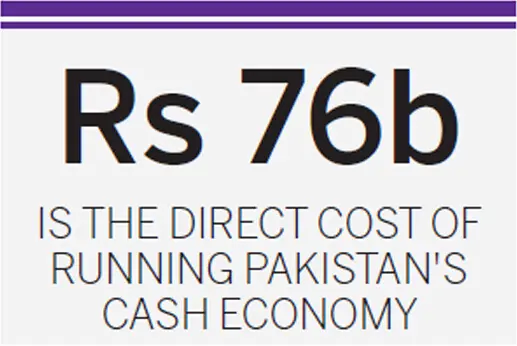
None of this is free. In a similar article a year ago, we estimated that the direct cost of running Pakistan’s cash economy, printing notes, transporting them, guarding them, feeding more than 18,700 ATMs, comes to about Rs 76 billion annually, a figure that rises every year the rupee depreciates against the imported paper and ink that go into every note.
That is the visible bill. The invisible one, capital that never becomes bank deposits, transactions that never generate a tax trail, informality that keeps businesses small enough to stay under the radar rather than scaling into exporters, is much larger and it is the one that actually constrains growth.
WHAT IS GENUINELY WORKING
Pakistan already has a Cashless Pakistan Initiative, launched in June 2025. Its first-year review produced numbers any emerging-market payments programme would be glad to show. Active digital merchants quadrupled from roughly 500,000 to more than two million, annual digital transaction volumes rose from 6.9 billion to about 11.3 billion, mobile-banking users grew from 95 million to 137 million and the share of home remittances credited digitally climbed from about 80 percent to 92 percent. On the government’s own side, roughly 75 percent of payments across centralised and self-accounting entities are now processed digitally.
The Eid livestock markets are the most vivid evidence that this is not just a slide-deck achievement. The State Bank’s “Go Cashless” campaign expanded from 54 cattle markets in 2025 to 123 in 2026, deploying mobile banking vans, on-site QR on-boarding and biometric verification for traders who have transacted exclusively in cash for generations.
Digital payments recorded at these markets rose from about Rs 4.6 billion to Rs 34 billion in a single year, a seven-fold jump, in arguably the most cash-entrenched, trust-deficient corner of retail commerce in the country. But this still remains at less than 10 percent of total value of transactions that are estimated in Eid livestock markets. If a livestock trader at a mandi can be moved onto a QR code, the excuse that ‘our market isn’t ready’ stops holding up for much softer targets.
However, the uncomfortable part of an otherwise good-news story is that every one of those metrics measures digital access, not cash displacement. Merchant sign-ups, transaction counts and app downloads all answer the question ‘can people pay digitally now?’ None of them answer the harder question this article opened with: is currency in circulation actually shrinking, or is it just circulating through a shinier front door before landing right back in the same drawer?
On the evidence assembled above, record nominal CIC, a stalled real-CIC decline, a widening cash-out loop and a Rs5,000 note still expanding faster than the economy around it, the honest answer, for now, is that access has outrun displacement.
WHAT NEEDS TO CHANGE
The next move needs to be on B2B and that doesn’t require yet another QR code. Large transactions need to be made structurally digital. Require any payment above Rs50,000, individual or business, to move through a bank transfer, Raast, card or other SBP-authorised digital channel, with linked or split payments aggregated to close the obvious workaround. Cash above the threshold should simply not be recognised for invoice settlement or title transfer. This is not a ban on cash, but a redrawing of where cash is allowed to do useful work.
Similarly, the real-estate gap between ‘white’ and ‘black’ value must be addressed. No property transfer should register unless the full sale consideration moves through a traceable banking channel, ideally via mandatory escrow linked to title records, tax valuation and the National Database and Registration Authority (Nadra) identity, eliminating the single largest legitimising use of large-denomination cash in the country. Everyone knows this exists, but no one dares touch it, because it potentially hurts their own interests.
The Rs5,000 note also needs to be on a managed glide path, not a cliff edge. There needs to be no net expansion of the denomination and gradual reduction in the replacement rate for worn notes surrendered to banks in phases — 75 percent, then 50 percent and then 25 percent of what is surrendered, while the note remains fully legal tender throughout. Passive demonetisation, done publicly and gradually, avoids the trust shock of an abrupt withdrawal, while still shrinking the instrument that does the most damage.
The B2B clusters where the money actually concentrates need to be targeted with mechanisms, not moral appeals. This is the highest-value, least-touched lever in the entire programme. The invoicing-payment gap needs to be closed by amending FBR’s e-invoicing rules, so every invoice reference number carries a mandatory, verifiable payment-method field, digital or cash, reconciled against actual settlement, not just the sale. An invoice without a matching digital payment trail above the reporting threshold should not qualify for input-tax adjustment. The infrastructure to capture this already exists.
Make formalisation bankable, not just compliant. Pair enforcement with working capital lines, priced against a distributor’s digital transaction history rather than land or fixed-asset collateral, precisely the collateral and data gap that credit guarantee institutions exist to close. A distributor who digitises should walk out of the bank with a thicker file and a cheaper rate, not just a smaller tax exposure.
Reforms need to start from where infrastructure half-exists already: fuel retail, where point of sale (POS) terminals sit largely unused at most pumps; cement and steel, concentrated among a handful of already-integrated large producers; sugar and tobacco, already tracked through excise, before moving to harder, more fragmented clusters such as general wholesale and imported goods. Early, visible wins in sectors that are easy to reach buy the political room needed for the harder rounds later.
None of this requires inventing new infrastructure, as existing infrastructure is sufficient to catalyse the movement. The merchant base has already quadrupled once and the Cashless Pakistan Initiative proved that adoption can be engineered fast when the incentives and the enforcement machinery are aligned, from a livestock market to a corporate treasury in Karachi.
What is missing is the second half of the programme, pointing that same machinery not at the shopkeeper with the QR code but at the wholesaler, the distributor and the anchor firm sitting one layer above him, the layer where the real money, and the real resistance, actually sits.
THE CHOICE
Pakistan can keep publishing merchant on-boarding numbers and mobile-app downloads and call it a cashless transition, or it can start measuring, and pricing, whether cash itself is actually shrinking. The two are not the same exercise and six years of State Bank data now make that gap impossible to ignore.
Currency in circulation is at a record high, the cash-out loop gets wider every year and a single banknote accounts for close to a third of everything printed. The infrastructure for the next phase already exists. What is missing is the willingness to make cash, specifically the large, structurally embedded kind, cost more than it is worth and to point that willingness at the wholesale market and the distributor’s ledger, not only at the shopkeeper’s till.
Until that happens, three people will keep occupying the same economy without ever quite meeting: the mandi trader who has learned to scan a QR code because the State Bank showed up with a van; the property dealer still counting out Rs5,000 notes because nobody has closed the gap between declared and actual value; and the distributor stuck paying an informal lender four-times the bank rate because the digital trail that would make him bankable is the same trail he’s spent years avoiding.
Pakistan will keep calling the first of those three progress. It is the other two that will decide whether cash actually dies or simply learns to wear a QR code on the days someone is watching.
The writer is a macroeconomist and
professor of practice at IBA, Karachi.
He can be reached at ammar.habib@gmail.com
Published in Dawn, EOS, August 16th, 2026
The author is an assistant professor of practice at the School of Business Studies, IBA, Karachi. He has previously worked at several financial institutions in Pakistan, both in commercial banking and capital markets.