What’s eating Pakistan’s mangoes?
Fruit sellers at roadsides and bazaars are bracing for Pakistan’s yearly mango madness. Their baskets are filled with the early Sindhri crop for now as they wait for the Punjab Langra and Dusehri, soon to be followed by the Chaunsa and Anwar Ratol.
This year’s season arrives with as much anxiety as anticipation. Fluctuating temperatures, erratic rain and hailstorms early in the year, the period critical for flowering, fruit set and ripening, have damaged orchards across Punjab’s mango belt, covering Multan, Dera Ghazi Khan and Bahawalpur divisions in the south and Sahiwal, Faisalabad, Sargodha and Lahore in the central and northern parts of the province.
The prolonged stagnation after last year’s floods weakened root systems and stressed trees already battered by climatic shocks. These setbacks, coupled with uncertainty in export markets amid tensions surrounding the US-Iran-Israel conflict, have kept growers, contractors and traders on the edge over the season’s fragility.
“I can safely say that around 40 per cent of the crop in my area has been damaged,” said Rabia Sultan, a grower who cultivates several varieties, including Summer Bahisht, White Chaunsa, Anwar Ratol and Sindhri, across nearly 100 acres of fertile land in Kot Addu, South Punjab.
Major Tariq Khan, director Lutfabad Farms and director operations Progressive Mango Growers Group, said the yield has been dropping over the last few years, but this year has been particularly “troublesome”. “If you drive through the mango-growing belt of South Punjab for instance, you’ll witness the extent of damage,” he said.
Although the Dusehri and Langra have been spared somewhat as they develop earlier in the season. “They had matured before the early-season stress set in. Chaunsa and Ratol that ripen later in the season have been most affected.”
Bad weather
Usually, from the cool days of February to the scorching months of May and June, each stage of the mango cycle is delicately timed. The trees emerge from dormancy, begin flowering, pollinate, and eventually bear and ripen fruit in smooth succession. This year, however, abrupt temperature swings tore through this cycle.
News reports, AccuWeather forecasts, and Pakistan Meteorological Department (PMD) outlooks say that February clearly departed from normal winter conditions across Punjab. It turned unusually warm, with day-time temperatures rising to 24°-28° Celsius and night-time lows ranging between 11°-14°. The PMD said the monthly mean was 17.1°, which is about 2.5° above average.
If it was warmer, it was also parched. It rained 88.8pc less across Punjab in February, leaving orchards thirsty at a critical stage of crop development. Perhaps the only upside to this pattern was that it sped up flowering earlier than usual. “We surveyed the orchards in February and saw trees profusely laden with boor (flowering),” said Hafiz Asif Ur Rehman, Principal Scientist, Mango Research Institute in Multan. This development initially gave them the impression that 2026 would yield a bumper crop.
Unexpectedly, the mercury stayed up as March rolled around, with day-time highs inching to between 32° and 37° — roughly 2° to 6° higher than normal. The night-time temperatures stayed at between 14° and 18° which was around 1° to 3° above normal for this time of the year.
“The high temperatures during this flowering period suddenly reduced pollen viability,” said Riaz Hussain, a scientific officer at the Mango Research Institute. “[This] disturbed pollinator activity, and conducive flowering. It also caused some premature fruit to drop.”
Worse, by mid-March, the pattern shifted again. Instead of temperatures transitioning into warmer degrees, they sank from the 30s to the 20s during the day. The night-time temperature remained more or less consistent.
This contrast between an unusually hot start and a cooler, unstable end of the month, complicated the crop cycle. Many orchards showed uneven flowering, multiple fruit-setting waves, delayed fruit maturity, and “increased bator or malformed clusters that favour pest infestation, particularly mango hoppers and fungal problems,” said Hussain.
April and May settled back into seasonal norms but sporadic hail, rain, and windstorms continued to disrupt the pattern. Temperatures would fall several degrees below average in affected areas. “Such bursts of temperature may scar the mango skin and make it less suitable for export and reduce its market value,” said Waqas Bucha, who manages 30 acres of orchards along Bosan Road in Multan.
Drowning
Even before the temperatures played up, prolonged waterlogging after the 2025 floods had damaged feeder roots, reduced soil aeration, and weakened overall tree physiology, particularly in low-lying orchards near riverine areas of Chenab.
According to the Pakistan Society for Horticultural Science, last year more than 41,000 acres or over half of the total orchards in Multan, Shujabad, and Jalalpur were left under water. “The brunt fell on small and medium-aged orchards, where trees, still in their most productive years, were uprooted or severely stressed,” it said.
In several areas, late vegetative growth remained tender for longer periods, making them more vulnerable to insect attacks and nutrient imbalance because saturated soils don’t absorb fertiliser the same way.
These conditions created an environment for the hopper and other stubbornly resistant pests. Waqas Bucha has already sprayed pesticides twice, but the disease refuses to go away. Major Tariq Khan has done it thrice, yet the infestation persists. “In some areas,” he added, “farmers have gone up to eight sprays, but still cannot bring pests under control.”
Dawn reported on May 13 that the Ministry of Commerce has extended the start of export season to June 1, 2026, saying it was doing so because of stakeholder requests and climatic shifts that have delayed fruit maturity, particularly for the Sindhri.
Long-range shifts
In the last five years Punjab has had a clear officially documented shift from seasonal stability to exceptional high heat and rainfall. It has prolonged summers, hitting up to 40°-45° Celsius, and shorter and milder winters, with day temperatures ranging between 18°-24° and night-time lows of 5°-10°, both reflecting an estimated 3° rise in mean temperature.
Rainfall has become far more unstable. The 2022 monsoon delivered about 77pc above-normal rainfall while 2024 again recorded above-normal monsoon activity.
Shrinking acreage
Across the five-year trajectory, according to the Final Kharif Estimates by the Punjab Agriculture Department, the mango economy shows a clear move from a stable, productivity-led system to an expansion-driven model in which land increase is beginning to compensate for weakening efficiency per acre.
In the early phase (2019-20 to 2020-21) the cultivated area was relatively stable, hovering around 240,000-244,000 acres. But yield fell 6pc from 143.79 to 135.02 maunds per acre. In the next phase (2021–22 to 2022-23) the area stayed at 244,500 acres, but yield dropped 4pc from 148 to 142 maunds. In 2023-24, the yield increased sharply to 173.5 maunds per acre despite unchanged acreage, possibly due to better weather. Last year, 2024-25, cultivated area jumped 55pc to 378,975 acres. But yield dropped to 148.4 maunds per acre, 14.5 percent lower.
Dr Azeem Sardar, an Agricultural Development specialist with The Urban Unit, is clear that the changing weather is “one of the major reasons behind the lower mango yield.”
Warning signs
Tariq Khan’s area was once known for its thriving cotton fields, which were slowly abandoned by farmers who could not keep fighting climate change, pests and sinking yields. He fears mangoes could meet the same fate unless growers adapt.
Hafiz Asif Ur Rehman said they advise farmers to adopt careful irrigation, like avoiding watering already wet soil, maintaining a green grass cover outside the canopy to reduce heat stress, spraying water on the sun-facing side of fruit-bearing trees during extreme temperatures above 45°C, and applying mulch under the canopy to regulate soil temperature. Farmers who combine good agricultural practices, such as timely pruning, nitrogen application during dormancy, and scheduled pesticide sprays, have been better able to protect their crops.
Weather forecasting and early warning systems help, but Dr Azeem Sardar added that “climate-smart orchard management remains an evolving field in the country.”
Experts say transitioning from traditional mango cultivation practices to climate-resilient approaches remains gradual and faces several challenges. “Many small and medium-scale farmers continue to rely on conventional farming practices due to financial limitations, lack of technical knowledge, and restricted access to efficient irrigation systems and quality inputs,” said James Robert Okoth, Officer in Charge, FAO Pakistan.
Farmers are slow to pivot but so is government. “We have approached the climate change ministry, Muhammad Nawaz Sharif University of Agriculture, and other bodies, but it is always the same response, ‘yes, yes, let’s do something,’ and then nothing materialises,” he said.
Around 92pc of mango growers in South Punjab are small landholders who don’t have the capacity to innovate or independently adapt to climate pressures. And each damaged crop and shrinking yield is spreading the fear that the king of fruit, the Pakistani mango may become another casualty of the global climate crisis.
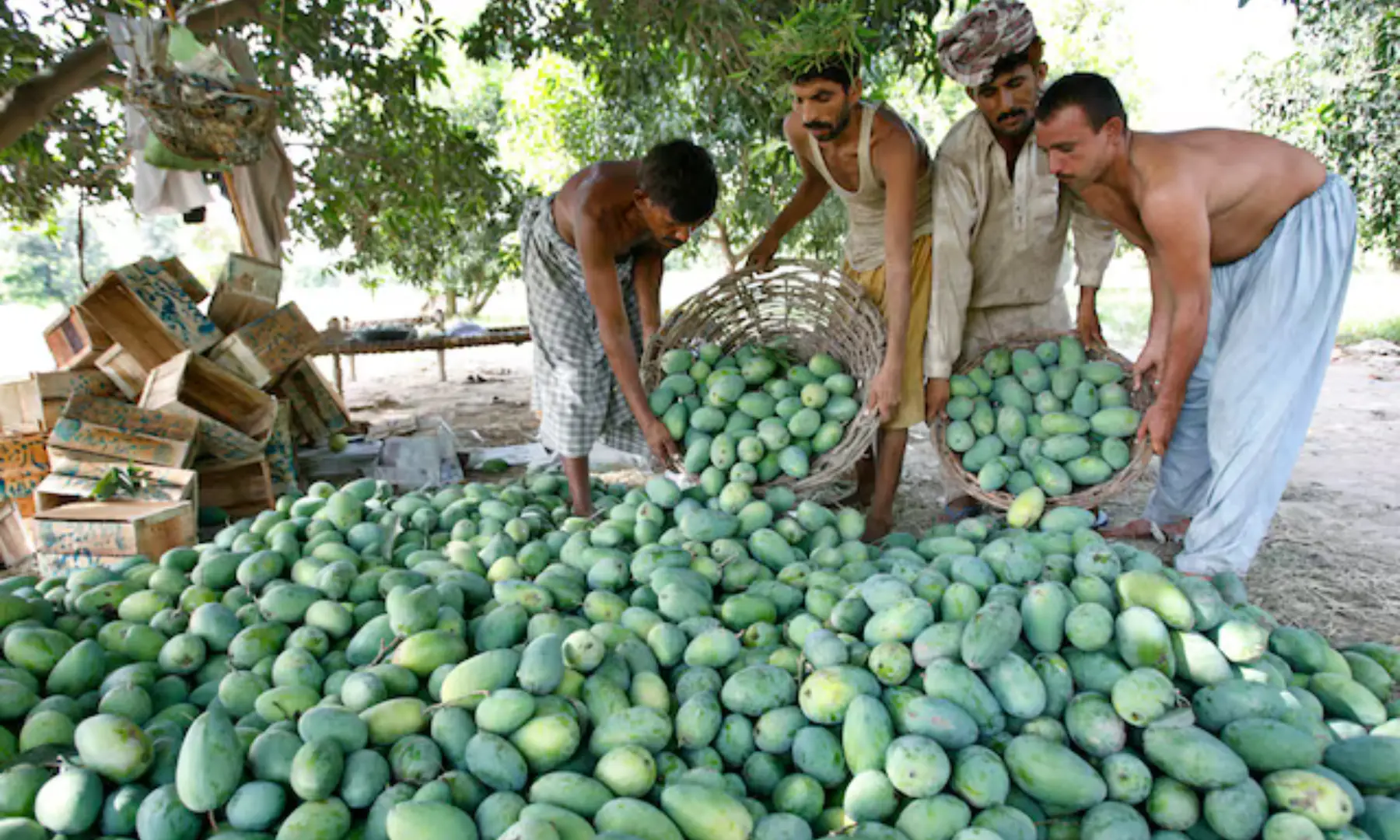
Header Image: Farmers sort mangoes near Multan August 15, 2007. Credits: Reuters


 14
14
The author is a freelance journalist based in Lahore. She can be reached at alefiath@gmail.com