The malnourished children of 2018 are teenagers now. What's the plan?
In 2018, Pakistan produced the widest survey in its history on how much nutrition its people were getting. The NNS or National Nutrition Survey was the fifth such epic exercise to be undertaken since 1965, and the first ever to show us the numbers from the districts. It was the most comprehensive data-gathering effort in Pakistan’s history and is regularly cited today in policymaking.
The NNS results painted such an alarming picture at the time that the government should have declared a national emergency. Instead, I find myself writing this seven years on with a question as Finance Minister Muhammad Aurangzeb tables an estimated Rs17.1 trillion federal budget for fiscal year 2026-27: What did Pakistan’s budget-makers do with the population nutrition evidence?
No prizes for guessing the answer was scant little. What we got instead is a story of policy documents without funding to see through on the ground, bodies meant to coordinate without the mandate or teeth, and a government that continues to treat nutrition as a humanitarian footnote rather than the country’s economic foundation it actually is.
The FY2025–26 federal budget offered a clear indication of where nutrition stood among national priorities. Health spending was reduced by 16 per cent, while no dedicated nutrition allocation was included in the federal budget architecture.
Quiz: Is this child malnourished, stunted or wasted?
Look at the photo carefully, then choose your answer below.
Age: 3 years · Height: 87 cm (average for age: ~96–99 cm)
How others answered
Be the first to answer
Image: UNICEF Pakistan
This poll accompanies Prism's reporting on childhood malnutrition in Pakistan. Stunting, wasting and malnutrition are clinical conditions defined by measurement — height-for-age, weight-for-height and weight-for-age respectively — and cannot be reliably diagnosed from a single photograph. This exercise is intended to illustrate how easily these conditions are misread by sight alone, not to diagnose any individual child.
What the survey told us
The 2018 National Nutrition Survey was an extremely big deal in health and policy circles. It was done by the Ministry of National Health Services that teamed up with the Aga Khan University and Unicef to survey over 115,600 households and, for the first time, drill down into district-level breakdowns, adolescents, and water quality. The data it produced was both authoritative and devastating.
-
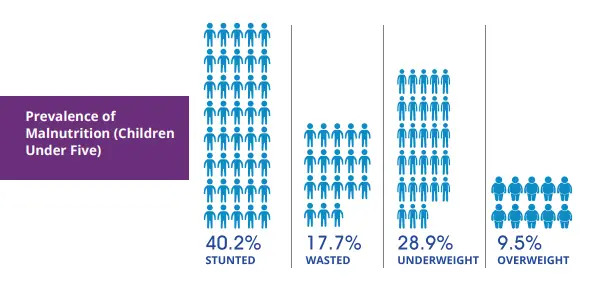
Four out of every 10 children under five years in Pakistan were stunted or too short for their age. This means that about 12 million children were suffering from chronic malnutrition.
-
Wasting was 17.7pc, the highest recorded in Pakistan’s history and well above the WHO’s 15pc emergency threshold.
-
More than half of children aged six to 59 months were anaemic.
-
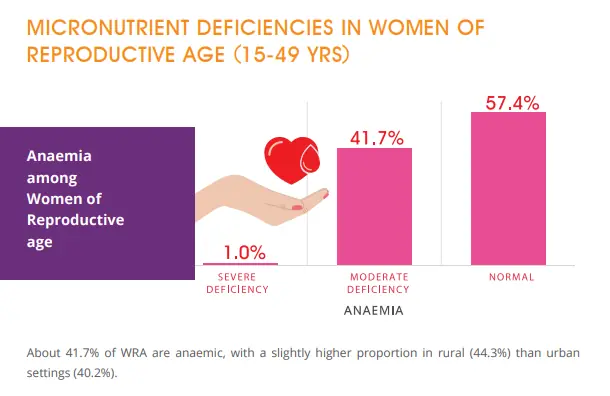
Among women of reproductive age, 42.6pc were anaemic and 46.9pc of pregnant women were iron-deficient.
-
A staggering 81.2pc of pregnant women were vitamin D deficient.
-
Meanwhile, the country was simultaneously confronting the other end of the malnutrition spectrum: overweight prevalence had nearly doubled in seven years, and 13.9pc of women of reproductive age were obese.
The NNS 2018 was also the first survey to reveal the burden of stunting and wasting happening at the same time in children: 5.9pc of under-fives are affected, and they live mostly in Pakistan’s south. Boys are worse off than girls, and children in cities were more wasted and stunted than commonly assumed. Also, 58pc of Pakistan’s household water supplies were contaminated with coliform bacteria. Malnutrition and unsafe water are not separate crises. They are the same crisis.
This data was published, cited in international fora, incorporated into global nutrition dashboards, and referenced in at least four major national strategy documents. What it did not do was translate into a budget line.
What we decided to spend on the 2025-26 budget
Pakistan’s federal budget for the soon ending financial year, 2025-26, was Rs17,573,000,000,000
Nearly half, Rs8.2 trillion, goes to debt servicing
Defence has been allocated Rs2.55 trillion, a steep 20pc increase
The Benazir Income Support Programme receives Rs716 billion, a 20-21pc increase, covering 10 million families.
These are not illegitimate expenditures at all, but they do tell us where our political priorities lie when fiscal space is compressed.
Health has not been spared in the compression. The health budget for 2025-26 stands at Rs46.1 billion — a 16pc reduction from the previous year’s Rs54.87 billion allocation.
No new health schemes appear in the Public Sector Development Programme for this fiscal year. Within this already-reduced health envelope, the share dedicated specifically to nutrition is not separately reported because, in Pakistan’s federal budget architecture, nutrition does not have its own line. It is submerged within health, within social protection, within agriculture, invisible, untracked, and unaccountable.
The estimated budget requirement for nutrition from 2023 to 2030 is Rs1.79 trillion. For the current fiscal year alone, the requirement is Rs227.9 billion. Against this need, Pakistan allocates a fraction which is declining. It is hard to describe this as a funding gap and easier to call it a choice.
The rule is that when a subject has no budget line, it will have no accountability because spending on it will not be tracked. If you can’t measure the impact of money being spent, then you cannot improve on your performance. What cannot be improved condemns the next generation before they even begin.
The weight of inaction
The NNS 2018 documented a country already in nutritional distress. Since then, the conditions have worsened in almost every dimension. The floods of 2022, which were among the most catastrophic in Pakistan’s history, disrupted nutrition services in 84 flood-hit districts at the exact moment when millions of women and children were most vulnerable.
The World Bank now projects Pakistan’s poverty rate to remain persistently high, between 40pc and 42.4pc, with an additional 1.9 million people pushed below the poverty line. Over two-thirds of the population cannot afford a nutritionally adequate diet on a daily basis.
Climate change is not an abstract future threat but an active, present accelerant for Pakistan’s nutrition crisis. We contribute less than 1pc of global greenhouse gas emissions but consistently rank among the world’s most climate-vulnerable nations. Floods, heatwaves, and agricultural disruption reduce food availability, drive up prices, and destroy the supply chains that deliver micronutrient-rich foods to rural and peri-urban communities. Every flood season that passes without a nutrition-crisis response protocol is a policy failure with measurable consequences — in wasted children, in anaemic mothers, and in preventable deaths.
Nutrition International’s Cost of Inaction Tool estimates that Pakistan loses at least $17 billion (about Rs4.7 to Rs4.8 trillion) per year as a direct consequence of undernutrition — through lost productivity, increased healthcare costs, reduced cognitive development, and premature mortality. The 2024 World Bank Nutrition Investment Framework calculates that every dollar invested in proven nutrition interventions generates approximately $23 in economic return. Meeting the 2030 global target on stunting reduction alone would avert 855,000 cases annually, prevent 48,000 deaths, and save 8.8 million IQ points and 1.4 million school years. The economic saving: $6.6 billion per year. From one intervention target.
A graveyard of good intentions
It would be unfair to say Pakistan has done no work on this front. In the years since the survey, we have come up with a substantive architecture of nutrition strategies, such as the Pakistan Multisectoral Nutrition Strategy (2018–2025), the Multisectoral National Nutrition Action Plan (2023–2030), the Pakistan Maternal Nutrition Strategy (2022–2027), and a separate Adolescent Nutrition Strategy.
Three provinces have enacted mandatory food fortification legislation and Pakistan has committed to the Nutrition for Growth summits, aligned with the UN Food Systems National Pathway, and signed the Sustainable Development Goals. The multisectoral convergence PANI (Pakistan Nutrition Initiative) project has secured initial support from the Islamic Development Bank.
These are real achievements and they must be acknowledged but they are achievements in aspiration, not in implementation. The Pakistan National Nutrition Coordination Council, which is the top coordinator for all this work, is essentially inactive. The Nutrition Advisory Group does not meet regularly and does not have a working reporting mechanism. Analysis from Sindh suggests that funding gaps for nutrition-specific and nutrition-sensitive interventions stand at approximately 75pc. No systematic financing gap analysis has been conducted at the federal level. We do not fully know, as a government, what we are not spending on whom, and with what consequence.
This is the paradox of our nutrition governance. We look good on paper with an impressive policy architecture, but it sits on an empty treasury and dud institutions.
What could be done now
I am putting down the minimum Pakistan needs to do to actually execute its own strategies, honour its international commitments, and put to use the evidence its own National Nutrition Survey produced.
We need to set up dedicated nutrition budget lines in the federal PSDP and the Annual Development Plan, with mandatory nutrition-tagging of relevant spending across health, education, WASH, agriculture, and social protection. Without visible expenditure, there is no accountability.
We should reactivate the Pakistan National Nutrition Coordination Council and the Nutrition Advisory Group with a formal mandate, quarterly convening schedule, and public reporting requirements. Multisectoral coordination must move from aspiration to documented practice.
We should urgently commission someone to do a financing gap analysis for federal-level nutrition financing, modelled on the Sindh exercise, so we can establish, for the first time, what Pakistan is actually spending on nutrition and what the true shortage is.
We should get the Ministry of Finance involved in decision-making as a stakeholder. Finance officials should receive regular, evidence-based briefings on the economic return on nutrition investment, framed in the language of productivity, GDP, and human capital, not humanitarian obligation.
We should aggressively mobilise climate-linked development financing for nutrition from the Asian Development Bank, World Bank, Islamic Development Bank, and the Child Nutrition Fund. This will position Pakistan’s nutrition crisis explicitly within the climate justice framework it legitimately occupies.
This is what the provincial governments should do
The 18th Amendment to the Constitution made health and nutrition primarily the job of the provincial governments. The federal budget for 2025-26 acknowledges this explicitly, with over 60pc of provincial ADP allocations directed toward social sectors. But acknowledging the structural reality of devolution is not the same as executing against it. Provincial governments must move from passive recipients of national strategies to active architects of their own nutrition financing.
Each province must develop a costed provincial nutrition action plan that is aligned with the national framework but rooted in local epidemiology, particularly the district-level data the NNS 2018 uniquely provides, and integrated into the Annual Development Plan with ring-fenced allocations.
Provincial finance departments must introduce nutrition budget tagging in their own PLAS (Provincial Loan Accounting System) and ADP tracking systems, enabling real-time monitoring of nutrition-relevant expenditure across sectors.
Provinces with enacted food fortification legislation (Punjab, Sindh, and Khyber Pakhtunkhwa) must urgently close the implementation gap between legal mandate and actual market compliance, including funding for inspection, enforcement, and public awareness.
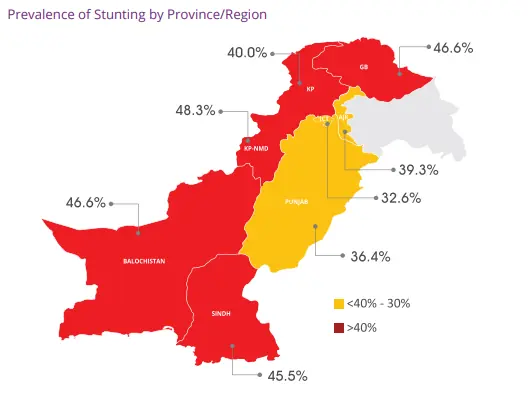
Sindh and Balochistan, which carry the heaviest burden of acute malnutrition and where the NNS 2018 recorded the highest wasting rates, should prioritise nutrition as a cross-cutting emergency response theme within their respective climate adaptation and disaster risk financing frameworks.
Provincial health and planning departments must nominate dedicated nutrition focal persons with budget authority (not merely technical advisors) and convene quarterly multisectoral nutrition coordination meetings with documented minutes and action trackers.
The verdict of the NNS 2018
Seven years after Pakistan’s most comprehensive nutrition survey delivered its verdict, the children it counted are no longer under five years of age. Many of the stunted children of 2018 are now in school or not, because impaired cognitive development in the first 1,000 days is not recovered by a later enrollment.
The wasted infants of 2018 are now children whose immune systems remain compromised by early malnutrition. The anaemic adolescent girls of 2018 are now young women approaching their own reproductive years, carrying the nutritional deficits of one generation into the next.
Pakistan cannot build the competitive, educated, productive workforce it aspires to be on a foundation of chronic malnutrition. It cannot achieve the 4.1pc GDP growth target in its own budget while losing $17 billion per year to preventable undernutrition. It cannot claim to be a serious development partner on the global stage while its apex nutrition coordination body remains inactive and its budget carries no nutrition line.
The 2018 National Nutrition Survey gave Pakistan’s policymakers everything they needed: the evidence, the geography, the scale, and the moral urgency. The 2025-26 federal budget gives us the answer to what they did with it. The question now is not whether Pakistan can afford to invest in nutrition. The question is whether it can explain, to the 12 million stunted children counted in its own survey, why it chose not to.
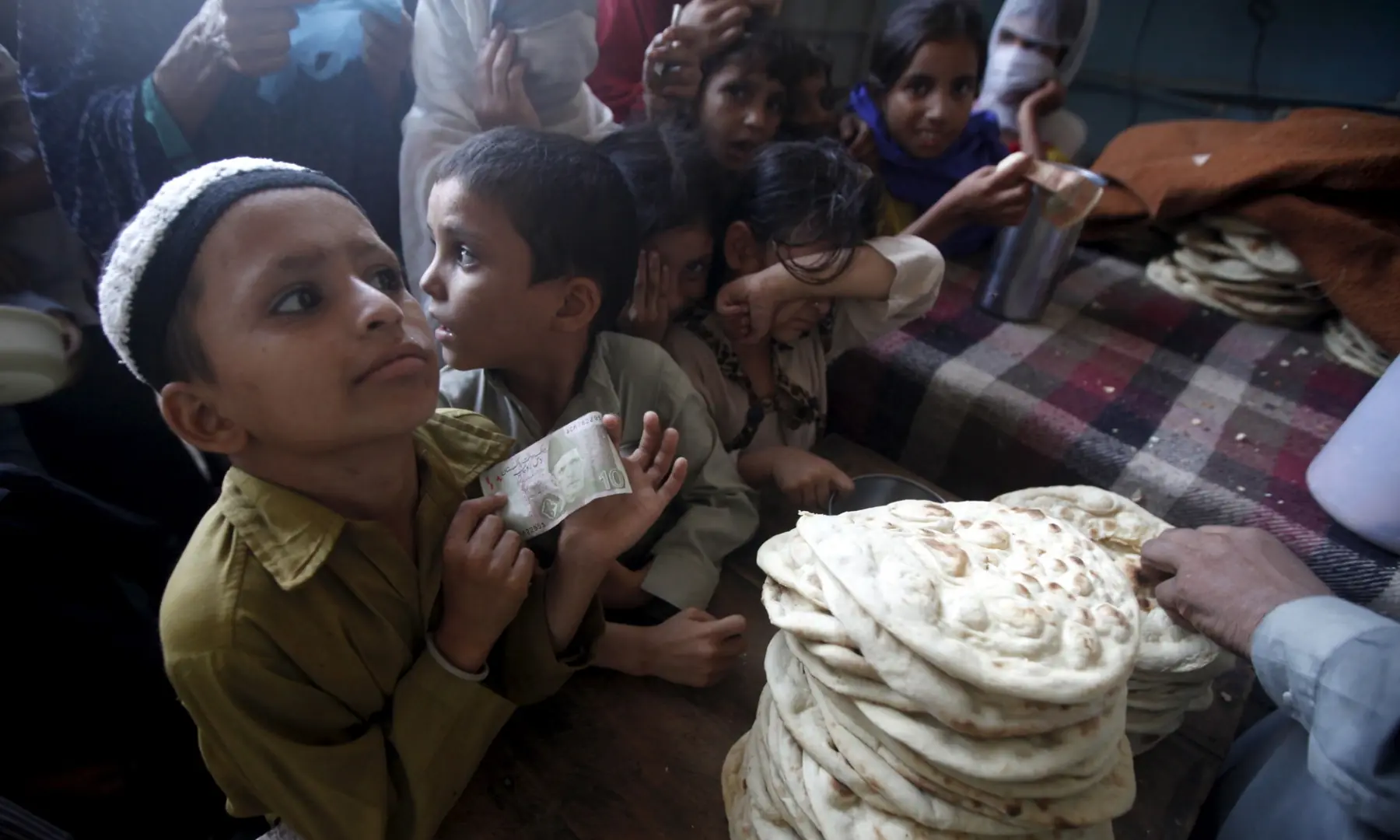
Header image: Children queue for subsidised bread at a food distribution centre in Karachi. — Reuters/File


 10
10
The writer is a senior policy advisor with over 22 years of international experience in governance reform, public policy, and development. He chairs the SUN Civil Society Network Steering Committee (60+ countries) and co-chairs the Global Nutrition Report Stakeholder Group. He is based in Islamabad and tweets @Irshaddanish