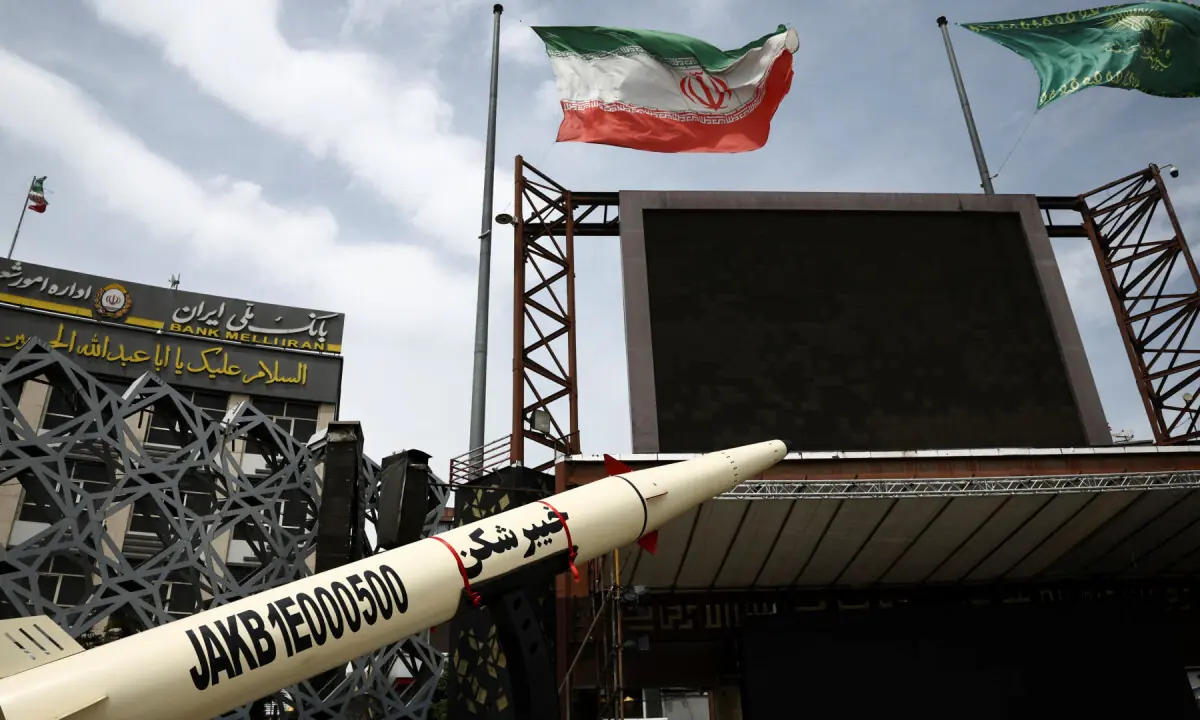
The US and Israel on Feb 28 launched what they described as a “pre-emptive” joint strike against Iranian targets, with Trump announcing start of “major combat operations”
US War Secretary Pete Hegseth says that the $1.5 trillion budget for the coming fiscal year will “continue to reverse the four years of underinvestment and mismanagement” by the administration of former president Joe Biden.
“The president’s budget request reflects the urgency of the moment, addressing both the deferment of longstanding problems as well as positioning our forces for both the current and future fight,” Hegseth states, testifying before the House Armed Services Committee.
He claims that the Biden administration was “focused on offshoring and outsourcing, riddled with cost overruns and degraded capabilities”.
“The $1.5tr budget will ensure that the United States continues to maintain the world’s most powerful and capable military, as we grapple with a complex threat environment across multiple theatres,” Hegseth adds.
Lebanon’s National News Agency (NNA) is reporting several Israeli attacks in southern Lebanon, one in the town of Jouaiyya and the other in al-Hanniye, Al Jazeera reports.
The attack in Jouaiyya has killed at least two people, and rescuers are searching for four people who are missing.
Meanwhile, the attack in al-Hanniye has killed three members of the same family.
Oil prices have spiked sharply after a report that US President Donald Trump told national security officials to prepare for a long blockade of Iran’s ports and the Strait of Hormuz, AFP reports.
At around 1335 GMT (6:35pm PKT), a barrel of Brent crude for June delivery was up 5.16 per cent at $117, its highest level since the fragile ceasefire between the United States and Iran came into effect.
Benchmark US oil contract, West Texas Intermediate, for delivery in the same month, gained 4.85pc to reach $104.78, following the report in The Wall Street Journal.
Lebanese President Joseph Aoun says Israel is mistaken “if it believes it can achieve security through violations and the destruction of border villages”, according to Al Jazeera.
Aoun adds that the Lebanese state, having its full force present throughout the entire south, can protect the borders.
“We are making every effort to reach a solution to the current situation, and this solution can be achieved through negotiations,” he states.
He adds that Israel must implement a ceasefire before moving on to negotiations and that Lebanon is waiting for Washington to set a date for talks.
Iran’s Deputy Foreign Minister Saeed Khatibzadeh says war is not a solution to resolve the ongoing crisis, stressing that diplomacy remains the only viable path forward amid a stalemate in talks with the US, Anadolureports.
Addressing a virtual conference themed, ‘’The US-Israeli Aggression Against Iran: Scenarios Ahead’, he says military approaches only deepen instability and prolong conflicts.
“War is not a solution; it is part of the problem,” Khatibzadeh says, stressing that all alternatives to diplomacy are “unattractive”.
Former US counter-terrorism chief Joe Kent has warned that Washington’s naval blockade of Iranian ports is affecting the American public more than Iran.
“The blockade will not force Iran to abandon uranium enrichment, ballistic missiles, or its proxy networks,” he says on X. “Instead, the blockade is hurting the American people and creating serious domestic pressure on [US President Donald Trump].
He warns that soaring fuel prices will affect the working class, jeopardising Republican majorities in November’s midterm elections. Moreover, he adds that deploying three carrier strike groups in the region to enforce the blockade is “unsustainable”.
“The global fallout only increases the pressure on us, not Iran,” Kent states.
A political deputy within Iran’s Islamic Revolutionary Guard Corps (IRGC) Navy has warned that if the United States attempts to launch another attack on Iran, the country will deploy its “new cards”, an apparent reference to US President Donald Trump’s remarks claiming Washington has “all the cards”, Iran’s Farsnews agency reports.
Speaking at a cemetery in Minab, Mohammad Akbarzadeh warns, “If the US wants to commit another miscalculation and attack the Islamic Republic of Iran, the IRGC Navy will employ its new cards, including in the field of smart targeting, and will burn the giant naval vessels of the criminal regime in its fire of rage, taking them out of operation.”
He further warns that in response to American aggression, Iran will “leverage its other instruments of power across other resistance fronts”, Fars adds.
The UK has asked its refineries to maximise jet fuel supply as it continues to make contingency plans to increase supply flexibility, Al Jazeera reports citing Energy Department Minister Michael Shanks.
His comments come as airlines are set to face a major challenge from rising jet fuel prices due to the war on Iran, as the peak holiday season approaches.
Five former US officials, including a former top military lawyer, have criticised the Pentagon for not acknowledging potential American involvement in a deadly strike on an Iranian school in Minab that killed at least 168, mostly children, BBCreports.
Some of those officials said it was highly unusual not to release even basic details of the strike after such a length of time. In the two months since then, the Pentagon has said only that the incident is under investigation.
The current US position “strikingly departs from the standard response”, said Lt Col Rachel E VanLandingham, a retired judge advocate general in the US Air Force and former senior legal adviser at US Central Command during the wars in Iraq and Afghanistan.
“To not even be able to have any comment on it whatsoever is just unacceptable,” said Wes Bryant, a former senior adviser on precision warfare and civilian harm mitigation who left the Pentagon last year when staffing at the civilian harm unit was significantly reduced under Hegseth.
A UN-backed report said that more than 1.2 million people in Lebanon were expected to face acute hunger due to the latest war between Israel and Hezbollah, AFP reports.
The figure was announced in a joint statement by the UN’s Food and Agriculture Organisation, the World Food Programme and Lebanon’s agriculture ministry.
Some “1.24 million people — nearly one in four of the population analysed — are expected to face food insecurity” at crisis levels or worse between April and August 2026, they said.
Russia has not yet taken a decision on whether to return its personnel to the Bushehr nuclear power plant, Alexei Likhachev, head of Russia’s state nuclear corporation Rosatom, was quoted by the Interfax news agency as saying, according to Reuters.
Iranian Foreign Minister Abbas Araghchi has met with the visiting International Committee of the Red Cross (ICRC) President Mirjana Spoljaric Egger in Tehran, Mehr News Agency reports.
The White House has said negotiators are continuing to engage with the Iranians, who, it claimed, are “struggling to sort out their leadership situation” amid the war, Al Jazeera reports.
In a statement to US media, spokesperson Anna Kelly said Trump would only enter into an agreement with Iran that “puts US national security first”.
The White House’s statement comes after Trump threatened Iran on social media to “get smart soon” and sign a deal on nuclear issues.
German Chancellor Friedrich Merz has insisted he and Donald Trump are still on good terms after the US president laid into him for saying Iran is “humiliating” Washington at the negotiating table, AFP reports.
“From my point of view, the personal relationship between the American president and myself remains just as good as before,” Merz told a press conference in Berlin.
The German leader said he had expressed doubts about the US-Israeli war on Iran “from the very beginning”.
“We in Germany and in Europe are suffering considerably from the consequences,” Merz said.
Commercial shipping traffic has remained low around the Strait of Hormuz over the past 24 hours, as talks between the US and Iran remained stalled, with only 10 vessels passing through the waterway, Anadolu reports.
Six vessels passed through the Strait from the Arabian Gulf to the Oman Gulf, while four traversed from east to west.
Russia plans to stay in OPEC+ despite a decision by the United Arab Emirates (UAE) to leave, the Kremlin has said, voicing hopes the alliance of oil producers would continue to operate amid turmoil in the global energy market, according to Reuters.
Kremlin spokesman Dmitry Peskov says OPEC+ remains an important organisation, especially during current turmoil on global markets.
“This format helps to substantially, let’s say, minimise fluctuations in energy markets and makes it possible to stabilise those markets,” Peskov tells a daily conference call with reporters.
Lebanon’s army says that one of its soldiers was among two people killed in an Israeli strike in the country’s south, the latest deadly raid despite a ceasefire in the Israel-Hezbollah war, AFP reports.
“A soldier and his brother were killed in an Israeli strike that targeted them in the town of Khirbet Selm in Bint Jbeil (district) while they were travelling on a motorbike” heading home from the soldier’s post, the army statement says.
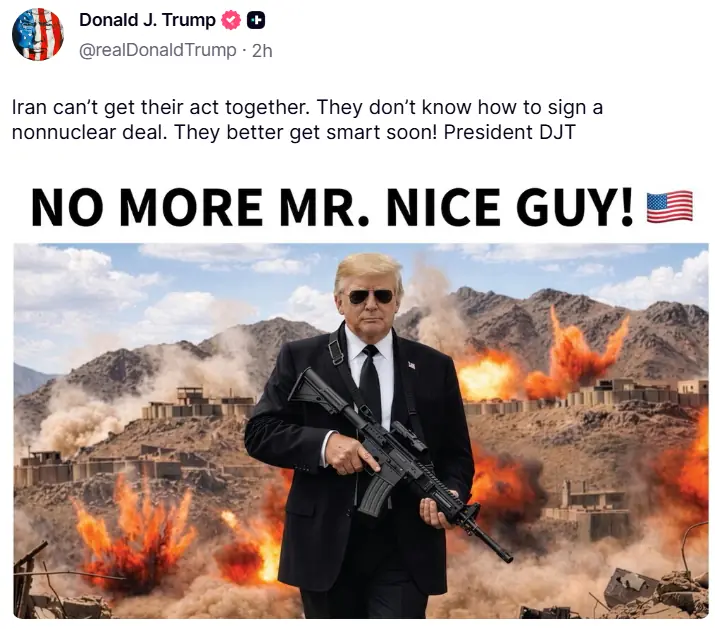
US President Donald Trump has urged Iran “to get smart” and sign a deal on the nuclear issues.
In a Truth Social post, he wrote, “Iran can’t get their act together. They don’t know how to sign a non-nuclear deal. They better get smart soon!”
Trump also shared an AI-generated image of him holding a rifle in his hand, with explosions taking place in the background, and a caption saying, “No more Mr Nice Guy”.
The Iranian rial has plummeted to a record low against the dollar, according to currency-tracking websites, as a US naval blockade of the country’s ports continued, AFP reports.
On the black market, the rial was trading at around 1.80 million rials against the dollar, the Bonbast and AlanChand websites reported. When the war erupted two months ago, one dollar was traded at about 1.70m rials.
Iran officially has several fixed exchange rates, but the two websites are generally used as benchmarks for unofficial rates.
Spot premiums for physical crude have slipped from record highs reached earlier during the Iran war as refiners are drawing on inventories and cutting back processing to cope with lost Middle East supply, Reuters reports, citing traders and analysts.
Since the US-Israeli war on Iran that began on February 28 caused the near-total closure of the Strait of Hormuz, the global market has lost access to 500 million barrels of crude and refined products output, according to analysts at Citi. That sparked surging prices on panic buying, but the higher prices have destroyed demand from consumers and refiners.
Scouring the globe for replacements, refiners paid up, pushing premiums for barrels from Africa, the US and Brazil, with some grades reaching record highs of more than $30 a barrel earlier this month.
However, premiums are easing as refiners are opting to reduce output and home in on previously sanctioned barrels, while Chinese state majors Sinopec and PetroChina tap commercial reserves and sell spot market crude.
Vessels in the Strait of Hormuz, Musandam, Oman on April 27, 2026. — Reuters
Lebanese civil defence teams are continuing to clear rubble and debris from side roads in Tyre after an Israeli attack last night, Al Jazeera reports, citing the National News Agency (NNA).
The air attack killed Madeleine Mughniyeh, her mother Ruqayya Zeidan and daughter Mila Abbas Zayyat, the report added.
Smoke rises following explosions in southern Lebanon, near the Israel-Lebanon border, as seen from northern Israel, on April 28, 2026. — Reuters