The US and Israel on Feb 28 launched what they described as a “pre-emptive” joint strike against Iranian targets, with Trump announcing start of “major combat operations”
Pakistan hosted the first round of face-to-face talks between the US and Iran in 47 years in April; the talks ended without a breakthrough, but also without a breakdown
US, Iran reached a preliminary agreement to end the war; MoU signed by Trump, Pezeshkian and PM Shehbaz
Israel has announced the lifting of all restrictions imposed on northern border areas as part of the war with Hezbollah in Lebanon, after fighting wound down following a flare-up, AFP reports.
“Starting at 6:00 am on Monday, June 22, 2026, all restrictions will be lifted in the Confrontation Line area,” the Israeli military says, adding that the border communities “will move to a full activity level, with no restrictions, instead of a partial activity level”.
Prime Minister Shehbaz Sharif has issued a statement about his meeting with Swiss Foreign Minister Ignazio Cassis on the sidelines of the Buergenstock summit, thanking Switzerland for its “support and constructive engagement” after the signing of the Islamabad Memorandum of Understanding.
“We agreed that its successful implementation will contribute to regional peace, stability and global economic prosperity,” he writes on X.
“We affirmed our commitment to strengthening bilateral cooperation in all areas of mutual interest. I also invited Vice President Cassis to visit Pakistan to further strengthen the longstanding friendship between our two countries,” PM Shehbaz adds.
US Republican Senator Lindsey Graham says that Trump plans to seize control of the Strait of Hormuz and impose tolls if diplomatic efforts with Iran fail, Al Jazeera reports.
In an interview on CBS, he says he spent four-and-a-half hours with Trump on Friday and outlined what he described as the administration’s fallback strategy.
“If this deal fails, President [Donald] Trump is going to take the Strait of Hormuz over by force,” Graham said. “The United States will control the Strait of Hormuz, we’ll charge a fee for all those who go through to pay for the operation.”
Speaking at a high-level meeting in Burgenstock, Switzerland, Qatari Prime Minister Mohammed bin Abdulrahman bin Jassim Al Thani has hailed the memorandum of understanding signed earlier this week as a landmark achievement and expressed hope it would mark a turning point towards regional stability, Al Jazeera reports.
“The past period has been among the most difficult our region has witnessed, with its peoples bearing heavy burdens due to uncertainty and escalation,” he says.
“We hope that the agreement we witness today will help create an environment that enables states to direct their energies towards development, cooperation, and providing opportunities for their peoples. The work does not end with the signing of an MoU,” he adds, stressing that technical talks would be critical to translating commitments into tangible outcomes.
Hussein Gurbanzadeh a member of Iran’s team negotiating with the US, tells state television, “In today’s negotiations, we discussed the issue of our frozen assets and the arrangements for their release,” according to Al Jazeera.
He adds that discussions focused on sanctions relief tied to Iran’s energy sector.
“In Switzerland, we discussed the temporary exemption from sanctions on oil and its derivatives, and the final draft of a proposal on this matter has been completed,” Gurbanzadeh explains.
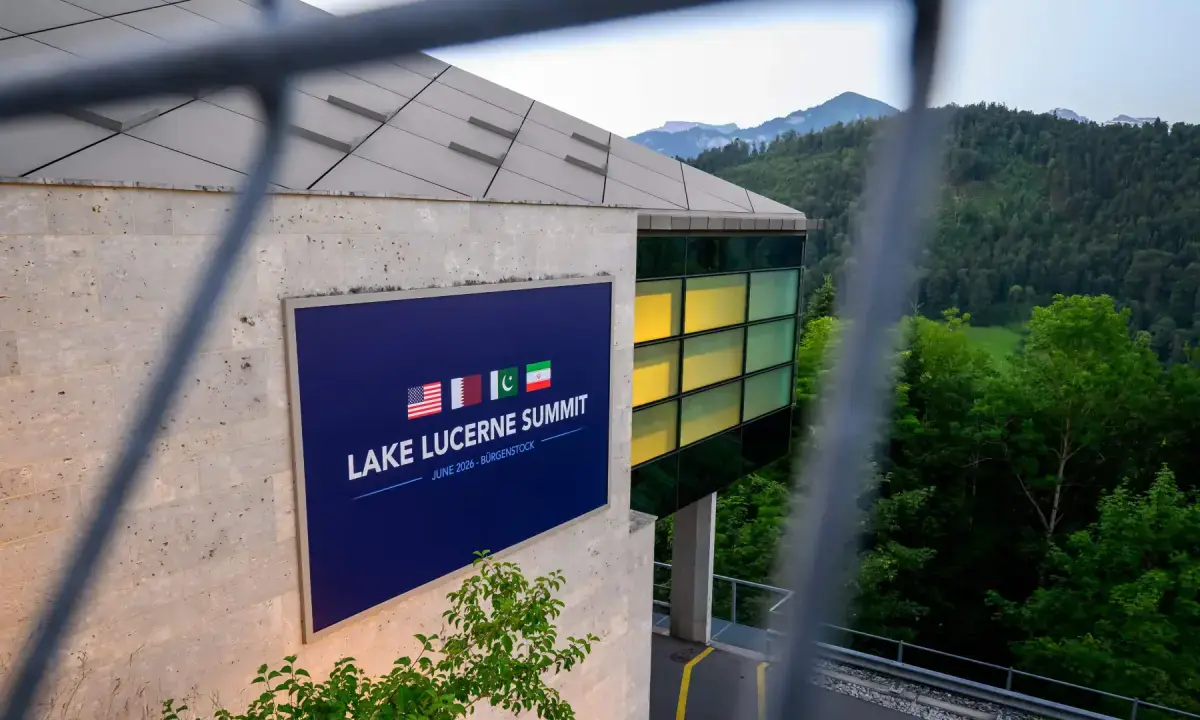
Prime Minister Shehbaz Sharif has spoken to the press at Buergenstock, on the sidelines of the Lake Lucerne Summit between the US and Iran.
He says Iran’s supreme leader Ayatollah Mojtaba Khamenei, President Masoud Pezeshkian, parliament speaker Mohammad Bagher Ghalibaf and Foreign Minister Abbas Araghchi have been “very, I think, straight and handled this entire crisis with a sense of dignity to de-escalate this situation”.
“I think they genuinely mean promoting peace in the region, [the] Iranian leadership. I think so is [US] President Trump and … I have no second thought about the fact that he is a man of peace,” PM Shehbaz tells reporters
“He has demonstrated that during the war between Pakistan and India, when the two countries were very close to the nuclear flashpoint and President Trump’s dynamic and courageous leadership, entering and doing effectively, saved hundreds of millions of lives.”
Responding to a question about US Vice President JD Vance saying he “loves” Pakistan, the premier has responded that a “renewed friendship between the United States of America is a very encouraging sign, and I am really grateful to President Trump for supporting Pakistan and promoting economic cooperation between the two countries [and] counter terrorism.
“I think this friendship, this new relationship, will usher into a period of very close coordination and cooperation between the two countries,” he adds.
French Foreign Minister Jean Noel Barrot will meet the Prime Minister of Qatar in Switzerland on Monday, where the United States and Iran are holding talks, Reuters reports citing Paris’ foreign ministry.
German Defence Minister Boris Pistorius has blamed US President Donald Trump for the closure of the Strait of Hormuz, calling for the vital waterway to be reopened, AFP reports.
“Ultimately, the cork in the bottle neck of the Strait of Hormuz was pushed in by Donald Trump, not by us, but we have an interest in getting it out again,” Pistorius says in an interview with broadcaster ARD.
“The opening of the Strait of Hormuz, or rather safe passage through it, is in Europe’s interest, in the interest of our energy supply and our economic recovery,” Pistorius states, adding that any agreement to reopen the strait will need the support of Iran and Oman.
The Strait of Hormuz, a key conduit for oil and gas shipments, was effectively blockaded during the hostilities that began on February 28 with US-Israeli attacks on Iran. Tehran had agreed to reopen it under a preliminary accord signed by Trump and his Iranian counterpart Masoud Pezeshkian, and shipping traffic had begun to recover.
But Iran on Saturday said it was once again closing the vital waterway over Israeli attacks in Lebanon.
Iran’s parliament speaker and head negotiator, Mohammad Bagher Ghalibaf, has dismissed US threats, saying Tehran is prepared to respond if necessary, Al Jazeera reports.
“Don’t they think to themselves that if their threats had any effect, they wouldn’t have reached the point of desperation they are in today? We don’t count on the American threats,” Ghalibaf has posted on X. “They [had] better be careful with their comments, our armed forces are ready to respond in a different way. Whatever they say, we are the ones who will act.”
Bilateral talks between the Iranian and Qatari delegations in Switzerland have begun following the conclusion of the first round of US-Iran negotiations, Al Jazeera reports citing Iranian state media.
Over 25 million barrels of Iranian oil have passed through the virtual blockade line since Monday, the head of the Iranian National Oil Company Hamid Bovard tells state TV, Reuters reports.
Deputy Prime Minister and Foreign Minister Ishaq Dar has departed Cairo for Islamabad after the R4 foreign ministers’ meeting, the Foreign Office says.
“En route to Islamabad, he will make a short transit stop in Medina before continuing his journey to Pakistan,” it adds in a post on X.
Deputy Prime Minister and Foreign Minister Ishaq Dar has met Egyptian President Abdel Fattah Al-Sisi, the Foreign Office (FO) says in a statement.
“DPM/FM, together with foreign ministers of Egypt, Saudi Arabia and Turkiye, made a joint call on HE Mr Abdel Fattah Al-Sisi, President of the Arab Republic of Egypt,” the statement reads, adding that Dar reaffirmed Pakistan’s commitment to “further strengthening its longstanding, brotherly and multifaceted relations with Egypt”.
“DPM/FM also welcomed President Al-Sisi’s acceptance of the prime minister’s invitation to visit Pakistan at an earliest convenient date,” the FO adds.
US Energy Secretary Chris Wright says 67 ships went through the Strait of Hormuz in the last 24 hours, similar to traffic before the war began in terms of oil and petroleum products, Al Jazeera reports.
Wright tells Fox News that Iran has not yet “de-mined” the strait’s central shipping channel, but the US has opened a separate route to the south and has been escorting ships through it.
Wright acknowledges some commercial shippers still have safety concerns.
Hezbollah has rejected the Lebanese government’s direct talks with the US, saying the negotiations will undermine Lebanon’s sovereignty and serve Israeli interests, Al Jazeera reports.
In a statement, the group says the Lebanese delegation in Washington is being asked to sign off on US dictates that “confiscate Lebanon’s sovereignty” and align Beirut with those reconciling with Israel.
The group says the talks are based on a “flawed” premise and will lead to “capitulation” rather than serve Lebanese interests.
The government’s participation, the group says, “hinders confronting the enemy’s project, the resistance’s efforts on the ground, and the great sacrifices of our great people”, which it claims the state could leverage to press for a complete and unconditional Israeli withdrawal from Lebanese territory.
The group adds that the government’s attendance increases risks to Lebanon’s stability and independence and amounts to “compliance with US and Israeli policy objectives”.
Al Jazeera’s Osama bin Javaid reports from Buergenstock that talks between the US and Iran are taking place in a “constructive atmosphere”.
“What we know is that this is going to be choreographed into multiple sessions, themed around the major sticking points,” he adds. “The first session was on Lebanon, and now a session on the Strait of Hormuz and a third session on the nuclear issue and sanctions on Iran.”
Bin Javaid says he has spoken to “a number of sources” and witnessed Iranian Foreign Minister Abbas Araghchi speak to Qatar’s prime minister before walking out.
“As soon as journalists were cleared from the room, the Iranian delegation came back inside. It appears the Iranians did not want to appear in front of the media,” bin Javaid reports.
“What we’ve heard is that the talks are carrying on in a constructive atmosphere, despite the tweets you’ve seen in the last hour or so from the US president. It is the first day, the first step toward these high-profile meetings. The first session is over, but all four teams are back in their rooms, and they’ll continue throughout the day.”
Multiple Iranian media outlets are reporting that quadrilateral negotiations between the US and Iran — mediated by Pakistan and Qatar — have paused, allowing delegations to hold internal consultations.
The pause comes roughly 80 minutes into the talks, according to reports by Iranian media outlets Fars and Press TV.
Al Jazeera also reported the pause in talks, citing Fars.
Prime Minister Shehbaz Sharif has met Swiss Foreign Minister Ignazio Cassis on the sidelines of the Lake Lucerne summit in Buergenstock, according to a post by the latter on X.
“As a country that places great importance on mediation, dialogue and good offices, Switzerland values Pakistan’s important role in supporting continued discussions on the implementation of the agreed US-Iran MoU,” Cassis writes. “I reaffirmed Switzerland’s readiness to support initiatives aimed at de-escalation, regional stability and lasting peace.”
Iraq plans to restore crude oil production gradually to the between 4.2 and 4.3 million barrels per day, Reuters reports citing Iraq’s deputy oil minister for upstream affairs.
The proposed increases will restore output to levels achieved before the Iran war and the resulting closure of the Strait of Hormuz.
Israeli Prime Minister Benjamin Netanyahu says Israeli forces will remain in southern Lebanon “as long as necessary”, while also vowing to prevent Iran from acquiring nuclear weapons, AFP reports.
“We will remain in the security zone in southern Lebanon for as long as necessary to protect the cherished residents of the north and all the citizens of Israel … Nothing will alter that commitment,” Netanyahu says.
“And with regard to Iran: whatever political developments may unfold, I will not allow Iran to acquire nuclear weapons. As long as I serve as prime minister of Israel, that will not happen. “
Iran’s negotiating team has refused a planned exchange of handshakes and a group photograph with the US team before talks began in Switzerland, according to Al Jazeera.
Iran’s semi-official Tasnim news agency reported the refusal, citing an unnamed “source close to the negotiations”.
US officials and meeting organisers had arranged for a handshake and photo between the two sides at the start of the multilateral talks in Burgenstock. However, the head of the Iranian delegation opposed the plan, Tasnim says.
Following Iran’s refusal, a live TV broadcast and photo session proceeded without the Iranian delegation. The Iranians entered the venue only after the media event concluded. The US delegation requested a five-minute delay to allow journalists to leave the negotiation room before the talks began, the news report adds.
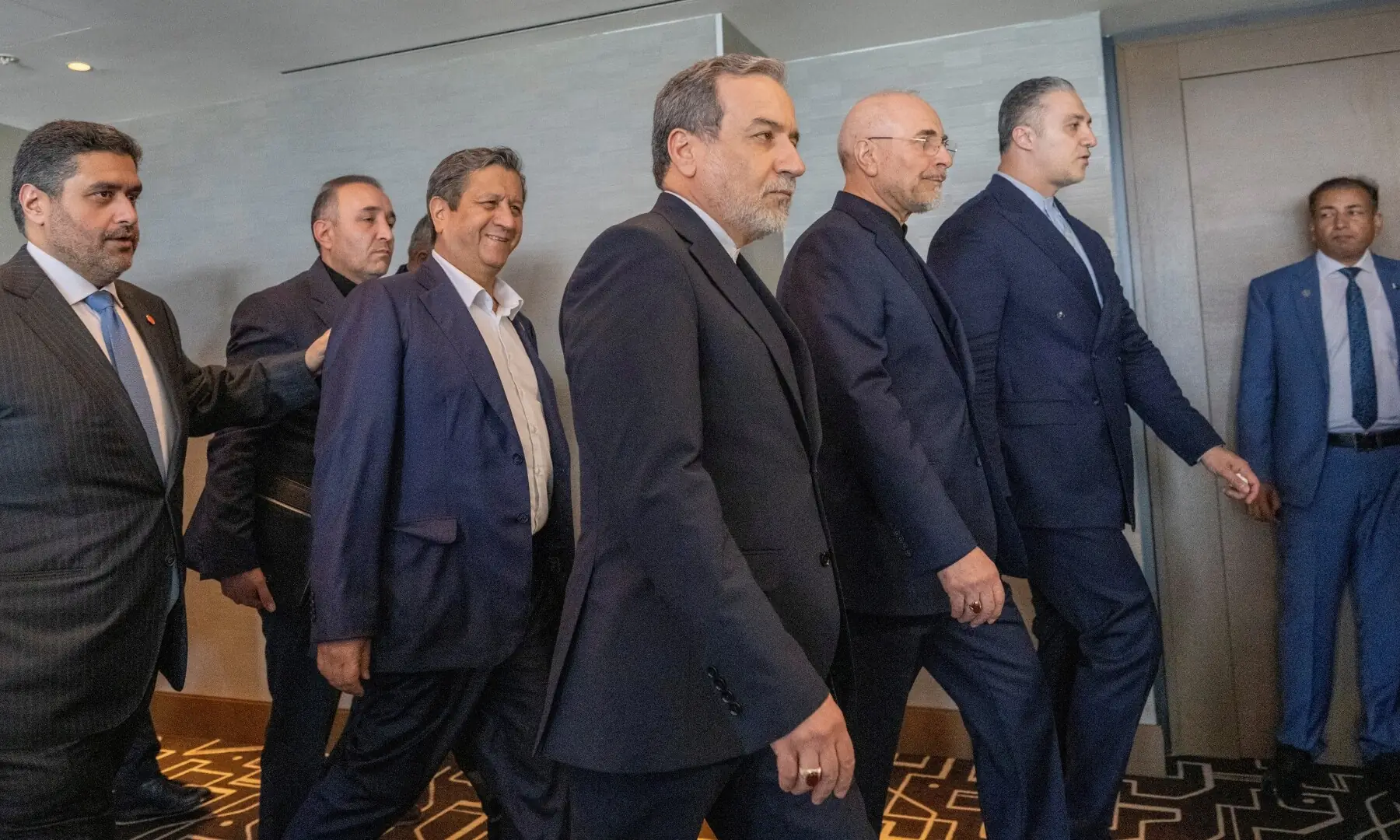
Minister of Foreign Affairs of Iran Abbas Araghchi and Speaker of the Iranian Parliament Mohammed Bagher Ghalibaf are photographed with the delegation of Iran at the Lake Lucerne Summit at the Buergenstock resort in Obbuergen, near Lucerne, Switzerland on June 21, 2026. — Reuters
Swiss Foreign Minister Ignazio Cassis has met United States Vice President JD Vance on the sidelines of the quadripartite summit at Buergenstock.
“We exchanged [views] on the ongoing talks on the implementation of the US–Iran MoU and their importance for peace and stability in the Middle East. Starting these talks in Switzerland is an essential first step,” Cassis writes on X.
He notes that Switzerland enjoys trusted relations with both Washington and Tehran.
“I offered our good offices whenever they are needed,” Cassis adds. “Being useful in an unsettled world is the best way to contribute to stability and peace for and the world.”
At least 4,106 have been killed and 12,153 wounded since the fighting between Israel and Hezbollah began on March 2, Al Jazeera reports citing Lebanon’s Ministry of Public Health.
Among those killed were 383 women, 251 children, and 135 medical workers, it added.