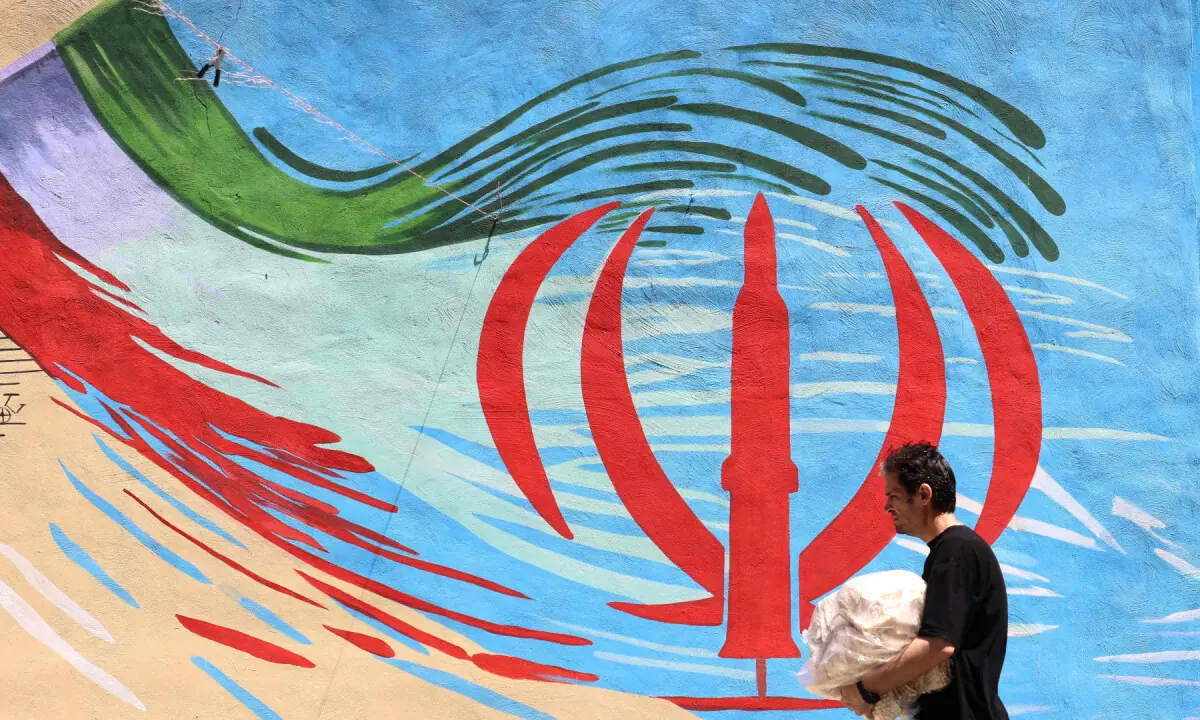
The US and Israel on Feb 28 launched what they described as a “pre-emptive” joint strike against Iranian targets, with Trump announcing start of “major combat operations”
Pakistan hosted the first round of face-to-face talks between the US and Iran in 47 years in April; the talks ended without a breakthrough, but also without a breakdown
US allies in Gulf reportdrone attacks as IRGC warns against attacks on Iranian ships
Trump rejects Iran’s response to latest US proposal that would stop the fighting but leave the most contentious issues unresolved for now
US President Donald Trump has repeated that Iran cannot have nuclear weapons, Al Jazeera reports.
“If Iran has a nuclear weapon, the whole world would be in trouble because they happen to be crazy. They’re not going to have a nuclear weapon,” Trump tells reporters gathered at the White House before heading on his trip to China.
Qatar has condemned the “infiltration” by an armed group consisting of members of Iran’s Islamic Revolutionary Guard Corps (IRGC) onto a nearby island to carry out “hostile acts” against Kuwait.
This “infiltration” and the group’s “clash with the Kuwait Armed Forces before being apprehended [are] a blatant aggression against Kuwait’s sovereignty and a dangerous development that threatens the security and stability of the region”, Qatar’s foreign ministry said in a statement shared on social media.
The foreign ministry also emphasised “the necessity of stopping Iran’s unjustified aggressions against brotherly countries, viewing them as a blatant violation of international law and a serious threat to regional security”, adding that it hoped those injured in the attacks would “recover swiftly”.
US President Donald Trump has again promised that fuel prices will rapidly decrease once the conflict ends, Al Jazeera reports.
“As soon as this war is over, which will not be long, you’re going to see oil prices drop and you’re going to see a stock market … go through the roof,” he tells reporters.
“You have hundreds of ships that are loaded up with oil that want to come out. As soon as they come out, we’re going to have a gusher of oil and you’re going to have inflation that goes way down.”
US President Donald Trump has stated that the naval blockade has been completely effective, but has skirted a question from a reporter about whether he has a “red line” that would end the ceasefire with Iran.
“Well, we’re going to see, and we’ll be thinking about it on the flight [to China], and we’ll be thinking about it for the next little while,” the US president has said ahead of his departure from Washington, DC.
He has reiterated his claim that the US has defeated Iran’s military “very soundly”, adding that the blockade of Iranian ports has been “100 per cent effective”.
“One way or another, it’s going to work out very well,” he adds.
The US Energy Information Administration (EIA) says that it expects Iran to be forced to reduce its oil output, partly due to the US blockade on its ports, Al Jazeera reports.
In a statement, it expects oil output and trade patterns will not return to prewar levels until late this year or early next year, even once shipping resumes through the Strait of Hormuz.
It adds that if the strait remains closed through late June, then crude oil prices will be $20 per barrel higher, as the current forecast is based on projections that the strait will reopen late this month.
Iran’s Deputy Foreign Minister Kazem Gharaibabadi has said that peace “cannot be built through the language of humiliation, threats, and coercive demands for concessions”.
“When a party that itself has played a direct role in war, blockade, sanctions, and threats of force rejects Iran’s response simply because it is not a document of surrender, it becomes clear that the real issue is not peace, but the imposition of political will through intimidation and pressure,” he writes on X.
“The Islamic Republic of Iran has emphasised clear principles: a permanent end to the war and guarantees against its recurrence, compensation for damages, lifting the blockade, removal of unlawful sanctions, and respect for Iran’s rights,” he adds.
Gharibabadi notes that these are not maximalist demands but prerequisites for any serious, sustainable peace arrangement consistent with the UN Charter to end a crisis started by the illegal use of force.
“One cannot simultaneously speak of a ceasefire while continuing the blockade; speak of diplomacy while intensifying sanctions; or speak of regional stability while providing political and military support to a regime that is the source of aggression and instability,” he adds.
“Such an approach is not negotiation; it is the continuation of a policy of coercion through diplomatic language.”
The trading arm of Vietnam’s state oil company has urged the US Navy to allow a crude oil tanker laden with Iraqi oil to sail through its blockade in the Middle East Gulf and provide a Vietnamese refinery with critical supplies, Reuters reports quoting a letter from the Petrovietnam Oil Corporation (PV OIL).
“This cargo is of extreme importance to Nghi Son Refinery (NSRP), to the Socialist Republic of Vietnam, and to the Vietnamese people,” PV OIL Vice President Hoang Dinh Tung has said in a May 12 letter seen by Reuters and sent to US military and diplomatic missions.
“NSRP’s feedstock inventories are critically low; any further delay risks halting refinery throughput, with cascading consequences for millions of Vietnamese consumers, businesses, public services and industries.”
US President Donald Trump has said Washington will “see what happens” when it comes to negotiating with Iran.
“We’re going to see what happens. We’re only making a good deal,” he tells reporters. “I believe that one way or the other, it’s going to be very good for the American people and I think, actually, very good for the Iranian people.
When asked if the US is reconsidering Pakistan as a mediator, Trump replies, “No, they’re great. I think the Pakistanis have been great. The field marshal and the prime minister of Pakistan have been absolutely great.”
The Lebanese government’s Disaster Risk Management Unit says that at least 2,883 people have been killed and 8,787 wounded since Israel escalated its attacks on Lebanon on March 2, Al Jazeera reports.
“The total number of displaced persons in shelters reached 127,721 and the total number of displaced families in shelters reached 33,125″, the organisation adds.
US President Donald Trump says he will have a long talk with Chinese President Xi Jinping about the war in Iran during his upcoming trip to China, but adds that he does not think he needs Xi’s help, Reuters reports.
India has launched a $1.5bn guarantee for a maritime insurance pool to shield its shipping sector from disruptions linked to tensions in the Middle East, AFP reports.
The so-called ‘Bharat Maritime Insurance Pool’ will “facilitate continuous maritime insurance coverages”, amid the risk of wars and sanctions, the finance ministry says in a statement.
The pool will cover “war risk for Indian flagged or controlled vessels destined to or starting from India in the context of the current Middle East tensions,” it adds.
Several major reinsurers, who provide vital support to insurers by helping them spread risk, have either withdrawn coverage or sharply raised premiums recently, according to local media reports. Under the latest initiative, policies will be issued by member insurers using the combined underwriting capacity of the pool.
Claims up to $100 million will be met from the pool’s own resources. For larger claims, the sovereign guarantee will serve as a backstop after reserves and reinsurance are exhausted.
“The pool will enable the country to strengthen sovereign control over maritime trade and ensure continuity of trade even in the event of withdrawal of reinsurance coverage due to sanctions or geopolitical tension,” the government says.
The Turkish foreign minister says he believes it will be possible to rework US-Iran peace proposals and find an “acceptable wording” that both sides can agree to, Al Jazeera reports.
Hakan Fidan says Turkiye and other regional countries, including Qatar, are working to support key mediator Pakistan.
“Sometimes during the mediation, the most difficult thing is [that] when you get stuck, you are in search of creative ideas. Sometimes, the parties cannot provide these ideas, sometimes the mediator cannot come up with a creative idea,” he tells Al Jazeera in an exclusive interview.
“So you need some outside partners, trusted partners,” he says, adding, “The regional countries are doing their best, actually, to provide some support to the ongoing process.”
Turkish Foreign Minister Hakan Fidan, in an interview with Al Jazeera’s Resul Serdar, says that Ankara wants to see the ceasefire between the US and Iran maintained.
“Our most urgent concern is to see that the ceasefire is holding, this is what we care about at the moment,” he says.
Fidan adds that “nobody would like to see” a return to war, because the global economy and the world’s energy security are “suffering” enough as it is.
The Turkish foreign minister has urged Iran and the US to “find a real solution to this problem, which is affecting not only two respective countries but also the entire world”.
“I think there is enough will now… on both sides to stop the war,” Hakan Fidan tells Al Jazeera.
“It is prone to escalation, it is prone to further tragedy and drama, and negative effects for both the world’s economy and regional stability. All in all, we think that both sides can succeed in reaching a permanent settlement.”
Turkish Foreign Minister Hakan Fidan tells Al Jazeera, “We want to see a free passage of all the ships, just like was happening before the war.”
He adds that this is “what the majority would like to see”.
“[The] status quo before the war, was [what] everybody was enjoying,” Fidan adds. “So, introducing a new regulation, which may not be accepted by the vast majority [of countries], might be a new source of a new conflict, which we don’t want to see.”
Deputy Prime Minister and Foreign Minister Ishaq Dar has discussed Pakistan’s efforts to mediate the US-Iran war during a phone call with his Chinese counterpart, Wang Yi, according to the Foreign Office (FO).
“The two leaders exchanged in-depth views on recent regional developments and Pakistan’s ongoing efforts to facilitate engagement between Iran and the United States, aimed at promoting sustained peace and stability in the region and beyond,” the FO says in a post on X.
It adds that Wang reiterated Beijing’s appreciation and support for Pakistan’s role as a mediator and that both top diplomats “underscored the importance of continuing a durable ceasefire and ensuring normal passage through the Strait of Hormuz”.
According to the FO, activities marking the 75th anniversary of the establishment of diplomatic relations between Pakistan and China and bilateral matters were also discussed.
US Central Command (Centcom) says its forces have prevented a Maltese-flagged tanker from crossing the Strait of Hormuz.
“Our forces prevented the oil tanker Agios Phanourios from crossing the Strait of Hormuz for violating the blockade,” a Centcom spokesperson tells Al Jazeera, adding that the vessel was not transporting Iranian oil.
The spokesperson adds that US forces intercepted several tankers not carrying Iranian oil because they violated the embargo, adding that the US-imposed blockade on Iranian ports remains in place.
Austrian Foreign Minister Beate Meinl-Reisinger has expressed appreciation for Pakistan’s diplomatic efforts to bring an end to the Middle East war in a phone call with Deputy Prime Minister and Foreign Minister Ishaq Dar.
According to the Foreign Office (FO), the two top diplomats discussed and exchanged views on the evolving situation in the region, with Meinl-Reisinger appreciating “Pakistan’s constructive role in promoting dialogue and its mediation between Iran and the United States, in support of regional peace and stability”.
“DPM/FM reaffirmed Pakistan’s commitment to sustained diplomatic engagement, including continued efforts to facilitate dialogue between Iran and the United States, aimed at maintaining peace and stability in the region and beyond,” the FO adds in a post on X.
Lebanese Health Minister Rakan Nasseredine has shared a video on social media showing several instances of Israeli forces attacking paramedics and other healthcare workers in Lebanon, Al Jazeera reports.
In one incident, as first responders try to evacuate an injured paramedic in an ambulance, a blast is seen blowing out the back windows of the vehicle.
“The systematic targeting of healthcare workers and facilities is a grave violation of International humanitarian law,” Nasseredine writes in a post on X alongside the video. “We place this evidence before the world: silence is complicity. Protect Lebanon’s healers.”
The Kuwaiti Ministry of Foreign Affairs says it delivered a “protest note” to Iranian envoy Mohammad Tutunji, after the alleged “infiltration” of a group of armed Islamic Revolutionary Guard Corps (IRGC) members in the Gulf country, Al Jazeera reports.
Kuwait’s deputy foreign affairs minister, Hamad Suleiman al-Mashaan, reiterated the country’s “strong condemnation of this hostile act” and demanded that Iran “immediately and unconditionally cease such actions”, the ministry says in a statement.
Al-Mashaan describes the incident as a “blatant violation of Kuwait’s sovereignty”, as well as a violation of international law and the UN Charter, and stressed that Kuwait has the right to self-defence.
Azerbaijani President Ilham Aliyev expressed his “deep appreciation” for Pakistan’s diplomatic efforts to achieve a ceasefire between Iran and the US during a phone call with Prime Minister Shehbaz Sharif, the Prime Minister’s Office (PMO) says in a statement.
“This was a clear reflection of the trust and confidence of the international community in Pakistan and its leadership,” the statement reads. “The two leaders agreed to maintain close contact and looked forward to their meeting, in person, later this year.”
The statement adds that the premier conveyed his best wishes to Aliyev for the upcoming World Urban Forum in Baku next week.
“He expressed confidence that the Forum, under Azerbaijan’s stewardship, would serve as a valuable platform for advancing the global urban development agenda,” the PMO says.