The US and Israel on Feb 28 launched what they described as a “pre-emptive” joint strike against Iranian targets, with Trump announcing start of “major combat operations”
A meeting of the foreign ministers of the regional countries, hosted by Saudi Arabia, has condemned Iran’s retaliatory campaign against Gulf countries, calling on the country to “immediately” cease the aggression
Trump has threatened to destroy Iran’s key South Pars gas field if there are further attacks against Qatar’s main gas plant
Israeli attacks on southern Lebanon earlier today put a main power substation out of service, a sign of expanding Israeli attacks on Lebanese infrastructure, Al Jazeera reports citing the Lebanese state electricity company.
In a statement carried by Lebanon’s state-run National News Agency, the electricity authority said the attack damaged various parts of the station in Bint Jbeil, impacting power provision in the city and surrounding towns.
Israeli Prime Minister Benjamin Netanyahu says it is unclear if the Iranian people will rise up and take control of the country from the authorities of the Islamic republic, Al Jazeera reports.
“It’s too soon to tell if Iranians will take to [the] streets. You can’t do a revolution from the air; there needs to be a ground component as well. There are many possibilities for a ground component, I won’t share what they are,” he told reporters.
Spanish military personnel deployed to Iraq have been evacuated to Turkiye, Al Jazeera reports, citing Spain’s Defence Minister Margarita Robles.
Fifty-seven were serving with the US‑led coalition against Islamic State, and 42 were part of the Nato mission in Iraq. Robles said there were missile exchanges near the latter group’s base, which hindered the operation.
Israeli Prime Minister Benjamin Netanyahu has denied what he called “fake news” that Israel had dragged US President Donald Trump into war with Iran, AFP reports.
“Does anyone really think that someone can tell President Trump what to do?” Netanyahu asked journalists at a press conference.
Iran no longer has the capacity to enrich uranium or make ballistic missiles after 20 days of US-Israeli air attacks, Israeli Prime Minister Benjamin Netanyahu has claimed in a news conference, Reuters reports.
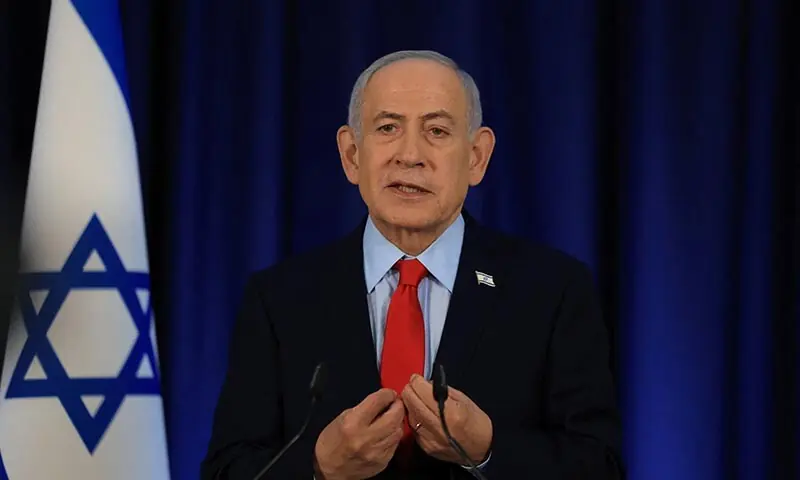
Israeli Prime Minister Benjamin Netanyahu speaks during a press conference, amid the US-Israel war with Iran, in Jerusalem, Israel on March 19. — Reuters
The International Energy Agency (IEA) has detailed the breakdown of its previously agreed record release of around 400 million barrels of oil from strategic stockpiles to deal with the effects of the US-Israeli war with Iran, adding that crude oil would make up the bulk of it, Reuters reports.
“The overall release of emergency stocks will largely consist of crude oil, while in Europe, the contributions will primarily take the form of refined oil products. This is being complemented by additional production from countries in the Americas,” the IEA has said, publishing a breakdown of the release in a table on its website.
Some 65 per cent of Americans believe US President Donald Trump will order troops into a large-scale ground war in Iran, but only 7pc support the idea, Reuters reports citing a Reuters/Ipsos poll.
The three-day poll showed Trump’s broader standing with the public holding largely unchanged at 40pc, up 1 percentage point from a Reuters/Ipsos poll carried out in the hours after the US and Israel attacked Iran on February 28.
The poll, which gathered respondents from 1,545 US adults nationwide, had a margin of error of about 3 percentage points.
International Atomic Energy Agency (IAEA) Director-General Rafael Grossi says once the US and Israel’s war on Iran ends, “we will still inherit a number of major issues”, including Iran’s inventory of enriched uranium that is believed to be under rubble, Al Jazeera reports.
In an interview with CBS’s ‘Face the Nation’, he said, “The focus on the campaign does not seem to be specifically the nuclear facilities.”
Asked how difficult it would be for the US to come in and remove enriched material from Iran, Grossi said, “We’re talking about cylinders containing gas of highly contaminated uranium hexafluoride at 60 per cent, so it’s very difficult to handle.”
Decoys may also be in place, he added. While Iran has a contractual obligation to allow UN inspectors in, “nothing can happen while bombs are falling.”
Grossi said a lot of Iran’s nuclear programme has survived. “They have the capabilities, they have the knowledge, they have the industrial ability. This is why we need to go back to a negotiating table.”
The head of US intelligence has declined again to endorse President Donald Trump’s claim that Iran posed an “imminent” threat before the United States and Israel launched military strikes, AFP reports.
Testifying on the war in the Middle East before the House Intelligence Committee, Tulsi Gabbard has doubled down on her claim from a day earlier that this determination is “the responsibility of the president” — a position that had already drawn sharp pushback from Democrats.
“The only person who can determine what is and is not an imminent threat is the President of the United States,” Gabbard has said, facing immediate pushback from the Senate panel.
When asked if there was an imminent threat from Iran despite its nuclear enrichment programme being “obliterated” and no efforts to rebuild, Gabbard responded: “It is not the intelligence community’s responsibility to determine what is and is not an imminent threat.”
Anwar Gargash, a diplomatic adviser to the UAE’s president, has slammed Iran for targeting civilian and economic infrastructure, saying these attacks constitute a violation of international and humanitarian law, Al Jazeera reports.
They also represent a dangerous step that undermines the international order and regional stability, he said.
Gargash called for the immediate cessation of Iranian attacks against neighbouring countries.
The Pentagon has asked the White House to approve a funding request of more than $200 billion to present to Congress to sustain military operations in Iran, Anadolu reports citing The Washington Post, which spoke with several people familiar with the matter.
The request aims to fund the military campaign that began on February 28 and ramp up the production of weapons used during the conflict, three people familiar with the matter told The Post.
The Defence Department has proposed different funding packages over the past two weeks, The Post reported, though some White House officials were sceptical that the request had “a realistic shot of being approved in Congress”.
The Pentagon did not immediately respond to Anadolu’s request for comment.
US Energy Secretary Chris Wright has said in a post on X that President Donald Trump’s administration has no plan to implement restrictions on oil and gas exports, Reuters reports.
Iran has asked Berlin to clarify the role of the Ramstein airbase in the US-Israeli war on Iran, Tehran’s ambassador to Germany Majid Nili has told AFP.
“We have asked them to clarify or explain regarding the role of Ramstein,” Nili said, charging that “the role of Ramstein is not officially clear for us”.
“Till now, we don’t have any answer.”
Iran believes Washington’s use of the airbase in western Germany may violate UN resolution 3314. The resolution says that territory placed at the disposal of another state cannot be used by that state for perpetrating an “act of aggression” against a third state.
“We don’t know yet whether Ramstein is in that line or not,” he said.
Benchmark US oil contract West Texas Intermediate (WTI) briefly rose more than 5 per cent to over $100 a barrel on fears for global supplies during the Middle East war, Al Jazeera reports.
At 1605 GMT (9:05pm PKT), the WTI price for delivery in April rose 2.29pc to $98.53 per barrel, while international oil benchmark Brent North Sea crude gained 2.01pc to $109.54 per barrel.
US Treasury Secretary Scott Bessent says Washington might lift sanctions on Iranian oil that is already being shipped, as energy prices soar due to the war in the Middle East, reports AFP.
Bessent’s comments to Fox Business on Thursday came as oil and gas prices made a renewed surge after Iran hit the world’s biggest liquefied natural gas (LNG) facility in Qatar and threatened to destroy the region’s energy infrastructure.
He added that the US government could also release more oil from its strategic reserves to help contain costs.
Iranian authorities have imposed a total internet blackout across the country since the start of the war, which has entered its 20th day, says monitoring group NetBlocks.
“The incident is now the longest recorded shutdown in Iran’s history, surpassing the blackout imposed during protests in January,” it says, in reference to deadly nationwide demonstrations earlier this year.
Sanae Takaichi, Japan’s prime minister, has told US President Donald Trump that he is the only person who can achieve peace, Al Jazeera reports.
Speaking during a press conference in the Oval Office, the Japanese leader has said that the entire world is going through a severe security environment and that the global economy is about to experience a “huge hit”.
“But I firmly believe that only you can achieve peace across the world,” she has said, noting that her trip to the White House was to directly convey that message from the international community to the US president.
Takaichi also mentioned that Japan has been reaching out to Iran and that she condemns Iranian attacks on Gulf countries and the closure of the Strait of Hormuz.
The United States has announced the approval of $16.46 billion in military sales to the United Arab Emirates and Kuwait, two Gulf states hit by the fallout from Washington and Tel Aviv’s war on Iran, AFP reports.
US Secretary of State Marco Rubio has “determined and provided detailed justification that an emergency exists that requires the immediate sale” of the military equipment, thereby waiving the requirement that Congress give its approval.
The biggest single sale is of lower-tier air and missile defence sensor radars — which are designed to track high-speed targets and give data to a missile defence network — for $8 bn, according to a statement from the State Department.
The next largest is to the United Arab Emirates for a long-range discrimination radar — which tracks ballistic missile threats — and related equipment at a cost of $4.5 billion, the State Department has said.
The UAE has also received approval to buy systems designed to defeat small, unmanned aircraft for $2.1bn, advanced air-to-air missiles for $1.22bn, and F-16 warplane munitions and upgrades for $644 million.
A US F-35 fighter jet has made an emergency landing at a US air base in the Middle East after it was struck by what is believed to be Iranian fire, CNN reports citing two sources familiar with the matter.
Captain Tim Hawkins, a spokesperson for US Central Command, has said the fifth-generation stealth jet was “flying a combat mission over Iran” when it was forced to make an emergency landing.
“The aircraft landed safely, and the pilot is in stable condition,” Hawkins added. “This incident is under investigation.”
The incident would be the first time Iran has hit a US aircraft in the war started in late February. Both the US and Israel are flying F-35s in the conflict, with the aircraft costing upwards of $100 million.
US President Donald Trump praised Japan’s efforts related to the Iran war, saying he had received an assurance of support, AFP reports.
“I believe that, based on statements [which] were given to us yesterday, the day before yesterday, having to do with Japan, they are really stepping up to the plate, yes — unlike Nato,” Trump has told reporters while meeting Japanese Prime Minister Sanae Takaichi.
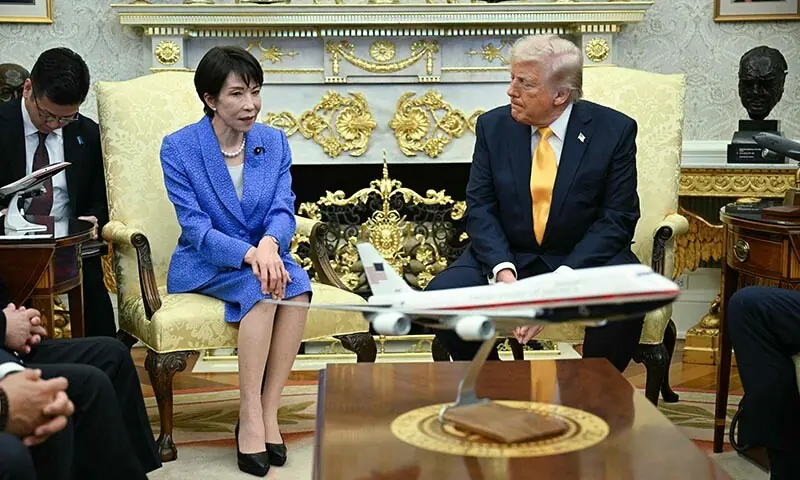
US President Donald Trump meets with Japan’s Prime Minister Sanae Takaichi in the Oval Office of the White House in Washington on March 19. — AFP
US President Donald Trump says he told Benjamin Netanyahu not to attack Iranian energy fields, adding that the Israeli prime minister had agreed not to, Reuters reports.
“I told him, ‘Don’t do that’, and he won’t do that,” he told reporters in the Oval Office.
US President Donald Trump has said, “I’m not putting troops anywhere,” when asked whether he was planning to send soldiers to the Middle East region amid the Iran war, Reuters reports.