The US and Israel on Feb 28 launched what they described as a “pre-emptive” joint strike against Iranian targets, with Trump announcing start of “major combat operations”
Iran Foreign Minister Abbas Araghchi will undertake a trip to Islamabad, Muscat, and Moscow from today, IRNA reports.
“The purpose of this trip is bilateral consultations, discussions, and dialogue regarding the ongoing developments in the region, as well as the latest status of the imposed war by the United States and the Israeli regime against Iran,” the report said.
Rebuilding trust between Abu Dhabi and Tehran will take “ages and ages”, UAE presidential advisor Anwar Gargash has said, after Iran targeted the United Arab Emirates during the Middle East conflict, AFP reports.
“You can’t be attacked with 2,800 missiles and drones and then talk to me about trust. That will take ages and ages,” Gargash has said at a World Policy Conference in the town of Chantilly, north of Paris.
The top official outlines that 89 per cent of the Iranian attacks targeted “civilians, civilian infrastructure, energy infrastructure”.
“Tehran was telling the Arab Gulf countries that ‘you don’t matter in my calculations,’ and I think this is going to last for a very long time,” he said.
“To the region — to the United Arab Emirates and other countries, Iran will be seen as a strategic threat,” Gargash said.
US Defence Secretary Pete Hegseth has brushed off Pope Leo’s comments criticising the war in Iran, saying the Pope is “going to do his thing” and that was fine, Reuters reports.
Russian Foreign Minister Sergey Lavrov has spoken with Deputy Prime Minister and Foreign Minister Ishaq Dar and “appreciated Pakistan’s constructive role in facilitating dialogue between Iran and the United States”, according to the Foreign Office.
In a post on X, it said that the two discussed bilateral relations and cooperation at multilateral fora in support of international peace and security.
It added that Dar underscored Pakistan’s resolve to “continue contributing to efforts aimed at promoting dialogue and diplomacy to resolve all issues”.
“Reiterating the importance of maintaining regular high-level engagements, they discussed rescheduling of the visit of Prime Minister Shehbaz Sharif to Russia at an early mutually convenient date,” it added.
Rebuilding trust between Abu Dhabi and Tehran will take “ages and ages”, AFP reports, citing UAE presidential advisor Anwar Gargash, after Iran retaliated with strikes on the American assets in the United Arab Emirates during the US-Israel war against Iran.
“You can’t be attacked with 2,800 missiles and drones and then talk to me about trust. That will take ages and ages,” Gargash says at a World Policy Conference in the town of Chantilly near Paris.
An Iranian delegation is expected to arrive in Islamabad later tonight, Pakistani sources have said.
They added that a second round of peace talks with the United States was also expected. According to the sources, Iranian Foreign Minister Abbas Araghchi is expected to arrive with a small negotiating team.
A logistics and security team from the US was already in the federal capital, according to the sources.
Only five ships, including one Iranian oil products tanker, have passed through the Strait of Hormuz in the past 24 hours, Reuters reports, citing shipping data.
The Iranian-flagged oil products tanker Niki, which is subject to US sanctions, was among the few vessels that sailed out of the strait with no destination listed, Kpler analysis and tracking data on the MarineTraffic platform showed.
It was unclear what would happen if it continued to sail further east towards the blockade line imposed by the US Navy.
Container shipping group Hapag-Lloyd also said that one of its ships has crossed the Strait but did not provide any information on the circumstances or timing. The Comoros-flagged supertanker Helga arrived at an offshore oil loading terminal in Iraq’s southern Basra port, the second vessel to reach Iraq since the strait’s closure.
The UN peacekeeping force in Lebanon, UNIFIL, announced on Friday that an Indonesian blue helmet died in hospital of wounds suffered on March 29 in an attack on his base, reports AFP.
“UNIFIL deplores the passing today of Corporal Rico Pramudia, who was critically injured following a projectile explosion in his base in Adchit Al Qusayr on the night of 29 March,” the force said in a statement.
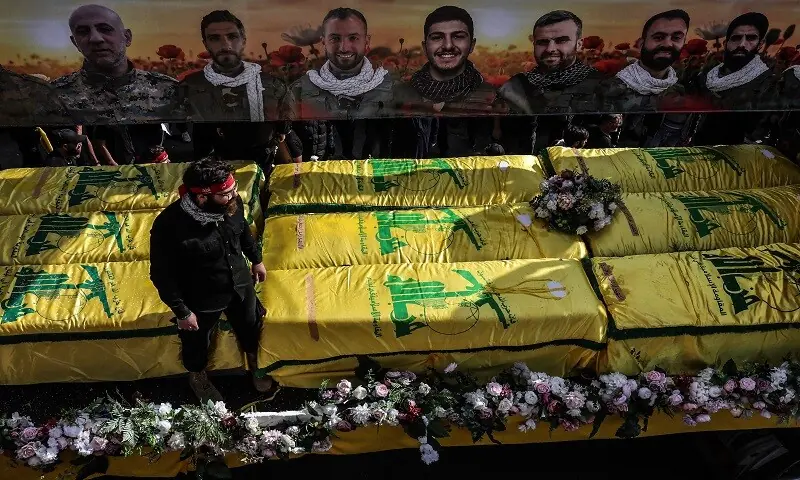
Lebanese group Hezbollah reserves the right to respond to any Israeli “aggressions” during the ongoing truce in Lebanon, Ali Fayad, an MP for the party, reports AFP.
He said extending the ceasefire “makes no sense” in light of continued “hostile acts” by Israel, saying they gave “the resistance the right to respond at the appropriate time”.
Nato has said there is no mechanism for suspending or expelling member states from the alliance, following a report that the United States could seek to suspend Spain over its stance on the Iran conflict, reports BBC.
Reuters reported that a US official said an internal Pentagon email had outlined possible measures to penalise allies it believed had failed to support its campaign.
The email also reportedly suggested reviewing the US position on the UK’s claim to the Falkland Islands in the South Atlantic, which are also claimed by Argentina.
A Nato official told the BBC that the alliance’s founding treaty “does not foresee any provision for the suspension or expulsion of Nato members”.
Spain’s prime minister has also dismissed the report.
An Iranian delegation is expected to arrive in Islamabad later tonight, Pakistani sources said on Friday, adding that a second round of peace talks with the United States was also expected.
According to the sources, Iranian Foreign Minister Abbas Araghchi is expected to arrive with a small negotiating team.
They added that a logistics and security team from the US was already in the federal capital.
Iran’s state media confirmed the visit, but said that he would hold “bilateral consultations”.
“Iran’s foreign minister will begin a regional tour on Friday evening, April 24, travelling to Islamabad, Muscat and Moscow,” the official IRNA news agency said.
“The purpose of this trip is to hold bilateral consultations, discuss ongoing developments in the region, and review the latest situation regarding the war imposed by the United States and the Israeli regime against Iran,” it said.
The development comes hours after Deputy Prime Minister and Foreign Minister Ishaq Dar and Araghchi, in a phone call, exchanged views on the US-Iran ceasefire and Pakistan’s ongoing diplomatic efforts, according to the Foreign Office (FO).
In a post on X, FO said, “Both sides exchanged views on regional developments, the ceasefire, and ongoing diplomatic efforts being pursued by Islamabad in the context of US-Iran engagement”.
It added that Dar, for his part, stressed the importance of “sustained dialogue and engagement to address outstanding issues, in order to advance regional peace and stability at the earliest”.
While his Iranian counterpart lauded “Pakistan’s consistent and constructive facilitation role in this regard”.
The FO added that the two leaders agreed to remain in “close contact”.
The first round of historic direct US-Iran talks was held in Islamabad on April 11 and 12, following a Pakistan-brokered ceasefire on April 8. It had ended without an agreement, but also without a breakdown.
However, the expected second round of negotiations witnessed a delay due to continued friction between the US and Iran, particularly regarding Iran’s closure of the Strait of Hormuz and the US blockade of Iran’s ports.
Over the past few days, Pakistan has ramped up its diplomatic efforts to bring the US and Iran back to the negotiation table.
On Thursday, Naqvi held an “important meeting” with US Chargé d’Affaires to Pakistan, Natalie Baker, in Islamabad, where the two discussed diplomatic efforts regarding the possible second round of US-Iran negotiations in Islamabad.
On Wednesday, Trump had hoped that a second round of talks could take place within two to three days, despite persistent mistrust.
“It’s possible!” Trump reportedly told the New York Post by text message, after the newspaper reached out to him to confirm whether the talks were “expected in Islamabad within the next 36 to 72 hours”.
Oil tanker HELGA, sailing under the flag of Comoros, has arrived at one of the offshore oil loading terminals in Iraq’s southern Basra port and is preparing to load 2 million barrels of crude, two port sources say according to Reuters.
The vessel is the second tanker to reach Basra’s southern offshore terminals since the closure of the Strait of Hormuz, the sources added.
Container shipping group Hapag-Lloyd says that one of its ships has crossed the Strait of Hormuz but does not have any information on the circumstances or timing, according to Reuters.
Four out of initially six ships remain in the Gulf, after one ship’s charter agreement expired, meaning it no longer belongs to the Hapag-Lloyd fleet, a spokesperson added.
The four Hapag ships remaining in the Gulf are staffed with 100 crew, who are well-supplied with food and water, he said.
Deputy Prime Minister and Foreign Minister Ishaq Dar and Iran’s Foreign Minister Abbas Araghchi, in a phone call, exchanged views on the US-Iran ceasefire and Pakistan’s ongoing diplomatic efforts, the Foreign Office (FO) says.
In a post on X, FO said, “Both sides exchanged views on regional developments, the ceasefire, and ongoing diplomatic efforts being pursued by Islamabad in the context of US-Iran engagement”
It added that Dar, for his part, stressed the importance of “sustained dialogue and engagement to address outstanding issues, in order to advance regional peace and stability at the earliest”.
Araghchi “appreciated Pakistan’s consistent and constructive facilitation role in this regard, and both leaders agreed to remain in close contact”.
European leaders have vowed to do more to de-escalate conflicts in the Middle East, as they prepared for discussions with regional counterparts from Egypt, Lebanon and Syria in Cyprus, AFP reports.
“Europe must do even more,” French President Emmanuel Macron told reporters in Nicosia before heading into talks with fellow European Union leaders.
They will later have a working lunch with leaders from Lebanon, Egypt, Syria and Jordan as well as the secretary general of the Gulf Cooperation Council.
This lunch will be “an opportunity, with Syria, Jordan, among others, to coordinate. They are affected by the situation in the region,” Macron said.