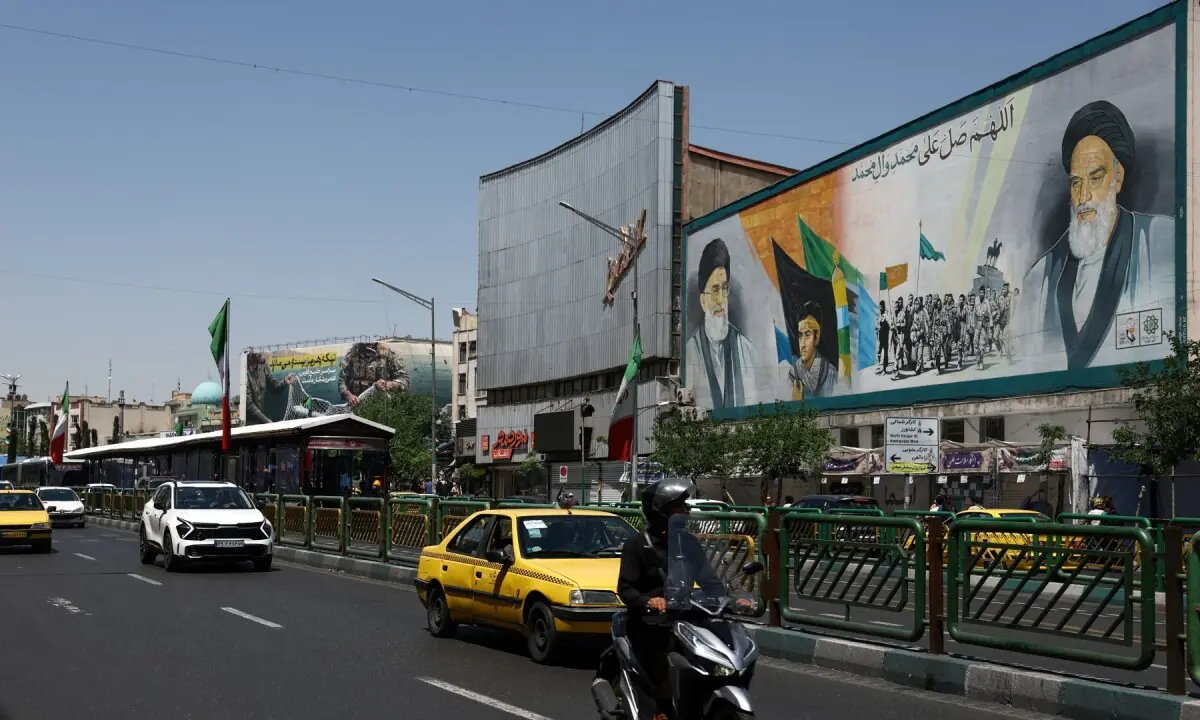
The US and Israel on Feb 28 launched what they described as a “pre-emptive” joint strike against Iranian targets, with Trump announcing start of “major combat operations”
Pakistan hosted the first round of face-to-face talks between the US and Iran in 47 years in April; the talks ended without a breakthrough, but also without a breakdown
Trump rejects Iran’s response to latest US proposal that would stop the fighting but leave the most contentious issues unresolved for now
Lebanon and Israel are to hold new peace talks in Washington, as their latest ceasefire — considered to still be in place despite hundreds of deaths in Israeli strikes — nears its end, AFP reports.
The two countries last met on April 23 at the White House, where US President Donald Trump announced a three-week ceasefire extension and voiced optimism for a historic agreement.
Trump at the time made the bold prediction that within the latest ceasefire period, he would welcome Israeli Prime Minister Benjamin Netanyahu and Lebanese President Joseph Aoun to Washington for a historic first summit between the countries.
The summit did not happen, with Aoun saying a security deal needed to be in place and Israeli attacks needed to end before such a landmark symbolic meeting.
The possibility that an entity other than Iran was responsible for the attack against a South Korean cargo vessel near the Strait of Hormuz is low, a senior official in Seoul was quoted as saying by the Yonhap news agency, according to Reuters.
South Korea is analysing intelligence shared by the US on the May 4 attack against South Korean shipper HMM’s Namu vessel, which caused a fire and damaged the lower stern hull, Yonhap quoted a senior foreign ministry official as telling reporters.
“Once we go through the investigation and present the evidence, I trust that the Iranian side will respond in an appropriate way,” the official said.
South Korea’s foreign ministry could not immediately confirm the official’s comments.
Japan’s government is looking at compiling a supplementary budget to reduce the burden on households from rising fuel bills, Kyodo news agency reported, a move that would put pressure on the country’s strained finances, according to AFP.
A supplementary budget for the current fiscal year would support households that are likely to be hit by elevated gasoline prices and utility bills during the peak-temperature summer season, Kyodo said, citing a few unnamed government sources.
Oil prices have edged higher as investors anticipate a high-stakes meeting between President Trump and China’s Xi Jinping later today in Beijing, but focus remains firmly fixed on the US-Israel war on Iran, AlJazeera reports.
As of 00:15 GMT, Brent crude oil futures rose $0.13, or 0.12 per cent, to reach $105.76 per barrel, while US West Texas Intermediate crude futures climbed $0.12, or about 0.12pc, to trade at $101.14.
The United Arab Emirates said it “denies reports” that Israeli Prime Minister Benjamin Netanyahu secretly visited the country, after Netanyahu’s office said he had met with the UAE president during the war with Iran, AFP reports.
Netanyahu’s office said Wednesday he had “paid a secret visit to the United Arab Emirates” during the war, “where he met with UAE President Sheikh Mohammed bin Zayed Al Nahyan”.
The announcement came a day after US ambassador to Israel Mike Huckabee announced that Israel had sent its Iron Dome air defence systems, plus personnel to operate them, to the UAE during the war with Iran.
While stopping short of confirming Huckabee’s comments, Netanyahu’s office said the visit “marked a historic breakthrough in relations between Israel and the United Arab Emirates”.
The UAE did not directly deny any such visit, referring to “reports” of a visit.
“The United Arab Emirates denies reports circulating regarding an alleged visit by Israeli Prime Minister Benjamin Netanyahu to the UAE, or receiving any Israeli military delegation in the country,” its foreign ministry said in a statement.
Iranian Foreign Minister Abbas Araghchi has said, “Enmity with the great people of Iran is a foolish gamble. Collusion with Israel in doing so: unforgivable.”
He said that Israeli Prime Minister Benjamin Netanyahu has “now publicly revealed what Iran’s security services long ago conveyed to our leadership”.
Netanyahu’s office said earlier that he held a secret meeting with the UAE President during the war on Iran.
“Those colluding with Israel to sow division will be held to account,” the Iranian FM said.
The US stock market closed at a record high overnight, as the fervour around artificial intelligence (AI) eclipsed concerns about the ongoing fallout of the Iran war, Al Jazeera reports.
The benchmark S&P 500 index rose 0.6 per cent, while the tech-heavy Nasdaq Composite climbed 1.2pc.
The S&P 500 has gained 8.5pc so far this year, while the Nasdaq Composite is up 13.6pc.
US Vice President JD Vance has repeated Washington’s claim that Iran cannot possess a nuclear weapon, noting that preventing nuclear proliferation is “probably the single most important thing that we can do to keep our people safe for the long term”.
“I agree with the president that Iran should not have a nuclear weapon. We’re obviously engaged in a very aggressive and very engaged diplomatic process to try to ensure that that doesn’t happen, and the president has a lot of options,” he says while addressing an event.
Anwar Gargash, an adviser to the United Arab Emirates’s president, says that the UAE remains committed to political solutions and diplomacy amid regional tensions, while stressing the country’s right to defend its sovereignty, Reuters reports.
He adds that the UAE had not sought conflict and had worked to avoid it, adding that relations between the Arab states and Iran should not be based on confrontation.
Iranian First Vice President Mohammad Reza Aref says the country’s “right to the Strait of Hormuz is established, and the matter is closed”, Al Jazeera reports.
Iran’s ISNA news agency quotes him as saying that Iran’s plans “were tailored to the sanctions and pressures of our enemies, but now we must plan for the security and well-being of our country and the region”.
Mahmoud Nabavian, member of Iran’s negotiating team, says the US had two main demands during the Islamabad talks: the complete opening of the Strait of Hormuz and the withdrawal of all 60 per cent- enriched nuclear material from Iran, Al Jazeera reports.
In comments shared by the ISNA news outlet, Nabavian is quoted as saying that Iran’s Parliament Speaker Mohammad Bagher Ghalibaf said that although the US could strike Iran’s infrastructure, Iran could also “raze all the infrastructure in the region to the ground in less than half a day”.
“The US said $6 billion in frozen assets [would] be released if Iran cooperated with the demands,” Nabavian adds.
He further says that after contacting US President Donald Trump, Vice President JD Vance suggested that negotiations continue based on the plan presented by Washington, to which Ghalibaf agreed.
“However, Vance suddenly announced that Trump would not accept the agreement,” Nabavian says.
Two people have been killed and one wounded by an Israeli attack on al-Abbasiya, in southern Lebanon’s Tyre district, Al Jazeera reports citing the state-run National News Agency.
This comes after at least three people were killed and several wounded in an Israeli air attack in Roumin that we just reported on.
US senators have rejected a resolution curbing President Donald Trump’s power to wage war on Iran — their first vote on the conflict since a 60-day deadline expired for the White House to seek formal authorisation, AFP reports.
The measure, introduced by Oregon Senator Jeff Merkley, was the seventh failed attempt by Democrats to rein in Trump’s war powers since the conflict began more than 10 weeks ago.
Democrats say that, under the War Powers Act, the administration had until May 1 to secure congressional approval for military action after Trump notified lawmakers in early March of strikes against Iran.
The administration disputes that interpretation, arguing that the clock was paused by a ceasefire announced more than a month ago.
Israeli Prime Minister Benjamin Netanyahu visited the UAE during the war on Iran, his office has just announced, according to Al Jazeera.
“In the midst of Operation ‘Roar of the Lion’, Prime Minister Benjamin Netanyahu made a secret visit to the United Arab Emirates and met with the President of the United Arab Emirates, Sheikh Mohammed bin Zayed,” a statement reads.
“This visit led to a historic breakthrough in relations between Israel and the United Arab Emirates,” it adds.
More than 10,000 homes have been damaged or destroyed in Lebanon since a ceasefire in the war between Israel and Hezbollah, AFP reports the head of the country’s National Council for Scientific Research.
“Since the current ceasefire … we have witnessed 5,386 housing units that were completely destroyed, and 5,246 housing units damaged,” CRNS chief Chadi Abdallah tells a news conference broadcast by local media.
Iranian Foreign Minister Abbas Araghchi alleges that Kuwait has “unlawfully attacked” an Iranian boat and detained four Iranian nationals in the Persian Gulf, adding, “This illegal act took place near [the] island used by the US to attack Iran.
“We demand [the] immediate release of our nationals and reserve [the] right to respond,” he says in a post on X.
Deputy Prime Minister and Foreign Minister Ishaq Dar has discussed the consequences of Iran closing the Strait of Hormuz during a telephone conversation with Kuwaiti Foreign Minister Sheikh Jarrah Jaber Al-Ahmad Al-Sabah, according to the FO.
“The two leaders discussed the wider implications of the closure of the Strait of Hormuz on the global economy and expressed hope for a peaceful, durable, and early resolution of the ongoing situation,” the FO has said in a post on X.
It adds that Sheikh Jarrah expressed his appreciation for Pakistan’s diplomatic efforts to encourage dialogue between the US and Iran, and “commended Pakistan’s constructive role in advancing regional peace and stability”.
About 80 per cent of war-damaged sites in Iran’s capital have been repaired, Al Jazeera reports citing state broadcaster IRIB.
“More than 60,000 residential and commercial units in Tehran province were hit by American-Zionist attacks during the third imposed war,” Deputy Governor of Tehran Seyyed Kamaleddin Mirjafarian is quoted as saying.
Estimates indicate Iran suffered about $270 billion in direct and indirect damage since the start of the US-Israel war on February 28.
Bridges, ports and railway networks, universities and research centres, and several power plants and water desalination plants were directly hit, while a large number of hospitals, schools and civilian homes were also damaged or destroyed.