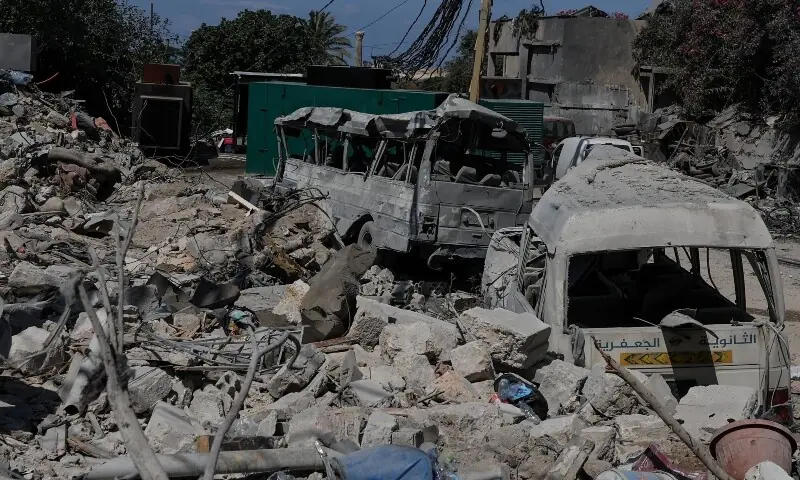
The US and Israel on Feb 28 launched what they described as a “pre-emptive” joint strike against Iranian targets, with Trump announcing start of “major combat operations”
Pakistan hosted the first round of face-to-face talks between the US and Iran in 47 years in April; the talks ended without a breakthrough, but also without a breakdown
US, Iran reached a preliminary agreement to end the war; hold high-level talks in Switzerland
Iranian and US technical teams working on the implementation of a memorandum of understanding are set to meet in Doha in the coming days, a source with knowledge of the talks tells Reuters.
Mediators have established communications channels to de-escalate any incidents, and technical talks are set to continue, the source added.
Iranian President Masoud Pezeshkian said that, after an agreement with the United States lifted oil and petrochemical sanctions, $6 billion out of $12bn of assets frozen in Qatar would be released and returned to Iran, Iranian state media reported, Reuters reports.
Iran and the United States signed an interim agreement this month to prepare the ground for a settlement of their conflict.
Iran’s semi-official Tasnim news agency, citing the Tehran governor, has provided details on the farewell and funeral procession to be held for former supreme leader Ayatollah Ali Khamenei.
The programme on July 6 will begin at 6am.
The main route starts from Damavand Street and extends from Imam Hossein Square, Revolution Street, and Azadi Street to Shahid Lashkari Street.
US envoy to UN Mike Waltz has claimed Iran stands “completely isolated” over its push to charge fees in the Strait of Hormuz and its leverage over the waterway is “diminishing by the day”, Al Jazeera reports.
Speaking after the US and Iran traded strikes following attacks on two ships in the strait, Waltz told Fox News that Gulf Arab states were already building alternatives with the UAE and Saudi Arabia, both expanding oil pipelines that bypass the waterway.
He added that the US will “create alternatives to our [military] basing posture” in the Middle East by “hardening some” and possibly moving others underground. “So this leverage that Iran thinks it has now is diminishing faster and faster, literally every week as we speak,” he was quoted as saying.
Waltz said even China had opposed fees or tolls in the strait and claimed that Oman had rejected Iran’s proposal to help set up the necessary infrastructure. “So they’re completely isolated here,” he asserted.
Michel Suleiman, who served as Lebanon’s president from 2008 to 2014, has defended the agreement with Israel, saying the country must be kept out of military conflicts in “service of foreign interests,” Al Jazeera reports.
In a statement carried by Lebanon’s National News Agency, Suleiman said it was “unacceptable” to accept the logic that decisions to launch wars and invite occupation could be taken “unilaterally in service of foreign interests” while efforts to end them required national consensus.
“Those who had the courage to take the decision to proceed with the framework agreement, based on the support of the majority of the Lebanese people, will not lack the same courage to annul this agreement if the other party fails to meet its commitments,” he said.
Middle East producers are pushing ahead with loading oil and liquefied natural gas despite fresh ship attacks in the Strait of Hormuz and renewed strikes between the US and Iran in recent days, shipping data shows, according to Reuters.
Today, a fourth Very Large Crude Carrier, capable of carrying 2 million barrels of oil, was seen loading at Saudi Arabia’s Ras Tanura terminal, LSEG data showed, even after a helicopter belonging to the company crashed on Sunday, killing 14 people. The cause of the crash was unknown.
Three other VLCCs have loaded oil and gone dark since leaving the terminal over the weekend, according to the data. Going dark refers to vessels with their transponders switched off to reduce the risk of attack while sailing through the Gulf.
One of these supertankers emerged today, having exited the strait, and is now heading for Japan, the data showed.
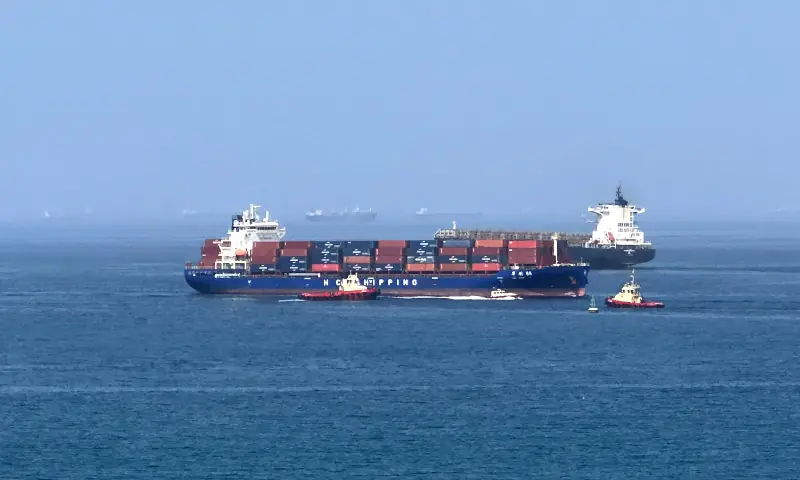
A cargo ship is pictured off coast of the Khor Fakkan Container Terminal, the only natural deep-sea port in the region and one of the major container ports in Sharjah Emirate, along the Gulf of Oman on June 28, 2026. — AFP
Yossi Karadi, director-general of Israel’s National Cyber Directorate, claims Iranian cyberattacks against Israel have surged since the launch of the US-Israeli war on Iran, Al Jazeera reports.
He told German newspaper Die Welt that hostile incidents rose from about 1,600 in June 2025 to roughly 4,800 in June 2026.
“Some groups are very skilled,” Karadi said. “We can handle them, but we have to take them seriously. Unlike in the kinetic realm, there’s no ceasefire in cyberspace.”
The attacks targeted critical infrastructure, large organisations and smaller businesses such as law firms and accounting practices. Companies that were easier to penetrate often had their systems wiped entirely, he claimed.
Iran and Oman have conducted the first meeting of a joint committee on the Strait of Hormuz in Muscat, an Iranian deputy foreign minister said on his X account, Reuters reports.
Kazem Gharibabadi said they had exchanged views on Gulf coastal states’ sovereign rights as well as on the strait’s future management based on the interim deal signed this month by Tehran and Washington.
Mohammed bin Salman bin Abdulaziz Al Saud and Emmanuel Macron have spoken over the phone, Al Jazeera reports, citing the Saudi Press Agency (SPA).
The agency said that the two leaders reviewed regional and international issues while emphasising the importance of ensuring freedom of navigation in the region and supporting diplomatic efforts to reduce escalation.
They also discussed recent developments regarding the memorandum signed between the US and Iran, as well as efforts to reach comprehensive solutions aimed at achieving security and stability in the region, according to the agency.
Corn futures slipped after hostilities between the US and Iran eased, while traders monitored hot weather in the US that could impact crops, Bloomberg reports.
The most-active futures in Chicago dropped as much as 1.3 per cent, extending declines for a second session. Washington and Tehran have agreed to stop attacking each other before peace talks resume this week over the Strait of Hormuz and other issues, following a recent flare-up that tested a ceasefire.
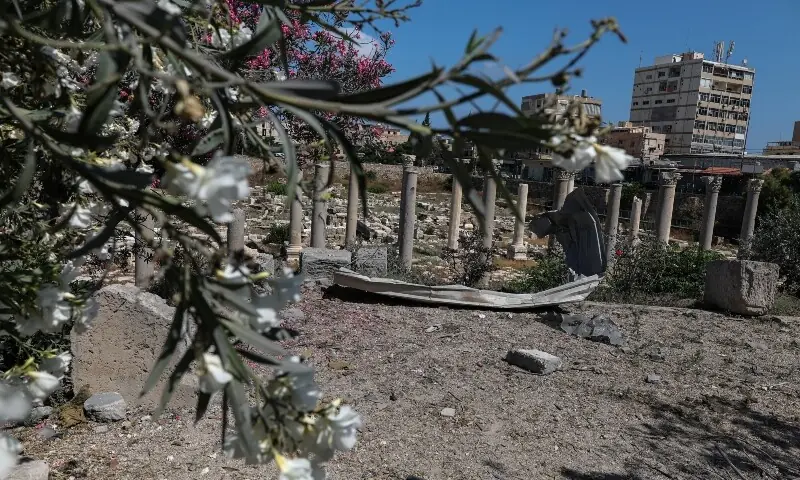
A piece of metal lies at the Al Bass Roman ruins, a Unesco World Heritage site hit by an Israeli airstrike in Tyre, southern Lebanon June 25, 2026. —AFP
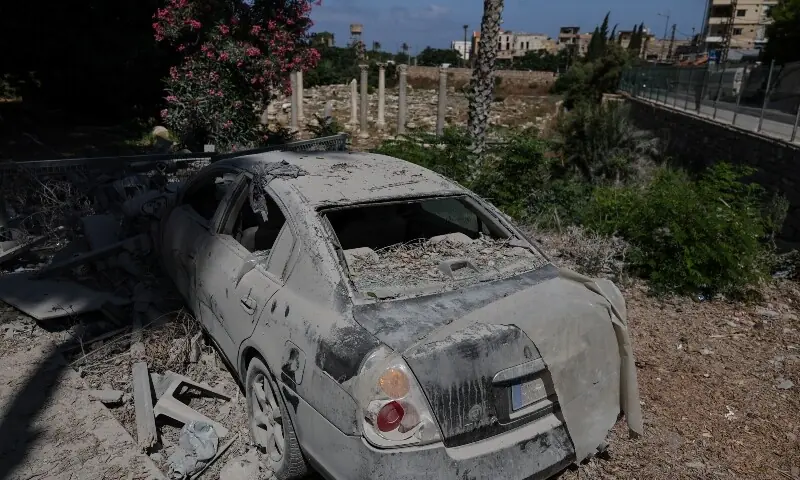
A damaged car at the entrance to the Al Bass Roman ruins, a Unesco World Heritage site hit by an Israeli airstrike in Tyre, southern Lebanon June 25, 2026. —Reuters
A damaged bus at the entrance to the Al Bass Roman ruins, a Unesco World Heritage site hit by an Israeli airstrike in Tyre, southern Lebanon June 25, 2026. —Reuters
Malaysia’s fuel supplies are sufficient to last until the end of August, economy minister Akmal Nasir told parliament, Reuters reports.
Fertiliser costs are expected to rise 15-20 per cent and livestock feed costs 8pc, Akmal said, adding that Malaysia’s rice supplies were also enough to last five or six months.
Yassamin Ansari, an Iranian-American lawmaker, has condemned Trump’s recent social media post threatening Iran.
In a post on his Truth Social platform yesterday, confirming US attacks on Iran, the US president said Washington may “be forced to militarily complete the job” if Tehran does not abide by the deal that was signed by both countries.
“If that happens, the Islamic Republic of Iran will no longer exist!” he wrote.
Ansari, a Democrat from Arizona, wrote on X that Trump’s rhetoric is “dangerous” and “unhinged”.
An adviser to Iran’s supreme leader has warned Bahrain that Tehran would strike the country with greater force if provoked, Al Jazeera reports.
“A serious warning is being given to the Bahrainis to know their limits and not play such games with their own fate, and not force Iran to adopt harsh decisions,” Ali Akbar Velayati was quoted as saying by the semi-official Tasnim News.
Oil prices rise following days of tit-for-tat strikes by the US and Iran that have underscored the fragility of their interim peace deal and again slowed energy shipping through the Strait of Hormuz, Reuters reports.
Brent crude futures climb 58 cents, or 0.8 per cent, to $72.57 a barrel at 0207 GMT while US West Texas Intermediate crude was at $70.11 a barrel, up 88 cents, or 1.3pc.
“There’s still plenty of risk facing the oil market. Even so, participants appear to be … focusing on what a continued recovery in oil flows would mean for the global balance,” ING analysts says.
“This complacency is odd and clearly leaves significant upside risk if the supply recovery proves slow.”
The U.S. and Iran will stand down on strikes and vessels will be allowed to move freely, as technical talks are slated to continue on all areas of the memorandum of understanding, a US official said, according to Reuters.
“Technical talks are slated to continue on all areas of the MoU. Both sides will stand down for now and vessels can move freely,” the official said.
The United States and Iran have agreed to stop attacking each other, American media reported citing senior US officials, and plan to meet on Tuesday in Qatar to resolve their dispute over the Strait of Hormuz, AFP reports.
The US and Iran have traded strikes in recent days despite a fragile June 17 memorandum of understanding aimed at ending the conflict that began in late February and disrupted shipping through the vital waterway.
Under that agreement, Tehran committed to allow safe passage of commercial vessels through the Strait of Hormuz while Washington agreed to lift its blockade of Iranian ports.
“We decided to stop all the kinetic activity,” a senior US official told media outlet Axios, using a military term for strikes.
Hezbollah said it reserved the right to self-defence after several Israeli attacks on southern Lebanon despite a truce between the two sides and a US-Israel-Lebanon framework to end hostilities, AFP reports.
In a statement, the group said that it “reiterates that what the enemy has done is a blatant violation of the ceasefire to which it has adhered until now, and that it is monitoring and tracking these violations, and reserves its right to defend its homeland and its people”.
The Israeli army destroyed an extensive tunnel built by Hezbollah in southern Lebanon, Prime Minister Benjamin Netanyahu and Defence Minister Israel Katz said, according to AFP.
“The tunnel, stretching more than 200 metres and reaching a depth of over 25 metres, contained hundreds of weapons as well as several launch shafts intended to target the State of Israel and its civilians,” the joint statement said.
The operation came two days after Israel and Lebanon signed a framework agreement mediated by the US in Washington, aiming to pave the way for peace between the two neighbours, which have officially been at war for decades.
The IRGC says its forces have destroyed eight US military sites in Kuwait and Bahrain, Al Jazeera reports, citing state broadcaster IRIB.
The statement said ballistic missiles and drones were used in the strikes, which it described as retaliation for recent US attacks on Iranian facilities in Sirik and Qeshm.
Iraqi President Nizar Amidi has emphasised resolving regional disputes through diplomacy and dialogue during talks with Iranian Foreign Minister Abbas Araghchi, Iran’s IRNA news agency reports.
Iran has called for the establishment of a clear timetable for Israel’s withdrawal from the occupied areas of Lebanon, describing it as an essential condition for achieving a lasting agreement to end the war and ensure regional stability, Iran’s Press TV reports.
Foreign Ministry spokesman Esmaeil Baghaei said, “Iran’s position is based on the principles of the United Nations Charter and the fundamental rules of international law.”
He stressed that respect for Lebanon’s sovereignty and territorial integrity was “indispensable for the durability of any agreement concerning the cessation of hostilities and Israel’s occupation of Lebanese territory”.
“Tehran has placed an end to Israel’s military offensive in Lebanon alongside the termination of hostilities against Iran as one of its principal demands and has consistently insisted on the implementation of those commitments.”
He also called for the prompt establishment of a timetable for Israel’s unconditional withdrawal from the occupied areas of Lebanon, saying, “Such a step is necessary for the successful implementation of the agreement and the achievement of durable peace and security.”
The Qatari Ministry of Interior has said that a “citizen was martyred after sustaining injuries from shrapnel resulting from the military operations in the area”.
“The Ministry of Interior clarifies that, as part of routine monitoring and verification procedures for maritime vessels conducted by the General Directorate of Coasts and Borders Security, it was noted that a vessel with two individuals on board had failed to return at its scheduled time,” the statement posted on X said.
Flights between Tehran and Dubai are to resume on Monday, AFP reports, citing the Iranian state media.
Iranian state TV and other media quoted Ramin Kashefazar, the head of Tehran’s Imam Khomeini Airport, as saying that “the necessary arrangements have been made to reopen the Tehran-Dubai route at Imam Khomeini Airport”.
Tickets were available to buy on the website of Iranian airline Sepehran for Monday’s 10:40am (0730 GMT) flight to Dubai.