The US and Israel on Feb 28 launched what they described as a “pre-emptive” joint strike against Iranian targets, with Trump announcing start of “major combat operations”
Pakistan hosted the first round of face-to-face talks between the US and Iran in 47 years in April; the talks ended without a breakthrough, but also without a breakdown
US, Iran reached a preliminary agreement to end the war; hold high-level talks in Switzerland
Nepal has rolled back fuel prices by up to 17pc, an official statement says, as the Himalayan nation responded to a fall in global prices following progress towards ending the war in Iran, Reuters reports.
State-owned Nepal Oil Corporation (NOC), the sole importer and distributor of fuel products in the country, reduced the retail prices of petrol by 9.2pc, of diesel by 13.3pc and of cooking gas by 4.6pc.
Jet fuel prices for the domestic sector have come down by 14.8pc and for the international sector by 14.47pc from Kathmandu, by 16.9pc for jets operating from Pokhara and by 17.04pc from Bhairahawa, it said.
A worker puts up a sign reading “no petrol” at a petrol pump as fuel crisis continues in Kathmandu, Nepal on Oct 1, 2015. — Reuters/File
Iran’s Supreme National Security Council has said that the “commanders and perpetrators” of late supreme leader Ayatollah Ali Khamenei’s assassination and the killing of Iranians in US-Israeli strikes will “face justice in due time”, IRIB reports.
“The file on avenging the blood of Martyr Ayatollah Khamenei and Iran’s martyrs remains open. The commanders and perpetrators of these crimes will face justice in due time, which will not be long, at the hands of righteous elements,” IRIB quoted the SNSC as saying.
Indirect technical talks between the United States and Iran are underway in Doha, with Qatar and Pakistan serving as mediators, a source with direct knowledge of the discussions tells Reuters.
US envoy Steve Witkoff and Trump’s son-in-law Jared Kushner met Qatar’s prime minister yesterday to lay the groundwork for today’s technical sessions but are not attending the talks themselves, the source said.
Ambassador Ali Bahreini says Iran will not allow the world to forget the attack as he held a virtual meeting with survivors and witnesses, Al Jazeera reports.
According to Iranian state media, Bahreini said: “The duty of justice demands that we ensure the victimisation … and crimes against civilians are not forgotten over time. Today, there is no country that does not recognise the criminal nature of this attack or is unfamiliar with the name of Minab school.”
US and Iranian officials will hold indirect lower-level technical talks with mediators today on a deal aimed at permanently ending the Middle East war, a diplomat with knowledge of the talks told AFP.
“US and Iranian officials are to hold indirect technical talks on Wednesday in Doha with Qatari and Pakistani mediators on the memorandum of understanding and building on the progress made at the Lake Lucerne Summit,” the diplomat said.
US envoys Jared Kushner and Steve Witkoff would not be taking part in the technical talks, the diplomat added, after they met with Qatar’s Prime Minister Sheikh Mohammed bin Abdulrahman Al Thani on Tuesday.
Former Israeli Prime Minister Naftali Bennett says Netanyahu is “incapable of governing” because he is controlled by far-right ministers Itamar Ben-Gvir and Bezalel Smotrich and ultra-Orthodox groups, according to AlJazeera.
“He is incapable of governing his own government because Ben-Gvir and Smotrich and Haredim, they all control him,” the opposition politician said in an interview with podcast host Mario Nawfal.
Bennett says he would not have allowed people like Ben-Gvir and Smotrich, who he said make “really stupid statements”, into a government. He said he would have called any of his ministers who make comments such as theirs “to order”.
But “Netanyahu can no longer do that because he depends upon them,” Bennett added.
He acknowledged that Israel’s international standing has deteriorated badly, saying it stems from the government’s conduct and ministers inflicting “ongoing self-inflicted wounds” while the country conducted “zero public diplomacy”.
The former prime minister has argued that prolonged Israeli wars in the Gaza Strip and Lebanon and the Iran war were contrary to Israel’s military doctrine and were draining the country. “It’s not Israel’s doctrine,” he said.
Lebanon’s Head of the Finance and Budget Committee Ibrahim Kanaan met President Joseph Aoun to discuss the “ceasefire” deal with Israel signed in Washington, DC, and the next course of action for the government, Al Jazeera reports.
“The state’s right to bear arms is a Lebanese matter and a necessity for the protection of Lebanon, particularly in the aftermath of the war,” the Lebanese Presidency quoted Kanaan as saying in a post on X.
European shares have slipped, pausing after a strong finish to the second quarter and amid caution over signs that peace talks between Iran and the US hit a new stalemate, according to Reuters.
The pan-European STOXX 600 index slips 0.3 per cent to 639.64 points by 0710 GMT after logging its strongest quarter since October 2020 in the previous session.
The technology sector, which had been a key driver over the past three months, is flat, with chip equipment maker ASML down 1.1pc and IQE and Infineon trading marginally lower. Schneider Electric loses 2.1pc after the AI equipment maker said it has signed an agreement to acquire Cognite Holding, a privately held provider of AI software and industrial data for $3.1 billion in an all-cash deal.
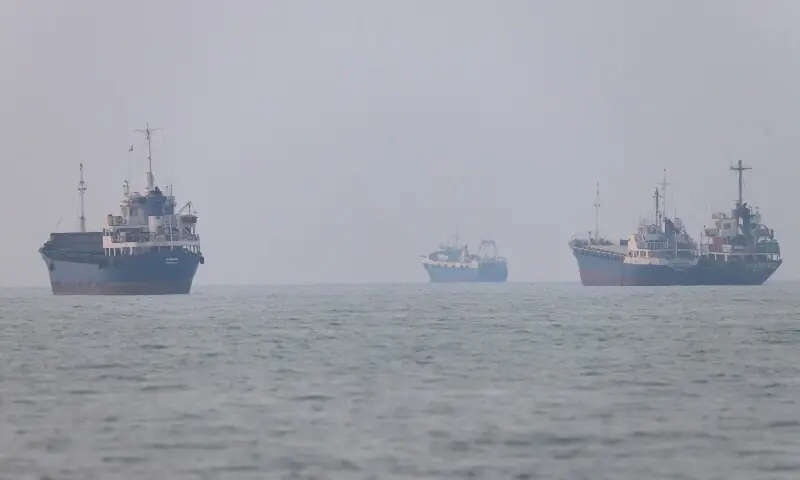
Windward, a maritime AI company that shares maritime updates, says that recovery in the Strait of Hormuz has “stalled”, AlJazeera reports.
In a social media post on X, it has said that on June 29, Strait of Hormuz traffic remained “well below pre-war levels”, reporting low transits and dark activity.
“Multiple sanctioned tankers moved through, including a second Iranian vessel in a week identified flying a false European flag,” it says, adding that “for now, only the US-assisted southern corridor under Project Freedom is keeping limited safe passage open.”
It reported that 16 cargo ships were inbound, and 23 outbound.
Iranian state television cuts short the broadcast of an interview with Mohammad Bagher Ghalibaf, Iran’s top negotiator in talks with the United States, drawing criticism from his team, AFP reports.
“This discussion was delivered to the Islamic Republic of Iran Broadcasting (IRIB) more than 2 hours before the broadcast time; but unfortunately, the broadcast of this discussion was stopped in the middle of it,” says a statement by the parliament media centre.
“This is despite the fact that this discussion was recorded and the least duty of the IRIB officials was to coordinate it with the parliament’s media centre if they decided not to broadcast part of the discussion contrary to procedures,” the statement adds.
The state broadcaster argued that the interview was cut into two parts and the second section will air on Wednesday night.
The parliamentary media centre notes that the parts that have been cut included the topics of UN nuclear watchdog inspections, the country’s frozen assets, and a 300-billion-dollar reconstruction credit.
Thailand’s Ministry of Foreign Affairs says 10 of 11 Thai-flagged vessels and vessels chartered by Thai operators stranded in the Strait of Hormuz since late February have safely passed through the waterway, Al Jazeera reports.
It said one vessel, the Hatthaya Naree, remains in the area while awaiting cargo loading and is expected to depart as soon as possible afterwards.
Indian Prime Minister Narendra Modi says he has spoken with Iranian President Masoud Pezeshkian about “recent developments” in West Asia, Al Jazeera reports.
In a statement on X, Modi said he welcomed the progress in negotiations with the US and “expressed hope that continued efforts will lead to lasting peace in the region”.
He added that he “reiterated the importance of freedom of navigation in the Hormuz Strait for India and the World”.
India imports about 40 percent of its oil and about half of its gas through the Strait of Hormuz, according to experts.
Malaysia may spend up to 40 billion ringgit ($9.8 billion) on fuel subsidies this year if energy prices remain elevated, more than double its initial budget allocation, Prime Minister Anwar Ibrahim said, according to Reuters.
Malaysia had set aside about 15 billion ringgit for fuel subsidies in its budget for 2026.
In a written parliamentary reply, Anwar said the government had spent about 800 million ringgit in each of the first two months of the year on subsidies for diesel and the RON95 transport fuel, before the figure jumped to about 5 billion ringgit in March and April after the outbreak of the war in Iran.
“The government’s priority is to ensure that the people continue to be protected if this crisis continues, especially those most affected by the cost of living pressures and rising global prices,” Anwar, who is also the finance minister, said.
The global oil market is set to swing back into oversupply as the impact of the Iran war fades and traffic through the Strait of Hormuz recovers, according to Goldman Sachs Group Inc, Bloomberg reports.
While purchases of crude to replenish strategic reserves are expected to tighten the global market to some extent, they would only partially offset the anticipated glut, Samantha Dart, co-head of global commodities research, said in an interview on Bloomberg Television.
US Congresswoman Rashida Tlaib says that she will vote for an amendment in the House to block $3.3 billion in military funding for Israel.
In a social media post on X, she has said: “This week, the House will vote on an amendment that would block $3.3 billion in military funding for the Israeli apartheid regime. I will vote yes.”
“We should not spend another cent arming a military that is committing genocide in Palestine, ethnically cleansing Lebanon, and committing war crimes in Iran,” she adds.
She further says that a majority of Americans and a supermajority of Democrats “support ending military aid to Israel. It’s time their representatives listened”.
The Terrorist Financing Targeting Center (TTFC), a joint US and Gulf initiative, has sanctioned parts of Hezbollah’s financial infrastructure including 16 individuals and five entities, AlJazeera reports.
The US Department of Treasury said the targets include Al-Qard Al-Hassan, Bayt al-Mal as well as their senior leaders.
Al-Qard Al-Hassan is a quasi-banking institution that offers interest-free loans to people and is one of the many charity organisations run by Hezbollah, including schools, hospitals and low-price grocery stores.
The US vice president JD Vance has been making several media appearances to tout the Iran MoU, Al Jazeera reports.
He told Fox News that the Trump administration was in a “great position” regardless of how the talks pan out.
The US “obviously” wanted the talks to succeed, Vance said, but added that his country was “still in a much stronger position” than Iran even if they fail. He insisted that Tehran’s nuclear programme and military had been “destroyed” and warned that Trump had made clear that any Iranian attacks on shipping in the Strait of Hormuz would prompt a US military response.
Vance again said Iran would be “permanently transformed” if negotiations aimed at securing a lasting settlement are successful.
South Korea’s Oceans Ministry said on Wednesday the cargo vessel Namu, operated by HMM, would exit the Strait of Hormuz in mid-July at the earliest once the damage sustained in an attack in May was repaired, Reuters reports.
The bulk carrier’s hull was hit near the stern in the attack, which Seoul claimed on May 27 probably involved an Iranian anti-ship missile, summoning the Iranian ambassador to share the results of its investigation and lodge a protest.
Saeed Koozechi, Iran’s ambassador to South Korea, denied Tehran’s involvement, the Yonhap news agency reported, and South Korea later said it could not conclusively determine who was responsible or whether the attack was intentional.
There are currently two vessels stuck in the Strait of Hormuz, including Namu, with 35 crew members on board, Nam Jae-heon, vice oceans minister, told a press briefing.
Israeli police have arrested a 20-year-old US citizen on allegations of spying for Iran, including taking photos and videos of “sensitive sites” in Israel, AlJazeera reports, citing media reports.
The man maintained contact with a Tehran-linked agent and allegedly received tens to hundreds of dollars for each task, the Times of Israel and the Jerusalem Post reported, citing a police statement.
They said he was arrested by the Jerusalem District police on June 9 and that a prosecutor’s declaration has been filed against him, signalling he will be formally charged in the coming days.
Gold prices extend losses after falling to a seven-month low in the previous session, as fading prospects of a permanent US-Iran peace deal have heightened inflation concerns and bolstered expectations of Federal Reserve rate hikes, according to Reuters.
Spot gold down 0.6 per cent at $3,981.69 per ounce, as of 0112 GMT, after hitting its lowest level since last November in the previous session.
US gold futures for August delivery lost 1.1pc to $3,994.40.
Traders are pricing in roughly a 67pc chance of a rate hike in September, according to the CME FedWatch Tool, reflecting firming expectations of tighter monetary policy.
Oil prices rose in early trade as investors responded to news that Iran will not be meeting with US envoys, a further strain on the interim ceasefire agreed between the two in the four-month-long war, Reuters reports.
Brent futures rose 50 cents or 0.69 per cent to $73.45 a barrel at 1208 GMT, while US West Texas Intermediate (WTI) crude climbed 63 cents, or 0.91pc, to $70.13 a barrel.
US President Donald Trump’s son-in-law Jared Kushner and envoy Steve Witkoff arrived in Doha for what the White House described as “high level” talks, but Iran and host Qatar said they would meet with mediators, rather than the Iranians themselves.