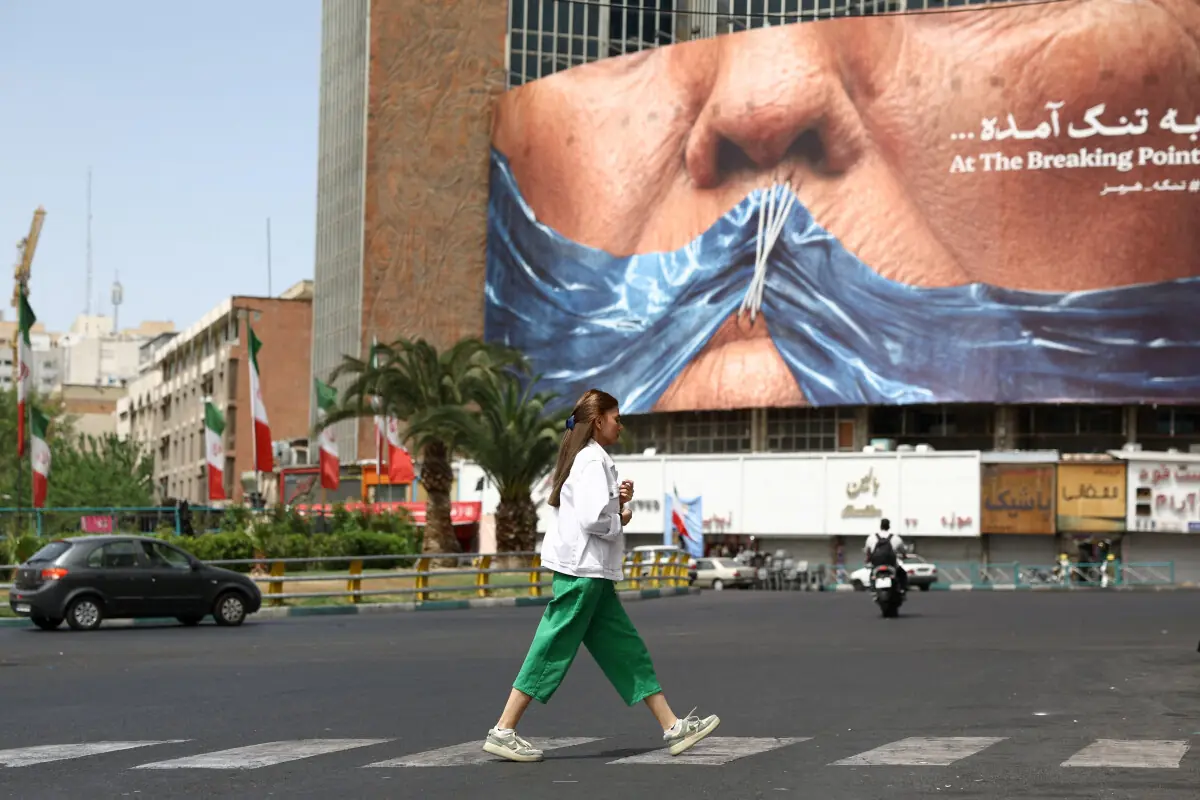
The US and Israel on Feb 28 launched what they described as a “pre-emptive” joint strike against Iranian targets, with Trump announcing start of “major combat operations”
Iran, US agreed to a two-week on April 8; the truce was later extended indefinitely and remains in place
Pakistan hosted the first round of face-to-face talks between the US and Iran in 47 years in April; the talks ended without a breakthrough, but also without a breakdown
US and Iran exchanged fire on May 8 despite the ceasefire
Even as hostilities briefly renewed, Washington said it was awaiting Iran’s response to a US proposal that would stop the fighting but leave the most contentious issues unresolved for now
Russian President Vladimir Putin hopes that the Iran conflict ends as soon as possible, but notes that if it does not, then “everyone would lose out”, according to Reuters.
The US military blockade of Iran’s ports is likely to cut Tehran off from vital oil revenue, but the country can likely endure the pressure for months without a major economic crisis or lasting harm to its oil industry, possibly dimming US hopes of forcing a quicker end to the war, Anadolu reports citing NBC News.
The blockade has stopped dozens of Iranian tankers near the Strait of Hormuz. Iran has slowly reduced oil production because of the blockade and could run out of storage space within two months, potentially forcing some wells to shut down.
“They’re going to have to shut down about half of their production. They can keep producing because they can refine it domestically,” says Robin Mills of Qamar Energy consulting and the Centre on Global Energy Policy at New York’s Columbia University.
Gregory Brew of the Eurasia Group says Iran has experience in reducing oil production after doing so twice in the past 15 years under US sanctions.
“I don’t think it’s going to do tremendous damage to their infrastructure,” Brew said. “They know how to do this. They’ve done it before.”
According to Brew, Iran has responded by cutting the amount of oil loaded onto tankers from about 11 million barrels per week to roughly 6-8 million.
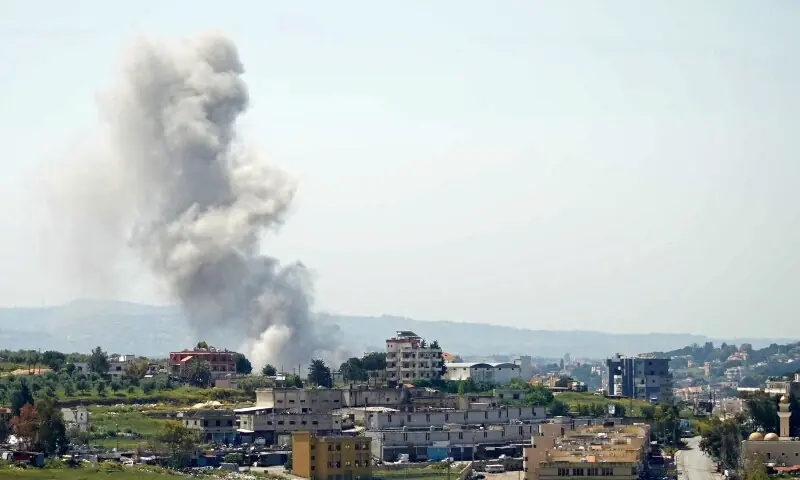
Al Jazeera’s Zeina Khodr reports on information from Lebanon’s Ministry of Public Health, which says that at least seven people have been killed and 15 wounded in Israel’s attack on Saksakieh in southern Lebanon.
“Those killed were families who fled their home in Jibshit and were seeking safety in Saksakiyeh when the building was targeted,” Khodr reports.
Global oil reserves are depleting at an unprecedented pace as the US-Israel war on Iran disrupts flows from the Gulf, eroding a key buffer against supply shocks, Al Jazeera reports citing Bloomberg.
Morgan Stanley estimates that global stockpiles fell by nearly 270 million barrels between March 1 and April 25.
The sharp drawdown means that governments and industries lose room to absorb the impact of more than a billion barrels of disrupted oil supply since the US-Israeli war on Iran started on February 28.
European Union crisis management chief Hadja Lahbib has called for increased humanitarian access in southern Lebanon, where Israel has continued strikes and Hezbollah has launched retaliatory attacks despite a “ceasefire” currently in effect, Al Jazeera reports.
“Humanitarian aid is ready, but too often it cannot reach those who need it most,” Lahbib tells a news conference on the second day of her visit to Lebanon, in advance of an expected EU aid delivery. “We need humanitarian access in full respect of international humanitarian law. Aid cannot save lives if it cannot reach people.
“Hospitals and ambulances targeted and journalists attacked [by Israel] for simply doing their job. There is no justification for this. International humanitarian law must be respected,” she adds.
Israeli forces have carried out a new wave of air strikes across southern Lebanon in the past hour, according to reports.
An Al Jazeera correspondent reports that attacks hit Safad al-Battikh in the Bint Jbeil district, as well as the town of Budyas in the Sour district.
Lebanon’s National News Agency also reports that Israeli warplanes struck the al-Bayad neighbourhood in Nabatieh for the second time in less than an hour.
There have been no immediate reports of casualties.
A senior Iranian official has issued a sharp warning to regional neighbours, specifically Bahrain, over their support for a US-backed resolution concerning the Strait of Hormuz, Al Jazeera reports.
Ebrahim Azizi, chairman of the National Security and Foreign Policy Committee in the Iranian parliament, cautions that aligning with Washington would result in “severe consequences”.
In a post on X, Azizi targets the island nation directly: “We warn governments, including microstates like Bahrain, that siding with the US-backed resolution will bring severe consequences. Do not close the doors of the Strait of Hormuz to yourselves forever!”
Kuwait has expressed solidarity with Bahrain and voiced support after Manama’s “uncovering [of] an organisation linked to the Iranian Revolutionary Guard”, the Kuwaiti Ministry of Foreign Affairs says in a statement posted on X, according to Al Jazeera.
The ministry commended “the efficiency of the Bahraini security apparatus and its vigilance in confronting the plots targeting the Kingdom’s security”.
The statement came after Bahrain’s Interior Ministry announced earlier on Saturday the arrest of 41 people accused of belonging to a group linked to the Iranian forces.
US Central Command says that 58 commercial vessels have been redirected and four others disabled since the naval blockade of Iranian ports began on April 13.
Fuel shortages due to the Middle East crisis have delayed by several weeks an annual mission to swap out researchers at South Africa’s sub-Antarctic Marion Island base, the government said Saturday, reports AFP.
The SA Agulhas II icebreaking polar supply vessel was meant to have left Cape Town last month to relieve a team based there since April 2025, the environment ministry said.
But it only received a shipment of specialised polar diesel required for Antarctic and sub-Antarctic operations on May 1, a statement read.
“The delay is primarily due to the global scarcity of fuel products linked to ongoing geopolitical developments in the Middle East,” it added.
The base on the island, about 1,920 kilometres southeast of Cape Town, had enough polar diesel reserves until about May 20 and food supplies for about two months.
Turkish President Recep Tayyip Erdogan says Ankara does not want the conflict between the United States and Iran to spread further across the region, Anadolu reports.
Erdogan has made the remarks during a meeting in Istanbul with Masrour Barzani, the Prime Minister of Iraq’s Kurdish Regional Government (KRG), according to Turkiye’s Communications Directorate.
The two sides discussed the latest regional developments during the meeting, where Erdogan expressed concern over attacks on Iraqi territory, including in Erbil, and said Turkiye opposed the expansion of the US-Israeli war on Iran to other countries in the region.
A liquefied natural gas (LNG) tanker has started to exit the Persian Gulf, with all other observable shipping through the Strait of Hormuz at a standstill following recent clashes, Bloomberg reports.
US President Donald Trump, meanwhile, seeks to reopen the vital energy channel at all costs, the outlet adds
Iran’s oil infrastructure may be the source of a suspected slick off a key island export terminal, but satellite images showed it is “much reduced”, an environmental group tells AFP.
Satellite images in the past days appeared to show an oil slick spreading off the coast of Iran’s Kharg Island. It was not immediately clear what had caused the apparent spill off the island’s west coast.
“The cause and origin of the slick remain unknown and cannot be determined conclusively from the available imagery alone,” a UK-based non-governmental organisation, the Conflict and Environment Observatory, tells AFP.
“While offshore infrastructure in the wider area could be a potential source, we are unable to identify a definitive point of origin or attribute the spill to a specific cause at this time,” says Leon Moreland from the observatory.
But, he adds, “the slick appears visually consistent with oil based on analysis” of imagery from the Copernicus Data Space browser.
The UK will send a destroyer to the Middle East ahead of any international mission to help protect shipping in the Strait of Hormuz, according to its defence ministry.
“The pre-positioning of HMS Dragon is part of prudent planning that will ensure that the UK is ready, as part of a multinational coalition jointly led by the UK and France, to secure the strait, when conditions allow,” a ministry spokesperson tells AFP.
An explosive drone launched by Hezbollah has been located in Israeli territory near the Lebanese border in the morning, Al Jazeera reports citing the Israeli military.
It adds that there was no damage or casualties, and that crews are working to remove it from the area.
Lebanese official media reported a new Israeli strike outside Beirut, moments after it reported two strikes on the highway linking the capital to the country’s south, AFP reports.
The state-run National News Agency said the strike hit the Chouf district, around 20 kilometres (12 miles) south of Beirut and not far from a previous strike on the Saadiyat highway.
Both areas are outside Hezbollah’s traditional strongholds and came despite a ceasefire in the Iran-backed group’s war with Israel.
This photograph taken from the southern Lebanese area of Nabatieh shows smoke trails of Israeli shelling on the village of Mayfadoun on May 9, 2026. —AFP
In an interview with Politico, former CIA director Leon Panetta says that the US is “stuck in a stalemate with Iran”.
Asked about US claims that military objectives have been met, Panetta says, “The basic objective that the president was after, which was regime change, did not happen.
“Since that time, the president has come up with a number of reasons why the United States got involved in this war and has really confused the issue,” he adds, citing perceived threats of an “imminent” attack by Iran, and stopping them from acquiring nuclear weapons.
“This was going to be a short war, six to eight weeks; we’re obviously in only the tenth week of this war,” Panetta says. “Both sides are exhausted, both sides would like to bring this war to an end.”
Turkish President Recep Tayyip Erdogan held a phone call with UAE President Sheikh Mohammed bin Zayed Al Nahyan, during which the two leaders discussed “bilateral relations, as well as regional and global matters.”
According to a statement, Erdogan underscored the importance Turkiye attaches to strengthening cooperation with the UAE across several sectors, particularly trade, energy and security.
Referring to the hardships experienced in the region amid tensions between Iran and the United States, Erdogan said the situation was saddening and stressed that Turkiye would continue to “fully support” the sovereignty and security of the UAE. He also extended his sympathies over the damages suffered.
He further stressed that dialogue and cooperation should be enhanced to address the region’s security needs and preserve regional stability.
Egypt will receive an extra $300 million as part of a $1 billion World Bank development financing package to help it confront fallout from the Iran war, Stephane Guimbert, the World Bank’s division director for Egypt, Yemen, and Djibouti, has told reporters, Reuters reports.
The package, consisting of $800m from the World Bank and a $200m British guarantee, is to support private sector-led job creation, macroeconomic stability, and the green transition. The bank’s board approved it yesterday.
The bank’s share was increased from $500m due to “the uncertainty in the region and the shock facing Egypt, like other countries, because of the war in Iran”, he said.
The financing is on terms unavailable in commercial markets at around 6pc interest, with a maturity of 30 years and a grace period before repayments begin, Guimbert said.
German Chancellor Friedrich Merz has said Europe wanted to work to keep the Nato alliance functioning, despite differences with the United States that the Iran war has exposed, Reuters reports.
“We are really willing to keep this alliance alive for the future,” Merz said at a press conference with Swedish Prime Minister Ulf Kristersson.
He also said Sweden and Finland had strengthened the European pillar of the alliance.
“We know that there are some differences. We know that we are seeing challenges, all of us, but our final goal is to bring this conflict to an end and to guarantee that Iran is not able to produce nuclear weapons,” Merz said.
“And this goal is a common goal between America and Europe.”
The US Treasury’s Office of Foreign Assets Control (OFAC) has targeted 10 individuals and companies for “enabling efforts by Iran’s military to secure weapons, as well as raw materials with applications in Iran’s Shahed‑series unmanned aerial vehicles and ballistic missile programme,” it says on X.
“While the surviving IRGC leaders are trapped like rats in a sinking ship, the Treasury Department is unrelenting in our Economic Fury campaign,” US Treasury Secretary is quoted as saying in a statement.
“Under President Trump’s decisive leadership, we will continue to act to keep America safe and target foreign individuals and companies providing Iran’s military with weapons for use against US forces.”
According to the Treasury, it has targeted entities in the Middle East, Asia and eastern Europe.
A young girl, who was previously reported as injured, has succumbed to her injuries at the President Nabih Berri Governmental Hospital in Nabatieh, after she and her father were targeted by a triple-tap drone attack, Al Jazeera reports citing Lebanon’s National News Agency.