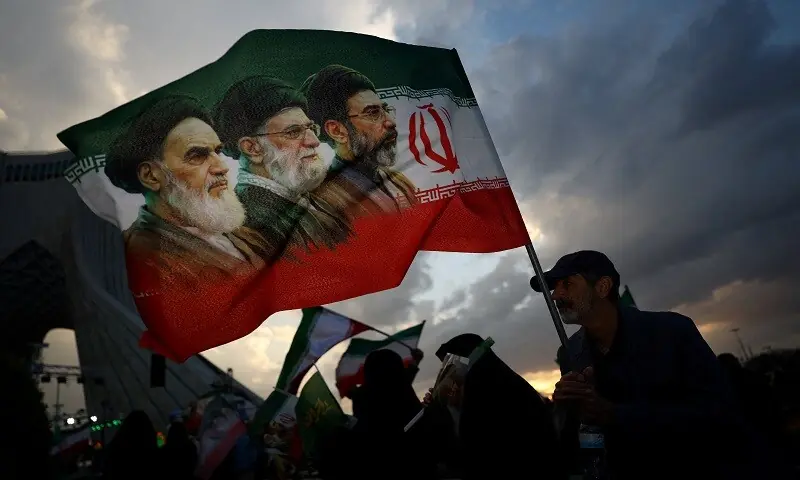
The US and Israel on Feb 28 launched what they described as a “pre-emptive” joint strike against Iranian targets, with Trump announcing start of “major combat operations”
The Pentagon estimates Iran has been denied nearly $5 billion in oil revenue because of the US blockade in the Gulf of Oman, causing unprecedented pressure on Tehran’s government, according to Axios.
Since the blockade began on April 13, the US military has redirected more than 40 vessels that have tried to pass through the blockade by carrying oil and other contraband, Pentagon officials have said.
“In total, 31 tankers laden with 53 million barrels of Iranian oil are ‘stuck in the Gulf’ and have a value of at least $4.8 billion,” Axios reports, adding that the US has seized two ships.
“Unable to fill oil in new tankers as on-land storage facilities reach capacity, Iran has begun to use older tankers as floating storage,” the outlet adds.
Axios, quoting US officials, notes that some tankers are taking “a costlier and longer route to deliver oil to China for fear of US maritime interdiction”.
Addressing a rally in Florida, US President Donald Trump has insisted that a deal with Iran is going to be done “properly”.
“They’re not coming through with the kind of deal that we have to have, and we’re going to get this thing done properly,” Trump says. “We’re not going to leave early and have the problem arise.”
US President Donald Trump says he expected worse numbers from the stock market when he launched strikes on Iran at the end of February, reiterating that Tehran cannot posess a nuclear weapon.
“I did something that was, I don’t know, foolish, brave … I would do it again, but I thought the numbers would be much worse,” Trump says, addressing a rally in Florida.
“I thought the stock market would go down much more; I thought the oil prices would go up much more. I said, ‘But we have no choice, whether it does or doesn’t, I have to do what’s right: we can’t let them (Iran) have a nuclear weapon,” he adds.
The United Arab Emirates has reaffirmed support for Bahrain’s “sovereign measures to safeguard its national security”.
“Sheikh Abdullah bin Zayed Al Nahyan, deputy prime minister and minister of foreign affairs, reaffirmed the UAE’s full support for the sovereign measures taken by the Kingdom of Bahrain to safeguard its security, uphold its sovereignty and national achievements, and counter any attempts to undermine the kingdom’s stability,” a statement by the UAE’s foreign ministry says.
It adds that the deputy prime minister stressed that the “security of the Kingdom of Bahrain is an integral part of the security of the UAE and the Gulf states, reiterating the UAE’s steadfast support for all measures undertaken by Bahrain to safeguard its national security and stability”.
China’s ambassador to the UN says it is of crucial importance that the ceasefire in the US-Israel war on Iran remains in place, Al Jazeera reports.
Fu Cong tells reporters at the UN that the Strait of Hormuz needs to be reopened as quickly as possible, adding that China is very concerned about remarks it had heard recently about the ceasefire being temporary and the need to initiate another round of attacks.
“Iran needs to lift its restrictions on the Strait of Hormuz, and the US needs to lift its naval blockade,” he says. “The most urgent issue is to keep the ceasefire. And the ceasefire needs to last, and there has to be a good-faith negotiation between the two sides.
“I think the international community should be mobilised and raise our voices against the resumption of fighting,” he adds.
Asked about Trump’s visit to China scheduled for this month, he says: “I’m sure if [the Strait of] Hormuz is still closed by the time President Trump goes to China, this issue will be high on the agenda of the bilateral talks”.
The ambassador also rejects allegations from some US officials about military cooperation between China and Iran as “false.”
The commander of Iran’s Islamic Revolutionary Guard Corps (IRGC) says that the “equations and rules of the new management of the Persian Gulf have been set based on the historic directive of the Supreme Leader of the Islamic Revolution and will be implemented”.
The IRGC Navy has vowed to make the waterway a “source of livelihood and strength for the dear people of Iran” by maintaining control of Iran’s 2,000-kilometre coastline.
A new poll has found that a large majority of people in the United States believe that the decision to take military action against Iran was a mistake, as the war roils the global economy and fuels cost-of-living concerns in the US, Al Jazeerareports.
A Washington Post-ABC-Ipsos poll released on Friday shows that 61 per cent of respondents believe the use of military force against Iran was a mistake, with just 36pc saying it was the right decision.
US President Donald Trump’s administration argues that a ceasefire with Tehran has “terminated” hostilities with Iran, as a legal deadline arrived for coming to Congress about the two-month Iran war, Reuters reports.
Under the 1973 War Powers Resolution, the president can wage military action for only 60 days before ending it, asking Congress for authorisation or seeking a 30-day extension due to “unavoidable military necessity regarding the safety of United States Armed Forces” while withdrawing forces.
Trump formally notified Congress of the conflict 48 hours after the first airstrikes, starting the 60-day clock that ends on May 1. As that date approached, congressional aides and analysts said they expected the Republican president to sidestep the deadline.
A senior Trump administration official said that the administration’s view was that the war powers law deadline did not apply.
“For War Powers Resolution purposes, the hostilities that began on Saturday, February 28, have terminated,” says the official, requesting anonymity while describing the administration’s thinking.
Iran’s Fars news agency reports that 14 Islamic Revolutionary Guard Corps (IRGC) personnel have been killed and two others injured when unexploded ordnance detonated in the north-western Zanjan province, according to Al Jazeera.
The personnel were part of a specialised unit tasked with clearing unexploded munitions from the area, which the agency says has placed around 1,200 hectares of agricultural land at risk.
Iranian Supreme Leader Ayatollah Mojtaba Khamenei has hailed the role of teachers and workers in the “cultural and economic battle” to mark Labour Day, according to a post on X.
“Teachers are the most influential link in the cultural battle, and workers are among the most effective elements of the economic battle; like the backbone of the spheres of culture and the economy,” he says.
Iranian foreign ministry spokesperson Esmaeil Baghaei says that it is “beyond dispute” that the US war on Iran is a “clear, unprovoked act of aggression”.
“The American public has both the undeniable right and the solemn duty to demand accountability from their ruling authorities for waging this illegal war against the nation of Iran, and for all the atrocities perpetrated during the war,” he says in a post on X.
US President Donald Trump suggests he will not seek Congressional authorisation for military action in Iran under the War Powers Resolution, describing those calling for it as “not patriotic”, Al Jazeera reports.
Arguing against the need for authorisation under the law, which requires a US president to seek approval within 60 days of deploying troops, Trump says, “many presidents… have gone and exceeded it. It’s never been used.
“Most people consider it totally unconstitutional,” Trump added. “Also, we had a ceasefire, so that gives you additional time … We’re in the midst of a big victory.”
US President Donald Trump says that he is not seeking congressional approval to extend the Iran war since it has “never been sought before”.
Under the 1973 War Powers Resolution, the president can wage military action for only 60 days before ending it, coming to Congress for authorisation or seeking a 30-day extension due to “unavoidable military necessity regarding the safety of United States Armed Forces”.
“Nobody’s ever gotten it before, they consider it totally unconstitutional,” Trump tells reporters, adding that he is “always in touch with Congress”.
“Nobody’s ever sought it before, nobody’s ever asked for it before, it’s never been used before, why should we be different?” he asks.
Tehran delivered a new proposal for peace talks with the United States via Pakistan, Iranian state media reported on Friday, with US President Donald Trump saying that he was “not satisfied” with what had been put forth.
Though the United States and Iran have suspended hostilities since an April 8 ceasefire, the two countries remain at odds over a range of issues, including Iran’s nuclear ambitions and control over the Strait of Hormuz, and they have yet to agree to a second meeting, following a brief summit of senior officials in Islamabad last month.
Trump’s comments on Friday indicated the deadlock over the two-month-old war is likely to persist.
He also conveyed to the US Congress his stance that the hostilities had “terminated” following a ceasefire with Iran as the deadline to get Congress’s approval for the war arrived.
Trump ‘not happy’
The text of Iran’s new proposal was handed to Islamabad on Thursday evening, the IRNA news agency reported on Friday.
Hours later, Trump spoke to reporters at the White House, saying, “At this moment, I’m not satisfied with what they’re offering.”
The US president said that the Iranian leadership was “disjointed”, “had a lot of problems” and “were not getting along with each other”.
“But we have just had a conversation with Iran. But I will say I am not happy,” he said.
Asked why he was unsatisfied with the Iranian offer, Trump said: “They’re asking for things that I can’t agree.” He gave no details.
The White House also declined to provide details on the proposal, but news site Axios reported that US envoy Steve Witkoff had submitted amendments reintroducing Tehran’s nuclear programme into talks.
The changes reportedly include demands that Iran not move enriched uranium from bombed sites or resume activity there during negotiations.
Trump said Iran had “made strides” in negotiations, but added that there was “tremendous discord” in the Islamic republic’s leadership and warned: “I’m not sure if they ever get there.”
Trump was asked what he would do if there was no deal but refused to say whether he would launch more strikes.
“Do we want to go and just blast the hell out of them and finish them forever — or do we want to try and make a deal? I mean, those are the options,” he said.
Trump added that he would “prefer not” to launch a huge offensive but added: “That’s the option: do we want to go in there heavy and just blast them away or do we want to do something?”
Addressing a rally in Florida, Trump again spoke on the matter.
“They’re not coming through with the kind of deal that we have to have, and we’re going to get this thing done properly,” Trump said. “We’re not going to leave early and have the problem arise.”
At the White House, he repeated his prediction that oil and gas prices would fall when the war ends.
Trump also said he had “great respect” for Pakistan, Prime Minister Shehbaz Sharif and Chief of Defence Forces and army chief Field Marshal Asim Munir.
For his part, Iran’s Foreign Minister Abbas Araghchi said his country was ready to pursue diplomacy if the United States changed what he called its “excessive approach, threatening rhetoric and provocative actions.”
However, Araghchi added in a post on his Telegram channel that “Iran’s armed forces remained ready to defend the country against any threat.”
On Thursday, Foreign Office (FO) spokesperson Tahir Andrabi said diplomacy to end the US-Iran conflict was continuing, with Islamabad maintaining its role as a facilitator between the two sides despite an apparent impasse in talks.
Negotiations between Washington and Tehran remain stalled, with both holding firm positions even as a fragile ceasefire continues. The truce, initially brokered by Pakistan in April, has been extended to allow space for diplomacy, but officials acknowledge that the process faces serious sticking points.
Last month, Pakistan hosted the first high-level contact between Iran and the US in decades and mediated those meetings. However, with challenges in convening a second round, Islamabad has shifted back to its role as a facilitator and go-between.
War Powers deadline
Trump also argued on Friday that a ceasefire with Iran had “terminated” hostilities, as he sought to bolster his argument that he did not need lawmakers’ permission to continue the conflict.
In a letter to congressional leaders on Friday, the deadline to come to Congress about the war, Trump said there had been no exchange of fire with Iran since the ceasefire. “The hostilities that began on February 28, 2026, have terminated,” he said.
Under the 1973 War Powers Resolution, a US president can wage military action for only 60 days before ending it, asking Congress for authorization or seeking a 30-day extension due to “unavoidable military necessity regarding the safety of United States Armed Forces” while withdrawing forces.
The US president formally notified Congress of the US-Israeli war on Iran 48 hours after the first airstrikes two months ago, starting the 60-day clock that ends on May 1.
As the date approached, congressional aides and analysts said they expected the Republican president to sidestep the deadline. A senior Trump administration official had said on Thursday the administration’s view was that the War Powers law deadline did not apply.
Trump said he considered the War Powers law unconstitutional. Both Republican and Democratic presidents have contended the measure violated the Constitution because it sets limits on the president’s powers as commander-in-chief. Legal experts say the matter has not been decided by the courts.
“We had a ceasefire, so that gives you additional time,” Trump said during his talk at the White House on Friday.
Congressional Democrats, who have tried repeatedly to pass War Powers legislation that would force Trump to end the war or come to Congress for authorisation, dismissed that characterisation, saying there was nothing in the 1973 law allowing for a ceasefire.
They also said that the continuing deployment of US ships blockading Iranian oil exports was evidence of continuing hostility, not a ceasefire.
“After 60 days of conflict, President Trump still does not have a strategy or way out for this poorly planned war,“ Senator Jeanne Shaheen of New Hampshire, the top Democrat on the Senate Foreign Relations Committee, said in a statement calling the deadline “a clear legal threshold” for Trump to act.
In his letter to Congress, Trump acknowledged that the conflict may not be resolved. He said Iran still poses a “significant” threat to the United States and its armed forces.
Lebanon’s health ministry has said six people including a woman and a child were killed in two Israeli strikes on a southern town where Israel’s army had issued an evacuation order despite a ceasefire.
The ministry statement has said eight other people, including a woman and a child, were wounded in the strikes on Habboush, where the state-run National News Agency had reported casualties after Israeli warplanes “launched a series of heavy strikes… less than an hour after warning” residents there to evacuate.
Asked about his options regarding Iran, US President Donald Trump says he has a choice between pursuing a deal or resuming military strikes.
“Right now we have negotiations going on, but they’re not going anywhere,” he tells reporters. “Do we want to go and just blast the hell out of them and finish them forever, or do we want to try and make a deal? I mean, those are the options”
Asked if he wants to resume strikes, Trump says, “On a human basis, I’d prefer not.”
US President Donald Trump tells reporters he is not worried about the state of American missile stocks amid reports of concerns about the pace of weapons use during the conflict with Iran, Reuters reports.
US President Donald Trump has expressed his displeasure with Iran, but says, “We just had a conversation with Iran, let’s see what happens.”
He tells reporters, “I would say that I am not happy,” reiterating his claim that Tehran’s leadership is “disjointed” and “very argumentative with each other”.