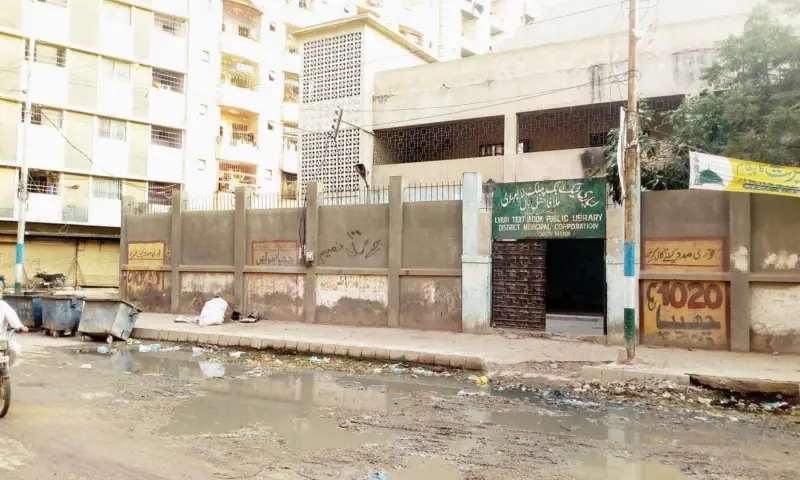
On the morning of April 7, Karachi’s Baghdadi police were alerted to a body on a footpath near a school in Lyari. Brown shirt, checked trousers, about 25 years old, no ID. Of note was a small tin sealed in golden foil that was found on his person. It said: “Queen Medam Pinky 🖤Don 🖤Naam hi kafi hai. Enjoy.”
The Baghdadi police put the body down as Unidentified Drug Addict in the roznamcha and dispatched it to a morgue. On May 9, they registered a murder case and nominated the name on the tin: Pinky. A forensic toxicology report confirmed their suspicion a few days later that it had traces of the A-class Schedule I narcotic cocaine.
In the official telling, Pinky was taken into custody from a flat in Karachi’s Garden on May 12 by the Sindh Police and a federal intelligence agency. Her arrest, it emerged, according to one version of events, was based on a tip-off. Pinky’s ex-husband had snitched on her to a sub-inspector in Karachi to tell him where she was hiding. The policeman, who cannot be named due to his current deputation, was ecstatic—he had been on Pinky’s case since 2019 and had once even come close. She had been dodging arrest for eight years and was thus well known to the Lahore and Karachi police, Counter-Terrorism Department and Anti-Narcotics Force as a most-wanted criminal in 28 cases involving narcotics, illegal arms and violent crimes.
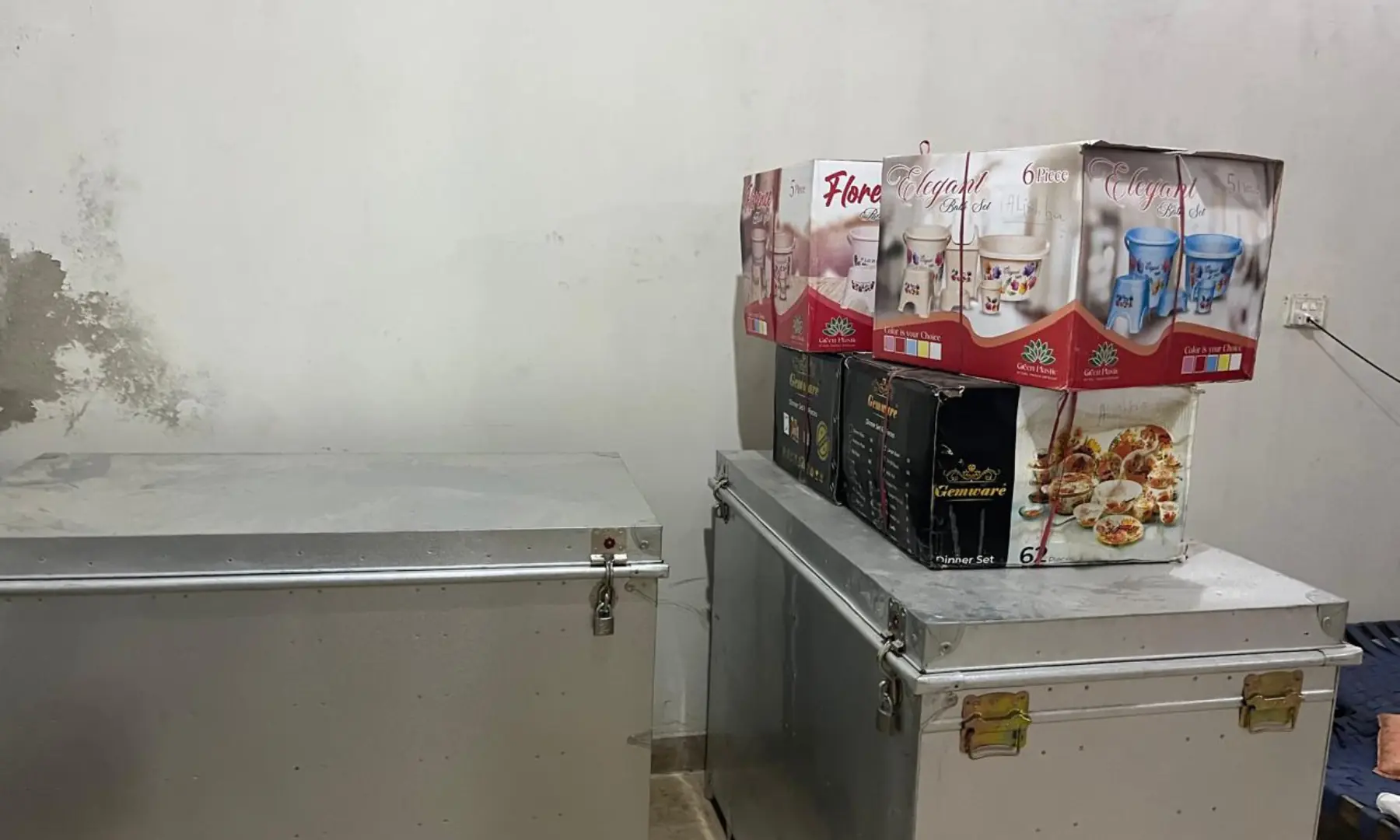
The joint operation team said it found in her flat boxes of packaging material, sealed tins like the one found on the Unidentified Drug Addict, other drugs, and a 9mm pistol with ten rounds. But most importantly, it had about 1.5kg of cocaine, which is worth as much as Rs30 million—a single seizure that equaled what the police intercepted from the entire City district in the first eight months of the year.
Recovery from Pinky’s flat. — photo by police
When Medam Pinky was presented at the Judicial Complex inside Central Prison Karachi on May 17, she challenged this version of the arrest loud and clear. As she was dragged into a police van—restrained by a clutch of women police officers who struggled to cover her face with a white chador—she shouted. “These people picked me up from Lahore and brought me here 22 days ago!”
The reporters latched onto this but she theatrically parried their questions: “Hum to doobay hain sanam, in sab ko lai doobay gain.”
I may be drowning, my love, but I will take all of them down with me too.
At one point in the ensuing media circus, a PDF list of 326 Karachi-based telephone numbers, supposedly from her smartphone, was reported as leaked. This news sent shivers down the city’s most expensive spines. The personal information doxxing was devastating for businessmen, journalists, bankers, and industrialists, whose CNICs and home and work addresses were spilled all over the internet. Frantic calls were made and eventually word had to be put out that the list was fake.
By this time, Pinky had captured the nation’s imagination. Television news channels were tickled pink that they could safely use the title “Queenpin” to salt the storytelling. TikTok—unencumbered by journalistic decorum—hashtagged her as #CocaineQueen. Indeed, the entire country had something to say about her brazen appearances. Look at the way she saunters in. Imagine coming to court in pajamas and a T-shirt! What’s with the vintage sunglasses? Shouldn’t she be in handcuffs?
Bulk supply
The officer who had received the tip-off accompanied the intelligence agency to the centre of Pinky’s web, Lahore. This is where over half of her contacts, 785 out of 1,286, resided. The Punjab capital, along with Islamabad and Rawalpindi, is a hot market for cocaine. A former investigation officer at the Anti-Narcotics Force explained that most of it is snuck in by air, usually as capsules swallowed by mules, a majority of whom travel from Africa. Others arrive from Europe carrying smaller quantities concealed among ordinary belongings such as infant formula.
Large consignments arrive by sea. Commercial vessels are used as unwitting vehicles. The packages of narcotics are concealed either inside a container in its cargo or within the structure of the container itself, hidden in the walls or below the floor. Reefer containers are used for their refrigeration units.
Pinky’s supplier was a Nigerian, identified as Chike Ochuba Chinwuba, according to her case file available with Dawn. The cocaine first came to Sialkot and then made its way to Lahore.
Once it arrived, it had to be bulked up. Pinky could turn 1.5kg from abroad into 5kg by adding impurities. She told the police that “Google Uncle” taught her how to mix with ketamine, methamphetamine, ephedrine, and lidocaine as they mimic cocaine’s sensory effects, or alter the perceived potency.
“Pure cocaine is rare here,” said the former ANF official. That is why most of what you get in Karachi is synthetically created in homes and labs. “And [the mixing] has resulted in deaths.”
Smooth operator
Selling the cocaine was fairly straightforward after Pinky’s brother Nasir helped her mix and package it.
All orders were placed directly with medam who would only entertain customers with a reference. Communication took place entirely over WhatsApp messages and voice notes. Pinky would share the bank account of an “accountant” and after a screenshot confirmed the payment, she shared the customer’s location with the rider and dispatched the delivery.
Deliveries to Karachi were organised through people she hired, mostly women, who travelled there by bus, with the cocaine concealed in small packages in their clothes and luggage. Bus staff helped couriers conceal the drugs under the seats or inside luggage compartments. Altogether, one kilogramme was dispatched a week.
Pinky’s other brother Shaukat would be waiting in Karachi to receive the packages, which he would measure off, put into the tins, brand and distribute among three handlers, who delivered them by riders. Everyone reported to Shaukat.
None of the payments was made directly to Pinky as she had two finance handlers, Sohail and Zeeshan, whose bank accounts were used. Muhammad Sameer managed ATM and other online transactions through four different banks. In one account, transactions over a year and a half amounted to Rs29.46 million. Across the four accounts—under the names of Sohail, Zeeshan and Sameer—she had Rs32.7 million.
Customer satisfaction
Cocaine is an elite drug because of who can afford to keep using it. It’s the people with the house with a garage and an eight-million-rupee car parked in the driveway. That is the point, said Ustad*, a user-turned-police informer. Age isn’t a consideration. Customers range from 14 to 65 years.
At a party, the customer reviews are glowing.
“Her stuff is good, not gonna lie,” said Inaya*. The first time she had tried the white stuff, she felt like she was “on top of the world”.
Another client, Hadi*, a 32-year-old introvert, experienced a personality transplant—the shyness that had plagued him his whole life simply switched off. “He was flirting left, right, and centre. He was unstoppable, man,” said his best friend, as they described the experience snorting cocaine.
They had come to know Pinky on a desperate night. “I was wasted…but had to walk back home,” said Hadi, who lived two streets from the house where they had been partying. “A friend suggested cocaine. A line.”
At 4am, the tin, bearing Pinky’s tagline, was delivered to their doorstep.
The effect doesn’t last, though. Fifteen minutes, stretch it to 20, and the floor drops out from under the high as fast as it had arrived. You chase that first quarter of an hour for the rest of the night and pay for it in thousand-rupee increments, said Hadi*.
“There goes your money,” added Inaya*.
Package deal
Pinky’s delivery network may have been pulling in the clients, but it was also putting her on the police radar. The sub-inspector who would go on to arrest her seven years later, first came across her name in 2019, while he was posted to DHA, Karachi and told to look into the area’s drug problem.
All he had back then was the nickname and a number. So they pulled the call detail record and ran the most frequent numbers through TrueCaller. Then they picked one number that barely showed up. “Sab se gareeb admi,” the SI told Dawn. That would have been the poorest customer. They called him and said a complaint had been filed. In exchange for immunity, he agreed to score 2g of cocaine for the cops.
After two days of dillydallying, the delivery was finally made. A man and woman showed up on a motorcycle, both of whom were pulled in. But their lips were sealed and eventually they had to be released. It was the second time round that the rider sang. His shift ran from 8pm to 2am for Rs70,000 a month. A single packet weighed 12g, worth about Rs300,000. At the time he was caught, he had already sold four.
The police told him to keep working and shadowed him on their motorcycles. The next pickup point was Gulshan-e-Iqbal, but 15 minutes later, it was changed to a french fries kiosk in Landhi. A man and woman came on a motorcycle again. This time, though, the man was none other than Shaukat.
That’s when Pinky entered the picture. “She tried to negotiate her brother’s release,” the sub-inspector said. “Her final offer was Rs900,000 with the condition: brother first, then the money.” The police declined and locked Shaukat up, but he would be out soon enough.
After that, “Pinky had figured out the tricks of the trade,” said the sub-inspector. Her riders multiplied and the drop points evolved. The tins were no longer handed over in person but tucked under a dustbin inside an ATM.
While the chase for Pinky finally ended this year, her name had already acquired a life of its own. Despite the media blitz, and the effort it took to nab her the police official insisted Pinky was not the drug tycoon she had been made out to be. “She was a mid-level player, no kingpin,” he said. “She was living normally, like you and me…she didn’t have a big house or scary dogs.”
He believed her reputation had grown faster than her operation. The business was not unlike any other: word spread about the quality of the product, customers returned, and the brand name acquired a currency of its own. But where was that name from?
Claim to fame
Pinky was born Anmol in Gwadar in 1995 and was raised in Karachi. She dropped out of school in the eighth grade and set off to Lahore with dreams of becoming an actress. Several failed auditions later, she met Rana Nasir and eventually married him. Soon, she began transporting drugs for him, and ultimately climbed the ladder to become his manager. They divorced 10 years later.
For Anmol, a decade was all she needed to reroute Nasir’s clients. All of them knew one name: Pinky.
It was a name she had chosen as a teenager, one for the world of modelling and elite parties. “The name has glamour,” the police officer said. “If it was Gulbano, Nuzhat or Fatima, people would not be as interested. [Pinky] is not easily forgettable.” Even after she moved to Lahore, her customers continued to find her.
The truth is that there are players far grander than Pinky, who operate quietly, produce more but rarely become the story themselves. Pinky did the opposite. Her name did the rest.
There is a particular cruelty in a name being spoken twice by death. Once when it is buried. And once when it is dug up again, because the truth could not rest with it. Mir Raza, the son of Mir Hassan Ali Khan, and Wafflix business owner, was laid into the earth of Rehmania Masjid graveyard on the 29th of July. Eleven days later, a board of doctors, a police surgeon, a magistrate, and a family that refused to let silence be the final word stood over that same soil and opened it again.
I have read the report. I do not think I will ever be able to unread it.
It is written in the flat, careful language that medicine keeps for what it cannot otherwise bear to say. Somewhere inside that distance is a twenty-five-year-old man who once had a face his mother could recognise without being told his name. What the doctors found confirmed what the family had feared all along, that Mir Raza did not simply die. He was taken from them. And when asked, plainly, whether his wounds came before death, someone circled a single word on the page: Yes.
That word has not left me since.
What stays with me most is not the injury itself, but the effort that surrounded it. The care taken. The insistence, even now, that this body still deserved to be handled gently, named properly, treated as someone rather than something.
Dr Summaiya Syed, Police Surgeon of Karachi, stood at that graveside and did what very few of us are ever asked to do. She looked directly at what injustice leaves behind, and she did not turn away. There is a particular kind of courage in choosing, on an ordinary working day, to be the last honest witness a murdered man will ever have. It is not the courage of headlines. It is quieter than that, and heavier, and it asks everything of the stomach and the soul, and gives back only the satisfaction of having told the truth when it would have been so much easier not to.
And yet, the final word on how Mir Raza died has still not been given. Not because there is doubt. The findings speak clearly enough. It has simply not been said out loud, in the way that matters, in the place that matters. Twelve days passed, the doctors believe, between his death and the moment anyone was able to examine him. Twelve days in which a family did not know. And then more days still, in which even his grave had to be argued for, before the truth was allowed to be looked at a second time.
We spend our lives pretending we are not what that grave revealed. We make plans, we argue over small things, we behave as though we will always have tomorrow to fix what we said today. But strip away the years, and every one of us ends the same way Mir Raza did. Plain. Unrecognisable, even to those who loved us most. If that is where we are all headed, then what exactly are we fighting for when we fight for justice? I do not think it is the body. The earth takes that regardless. I think it is the truth of what was done to someone while they were still here to feel it. That is the only part of us that does not decay. It is the only inheritance a murdered man can leave behind that no grave is deep enough to bury.
Karachi did not let this one go quiet. Somewhere between a graveyard and a courtroom, ordinary people, neighbours, strangers, a city that has buried too many of its sons without asking enough questions, decided that Mir Raza’s silence was not going to be mistaken for peace. They spoke. They kept speaking, until an order was signed and a grave that should have been the end of his story became instead the place where it finally began to be told properly. That is not a small thing. In a country where so many cases are allowed to fade as quietly as a body returns to the earth, the refusal of ordinary citizens to look away is very often the only justice the dead will ever be given.
So I find myself asking the only question I have left. If the truth has already been found, plainly, and written down, and confirmed by a circled word on a page, then what are we still waiting for? Where does justice go, in the space between a death and its acknowledgment? And where, in a city that loved this man loudly enough to bring him back up into the light so his story could be told rightly, does our humanity actually stand today? Not in the vigils. Not in the slogans. But in the quiet, unglamorous work of finishing what we started for Mir Raza.
I do not have that answer yet. I am not sure any of us do. But I know this much. A city that will not let its dead be forgotten has not yet forgotten itself. And whatever else remains unresolved, that much still holds true: somewhere beneath all our exhaustion and all our grief, we still believe a man’s name is worth saying twice.
Header image:Mir Raza Ali, a 25-year-old business owner whose body was found in bushes in Karachi’s Gulistan-i-Jauhar on July 29, following which a police probe into his death is ongoing. — Instagram/Wafflix
For at least two decades, Hijri Road has been a nuisance for the people who live in Gulshan Town’s Metroville Colony.
So when UC 6 chairman Nasir Ashfaq managed to get the Karachi Development Authority to fix the inner neighbourhood service lane, they insisted on paver blocks this time. Three years later, sewerage still overflows from time to time, but at least by the time they clean it up there is still a road underneath the muck.
“When we installed pavers, we’ve seen that the lifespan of the road increases,” said the UC chairman. “The problem hasn’t resurfaced.”
Neighbourhood after neighbourhood is switching to the newer technology. End of last year, Mayor Murtaza Wahab even announced a Rs281 million push to redo roads in District Central alone.
“Paver work … is now a preferred option for local union council level leadership because of its sustainability,” Wahab told Dawn.
The success of an experiment at a nasty spot on the well-worn 26th Street persuaded the city government it was making the right choice. And if you take the FTC flyover from Gora Qabristan and exit on to Sharea Faisal, you’ll notice the difference there too.
These two spots would keep ponding no matter how many times the city patched them up. But since these strips were done over in blocks in 2022, there has been a marked difference.
A bigger experiment for an entire underpass at Gulistan-i-Jauhar was undertaken a year later. The decision raised eyebrows at the time, but the mayor defended it as a solution to persistent water damage. But when should pavers ideally be used in Karachi, and is this construction material actually a solution to one of this city’s worst problems: potholes?
Why pavers in the first place?
Pavers became popular when clay bricks fell short as Europe patched itself back together again after WWII.
The Netherlands introduced them in 1951, Brazil has relied on them for entire favelas, and use has doubled in the United States every five years. And according to Farhad Jatoi, the managing director at Magnacrete, pavers have long been tested in far more demanding environments such as ports and steel mills.
Karachi began using them under very different pressures. When a road is not designed or levelled properly, rainwater or sewerage tends to sit on it. This eats away at the top coat of asphalt. Potholes appear in days, even on new roads.
The engineers needed to keep the city’s roads in working condition and could not keep repairing them every time a gutter overflowed. They couldn’t wait for Karachi’s entire drainage to be fixed either.
And so when the Umar Sharif underpass was repeatedly breaking down, they decided to fix it once and for all by patching it with pavers. The same approach was taken for Jehangir Road, which would keep flooding with sewage because it is about 2 feet lower than its surrounding areas.
“We only install them in places where there’s subsoil water, leaking sewerage lines, or underground cross-connections causing repeated damage,” said one of the city government’s senior engineers, Ishrat Rehan. Pavers are the response to chronic drainage failures, even if they are a “majburi” for a city with few workable choices.
As per the Karachi Metropolitan Corporation’s latest progress report of the district Annual Development Programme, at least Rs4.2 billion were sanctioned for paver-related work in the city, with District Central seeing the largest share of around Rs1.13bn. The data, however, did not include figures from Districts Malir and Keamari.
The science of soil failure
Judge a road’s strength not by what you can see, but what lies beneath.
The roads you see in Karachi are built a little like Caked Alaskas. You scoop out the ground and refill the length of the strip with layers of soil or aggregate (crushed stone, gravel, sand, or recycled material).
This layer is pressed down by rollers. In the end, a thin layer of smooth, durable black asphalt is spread evenly over the top. The stronger the compression or compacting, the better the road.
As any Karachi meme will inform you, the trouble is that flooding and sewage sit on the roads, eventually seep into the compacted layers below and turn this base into mush. Naturally, if the lower layer is wobbly, the hard top coat can crack when cars and trucks pass over it.
“The failure appears on the surface—but the real failure is happening underneath,” explains Ashar Lodi, executive director at Exponent Engineers, which has worked on the Karachi Transport Master Plan, the Malir Expressway and the BRT Red Line most recently.
This is why proper drains are critical to road design and why engineers give their surface a slight slope so water runs off.
The science of drainage hinges on permeability: the ability of water to seep into the ground. Soil can absorb a lot of rain, but if you cover it with asphalt or concrete, you need proper drainage to respond.
“If water cannot percolate into the ground, it has to be carried away,” said Lodi. “Without a functioning drainage network, it will inevitably accumulate on the surface.” Pavers, he said, marginally improve permeability, but they cannot handle the volume of water generated during heavy rainfall, especially when runoff from surrounding areas converges on a single point.
Paver roads are far simpler engineering of relatively thin, loosely compacted soil, over which the blocks are fitted. It is because these roads don’t have the deep, well-pressed lower layers that they are not considered to have the same ability to take heavy loads as asphalt. Pavers are convenient for smaller roads in neighbourhoods where tankers and trawlers don’t move.
They work as a localised fix but are no substitute for a proper road network.
Illustration of a cross section of a concrete block pavement structure. — Ilan Ishai (2003) Comparative Economic-Engineering Evaluation of Concrete Block Pavements, Road Materials and Pavement Design
Professor Noman Ahmad of NED University considers using the blocks a departure from standard road-building practices. Pavers are, according to him, better suited to low-velocity traffic and pedestrian movement (think schoolchildren, pushcart vendors and motorcycles), instead of roads carrying buses, dumper trucks and rush-hour cars.
Lego pieces
The science of topography, engineering and hydrology do not, however, account for the reality of trying to deal with Karachi’s civic institutions.
Pavers are a much less fussy material to install if the city government isn’t taking your calls. This is what many frustrated neighbourhoods have discovered.
Amir Khusro Road had trouble for years with the leaks of a 48-inch and a 24-inch water line.
“For the past 15 years, we’ve written to the water board multiple times, but they’ve always said they don’t have the budget to fix it,” said Jinnah Town Municipal Corporation chairman Rizwan Abdus Sami of the Jamaat-i-Islami.
“So we had no choice: we first laid concrete on the road and then installed pavers on top. The water lines are still leaking underneath. But since there’s now a thick layer of concrete above, the water is just dispersing somewhere below. Where exactly it’s going, only God knows.”
KWSC disputed this characterisation. Its Chief Communications Officer, Naveid Siddiqui, said that in the past six months, nine complaints (4 leaks, 4 line bursts, 1 line damage) had been reported and resolved from Amir Khusro Road and its neighbourhood.
One side of the two-way Amir Khusro road revamped with paver bricks. — Photo by author
An average Karachi road often sits on 13 different lines (sewerage, water, PTCL, internet, gas, K-Electric, Safe City project), which develop faults frequently. When you dig up an asphalt road and then repair it, the uniformity is sacrificed, and bumps appear. Machines lay asphalt roads, but post-digging repairs are done manually and never match the original quality or lifespan.
KDA’s Chief Engineer Abdul Samad Jamlani added that his department usually asks KWSC to fix its lines before they build roads. “But they usually address only small sections,” he said.
“Ideally, if we are constructing a 2,000 or 3,000-foot road, the entire pipeline beneath it should be replaced. But that rarely happens.”
The executive engineer at TMC Safoora, Imdad Solangi, felt that at least with pavers, you can remove and reinstall them, unlike asphalt. As engineer Lodi put it: “They’re like Lego pieces. If one part fails, you can just remove a few blocks, fix the base, and put them back.”
Cities need hydrological planning, but Karachi’s ad hoc paver solution to waterlogging and damage just signals institutional resignation, if you ask Envision Engineering’s managing director, Sameem ul Islam.
“It means that they are saying, ‘We cannot fix drainage, we have given up’,” he told Dawn.
One side of the two-way Amir Khusro road revamped with paver bricks. — Photo by author
But is it cheaper?
The standard paver in Pakistan is 100mm by 200mm, with two common thicknesses of 60mm (most used) and 80mm. The common grey ones with a compressive strength of 6,000 PSI typically cost Rs135 per unit. (PSI is pounds per square inch, or how much crushing force the block can handle before it breaks). Pavers may be cheaper, but experts argue comparing prices isn’t enough.
Engineer Rehan presented this math: The wearing course for asphalt (the top layer of the road that comes in direct contact with traffic) costs about Rs150 per square foot. The binder layer (the base that provides structural support) is around Rs95. That comes to Rs245 per square foot. Pavers, on the other hand, cost around Rs230.
The assumption that pavers are a cheaper alternative is challenged. Urban planner Bilal Khalid argues that you may save initially, but in the long run, maintenance will still set you back.
“The initial cost of pavers is roughly 50pc to even 100pc higher than asphalt,” said Khalid. “If we assume they are cheaper in terms of maintenance, the issue is that wear and tear of bricks also increases, especially if they are subjected to loads beyond their design capacity.” Repeated cracking and displacement, he suggested, could undermine any perceived savings.
Pavers can last 8 to 10 years if they have a compressive strength of 5,000 to 7,000 PSI. But if you go to lower PSIs, those blocks can wear out quickly. Well-installed pavers (7,000 PSI) with proper interlocking and consistent bedding can take heavy vehicular loads.
A study by Denmark’s Aalborg University has found that while pavers can help manage surface runoff, they are not the longest-lasting or cheapest options for roads. They can require significant maintenance and, in some cases, partial reconstruction within six to seven years, a lifespan many people consider too short compared to conventional road surfaces.
As an alternative, Khalid suggested reviving the city’s own asphalt production and maintenance capacity. “Today, those plants are dysfunctional,” he said. “Reactivating them, either through public resources or public-private partnerships, could provide a more sustainable solution”
Part of Garden Road alongside Karachi zoo lined with paver bricks. — Photo by author
Gulistan-i-Jauhar’s underpass experiment
Public opinion, as far as a quick street survey could reveal, is mixed on whether paving the Gulistan-i-Jauhar underpass was a good decision.
Some people who use it, such as Muhammad Owais, have road snobbery. He reached the conclusion that you shouldn’t use paver blocks if you want to make a “proper” road. Pavers are just meant for footpaths.
“I went through [the Gulistan-i-Jauhar underpass] once, and my bike ended up in such bad condition that I never used it again,” he said, explaining that he just uses the overhead bridge despite traffic congestion.
Rickshaw driver Kifayatullah who uses the route, was more blunt: “This underpass isn’t right,” he said. “Vehicles and bikes are getting damaged here.” He claimed to have witnessed an accident in which two children died.
The primary complaint is that pavers create an uneven surface that is unstable for motorcycles. The vehicle vibrates, its handlebars shake and riders can’t drive in a straight line.
This ‘wobbling’ sound is caused by the friction between the wheel and the paver, explained Professor Noman. This can make pavers shift from their position, which can leave gaps that can derail a vehicle. Another hazard is loose pavers or kerb blocks at the end of the median or when the edges are not tightly fitted.
Bykea rider Muhammad Jan dismissed the criticism entirely as a frequent user of the underpass. “It’s completely fine; first class,” he said. “There’s no problem at all.” Others felt it saved time, and at least even after the recent rains, you did not have potholes that gave you punctures.
The project engineer, who requested anonymity, said the decision to use paver blocks was driven by site conditions, particularly water flow and gradient.
“Standing at Jauhar Chowrangi and looking towards Samama, [you will see] there is a significant height difference of around 22 feet,” he told Dawn.
“When rainwater flows down from that height, its velocity is very high. If we had used asphalt, the force of that water would have stripped it away in the first heavy rain.”
They chose pavers because they are more resistant to water damage and can withstand high-velocity runoff. “We’ve used 8,000 PSI strength pavers here,” he added. “Nothing will happen to them for 20 to 25 years.”
The project’s contractor, Sherjan Mosakhail, did not respond to a request for comment.
Underpass built using paver bricks in Gulistan-i-Jauhar. — Photo by author
However, in an article published in 2023, following the construction of the underpass, urban planner Muhammad Toheed had argued that the perceived lack of attention to quality in the construction had led to accusations that the contractors prioritised personal financial gain over the welfare of the public.
“Residents are avoiding the underpass, which is supposed to be a faster, signal-free corridor, and opting for longer routes instead,” he wrote. “In essence, the millions, if not billions of rupees spent on the underpass are being under-utilised at best and wasted at worst.”
Speaking to Dawn, Toheed suggested that contractors, instead of need-based assessments, sometimes influence infrastructure decisions.
“The contractor says that this road should be built again, and the same contractor is awarded the project,” he alleged, adding that the sudden visibility of certain materials and suppliers raises questions about procurement practices.
Quality control
Pavers undergo standardised tests before use, with compressive strength being the most commonly assessed indicator of quality.
Engineers typically rely on three major parameters: compressive strength, split tensile strength, and water absorption. A lab will test the quality of three to five samples rather than what is installed on the ground, which is the responsibility of the on-site engineer.
It is ‘abrasion resistance’ or how much wear a surface can endure under repeated traffic cycles before its thickness begins to reduce that is key to look out for.
According to Amir Nizam, the principal laboratory engineer at NED University’s Civil Engineering department, it is an expensive and important but less frequently conducted test. Labs will basically do a scratch test and see how much powder the sample will shed if ground down. High-end companies should be able to provide a certificate.
Compressive strength is where new companies can cut corners, so testing this parameter is recommended.
Paver blocks manufactured in Pakistan typically range between 5,000 and 10,000 PSI in compressive strength.
“Big companies like Hubcrete, Envicrete and Magnacrete produce blocks in the range of 7,000 to 8,000 PSI and above,” Nizam said. But the market is expanding, as in the last year alone, the NED lab has tested products from around 25 new companies. Many newer manufacturers have shown inconsistent quality, often achieving only 3,000 to 6,000 PSI.
Outdated construction standards are to blame for dodgy quality as well.
We still adhere to the British Standard 6717 for precast, unreinforced concrete paving blocks, but this was withdrawn in 2005. Farhad Jatoi of Magnacrete said newer benchmarks, such as BS EN 1338, that prioritise testing tensile strength and abrasion resistance over compressive strength should be adopted.
In other parts of the world, they have laws that a concrete block being used in construction cannot have strength less than, let’s say, 1,000 PSI.
“And if we find a single concrete block at a construction site that is less than 1,000 PSI, we’re going to shut down that construction site,” he added. He claimed he had reports of blocks as low as 400 PSI.
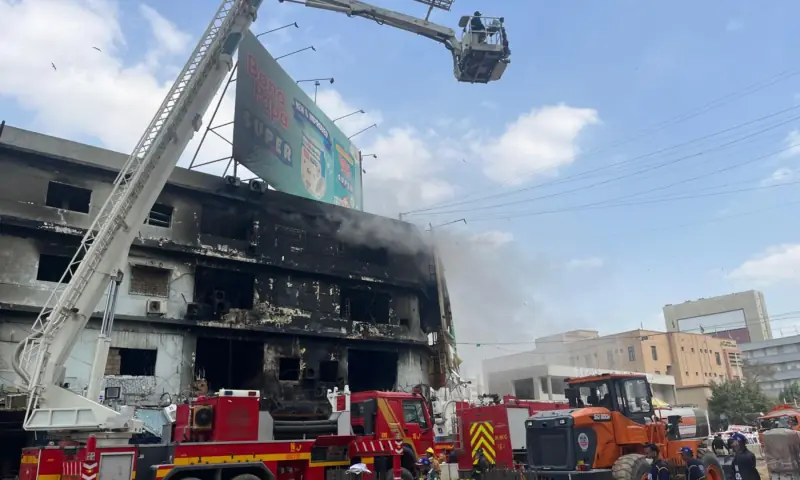
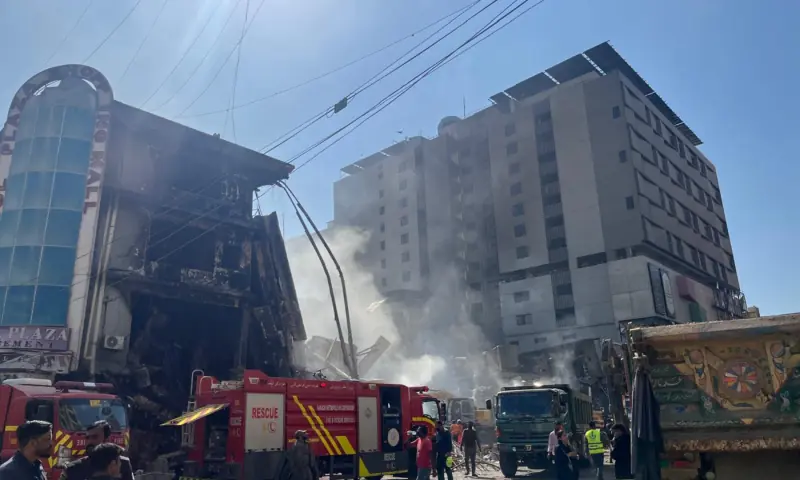
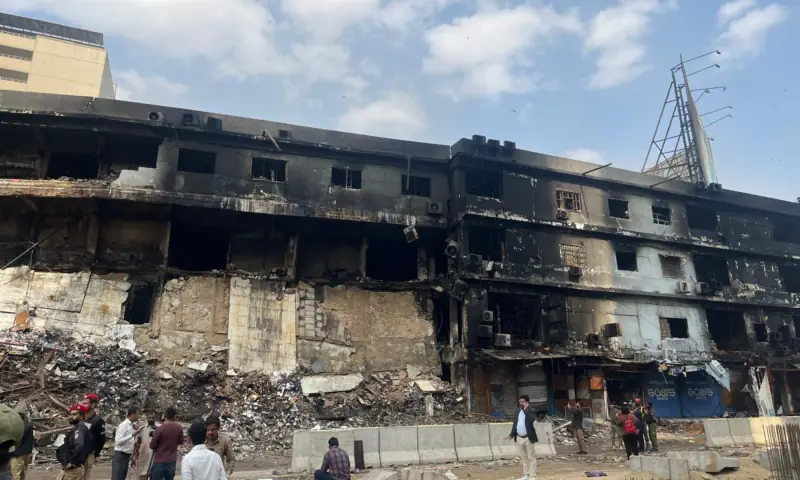
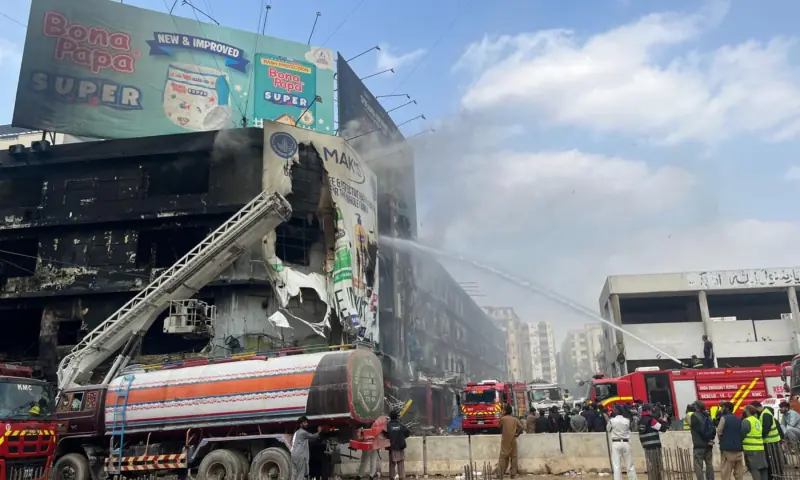
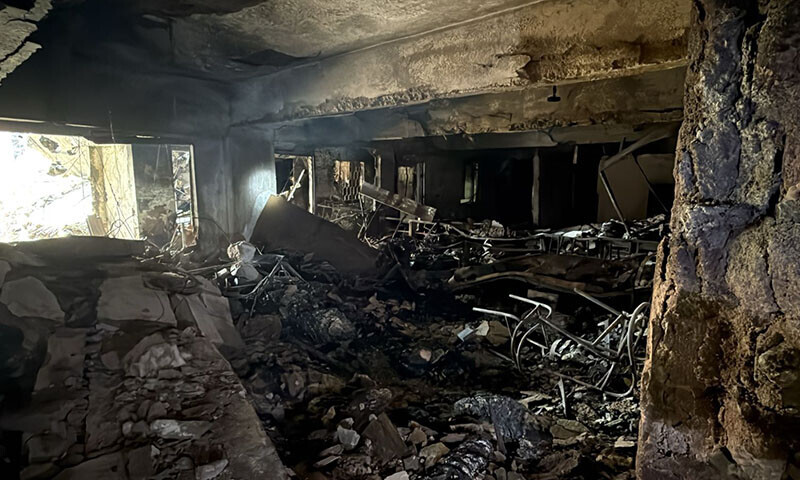
Gul Plaza’s three facades were clearly damaged in the stage II and III January 18 fire which killed 70 people, but when a building inspector came afterwards, he held back. “It was impossible to go inside,” he said, “the heat was too intense even after two days.” That same month, one after another, three other market fires erupted in Karachi, intensifying the feeling of anger and helplessness that the city had turned into a tinderbox because of years of neglect. The bodies just keep piling up.
The preventable deaths from urban negligence — fires, open manholes, building collapses, electrocution, rains, bad road design — all speak to the systemic weakening of Karachi. At least 300 have been reported in newspapers so far in 2026 by rough count. Many of these deaths are evidence of the failure of vertical expansion of informality. You cannot allow floor upon floor, shop upon shop, to be slowly added to urban spaces and infrastructure that was never designed to support such density in the first place.
Neither the Karachi Metropolitan Corporation (KMC), its fire brigade nor the regulatory Sindh Building Control Authority (SBCA) seemed to respond to this state of affairs in any way that would persuade us that they were aware or care about just how unliveable they were making the city.
Instead of focusing on the accountability of these governing institutions and their actors, so much of the talk surrounding these preventable deaths skips to championing what is described as informalisation as resilience or a rose-tinted tale of survival against odds. But for the oppressed with no choice but to live and work in Karachi, resilience’s ugly reality consists of working in a building with no safety standards. There is no ventilation when smoke chokes it, and the flames swallow the stairwells or when its exits are blocked or structurally insufficient to cater to the actual volume of people inside. That is not the resilience of a people. It is the abandonment of the system supposed to serve them.
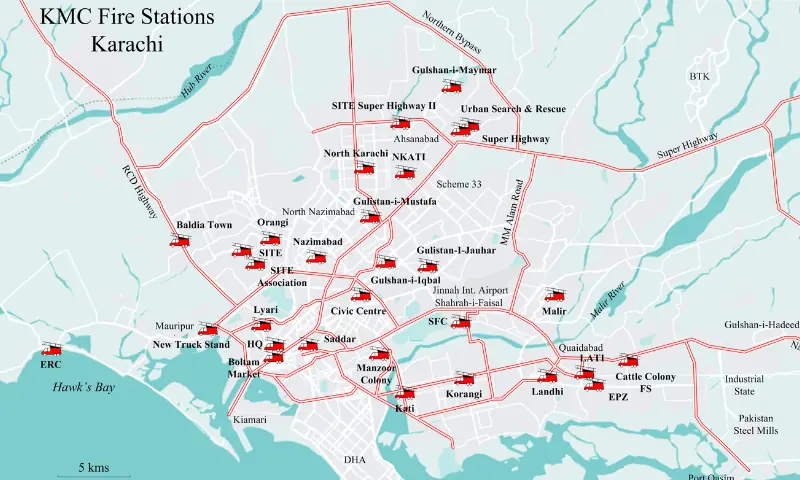
Fire station coverage
The international benchmark, guided by the National Fire Protection Association, says that the first responding unit should take no more than 4 minutes to reach a fire. Full deployment should take no more than 8 minutes. In cities with thin traffic, this translates into a 2-3km service radius for a fire station.
In places where fires spread rapidly, such as high-risk commercial hubs and industrial zones, the standard is for a station to be located within a distance of 1.5kms. But in Karachi, however, congestion shrinks this safety zone to a mere 0.5km. In other words, a fire station should be 500m away. By these standards, the city needs over 200 fire stations. It has only 26.
In high-density zones, where water infrastructure is already unreliable, spatial shortage ensures that by the time help arrives, the window for containment has already slammed shut. The following data shows the huge gap between population density and the available emergency infrastructure.
Given the shortage of fire stations, the state needs to reconsider how the existing ones should serve their areas. It should not allow taller buildings (through floor-area-ratio relaxations) until it is confident it can tackle their fires. This applies to vertical intensification, for cases when a builder wants to turn an old two-story bungalow in PECHS into six floors of apartments. This adds to the load of the service areas of existing fire stations.
Since the 1980s, land values and floor area permissions have drastically changed in the city. This has raised concerns about the idea of “disposable architecture” — buildings designed for short-term profit at the expense of long-term human survival.
The money trail
Poor safety in Karachi is often blamed on oversight, but in the fire department’s case, it is also a symptom of cost-cutting, or worse, the creative diversion of funds. As recently as the 2024-25 financial year, audits from its ledgers provide ample damnation.
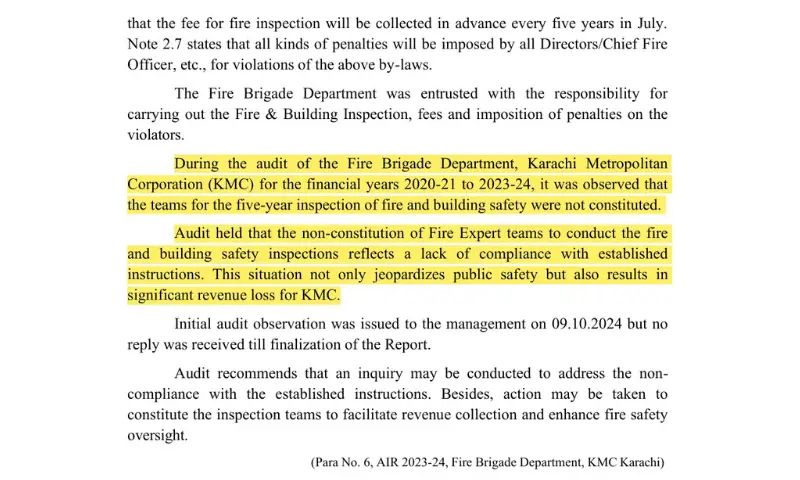
In one instance, the Auditor General of Pakistan found that Rs33 million was paid out for vehicle repairs, but the work was not authenticated with original vouchers, daily work orders or logbooks. In earlier years (from 2020-21 and 2023-24), KMC didn’t ensure mandatory five-year fire and building safety inspections. Other discrepancies speak to sheer neglect, such as KMC forgetting for three years to register 55 fire vehicles sent as a gift from the federal government, in violation of its own Sindh Motor Vehicles Ordinance, 1965.
The Auditor General’s office was cognisant of the significant operational challenges KMC’s fire brigade wing faces in the shape of sprawling urbanisation, ageing infrastructure, and high vulnerability to disasters. These factors notwithstanding, the AGP’s findings suggest that the state is effectively feeding the city’s decay by ignoring how critical safety budgets are mismanaged.
Excerpt from the Audit Report on the accounts of Climate Change, Environment and Disaster Management Organisations of Government of Sindh (Audit Year 2024-25)
Half the frustration is that people wondered why nothing had changed since the terrible lessons learned from the 2012 Baldia factory fire, in which more than 250 people were killed. After Gul Plaza, people working and living in high-rise buildings across the city started wondering where their fire escapes were located. An employee of a commercial bank on I. I. Chundrigar Road said they were worried that their office had not held any fire drills after Gul Plaza.
It is not much better in the neighbourhoods, with the 38-year-old resident of an apartment building in North Nazimabad saying all they received was an SBCA warning to comply with fire regulations in three days. “Our building has only one staircase, and two lifts, one of which has not been working for more than two years,” he said. “When the 11-storey apartment was built on a 2,000 square yard plot without a proper fire exit, where was the SBCA?” Builders build for profit, so they compromise on safety, he added. A building can be structurally sound, but it can still be a death trap.
If the people of Karachi were wondering what had been going on, the Sindh High Court outright asked how the SBCA had been doing business for the last forty years. Turns out it had not written the actual Rule book for buildings (as Section 21 of the Sindh Building Control Ordinance, 1979 insists). Instead, the SBCA has relied on the lesser powerful instrument of Regulations. To the court, this effectively meant that many buildings were given the green light “without lawful sanction”. The city’s Master Plan gathered dust on the tenth floor of Civic Centre while its skyline shot up with deathtraps.
“No regulator in the world allows 20 per cent violations in bylaws, but the SBCA does,” said an architect who did not want to be named, as it carries the risk of jeopardising drawings that need approvals. In fact, the builders are just as much to blame. They work with the architect and pay just 60 per cent of the fee until they receive the SBCA approvals. “Once they have the approvals, they forget about the architect and the submission drawings,” he added. “If an architect is principled, they would withdraw their approval. This forces the builder to [look for] some other architect willing to stamp without even a look at the submissions.”
This is why it is said that a stamp mafia is the dark underbelly of Karachi’s building and construction sector. It is alleged by many associated with the built environment, including some researchers and civil society activists, that very few buildings, commercial or residential, are built according to their submission plans. Many are not fire safe. These independent voices hold the city’s regulators responsible, along with Sindh’s legislators, as builders pay off this entire layer of elite to keep this system intact.
It is not difficult to speculate that this was the case with Gul Plaza. And indeed, some digging proves it.
At Partition, the land where the shopping plaza was built was originally an amenity plot for a KMC tram depot. But then the city government converted Plot No. 32-PR-1, Preedy Quarters, Saddar Town into a commercial site, thereby dispossessing the public of its right to a safe environment just so it could grease the wheels of capital accumulation for builders and traders alike. By the 1980s, Gul Plaza rose up with a plan for 1,021 shops on the ground, first and second floors with parking in the basement. In 1998, another floor, parking on the roof and 179 shops in the basement were crammed in.
Over time, the shop owners built wooden storage lofts so they didn’t have to keep ferrying stock from warehouses outside. The corridors and exits narrowed as displays bulged into them. Gul Plaza was, after all, the city’s most popular home store. This gradual erosion of safety features was codified under the guise of “meeting commercial demand,” according to the court documents. And by 2003, the SBCA was only too happy to certify that the building complied with all its rules and bylaws.
It did this even though the lofts alone degraded the building squarely to the most dangerous Type V (combustible) category. Type V structures that exceed basic height and area limits are often not permitted for high-density commercial use. The SBCA’s Technical Committee on Dangerous Buildings notes: “The entire building was occupied by various categories and types of shops and godowns in different sizes with display and storage of all household saleable goods and items, right from imported and local top quality products in plastic, wood, glass, leather, metal, marble, stone, rubber, fibre glass, PVC, foam, paper, hard and soft boards to cloth and carpet rugs, artificial plants/flowers, crockery and cutlery, electronic household machinery, etc. Mostly, they are combustible. Thus, it provides a soft media (for) fire to spread.”
For buildings like these, you are supposed to use fire-resistant construction materials, protect escape routes, install standpipes, and automated suppression systems if you want to follow the Pakistan Fire Safety Provisions 2016 developed by the Pakistan Engineering Council and the National Disaster Management Authority.
Thus, a building that received the SBCA’s completion certificate, but did not have a valid fire safety NOC from KMC lands in a regulatory grey zone. This informalisation of its existence spurs its disposability. This is why the SBCA must be legally barred from issuing completion certificates or any regularising documents, permanent or ad-hoc, if a KMC fire safety NOC is missing.
Financially disposable
It is truly frightening to consider that the losses at Gul Plaza were not limited to what was physically present. One trader, for instance, lost two basement shops with stock worth Rs25 million. He is in debt now because in early January, he bought Eid inventory with Rs2.5 million of credit. “That is all ashes now,” he told Dawn.
The gap between high-end malls and “regularised” plazas is defined by three factors: construction class, accessibility, and the informal nature of the trade itself. Small businesses mostly operate without formal registration, proper invoicing, or documented records of assets and inventory. In the event of a claim, the lack of paperwork makes it impossible for insurers to accurately assess exposure, price risk, or verify ownership. In the eyes of the formal economy, if the inventory isn’t documented, it doesn’t exist — meaning it cannot be insured. This creates a state where assets are physically present but financially “disposable”.
Shopkeepers choose to keep their inventories invisible to avoid the federal or Sindh boards of revenue. “There is a conflict between tax documentation and risk mitigation,” Syed Farrukh Bukhari from UBL Insurance explains. “Traders are often reluctant to insure their inventory because doing so requires a formal declaration of value, which can alert tax officials.”
Overall, insurance penetration in Pakistan is low. Fire and property insurance accounts for approximately 32pc of total non-life insurance premiums, says the Securities and Exchange Commission of Pakistan (SECP). This share is, however, largely driven by industrial properties and undertakings, rather than retail (individual, shop owners, traders, etc.).
The SECP spokesperson said that fire and property insurance coverage was concentrated in industrial and large commercial assets, projects under construction, and properties linked to foreign financing, bilateral government agreements, REITs, or bank borrowing. But even in these cases, insurance is typically obtained to meet mandatory requirements imposed by lenders, investors, or regulators, rather than as a voluntary risk management choice. The SBCA and other provincial building control regulators do not have a mandatory legal requirement for property or fire insurance for commercial or retail buildings.
In a typical shopping plaza, a developer sells individual shops instead of renting them out. Insurance thus becomes an individual responsibility. Large, formal malls get insured for construction to operation (covering labour, machinery, and stock), but this does not happen in fragmented ownership of plazas like Gul Plaza.
Buildings are classed A, B, and C for insurance. Premiums are low for A-class buildings that comply with the rules (as low as Rs5,000 annually for fire coverage on Rs10 million worth of stock). In C-class buildings characterised by old structures, wooden lofts or mezzanines, and encroached corridors, the premium rates skyrocket. In very high-risk areas and extremely low compliance, where even a firefighting unit may have difficulty accessing in case of an emergency, the insurance companies can simply decline.
One possible remedy is a law that makes property insurance a mandatory requirement for commercial occupancy, so public safety is backed by financial indemnity. Insurance companies could recommend the government remove buildings from class C, so more shop owners can be made part of the formal economy.
But all these changes would require the authorities to actually do their job.
Consider this: she gets back home after a long hard day at work. “It’s 10pm already,” she thinks to herself, as something outside the window catches her eye. It’s her roommate excitedly waving a cricket bat at her.
She now begins to notice her surroundings: almost 15 girls from her neighbourhood out on the street. All positioned for the game, all looking as disheveled as one can be, yet they all have this fiery spark in their eyes. Clearly they feel passionately for the game. They play for the next two hours.
Unperturbed by any restrictions. The dark shadows on the street do not scare them. Time is of no concern. They feel free. Their energy, loud passionate voices, and roaring laughter fill the dimly lit street. No one cares for their appearance, they just run and trip and get back up. They get into silly brawls over the rules of the game. By the end of the night, they are drained but they return to their homes content.
The kind of contentment almost every young girl and woman in Karachi is starved for; to occasionally be able to show up back home past midnight after having a carefree time with her friends.
You see, this simple image of freedom feels like a distant reality for most women in Karachi. Something as simple as existing outside one’s home can be as complicated for a woman as it is unnatural for a man to remain confined within it. Most public spaces in our city are predominantly occupied by men; almost all force a woman to constantly adjust herself away from prying, judging, and stalking eyes simply to survive.
The not-so-silent exclusion
All of this, despite being a majority, at least statistically.
Women’s enrolment at colleges and universities in Karachi is higher than that of the other gender. At medical schools, an estimated 85 per cent of students are females. Similarly, about 76pc of teachers at primary and secondary schools here are women.
They, the women, are everywhere — from malls to banks, offices, and even marketplaces. Yet, proportionate to their overall number, the workplace participation of women is at a meagre 17pc, and it often has to do with the environment.
In today’s Karachi, equity is missing in how access is distributed. Public spaces often feel exclusionary because of unequal safety, comfort, and even healthcare.
Women can not walk the streets freely; movement is always cautious, always calculated. Every step is taken with an awareness of risk. The city assumes a default male body able, unburdened, and unconcerned with safety, while women are expected to adapt to spaces never designed with them in mind.
But in an ideal Karachi, safety is guaranteed to all; a place without any social divide. If we are to ask whether this city can ever become ‘ideal’, we must first understand what feminism truly means.
Women with men, not against
Feminism should be natural. It isn’t women against men, it’s women with men. Our city needs equality, kindness, safety, and joy. It doesn’t need debates on whether it’s okay for a woman to be out on the street post midnight. It needs better-lit streets, accessible public spaces, and more freedom of movement for women.
Feminism pursues a kindness that nurtures, fosters, and protects political, social, environmental, personal, and economic spaces. Its goal is an equitable world that balances justice, dignity, and emotional well-being. It calls to create a balanced world that is constantly moving to eradicate poverty of all kinds: poverty of mind, poverty of income, poverty of health, and poverty of justice. It seeks a balance between all genders, their freedom of choice over their own lives and bodies, and their freedom of movement in a city that doesn’t stop moving.
That is feminism.
A ‘feminist’ city
Think of it like this: a feminist city is a place where a woman doesn’t have to constantly think about herself, how she is walking, what she is wearing, or whether it is safe to be outside. She just moves, the same way anyone else does, without that extra layer of caution. The streets feel open and calm, not because they are empty, but because they are shared without fear.
A city where public transport, parks, and markets are all designed with the understanding that women belong there just as much as anyone else. What really changes is not just the physical space, but the feeling of it. There is less tension, less hesitation. A woman does not have to plan her movements or limit herself. She can just be present. And in that simple freedom, the city starts to feel like it truly belongs to her.
A place where women can ride scooties and motorcycles without it being a novelty, and men can look after the household chores without any social stigma attached to it. Where a housewife managing finances is as applaudable as a man being the breadwinner of the family, a place where everyone’s work is equally valued and appreciated. Where being a single mother, widow or divorcee is not seen as a disgrace to the family.
But here is the harsh truth: Karachi is built on endurance, speed, and survival, and demands constant adjustment instead of offering support. Its streets reward those who can move quickly, claim space loudly, and exist without explanation. Others have to adjust silently and survive; a survival often mistaken for strength.
An ideal city
But isn’t an ideal city meant to be lived in rather than survived in? And that is definitely what Karachi is.
As loved as this city is, it is also ruthless — one that constantly demands movement and yet confronts its people with potholes at every turn. And it is tiring, very tiring.
It is built on reclaimed land where roads and buildings try to colonise the sea. It’s a landscape built on an imbalance of power. The concrete is wide, smooth, and expansive, yet it feels suffocating; it is a design that ignores the pulse of the citizen for the sake of private view.
From the changing sea shore to the Malir and Lyari river basins, our city’s geography shifts from ego to neglect. The rivers should be the city’s nurturing lungs; instead, they are scars. This is the negative space in the city — the parts left to drown in the rush of real estate development. When entire neighbourhoods are neglected this way, what should women, who are living in these very neighbourhoods and are navigating a city that offers them little room to breathe, expect?
Karachi is unkind to women. The streets belong to the men, while women are shadows moving quickly through the margins. For some reason, everything belongs to men, and women are expected to just exist somewhere on the crossroads.
An ideal city would let women live without having to fight for respect or basic rights. It would accommodate all without an extra layer of caution. This city wouldn’t call a woman vulgar when she protests for her freedom; it would stand by her. Safety and dignity would be treated as public priorities rather than private burdens. Public transport would be reliable, affordable, and monitored, making movement possible without dependence.
No “ladies section”, no hurried pace, just the freedom to linger in every space. A feminist Karachi would be a city that everyone can own, a city that pays attention, a city that understands that when spaces are safer and fairer for women, they become better for everyone.
Reimagining Karachi would mean that public spaces welcome women as citizens, not guests. This reimagining also values visible labour. Domestic work, care giving, and emotions are acknowledged as essential to the city’s functioning and reflected in accessible transport, childcare spaces and inclusive infrastructure.
Viewing the city through a feminist lens brings the realisation that designing a just city is not only about infrastructure but also about the mindset. A feminist Karachi would prioritise care for women, for pedestrians, for workers, for rivers, and for forgotten spaces like old bookshops. It would be walkable, accessible and inclusive, not divided by class, gender or gated boundaries. And that development does not silence land or water. Most importantly, it would require unlearning the biases we hold about place, poverty and power.
Finally, a feminist Karachi is one where the “City of Lights’ refers to the safety and dignity afforded to the most vulnerable. It is a city that protects your peace by ensuring that the necessities of life — income, shelter, water, light and safety are treated as sacred rights, not just charity. It is a metropolis that functions with a fierce, mothering kind of love, where a woman’s freedom isn’t a hard-won battle but a quiet daily reality.
In this Karachi, an all-women street cricket match wouldn’t raise eyebrows; it would be applauded and cheered by the neighbourhood.
Written by the Indus Valley School of Art and Architecture’s class for ‘Approaching the City Through Literature and Creative Writing.’ Essay compiled and edited by class member Suraksha Ramesh.
KARACHI: Around 4.30pm on Feb 25 last year, an altercation took place between two groups of people on Mai Kolachi Road, near the US consulate. While the details of the brawl itself are unclear, the bone of contention was allegedly a three-acre chunk of prime real estate located just off the thoroughfare. One of its two co-owners, builder and developer Javed Iqbal had employed a local JUI-F leader named Jibrail Khan, 32, to work there as a supervisor. Several sources claim that the huge plot is coveted by extremely powerful individuals at the top of the political food chain.
Some days earlier, this party had sent in their supporters to occupy the plot. On Feb 25, Jibrail got into a heated confrontation with them. An FIR was filed against him for rioting armed with a deadly weapon, kidnapping and attempted murder. Several other FIRs (copies of which are in Dawn’s possession) were also filed against him in Karachi and other parts of Sindh, including Shikarpur, Moro, Qazi Ahmed and Nawabshah for various crimes, ostensibly committed within the span of a few weeks, including theft of cattle, cash and a motorbike. He was arrested, taken to Central Jail and a few weeks later, transferred to prison in Nawabshah.
According to an individual close to Jibrail, who originally hails from KP, “He’s never been anywhere in Sindh except for Karachi”. Even after he was acquitted by a Shaheed Benazirabad court, with the judicial magistrate in his order saying there had been an abuse of power and that Jibrail had been falsely implicated, he continued to be detained in the same prison.
The plot’s co-owner, Mr Iqbal, alleges that a fake FIR was filed against him as well and he was detained by the Counter Terrorism Department police for four days, during which, he says, he was ordered to surrender the plot in writing. He refused; ultimately, he obtained relief from the Sindh High Court.
Political big guns soon became involved. Rashid Mehmood Soomro, secretary general of JUI-F Sindh, issued a strongly worded statement on social media in Jibrail’s defence, describing the dispute as one in connection with a plot which “two big crocodiles are rushing to grab”. He denounced one of them as “someone who perhaps believes he owns Sindh, owns the country, and thinks he can use brute force to grab land…”; he warned that if the matter was not resolved quickly, Sindh would go up in flames.
This is the tip of the iceberg that illustrates the lawlessness prevailing in Sindh, where an entire system allegedly operates free from the constraints of the law and institutional guardrails, beholden only to its political masters and their whims, and existing solely to rake in eyewatering fortunes for everyone involved.
While the sources of this wealth are many and varied, Karachi’s precious real estate is the gift that keeps on giving, and it is the focus of this report. Sources within the political leadership, bureaucracy and civil society speak of a city divided up into zones, with a trusted front man (sometimes several) presiding over receipts from each area under his control. Among these are a seasoned medical professional, a civil servant active in brokering land deals, a business group that allegedly handles all the ‘earnings’ generated in the province, etc.
Given the heft of the personalities involved, most sources were unwilling to speak on the record, but there is sufficient documentary evidence and on-ground reporting by Dawn to support their statements. Certain names have been changed to protect the individuals’ identity. With the law having been weaponised to silence the media, drawing too clear a picture can be fraught with risk, so readers are invited to connect the dots where possible.
King of the West?
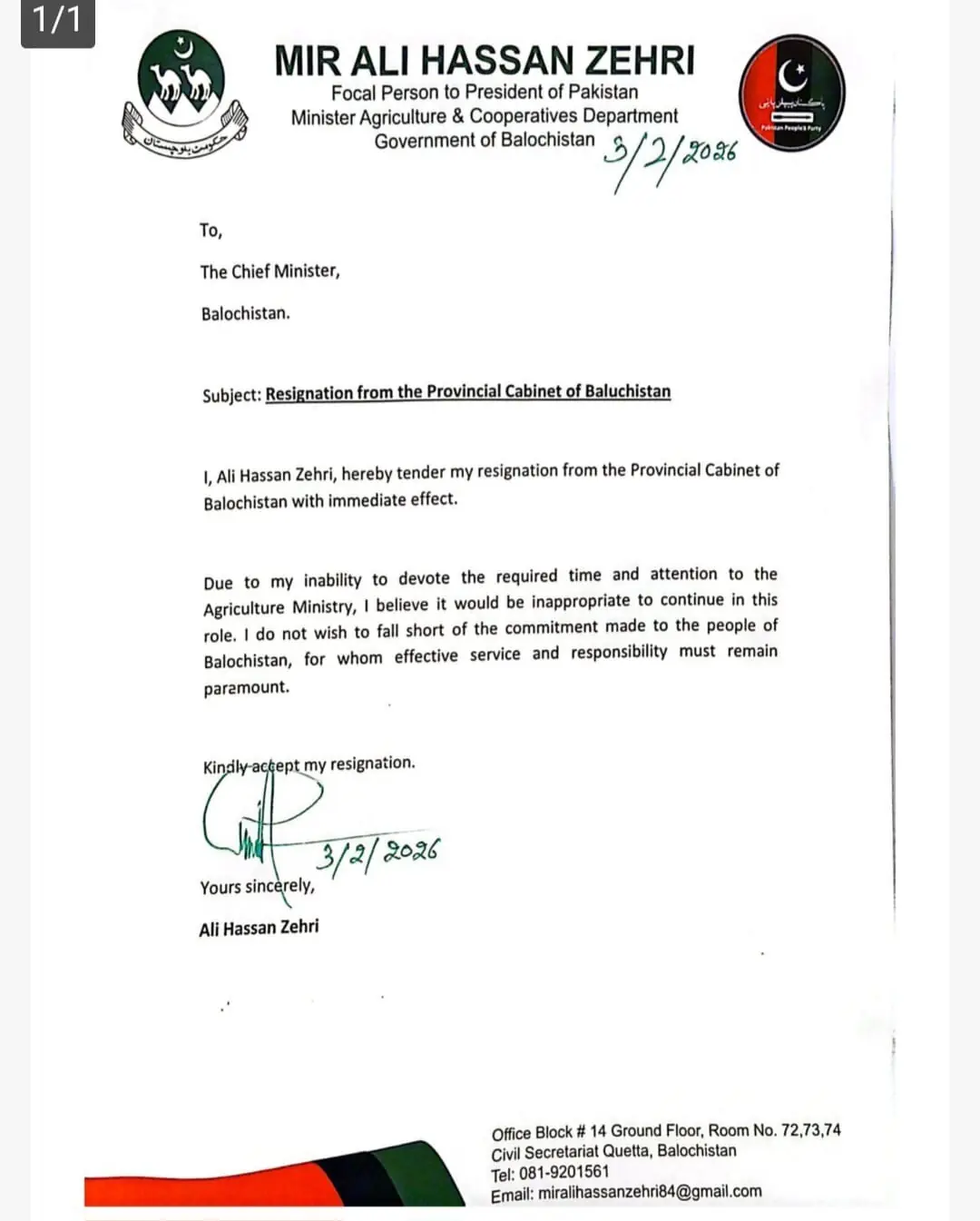
In a country where political fortunes can go through cycles of boom and bust, Ali Hassan Brohi — also known as Ali Hassan Zehri because of his Baloch tribal ancestry — has suffered a setback of sorts. On Feb 3, he tendered his resignation from the Balochistan cabinet. But, given his powerful connections, this may be only a bump in the road.
There was a time he was said to be on the run and allegedly in the crosshairs of the ‘encounter specialist’ — Rao Anwar, then SSP Malir. Fast forward to December 2024, he was sworn in as Balochistan’s minister for agriculture and cooperatives. His recent setbacks in that province notwithstanding, he is arguably one of the most powerful people in Sindh, rumoured to have the ear of no less than the president himself.
Letter of resignation by Ali Hassan Zehri to CM Balochistan.
Hailing from Bandhi, Nawabshah district (since renamed Shaheed Benazirabad), he was once, as a prominent politician told Dawn, in the employ of an octroi tax collector in Bolari, district Jamshoro.
“He wasn’t even a manager, but a helper. However, according to the contractor, he was extremely sharp.” Showing a political savvy that was to stand him in good stead, Mr Brohi developed contacts with low-level PPP workers and over time, with senior party leaders in Nawabshah. With the help of his connections, alleges the politician, Mr Brohi gradually worked his way out of small-town Sindh to providing muscle for the PPP in connection with Karachi’s pricey real estate — but then, there was a falling out.
Several sources confirmed to Dawn that Mr Brohi made a run for Balochistan; police close to the Sindh-Balochistan border had received orders from SSP Rao to ‘intercept’ him, and they fired upon his vehicle in the Mochko area, but he made it across. There he sought shelter with certain political and tribal heavyweights, two of whom are said to have paved the way for his rapprochement with his former benefactor several years later when they joined the PPP.
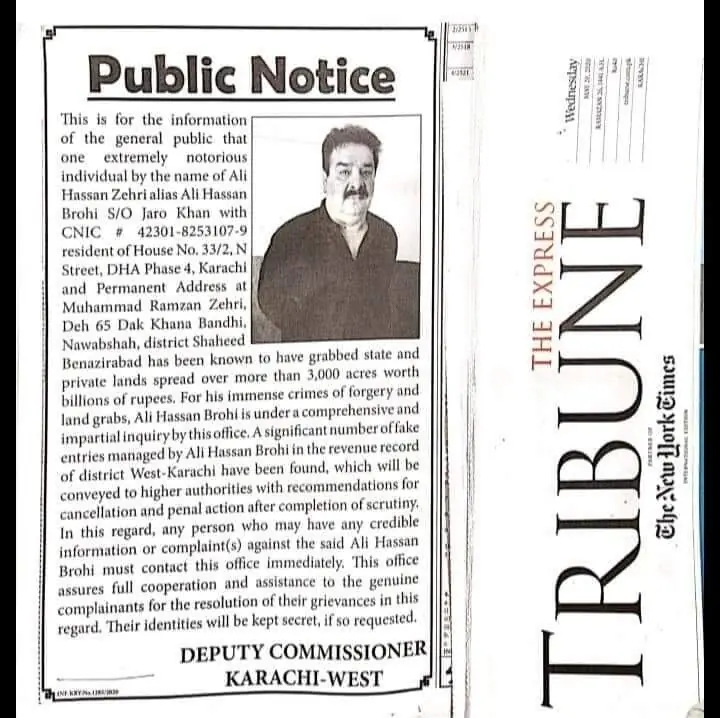
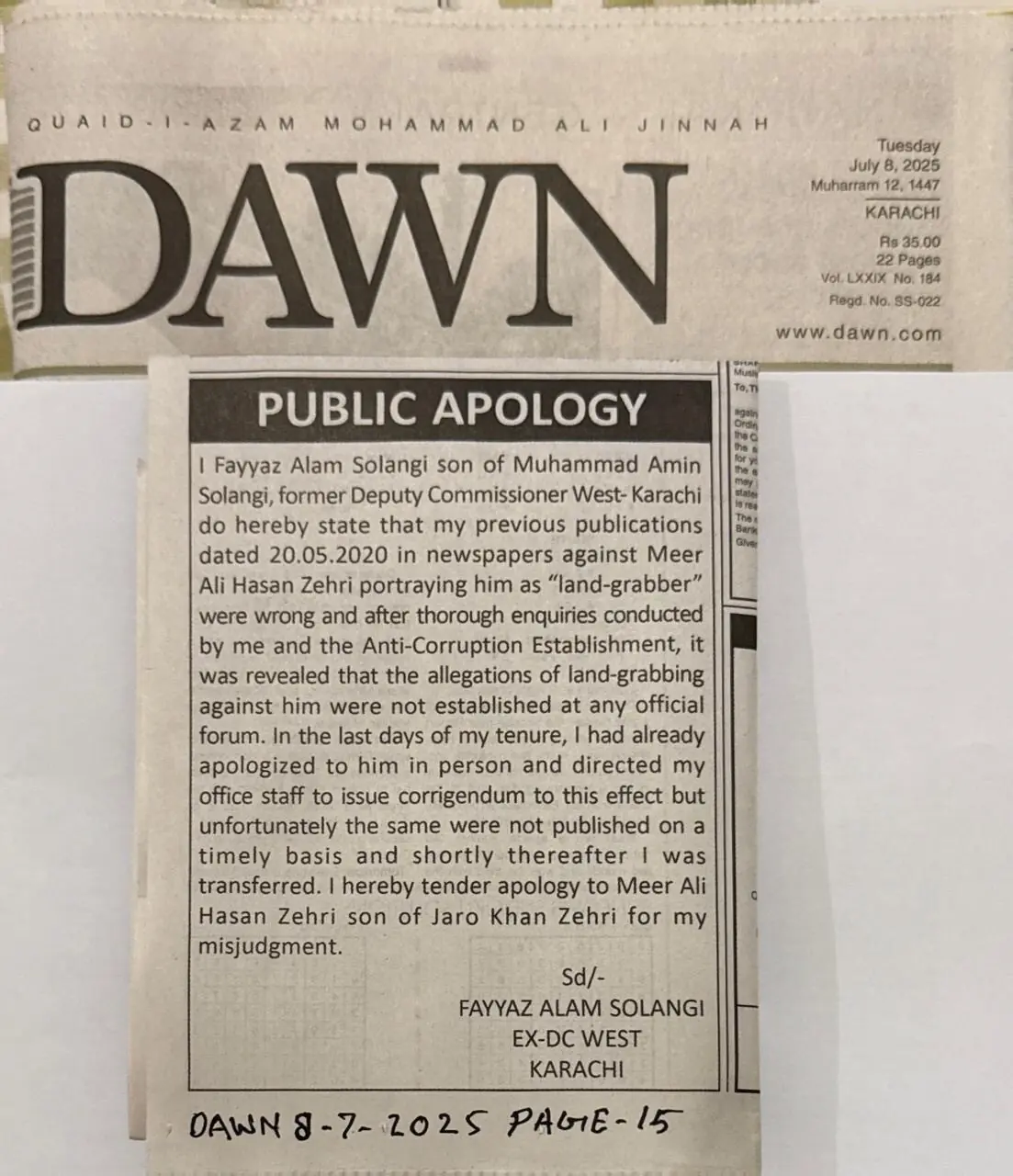
Until then, though, Mr Brohi’s travails were far from over. On May 20, 2020, English and Urdu newspapers carried a public notice by the deputy commissioner, district West (the DC office is the most senior in the district revenue department). The notice declared Mr Brohi “an extremely notorious individual” and claimed he had grabbed over 3,000 acres of state and private land worth billions of rupees. It read: “For his immense crimes of forgery and land grabs, Ali Hassan Brohi is under a comprehensive and impartial inquiry by this office. A significant number of fake entries managed by Ali Hassan Brohi in the revenue record of district West have been found, which will be conveyed to higher authorities with recommendations for cancellation and penal action after completion of scrutiny.” The notice asked for public assistance in gathering further information.
Public notice published in a national daily, declaring Mr Brohi “an extremely notorious individual” and claiming he had grabbed over 3,000 acres of state and private land worth billions of rupees.
On the orders of Owais Muzaffar Tappi who was believed to run the system at the time, the then DC West Fayyaz Solangi retrieved the lands that Mr Brohi had allegedly grabbed. However, as this story will later show, Mr Solangi would come to regret following those orders so faithfully.
In 2021, FIA’s corporate crime circle, Karachi office, instituted an enquiry based on what it claimed was a reference from the DIG CTD, Sindh, in which Mr Brohi and eight others were named on the basis of an FIR (no 811/2021) filed in Karachi. Briefly, the FIR accused Mr Brohi of having taken Rs20 million from drug dealers to bribe two policemen with Rs7m to get two of his alleged front men to spring three Nigerian nationals from custody. According to the FIA’s brief, subsequent enquiries brought to light 14 FIRs dating from 2007 till 2020, in which Mr Brohi is named as the accused in eight, while the rest nominate two other individuals described as his “front men”.
The charges against him include terrorism, murder, attempted murder, rioting armed with a deadly weapon, dacoity, causing hurt and criminal intimidation, among others. The document also names nine “front men” of Mr Brohi in whose name the latter had “acquired/ purchased various properties in different areas” of Karachi. These findings, according to the brief, are based on only a partial record, some of it obtained from the digitised records compiled by the Land Revenue Management Information Systems (LARMIS), Board of Revenue (BoR), Sindh. Mr Brohi did not respond to questions put to him in writing by Dawn regarding these allegations and other claims about him by sources quoted in this report.
(Of the eight FIRs in which Mr Brohi is nominated as the sole accused, police sources contacted by Dawn were able to confirm three FIRs from their record, plus two more registered in 2021 that are not listed in the FIA brief.)
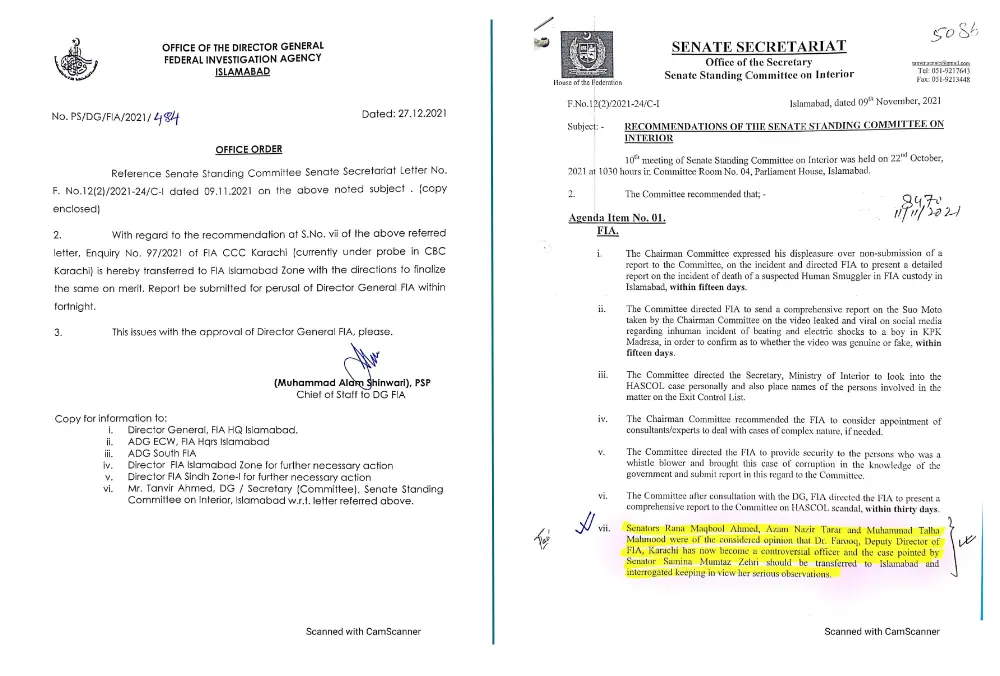
In conclusion, the brief says that in December 2021, the enquiry was transferred to FIA headquarters in Islamabad. The story of that transfer is revealing in its brazen conflict of interest.
In March 2021, Mr Brohi’s wife, Samina Mumtaz Zehri was elected to the Senate on a reserved women’s seat. According to a senior political leader, her election was managed by former ISI chief Faiz Hameed, who had her vote shifted to Hub from Karachi and presented her as a Senate candidate from the Balochistan Awami Party. (The BAP is well known to have the military establishment’s backing.) After her election, Ms Zehri became a member of the standing committee on interior. At its meeting on Oct 22, 2021, the minutes of which are in Dawn’s possession, the members made several recommendations. One of these reads: “Senators Rana Maqbool Ahmed, Azam Nazir Tarar and Muhammad Talha Mahmood were of the considered opinion that Dr Farooq, deputy director of FIA, Karachi has now become a controversial officer and the case pointed by Senator Samina Mumtaz Zehri should be transferred to Islamabad and interrogated…” The case in question was the FIA’s inquiry into Ms Zehri’s own husband.
As per its letter dated Dec 27, 2021 acknowledging the standing committee’s decision, the DG FIA’s Islamabad office directed that the enquiry report be submitted for perusal to the DG, FIA within a fortnight. The DG FIA did not respond to repeated requests in writing from Dawn as to the fate of the enquiry.
Minutes of the meeting of the Senate standing committee on interior from Oct 22, 2021.
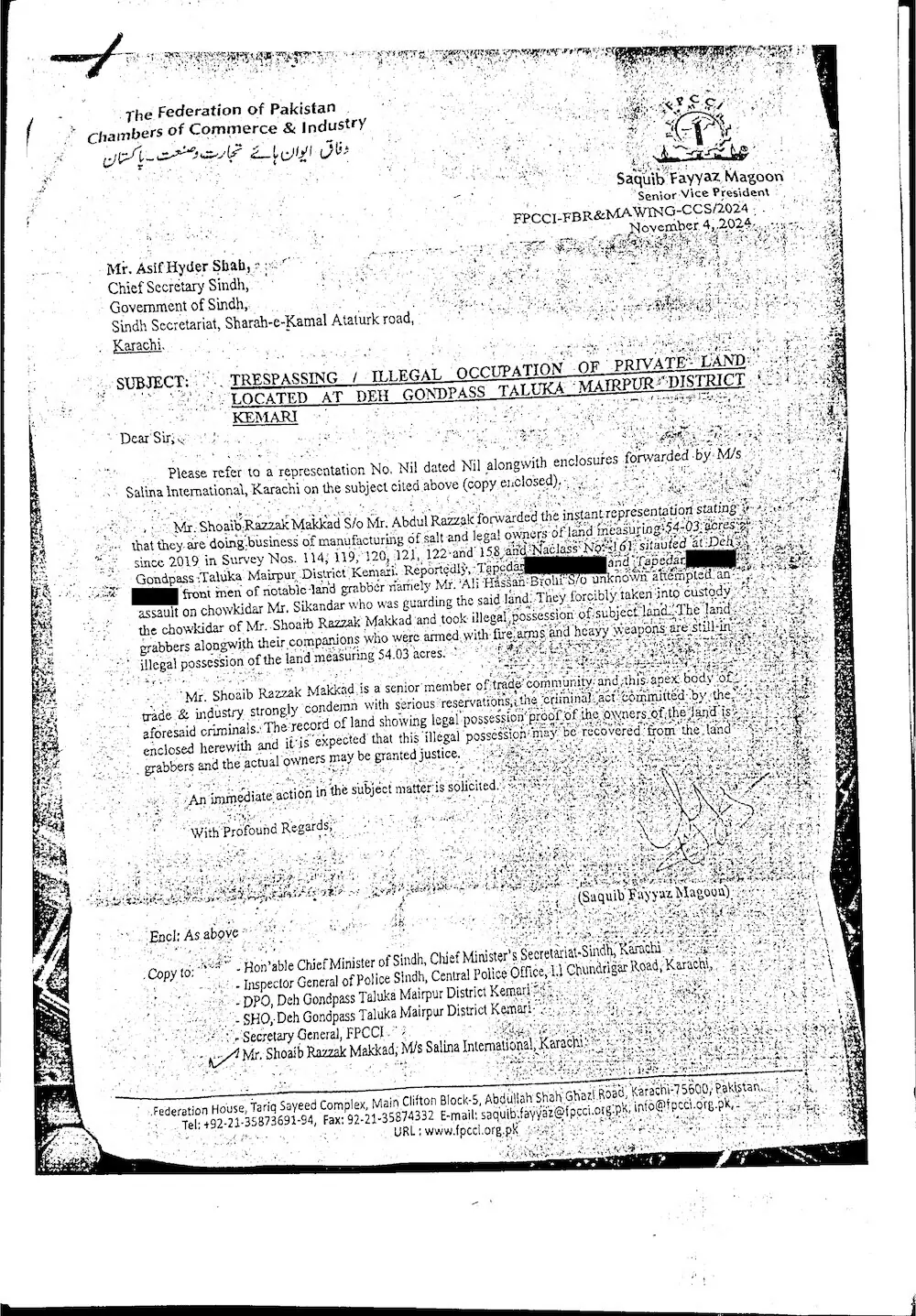
On Nov 4, 2024, Senior Vice President of the Federation of Pakistan Chambers of Commerce & Industry Saquib Fayyaz Magoon wrote to Chief Secretary Sindh Asif Hyder Shah about a complaint forwarded to him by President, Karachi Chamber of Commerce & Industries Jawed Bilwani. The complaint, by businessman Shoaib Razzak Makkad and also dated Nov 4, 2024, was enclosed with the letter to the chief secretary.
Mr Makkad in his complaint stated that he was a partner in Salina International, a salt manufacturing business. According to him, he was “in possession of land measuring 54.3 acres since 2019” in Mauripur, district Keamari. “…[O]n June 28, 2024, Tapedar … and Tapedar …, notable front men of Ali Hassan Brohi, with some unknown people came with heavy weapons and … encroached on the entire land. They are still today residing [there] with heavy weapons.”
Saquib Fayyaz Magoon’s letter to chief secretary Sindh.
A senior government officer told Dawn, “In districts West and Keamari, without Ali Hassan’s NOC, neither DC, nor SSP, nor mukhtiarkar, nor some ACs — such as of Manghopir and Mauripur — can be appointed.” This view was corroborated by sources in the police, bureaucracy, business sector and PPP itself. A seasoned bureaucrat said that even after lease papers for a particular housing society in district West had been signed, “the AC and mukhtiarkar wouldn’t make an entry in their mutation registers because they don’t do anything unless specifically ordered by Ali Hassan.”
(A mukhtiarkar is a BoR official just below the assistant commissioner, responsible for processing and issuing documents related to land revenue, which makes this an extremely powerful post.)
This is not to suggest that Mr Brohi is the only one whose name crops up in context of allegedly questionable land dealings. However, given his political profile, he is arguably the most prominent among these individuals.
Dirty business
Before moving on to the other actors in the sordid saga of land grabbing in Karachi, a brief note on how land ownership is created followed by some instances of shady real estate dealings that Dawn has uncovered.
The Board of Revenue, Sindh is original custodian of all the land in the province. Aside from revenue collection and maintaining land records in Sindh, BoR allots land to individuals, societies and various institutions and development authorities such as Karachi Development Authority (KDA), Lyari Development Authority (LDA), Defence Housing Authority, etc to develop schemes for specific purposes.
Relevant revenue officials ‘survey’ an area of state land and divide it into blocks with each given a unique identifier called a “survey number”. The surveyed land can then be allotted according to a procedure specified under the Sindh Colonisation and Disposal of Government Land Rules, 2005. Unsurveyed land is termed ‘na class’ land, which belongs to the original owner, the state, which holds it in trust for the public. Na class or unsurveyed land is distinguished on BoR maps by a different colour and different sequence of numbers than surveyed land.
But evidence that rules of procedure are being violated with breathtaking impunity — and with full knowledge of the authorities — lies scattered all across Karachi. Districts West (particularly in Halkani, Bund Murad and Jam Chakro), Keamari (which was carved out of the original district West in 2020), East and Malir have become increasingly attractive for builders. “To make a project viable inside the city is quite difficult because you can’t find big chunks of land there, and whatever land that does exist there is expensive,” says Hamid Khan* of the Association of Builders and Developers of Pakistan (ABAD). “That’s why builders tend to focus on the suburbs.”
No doubt there are countless examples of illegal land use within Karachi proper, including encroachment on amenity plots, by elements connected with all political parties — PPP, MQM and ANP (during the latter two’s heyday in the city), and even by the proscribed Tehreek-i-Taliban Pakistan for a period. For reasons of space, however, this report focuses on Karachi’s outlying areas and encroachments within recent years.
Dawn Investigations visited multiple sites in district West, as well as the huge development scheme known as Hawkesbay Scheme 42 in district Keamari. Where until some years ago there were vast stretches of empty land dotted with goths (rural settlements), dozens of gated housing schemes are now coming up, many boasting little more than an entrance, a boundary wall and a booking office where dubious claims about the builders’ title to land are made.
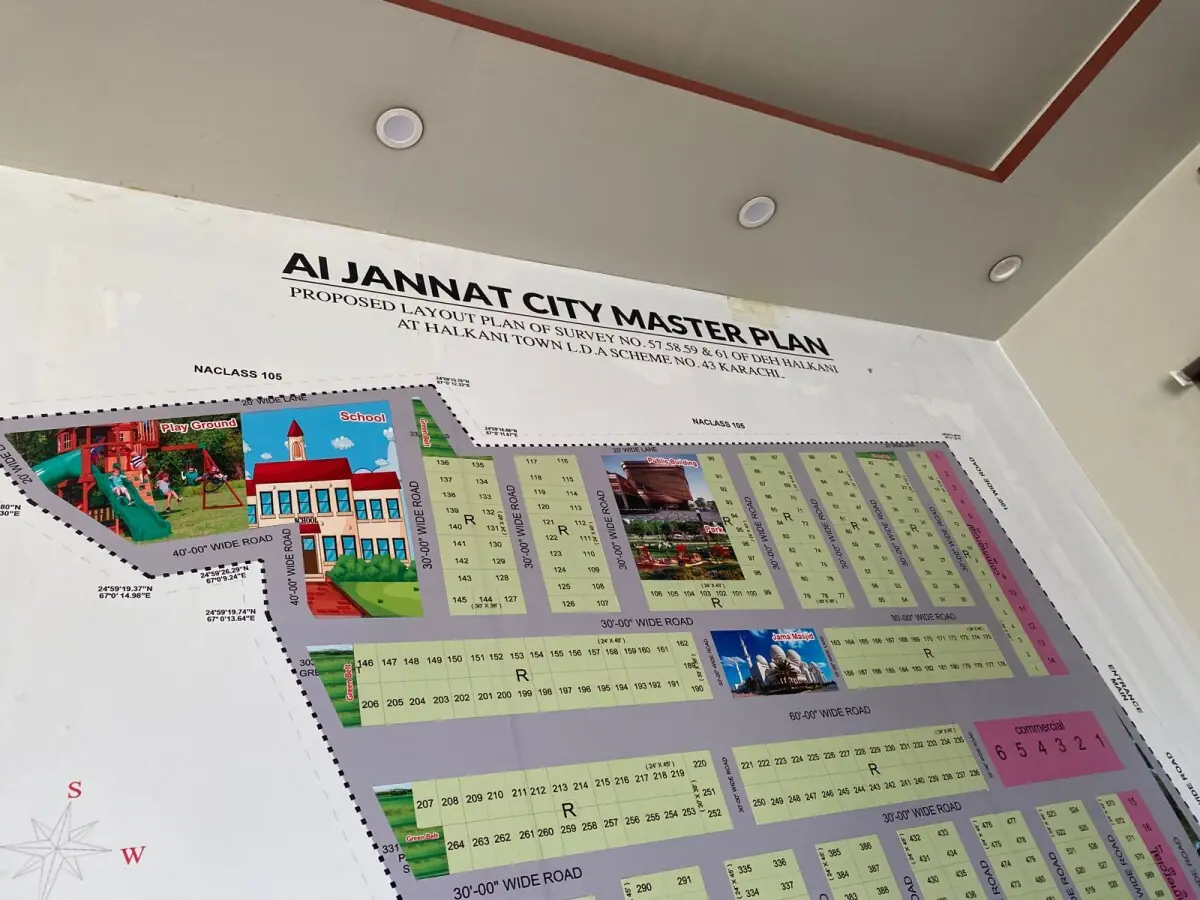
Take Al-Jannat City by MAA Construction & Builders Pvt Ltd in deh Halkani, for example. Mohammed Aqeel in the booking office informs the Dawn correspondent, who approaches him as a prospective investor, that there are 575 residential plots of 120 sq yards each available here, and a number of commercial plots. The proposed layout plan displayed in the booking office shows the project as being spread across 32.8 acres on survey numbers 57, 58, 59 and 61. The salesperson says six families are already residing in the society while around 20 houses are under construction. Residential plots cost between Rs3 to 3.5 million, with all sales final. Calculated at Rs3.3m each, the residential plots alone add up to at least Rs1.84 billion.
A masterplan of the housing society is plastered on a wall inside the Al Jannat City office.
“If you delay buying for a month, the price could cross four million rupees,” cautions Mr Aqeel. “Construction has been picking up pace here and there’s no other leased project nearing completion in the area.” He adds: “We have been issuing sub-leases to owners of the plots.” The question is: how is that possible when the land on which Al-Jannat City is coming up does not even belong to the builder?
Mr Aqeel claims LDA has leased the land to the builders, but tellingly, he refuses to show the lease. “Not until you purchase a plot,” he says firmly. (Deh Halkani is part of what is known as Scheme 43, which the BoR has given only as a ‘controlled’ area to LDA. The Authority itself has no lease for it.)
To delve deeper into the builder’s claims, Dawn GIS department referred to the digitised data in LARMIS. The apex court in 2012 banned the mutation of public land in Sindh, but in 2019, it partially lifted the ban in areas where the land record had been digitised. Thus, one can reasonably assume that the LARMIS data, where it exists, is up to date.
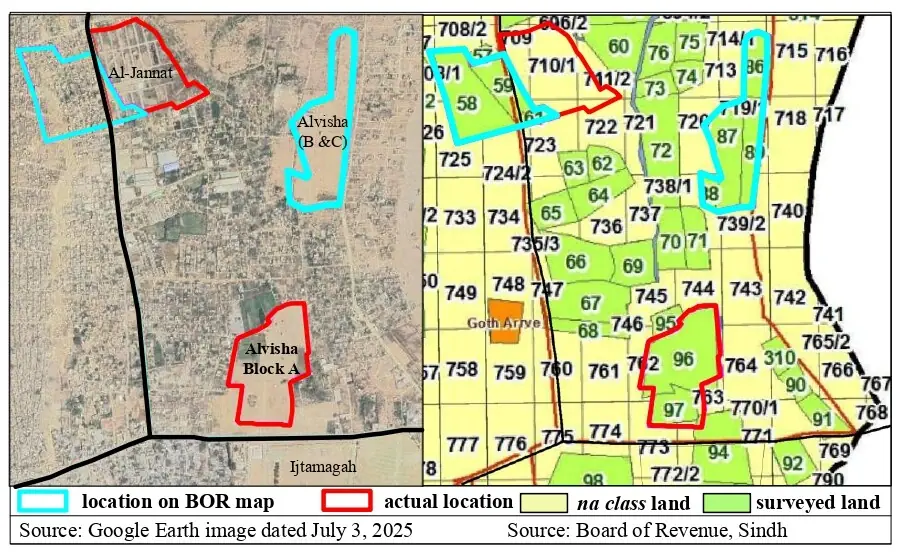
It turns out that survey numbers 57, 58, 59 and 61 actually lie on the other side of the road from where Al-Jannat City is coming up. The project is located on what is entirely state land. Interestingly, taken together, these survey numbers almost mirror the dimensions of the project itself.
A short drive away on the main road is Alvisha Housing Society by the same builder, located opposite the Ijtema Gah where a mammoth religious congregation gathers every year. The salesman at the project office tells the correspondent that 120- and 160-sq yard residential and 200 sq yard commercial plots are available for sale in blocks A, B and C. In block C, a 120 sq yard plot costs Rs2.8m lump sum, and Rs3.6m on a 42-month installment plan.
When asked about official approvals, one of the two men present says that for the time being, the plots in block A, where the office is located, are being offered on sale to “those who have faith in the builder” and not to the general public. When asked why that is so, he admits that the “paperwork for block A is not 100 per cent complete, unlike blocks B and C.”
He lays out the society’s proposed layout plan on the desk; it lists the survey numbers (86, 87, 88 and 89) on which it is being constructed. Frontline Marketing, which is handling the project, shares with Dawn an NOC issued by LDA which also mentions the same survey numbers, 86 to 89.
However, Dawn’s GIS department has determined that these survey numbers lie quite some distance away, in the direction where the men in the sales office vaguely indicated that blocks B and C will come up. Moreover, Alvisha’s block A is actually situated on survey numbers 96 and 97. It is not known what is the reason for this discrepancy.
Maps showing the Alvisha and Al-Jannat housing schemes.
But revenue officials tell Dawn this kind of discrepancy is very common. One explains it thus: “Sometimes there are other claimants to the land; sometimes builders will use ownership of one piece of survey land to falsely claim ownership over other surveyed land, or even over unsurveyed land; another ploy is to get a fake allotment of unsurveyed land and, after possession, go to the revenue department for a survey number.”
Dawn’s letter to MAA Construction & Builders Pvt Ltd was returned. Another letter with questions to Frontline Marketing received no response either.
With around 60 projects in Karachi, GFS Builders & Developers is one of the big players in Pakistan’s real estate market. Supported by a slick marketing campaign, its numerous smooth-talking salespersons push discount offers, and district West is dotted with a number of their projects. A closer look at North Town Residency Phase-2 exposes some shocking facts.
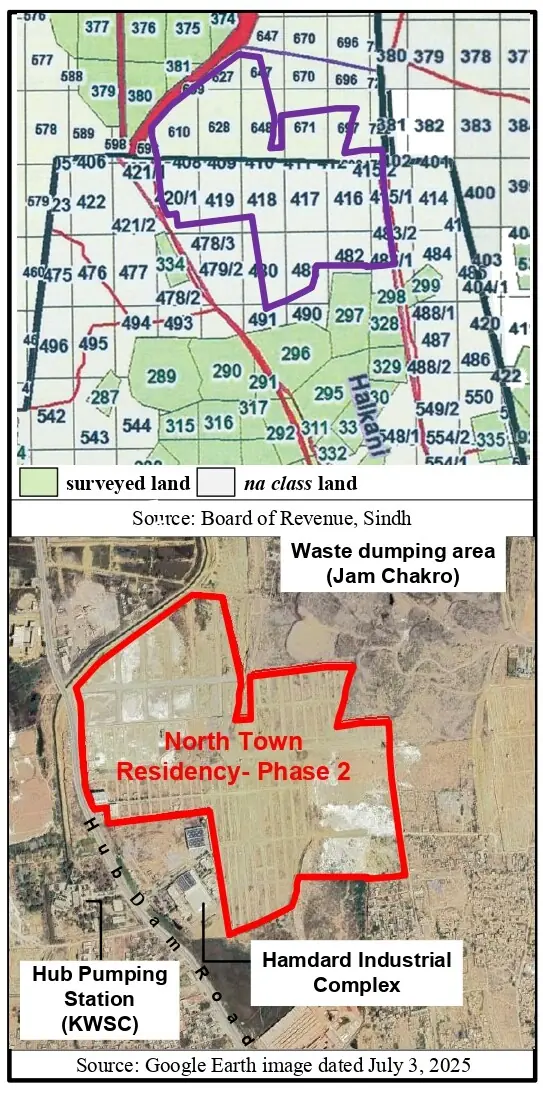
According to an ‘NOC’ for sale and advertisement of plots in NTR phase 2 issued by the Sindh Building Control Association, the project measures 30 acres on land bearing survey numbers 363 to 367 “out of na class no 294 in deh Halkani”. The BoR map submitted to the Supreme Court in 2013 clearly shows this entire area — which falls partly in deh Halkani and partly in deh Bund Murad — as being na class (or unsurveyed/state land). The LARMIS website currently shows the same situation in deh Halkani. The map for deh Bund Murad is missing. Dawn received no response to questions it sent in writing to the GFS CEO.
Map of GFS North Town Phase 2.
(Dawn repeatedly contacted the DC West; Senior Member Board of Revenue, Sindh with a cc to the Chief Secretary, Sindh; Member, Land Utilisation, BoR; and Project Director, LARMIS to ask about the provenance of the survey numbers in connection with the aforementioned housing projects. There was no response from any of them except for LARMIS Assistant Director, Coordination, Hafeezullah Abbasi. Mr Abbasi informed Dawn over the phone that LARMIS does not possess the data in question. “We can only digitise the data that we have been provided.”)
Filthy rich
Interestingly, the above-mentioned na class number — no 294 — from which piece of land GFS representatives claim that survey numbers 363 to 367 have been carved out for its North Town Residency-Phase 2, crops up in a complaint to NAB about huge tracts of land being illegally taken over and sold. A list of suspicious sales/allotments was enclosed with the complaint, mentioning the survey/na class numbers, area and value, and ‘sellers’ and ‘purchasers’ of the land in question. According to this, 82 acres on na class numbers 284 – 294 were illegally sold/allotted to GFS.
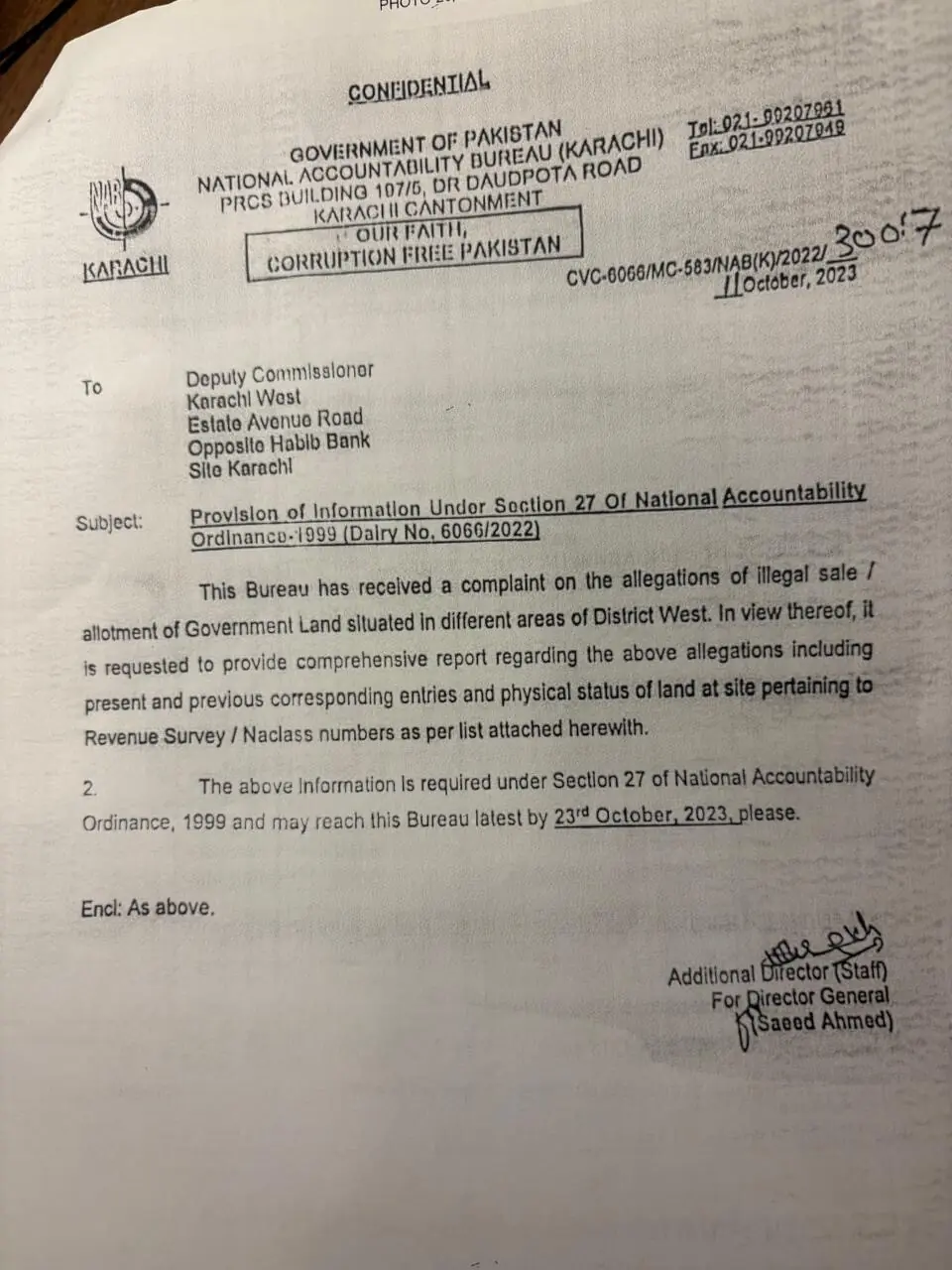
The dubious transactions listed in the complaint to NAB involve nearly 1,500 acres, including around 1,150 acres of state land. On Oct 11, 2023, NAB wrote to DC West informing him about the complaint it had received regarding “illegal sale/ allotment of government land”, and asking him to furnish NAB with a comprehensive report by Oct 23, 2023.
Letter written by NAB to the DC West, informing him about the complaint it had received regarding “illegal sale/ allotment of government land” in the district and seeking a comprehensive report by Oct 23, 2023.
Repeated attempts to seek NAB’s official response to this complaint went unanswered. Sources told Dawn that NAB had initiated a formal enquiry based on the allegations in this complaint, but recently, 166 cases, enquiries, references and complaints relating to the departments of revenue, local government and food had been transferred to Sindh’s Anti-Corruption Establishment.
The list enclosed with the complaint to NAB lays bare how predatory networks have hollowed out governance in Sindh — like locusts stripping bare every field they descend upon. Those who acquired the land allegedly through illegal sale/allotment include a number of well-known builders and developers. And among those accused of supplying them the land — the ‘sellers’ — are Ali Hassan Brohi, an SHO and a mukhtiarkar.
The cop is Ghulam Hussain Korai, then SHO Manghopir in district West. Consider just one of the parcels of land that he, jointly with one Yousuf Brohi, is accused of grabbing: 200 acres of state land in deh Bund Murad which was, as per this document, worth an eye-watering Rs4 bn.
An SHO can be a grade 14 (sub-inspector) or grade 16 (inspector) officer, whose monthly salary is at the most Rs120,000. In December 2024, after complaints by a number of businessmen about brazen land grabbing in Karachi became too vociferous to ignore, the powers that be ordered the Sindh government to address the issue.
Inspector Korai was among five police officers who were subsequently transferred to desk jobs at the police headquarters. (A number of revenue officials were also transferred, though often replaced, say sources, with others of equally ill repute but boasting strong ties with those who matter in the provincial leadership.)
In response to Dawn’s questions, Inspector Korai described the allegations against him as “false, fabricated, and baseless … the [Association of Builders & Developers] have withdrawn their application, and the issue has been resolved accordingly.” He enclosed a letter from ABAD with his response. An excerpt from it reads: “… due to unavoidable circumstances the complainant currently displaying a lack of coordination with ABAD regarding their submitted complaints … We hereby request to withdraw the complaint against him.” Dawn was unable to confirm the nature of the “unavoidable circumstances”. Mr Korai remains without any posting. Sources say he has been sanctioned several times for misconduct.
There is on the same list one Ejaz, described as mukhtiarkar Scheme 33, who is alleged to have handed over in a fraudulent manner seven acres in Scheme 33 itself to an undisclosed builder and developer. This appears to be a reference to Aijazul Hassan Khan. Incidentally, Mr Aijaz was among 11 mukhtiarkars suspended in 2023 for land fraud.
It is difficult to overstate the cruel irony in this situation. While public land gets siphoned away by unscrupulous builders hand in glove with rapacious elements from the ruling elite and corrupt government officials, affordable public sector housing schemes almost never go beyond the blueprint.
Hawkesbay Scheme 42, Karachi’s oldest public sector project, is a stark example. This scheme was started in 1984 for the low- and middle-income segment by KDA and transferred to LDA in 1996. Over four decades later, much of it is still undeveloped and without electricity or water. Many original allottees remained unable during their lifetime to take possession of their plots, which they had paid for with their hard-earned money.
Scheme 42 even includes a block exclusively for overseas Pakistanis, but they too have nothing to show for their investment till today. And yet, those with no right to the land but plenty of clout have staked their claim to the overseas block by building a boundary wall around its perimeter, repeatedly. Each time the wall is bulldozed by the authorities, it comes up again within no time.
An illegal housing society called Aashqan-e-Mustafa has materialised along the Suparco Road which cuts through Scheme 42. Two front men of an MPA are said to be handling transactions.
A view of the Aashqan-e-Mustafa society’s site office.
A view of the Aashqan-e-Mustafa society on Suparco Road.
When a Dawn Investigations team visits, a man strolls up, asking if they are interested in a plot and if so, to take their queries to Madina Real Estate nearby. There are 100- or 120-square yard plots available for sale here, says the realtor: “a 400-sq yard commercial plot alongside the main road costs Rs6.5m with cash payment over three months.” When asked whether the society has a lease from the development authority, he replies: “No, it’s not leased but this is part of the Gothabad Scheme, so you’ll get a sanad if you buy here.” This means the government had notified this piece of state land for a goth situated here — ostensibly in this case, Kachelo Goth. However, sanads can only be issued to the original residents of a goth. Incidentally, Kachelo Goth actually lies around 2km away.
A map of the Aashqan-e-Mustafa society.
Predictably, the Gothabad Scheme over the years has become another vehicle for corruption since it began in 1987 to provide housing to the deserving indigenous population in rural Sindh. Gothabad mukhiarkars began issuing fake sanads, even multiple sanads to one individual to enable the latter to claim title over a large area.
Mohammed Shahnawaz at the Aashqan-e-Mustafa housing society site office in fact claimed that buyers would be given backdated sanads because “sanads stopped being issued after 2012”. Dawn received no response to questions addressed in writing to the proprietors of Aashqan-e-Mustafa.
In June 2014, during Supreme Court hearings into the Karachi unrest case, BoR submitted a report stating that 59,803 acres of state land had been encroached upon. Backroom land deals are not mere irregularities — they are a fundamental breach of public trust. State land is not for the government to bestow upon whomever it favours, which is why a recent Sindh High Court judgement underscored that, in the interest of transparency, state land must be disposed of through an open auction.
Fake NOCs, no paper trail
All the housing societies investigated for this report happen to fall under LDA. Ahmed Saeed*, who is very familiar with the LDA’s workings, reveals that the Authority has in umpteen instances showed ‘na class’ land (ie unsurveyed land which cannot be allotted to anyone and on which no project can be constructed) as survey land. He alleges that everyone, including BoR, is party to the fraud.
According to him, the landgrabber writes to the Director General LDA to request an NOC for the layout plan on what they claim is their land. The DG sends the letter to the relevant DC, asking for clarification on the status of the land in question. The DC forwards it to the mukhtiarkar who takes out a report which then goes back to the DC, who forwards it to the DG confirming the land does indeed belong to the interested party.
“The official fee for approval of the layout plan is Rs1.3m per acre, and the bribe for showing na class land as survey land is Rs500,000 per acre,” says Mr Saeed. “But because the letters have been sent around by hand, not by a dispatcher, there’s no trail. LDA will say they did this on BoR’s say-so; if you ask BoR for verification, they’ll say this is state land and they never gave approval for it. You show them the correspondence — and they’ll say it’s fake, but they all know. They’re all involved.” In other words, classic smoke and mirrors.
At his office, a rather harried-looking DG LDA Safdar Bughio, tells Dawn: “Our planning department verifies ownership through the concerned DC office; it’s BoR that checks whether the builder has ownership or not. When they confirm ownership title, then our planning department does the technical work on it [to issue NOC for layout plan].”
LDA planning department head, Mohammed Arbab, toes a similar line: “Our mandate and function is the KBTPR [Karachi Building and Town Planning Rules]. We are only a town planning agency. The identification of the land is done by the DC, title verification is done by the DC, record of survey numbers is with the DC.”
However, Mr Bughio concedes there are some illegal housing societies. “It is also our responsibility to stop them. We do stop them, but officially we deal only with those who come for [layout plan] NOCs from us. But definitely I will soon start a programme in which we will take on the responsibility of dealing with them.”
As for Mr Arbab, when pressed further on the issue, he says: “Qabzay bhi wohi log kartay hain … na class land pay jin kay hukoomati links hotay hain.” (Encroachment on state land is done by those who have government connections.)
Other cogs in the wheel
There are nevertheless some public servants who try to discharge their duty with at least a degree of integrity. In instances where the mukhtiarkar concerned takes action and issues a notice to a suspected land grabber, the latter can approach the anti-encroachment tribunal. The Sindh Public Property (Removal of Encroachment) Act, 2010, empowers anti-encroachment tribunals headed by a retired district and sessions judge or an advocate of 10 years’ standing to determine the rights of the parties involved.
Too often, though, the only anti-encroachment tribunal in Karachi has given questionable decisions. In fact, several sources told Dawn that encroachers go to the tribunal with fake/ forged documents to establish title to the land they have grabbed by obtaining a stay order. “It’s simple,” says Umair Rafiq*, a senior bureaucrat. “Go meet the court reader, file an application quickly and get a stay. Then anyone who visits that land becomes guilty of contempt. You just pay one or two million rupees for this.”
Dawn has in its possession the copy of an order in suit no 15/ 2024, issued on July 23, 2024, by Muneer Bhutto, district and sessions judge and, until recently, presiding officer of the anti-encroachment tribunal. The plaintiff is Al-Faiz Builders Pvt Ltd while the defendants include officials from BoR, SBCA, LDA, anti-encroachment police personnel, etc.
In his interim order, the presiding offer restrained “the defendants, their agents and anyone on their behalf from eject[ting], evict[ing], dispossess[ing] the plaintiff from the suit property ie 32 acres land na class No 42 situated at Deh Methan, tapo Manghopir, district Keamari”.
Interestingly, the same presiding officer (now heading the Karachi Water & Sewerage Tribunal) was the focus of a complaint made earlier that year. In a letter dated Jan 30, 2024, a copy of which is available with Dawn, the DC East wrote to the Sindh High Court Registrar, the Member Inspection Team-II (a body that handles complaints against judicial officers in the district and lower courts), requesting further action on a complaint against Mr Bhutto that had been forwarded to him by the assistant commissioner East. With his letter, he enclosed a report submitted by a mukhtiarkar of Karachi East, Muhammad Irfan Lashari.
Mr Lashari in his complaint alleged that the presiding officer had granted a stay to land grabbers on 500 sq yards of state land at Fateh Mohammed Gabol Goth that had been reserved by the Sindh government for a dispensary for the local residents. In fact, he said in his report, possession had already been given to the health department representative with documentation to the effect. According to him, through the stay order, a contempt of court notice against him and letter of suspension, he was “pressurised to follow the unlawful order passed by the presiding officer of the tribunal. … The stay orders … not only provide cover to the land grabbers but also encourage them to usurp more state land in connivance with support of presiding officer of the said tribunal and his staff…”
Nothing came of this complaint. In fact, sources said that a “fake case” had been filed against the DC concerned, his properties were attached and he was declared an absconder.
(On Oct 15, 2025, in a development unrelated to Mr Lashari’s complaint, Muneer Bhutto was found guilty of misconduct after an enquiry by MIT member Justice Muhammad Faisal Kamal Alam of the Sindh High Court that began in 2021. Concluding that Mr Bhutto had “misused” his “senior official position”, the MIT imposed on him “the minor penalty of withholding of annual increment for a period of three years”.)
Despite repeated attempts, Mr Bhutto refused to receive Dawn’s letter with questions regarding the above allegations.
Nothing oils the wheels of elite capture like a corrupt bureaucracy. Seasoned bureaucrats hold that officers were generally appointed on merit in Benazir Bhutto’s time, but this changed after her assassination in December 2007. “As soon as PPP’s victory in the 2008 election seemed assured, officers began to get calls from the PPP leadership telling them to refrain from recruitment and from making any appointments,” says Rashid Saleem*, a retired assistant commissioner. “As soon as they came in, they began to recruit their own people.”
The passage of the 18th Amendment, say old-school bureaucrats, removed the guardrails entirely. “The 2012 recruits were rapidly promoted and are now in grade 19. Soon they’ll be in grade 20, secretary level. God help Sindh when that happens,” says Mr Saleem.
According to several senior civil servants, the Sindh Public Service Commission’s (SPSC) examination process has become seriously compromised, with ‘favoured’ candidates awarded inflated scores in the oral segment while deserving candidates are failed despite strong written performances. Each recruitment, appointment and promotion has a price, they claim.
Journalist Imdad Soomro has extensively investigated corruption in the SPSC. “To get recruited into a department, one has to pay between Rs5m to Rs10m,” he alleges. At the other end of the spectrum are the top posts, such as assistant commissioner, excise and taxation officer, DSP, mukhtiarkar, etc for which candidates must sit the Combined Competitive Examination or CCE. The ‘rates’ are higher for such “kamanay walay [lucrative] posts” as Mr Soomro puts it. According to him, to become AC or ETO, one must pay Rs80m; appointment as mukhtiarkar entails a bribe of Rs40m.
According to a retired official, “There’s an exam called the revenue qualifier exam for clerical staff who have served three years in the Revenue Department. Clerks have paid Rs15m to Rs20m to become assistant mukhtiarkar. Close to 30 clerks have become assistant mukhtiarkars in this manner.”
Often, all it takes for career advancement is to cultivate a mutually beneficial relationship with a political patron. Dawn was told that in one land development authority, an individual on a contingency contract as a watchman was now a grade-19 officer on an extremely important post.
The great Karachi land grab
Real estate in Karachi has been the cause of much disorder and violence. The final JIT report looking into the murder on March 13, 2013 of Perween Rahman, director of the Orangi Pilot Project, offered a revealing commentary.
Referring to the period between 2006-2012, and the ethnic conflict between Pashtuns and Mohajirs, it noted that cadres of both MQM and ANP were heavily involved in various criminal activities, especially land grabbing, as were the Taliban who were a potent militant force in Karachi at the time. “… whatever their stated political differences, all three groups worked hand in glove … Big developers … would ally themselves with these groups, using the militant wings of these groups as their ‘muscle’, in order to forcibly seize land. Anyone who came in their way was either threatened, or if they refused to back off, killed. …[O]ften murders that were declared as being politically motivated or acts of terrorism, were in actual fact land disputes that were made to look like political killings to cover up the real facts. The state apparatus, in the shape of the land revenue administration or the police, was either too weak, or complicit in the face of the great Karachi land grab.”
It was against this backdrop that the then Supreme Court Chief Justice Iftikhar Chaudhry in 2012 while hearing the Karachi ‘badamni’ (unrest) case, banned the Sindh government from effecting mutation, allotment, or transfer of any government land in Sindh until the province’s land record — huge amounts of which was destroyed in the rioting following the murder of Benazir Bhutto — was digitised. (The court conditionally lifted the ban in 2019 in instances where the record had been computerised.)
But the ban meant little in the areas of Karachi where state land was plentiful.
During retired Justice Maqbool Baqar’s tenure as chief minister Sindh in the runup to the 2024 election, an enquiry was held into allotments and mutations made by BoR Sindh between 2012 and 2023. That is, after the Supreme Court ban. Some of the findings are as follows.
In Manghopir, district West, there were forged entries and fake allotments in land record; an incident of arson was committed in 2021 by revenue officials, including mukhtiarkars and tapedars, “to deliberately destroy fake entries kept by the revenue officials in collusion with private beneficiaries”.
In deh Bund Murad, also district West, the enquiry found that “Government land worth billions of rupees in various na class … was illegally transferred to private individuals… .” Numerous revenue officials were named as being complicit and acquiring assets beyond their means. None of them appears to have been prosecuted.
According to the 2018 JIT report on money laundering worth billions of rupees through fake bank accounts, 562 acres of state land in Sindh, including 363 acres of Pakistan Steel Mill land, were “illegally allotted to private builders causing a loss of Rs4.14 billion to the national exchequer”. The report also alleged that Bahria Town Ltd had remitted Rs10bn into the fake accounts as kickbacks for grabbing thousands of acres of state as well as private lands for its projects in Karachi.
In 2023, a member of Sindh’s caretaker cabinet told Dawn: “[During the previous government,] the sub registrars and mukhtiarkars in Karachi would collect 600 to 700 million rupees per month for ‘upward’ distribution. They had a free hand. Even if someone’s land was legal, they would still charge according to the ‘system’ at the rate they had set, eg Korangi, Rs300,000 per acre. By transferring mukhtiarkars, we disrupted that system of collection.”
Under the caretaker setup, per one government official, security agencies were said to have taken up the task of ‘cleaning the system’. Officials were assured that “qabzas will not happen like before”. A number of people were even put on the ECL, unofficially if not officially. But despite those claims, rather little has changed in the way that real estate is occupied in the city. The faces may be different, but the practices remain the same.
Thus, individuals like Mr Brohi have even greater sway than before; they are fixtures in the corridors of power, protected by their formidable patrons. According to a bureaucrat, “Even DIGs, senior government officials will go out of their way to maintain good relations with them.”
Perhaps that is why Fayyaz Solangi, the former DC West who placed that damning notice in the newspapers against Mr Brohi back in 2020, put in another notice on July 8, 2025 — five years later — in Urdu, English and Sindhi newspapers containing a grovelling apology, and stating that an enquiry had not established allegations of land grabbing against him. An excerpt from the notice reads “…I had already apologized to him in person and directed my staff to issue corrigendum to this effect but unfortunately the same [was] not published on a timely basis and I was transferred…”
Former DC West Fayyaz Solangi’s public apology to Mr Brohi published in Dawn on July 8, 2025.
That shameful apology was a step too far, even for a severely compromised bureaucracy. Two days later, the former DC West swiftly found himself reduced to officer on special duty by the chief secretary Sindh. Mr Solangi did not respond to Dawn’s repeated requests for comment.
As for Jibrail Khan, the JUI-F local leader who ran afoul of certain political bigwigs, the intercession of his party leadership appears to have magically made the FIRs against him melt into thin air. Even though he has yet to obtain bail in all the cases, he is out of prison. The ‘system’ knows when compromise is a better closing gambit.
*Some names have been changed to protect identity.
It was the monsoon season of 2021. The opposition alliance, the Pakistan Democratic Movement (PDM), was locked in a direct confrontation with the government of Prime Minister Imran Khan.
The Pakistan Tehreek-i-Insaf (PTI) administration was running the affairs of the state with little room for opposition voices, an increasingly constrained press and an aggressive stance against any narrative seen as anti-establishment.
At the centre of this political standoff was the then leader of the opposition, Shehbaz Sharif, who had taken a hard line against the ruling PTI. During a lengthy and closely watched visit to Karachi in August 2021, Shehbaz spent three days meeting industrialists, businessmen, political leaders, intellectuals, media professionals and other stakeholders.
As his visit drew to a close, he invited a select group of journalists over a cup of tea at a local hotel — an informal setting that followed days of intense political engagement and quiet maneuvering.
Four years on, Karachi is still waiting
Ranging from foreign policy to the economy and from political uncertainty to the fast-eroding space for genuine democratic forces, he argued for the need of a political consensus keeping the audience gripped, unmoving, and fully attentive.
For Karachi’s journalists, the pleasant surprise came when Shehbaz Sharif spoke with rare candour about the neglect the city had long endured. He laid out his thinking on Karachi’s revival, outlining plans for its rebuilding and development, and spoke with calculated clarity about restoring the metropolis to its rightful status as the country’s financial capital.
“Believe [me] when I was chief minister of Punjab, I came to realise that funding or resources for development has never been an issue,” he cited before sharing his Karachi plan. “I have been here for three days meeting industrialists, businessmen, industrialists, political leaders, intellectuals, media persons, and many others. I firmly believe Karachi only needs political will and ownership to turn things around. We do have a strong, in-depth and comprehensive strategy for Karachi but let me share with you one thing very briefly.”
“The federal government would have to pump in more money every year for Karachi than what is allocated by the Sindh government in its annual budget for the city’s development. And this cycle should continue for 15 or maybe 20 years. Then we would be able to fix this city’s problems,” Shehbaz asserted.
His convictions were so firm that few dared to question his intentions or calculations. The formula put forward by the three-time chief minister of Punjab was accepted without scrutiny, leaving little room for dissent or debate.
When his statements began making headlines, many in Karachi believed their voices had finally been heard. There was a sense that the national leadership, if not immediately then eventually, would sit in Islamabad and work to address the city’s long-standing grievances.
More than four years on, however, those hopes have proven to be little more than wishful thinking. After serving 16 months as prime minister from April 2022 to August 2023 and returning to office again in March 2024, the expectations attached to his leadership remain unfulfilled for the Karachiites.
A story of stalled initiatives and unmet promises
Why have his ideas and commitments for Karachi yet to translate into tangible outcomes? Is this due to an apparent shift in approach, or are there concrete plans that may materialise in the coming years? When contacted by Dawn, Minister for Planning and Development Ahsan Iqbal did not directly respond to these questions.
Instead, he pointed to the shrinking fiscal space available to Islamabad and the growing resource availability of the provinces over the years. Regardless of the views held by Karachi’s residents, experts, political parties, and other stakeholders, the federal minister maintains that the Centre is still “making a contribution” to the development of the metropolis.
“Federal government share in national development budget has shrunk from 50 per cent to 25pc, whereas provincial governments share has increased from 50pc to 75pc. Despite that, the federal government is making contribution towards the development of Karachi through billions of rupees worth projects like Green Line extension project, Site area development project and K-IV water project,” he said.
However, this explanation is contested by his predecessors, who were directly involved in planning and financing development initiatives for Karachi. They argue that the issue has been less about fiscal constraints and more about political prioritisation and continuity.
Among them is Asad Umar, who, as finance minister and later as planning minister during the PTI government, oversaw several federally funded projects for the city under the Karachi Transformation Plan, and maintains that viable, economy-linked initiatives for Karachi were not only conceived but taken to advanced stages before being stalled.
Questioning the argument of limited fiscal space, Umar said the issue was not the absence of resources but the consistency of federal priorities.
“If a sports stadium in Narowal (the hometown and constituency of Ahsan Iqbal) can be justified under the federal Public Sector Development Programme (PSDP), then there should also be space for Karachi’s extremely critical, economy-linked projects from which the entire country would benefit,” he said.
He also referred to the Lahore-Bahawalnagar motorway, a project located entirely within one province, which had also been approved under the federal PSDP.
“If development spending is to be undertaken at the federal level, it should be applied consistently. Why is Karachi treated like a stepchild?” he asked.
Umar argued that Karachi’s economic importance alone warranted sustained federal investment.
“Karachi has a special role by far. It’s the largest revenue base, export hub, and industrial centre in the country. There is definitely a case for the Centre supporting Karachi in a meaningful way,” he said.
Referring to the PTI government’s ‘Karachi Transformation Plan’, Umar said the initiative comprised five major projects, two of which were completed during the PTI’s tenure.
“The first phase of the Green Line BRT was completed and significant road and drainage projects were also carried out under the package,” he said.
He said the federal government had assumed full responsibility for the K-IV water supply scheme, with a clear timeline for completion.
“We had planned to complete K-IV by September 2023, and the entire project was taken over by the federal government to ensure progress,” he said.
Two additional transport projects, he said, had reached advanced stages before work was halted. One involved a modern Karachi Circular Railway designed as a 42-kilometre system, including a 27-kilometre elevated track, modelled on systems such as Delhi’s. “All the preliminary work had been completed, and the project had entered the bidding phase,” he said.
The second was a dedicated rail freight corridor running parallel to existing railway lines from the port to Pipri. “This would have shifted freight traffic off city roads, significantly reducing heavy truck movement, easing congestion within Karachi and at the ports,” he said, adding that the project was in the design stage when progress stalled.
A closer examination of official budgetary allocations also raises questions about the scale and seriousness of Islamabad’s claimed contribution. Despite repeated references to flagship projects, the federal government has earmarked only Rs3.2 billion for the K-IV water supply scheme in the current fiscal year, which is far short of the estimated annual requirement of around Rs40 billion to keep the project on track.
Similarly, beyond a limited extension of the Green Line BRT covering only a few additional kilometres, there appears to be no major federally funded infrastructure initiative currently planned or underway for Karachi.
This growing gap between rhetoric and resource allocation has prompted criticism from political leaders, business representatives, and development experts, who argue that without sustained and substantial federal investment, the long-promised revival of the country’s largest city will remain elusive.
The funding paradox
Syed Aminul Haq, a senior leader of the Muttahida Qaumi Movement-Pakistan (MQM-P) and a key ally of the ruling PML-N at the Centre, argued that the federal government has not completely ignored Karachi in recent years.
He pointed to a number of development initiatives, including the construction of three flyovers in the Central district, rehabilitation of Garden Road, and the induction of 52 fire tenders into the city’s fire brigade. According to him, these interventions helped address some of the city’s most urgent infrastructure and emergency response needs.
However, Haq acknowledged that these projects were initiated during the previous PTI government, when MQM-P was also part of the ruling coalition at the Centre. At the same time, he agreed that Karachi’s contribution to the national exchequer has not been matched by federal spending.
“Karachi generates around 66pc of the country’s federal revenue, and this alone justifies a much larger and sustained investment by Islamabad,” he said, adding that without a long-term federal commitment, the city’s structural problems would continue to resurface.
Beyond the political and policy debate, concern is also growing within Karachi’s business community, which increasingly views the city’s prolonged underinvestment as a risk to national economic stability.
In recent weeks, a group of 15-20 leading businessmen and experts from Karachi formed a committee, holding detailed discussions on how the city’s deteriorating infrastructure and governance challenges could be addressed. They studied the city’s problems and proposed practical solutions.
In these discussions, the participants also emphasised the need for the federal government to play a stronger and more consistent role in addressing Karachi’s infrastructure and development challenges, given the city’s critical contribution to national revenue, exports and industrial output.
Among those involved was prominent businessman Hanif Gauhar, who argued that without sustained federal involvement, Karachi’s economic potential could not be fully realised. “The federal government’s involvement in Karachi is far less than it should be. In such a large and economically critical province, the Centre needs to play a meaningful role,” he said.
“We have presented our findings and recommendations directly to Speaker Ayaz Sadiq and Federal Minister for Board of Investment (BOI) Qaiser Ahmed Sheikh,” he confirmed, further stating that the committee is focused solely on identifying Karachi’s issues and suggesting actionable steps.
Highlighting the city’s disproportionate contribution to national revenue, Gauhar argued that federal investment should reflect this economic significance.
“This is exactly what frustrates us. This city generates the highest revenue, yet when we look at even the roads, the support is minimal. Ayaz Sadiq himself told us that his constituency received a budget of Rs38 billion. Just imagine if a single MNA gets Rs38 billion for their area, you can see tangible results. Why can’t Karachi, which contributes so much more, see the same level of federal attention?” he asked.
The issue is not just funding but also long-standing neglect and a lack of political will to address Karachi’s structural problems. Among those raising these concerns is City Council’s opposition leader Advocate Saifuddin, who said that the city’s grievances remain largely unaddressed despite repeated promises from both federal and provincial authorities.
According to him, the federal government has effectively “handed over” Karachi to the Sindh government, absolving itself of responsibility for the city’s long-neglected infrastructure and development needs.
“The federal government has shown no serious interest in Karachi. Projects that fall squarely under the Centre’s domain have either been ignored or left incomplete for years,” he said.
Questioning Shehbaz Sharif’s priorities, Saifuddin said the premier’s recent engagement with Karachi had been largely symbolic.
“The prime minister recently visited Karachi only to inaugurate new lounges and facilities at the Cantt Railway Station. This reflects the limited scope of federal interest in the city,” he said.
He also referred to “an unjust allocation” of development funds.
“Out of the federal PSDP of Rs1,100 billion, Karachi receives only around Rs40 to Rs50 billion. Based on population alone, the city’s share should be at least Rs200 billion and if revenue contribution is taken into account, it should be closer to Rs300 billion,” he said.
Comparing Karachi to Lahore, Saifuddin alleged a clear imbalance in federal spending.
“Lahore has been given far more development schemes than Karachi, while this city continues to receive a disproportionately small share,” he said and criticised both tiers of government. “The federal government has been unfair to Karachi, and whatever funds are transferred to Sindh are also insufficient when distributed for Karachi, whether measured by population or by revenue contribution. As a result, the city continues to suffer from systemic neglect.”
How Karachi slipped down PML-N’s priority list
While debates over funding, policy and governance continue, and criticism of the federal government for neglecting the city comes from both political and business circles, there is a growing sense even within PML-N ranks that the party’s interest in Karachi has been waning.
One example is Nasiruddin Mahmood, who was once the party’s face in the city as the general secretary of its Karachi chapter. But he quit the party in 2025, at a time when it was in power at the Centre, citing its continued apathy towards Karachi and its local party workers.
His exit served as a powerful indictment of the party’s attitude towards the country’s economic and revenue-generating hub, reinforcing the perception that Karachi has remained peripheral to the federal government’s priorities under Shehbaz. He claimed that the PML-N has long lost interest not only in governing Sindh but also in functioning as a meaningful political force there, with Karachi in particular having been largely neglected.
“In my view, the persistent electoral failures of PML-N across Sindh stem primarily from the lack of attention by the party’s central leadership,” he said. “During the 2024 election campaign, no key leader including Nawaz Sharif, Shehbaz Sharif, or Maryam Nawaz, led any public rally or procession in Sindh. Moreover, Shehbaz, who was contesting from Karachi’s Baldia Town, left without even filing his nomination papers. His sudden withdrawal from the election deeply demoralised party workers. As a result, despite a significant political vacuum in Karachi, PML-N failed to win a single seat, while MQM won 15 seats and the PPP secured seven.”
Per Mahmood, the city’s influence within the party was much stronger when Mian Nawaz Sharif was personally active in politics. Over time, however, successive leadership transitions and political crises have gradually pushed Karachi down the party’s list of priorities.
“After 2015, following Nawaz Sharif’s political crisis, disqualification, imprisonment and subsequent departure to the UK, the city’s importance within the party gradually declined. When Shehbaz Sharif and Maryam Nawaz later took over the party’s leadership, Karachi’s standing continued to diminish. By the time of the 2024 elections, it became evident that Karachi and Sindh more broadly held little significance for the party. This gives a clear indication of where Karachi ranks in their priorities,” he said.
Header image:A man moves past debris following a massive fire that broke out in the Gul Plaza Shopping Centre in Karachi, Pakistan, January 19, 2026. Reuters/Akhtar Soomro
As cities swell and skylines thicken, urban planning has quietly become a matter of life and health. City planning and policy decisions increasingly dictate how people breathe, move, and survive within the urban sprawl.
From walkable neighbourhoods and cycling infrastructure to accessible parks and green spaces, modern urban planning is increasingly framed as a public health intervention. Efforts to curb air and water pollution through green infrastructure, wastewater management and hygiene facilities, alongside reducing vehicle emissions by promoting public transport, all sit at the heart of healthier cities.
Equally critical is the promise of equity: fair access to housing, healthcare and mobility for all residents, not just the privileged few.
Each of these pillars warrants scrutiny in its own right.
This article, however, narrows the lens to the provision of hygiene infrastructure and specifically examines the availability and condition of public toilets in Karachi’s market areas, where the absence of basic sanitation poses a serious public health risk.
Pakistan’s toilet crisis
Access to toilets is central to safe sanitation, which is fundamental to human health and dignity. This understanding has slowly gained global traction over the past two decades, beginning with the establishment of the World Toilet Organisation in 2001 and culminating in the United Nations’ recognition of World Toilet Day in 2013, observed annually on November 19.
Together, these milestones helped catalyse a broader shift in how cities approach public toilets. Long relegated to the margins of urban planning, public toilets have begun to enter mainstream policy conversations — a shift largely driven by efforts to break the silence surrounding sanitation and recognise toilets as essential urban infrastructure.
Despite this progress, the scale of the crisis remains staggering. According to the World Health Organisation (WHO) and Unicef, 3.4 billion people worldwide still lack access to safe toilets. As a result, drinking water sources are routinely contaminated with human waste, leading to the spread of preventable diseases.
Each day, nearly 1,000 children under the age of five die from illnesses linked to inadequate water, sanitation, and hygiene. Environmental damage is equally severe; lakes, rivers, and groundwater continue to be polluted due to insufficient sanitation infrastructure.
In Pakistan, the situation is particularly acute. An estimated 79 million people lack access to proper toilet facilities, per World Bank data. The crisis is most pronounced in rural areas, compounded by rapid population growth, weak infrastructure planning, recurring natural and man-made disasters, and shifting economic pressures. Open defecation contaminates groundwater and natural water sources, fostering bacteria and pathogens that make water unsafe for consumption.
Beyond public health, inadequate access to toilets has serious social and gendered implications. Limited or unsafe facilities disproportionately affect women, exposing them to harassment, abuse, and infection, while also forcing many to delay relieving themselves (behaviour that can result in severe medical complications). The Covid-19 pandemic and the continued emergence of infectious diseases have further underscored the importance of functional public toilets as a basic prerequisite for healthy cities.
A private struggle in a public space
Karachi, a city that contributes substantially to Pakistan’s national economy, continues to function with a strikingly minimal presence of basic public amenities. Among these, access to hygienic and dignified sanitation facilities remains severely limited. Embedding hygiene into dense urban environments requires deliberate planning aimed at providing a humane and convenient experience that can significantly enhance urban livability.
To examine this gap, a study was undertaken by the Department of Architecture and Planning at NED University, focusing on public toilet accessibility in Saddar, one of Karachi’s most prominent commercial localities. Saddar is characterised by a diverse mix of retail and wholesale activity housed within buildings of varying sizes, ages, and typologies. Its vibrancy and chaos are driven by constant flows of shoppers, vendors, workers, and vehicles, resulting in exceptionally high pedestrian and traffic density throughout the day.
The study revealed deeply concerning deficiencies in sanitation infrastructure and access to public toilets. This issue remains largely invisible because visitors and passersby may not immediately feel the absence. But for those who spend long hours in these areas, such as workers, vendors, and shoppers who stay from morning till evening, the lack of clean or even functional toilets is a daily hardship. In Pakistan, the much-discussed global “toilet revolution” has yet to meaningfully materialise.
Five key blocks in Saddar, each representing zones of high commercial activity.
For analytical clarity, Saddar was divided into five key blocks, each representing zones of high public or commercial activity. Toilet facilities located in ancillary spaces, such as petrol pumps, were also documented. The research team comprised the author alongside three student interns: Faryal Raza, Ghulam Rasool Magsi, and Khadija.
Block 1: NED University’s city campus and surroundings
The first block, encompassing NED University’s city campus, includes public toilets located within institutional premises such as SM Arts and Commerce College, the National Museum, and People’s Square. People’s Square, a pedestrianised public space, offers centrally located and reasonably maintained toilet facilities. However, these remain accessible only after 5pm, significantly limiting their utility during peak daytime hours.
Additional facilities are present near the mosque on Strachan Road, outside SM Arts and Commerce College. These are male-only and consist of three open WC stalls without doors and a single enclosed toilet. Such a layout not only raises sanitation concerns but also renders the facility entirely unusable for women.
Toilets at the National Museum, while clean and equipped with separate male and female sections, are semi-public (restricted to museum visitors or those visiting Burnes Garden), thereby limiting their role as truly public infrastructure.
Block 2: Lighthouse Market area
The Lighthouse Market area, one of Saddar’s busiest zones, is frequented by a constant stream of shoppers and vendors. Despite this, no formal public toilet facilities were identified, apart from those within a nearby mosque.
The mosque’s toilet complex includes several open WC stalls (without doors) and a limited number of enclosed units. Low partition walls, lack of women-only facilities, and poor maintenance make these toilets unsuitable. Notably, these inadequately maintained facilities are fee-based. Given the scale of commercial activity in the area, the absence of accessible public toilets is a particularly alarming finding.
Public toilets across Empress Market
Block 3: High Court and Sindh Secretariat area
Block 3 comprises the Sindh High Court (SHC) and Sindh Secretariat precinct, catering primarily to government employees, legal professionals, and visitors. Washrooms are available within the SHC premises near the entrance; however, these are semi-public and accessible only to authorised users. While these facilities are well-maintained, offering gender segregation, privacy, wheelchair accessibility, and acceptable hygiene standards, they do not cater to the broader public. Nearby areas, such as the passport office, where large crowds queue daily, remain entirely devoid of public toilet facilities.
Block 4: Zainab Market and surrounding shopping complexes
The retail hub surrounding Zainab Market, Medina City Mall, Victoria Mall, and the Leather Market was identified as Block 4. While toilets exist within these commercial buildings, their placement and design reveal that sanitation was treated as an afterthought. Facilities are typically located on upper floors, away from primary circulation areas, reducing visibility and accessibility.
Gender segregation is largely compromised, with minimal consideration for privacy or cultural norms. Circulation space within toilet areas is often restricted to the bare minimum (approximately 3ft), making movement difficult and uncomfortable. All documented stalls consisted of squatting WCs, with no alternatives for elderly users, people with disabilities, pregnant women, or children.
Medina City Mall contained the largest toilet complex, comprising 14 enclosed stalls and seven open toilets. However, only one toilet was designated for women, positioned directly at the shared entrance used by men. This arrangement reflects a disregard for privacy and cultural sensitivity, leading many women to avoid the facility altogether.
Additionally, the presence of only four washbasins is inadequate for the volume of users. Similar issues, such as a lack of gender segregation, poor sanitation, and insufficient privacy, were observed at the Leather Market and Victoria Mall.
Toilets at Jamia Masjid, Mochi Gali, Saddar
Block 5: Jahangir Park, Empress Market, and Mochi Gali
The area encompassing Jahangir Park, Empress Market, and Mochi Gali was marked Block 5. In Mochi Gali, a well-used toilet facility is located at the Jamia Masjid at the end of the lane. This is accessible from outside the masjid and includes 12 closed toilets and eight open toilets, all of which are for men and unsuitable for women due to privacy concerns. These facilities are charged per user and also face sanitation issues.
Jahangir Park, located in close proximity, has comparatively well-maintained toilet facilities that are accessible during park hours, from 10am to 10pm. The park has two entrances: one opening onto Zebunnisa Street and the other facing Empress Market. Notably, the gate towards Empress Market remains closed to prevent users from Empress Market and Mochi Gali from accessing the park’s toilets. As a result, women from these areas must walk the full length of Mochi Gali, enter the park via Zebunnisa Street, and navigate through the park to reach the facilities. While the toilets are clean, adequately sized, and inclusive, with separate male and female sections, wheelchair access, and sufficient basins, their restricted accessibility significantly undermines their function as a public amenity.
Empress Market itself lacks any dedicated toilet facilities for its users. Directly across from the market, on a footpath, there is an illegally constructed toilet complex intended for market-goers. This facility includes nine enclosed stalls and three open toilets, but its placement on a pedestrian footpath results in severe spatial congestion.
Mapping public toilets in Empress Market area
The presence of open stalls, combined with the absence of gender segregation, renders the facility largely unusable for women. Compounding these issues is the availability of only a single washbasin for all users. Despite its inadequate design and poor accessibility, the facility charges users per visit through a payment counter at the entrance.
Accessibility remains a critical concern for women in Empress Market and Mochi Gali, many of whom are compelled to rely on Jahangir Park as the only viable option for safe toilet use. Opening both entrances of the park would substantially improve access for these underserved populations and enhance the overall usability of existing infrastructure.
Restroom facilities at petrol pumps were also assessed, as these are common alternatives for the public. Some petrol pumps, particularly those near Empress Market, keep their toilets locked due to theft concerns, while others restrict use exclusively to staff. A few stations, such as those near the provincial assembly, do provide facilities accessible to women; however, regular maintenance and oversight are required to ensure continued usability.
Across Saddar, the provision of toilet facilities remains grossly inadequate when measured against pedestrian footfall and the number of people who work in and rely on these markets daily. Existing standards for public buildings typically allocate sanitation facilities in proportion to user volume, yet the findings of this study suggest that toilets are designed only to serve those in absolute desperation.
Sharing this research is intended as an appeal to citizens, developers, regulatory authorities, and property owners to reimagine public toilets as essential market-support infrastructure. A 21st-century city cannot claim to be functional or inclusive without adequate and accessible sanitation facilities for all.
A crisis that demands immediate sanitation reform
Needless to say, there is an urgent need for improvements in public toilet facilities across Saddar. The existing infrastructure, both within the blocks and at petrol pumps, fails to adequately serve the public, especially women and vulnerable groups.
Most public toilets suffer from unhygienic conditions, including contaminated water, damaged or inappropriate flooring, and flimsy structures. Important elements such as properly defined access points and legible signage are almost entirely absent. Chronic neglect has also created serious safety hazards, including exposed and unsecured wiring that raises the risk of short circuits.
Internally, cramped circulation spaces, flawed layouts that compromise privacy, and the complete absence of waiting areas severely undermine functionality. These deficiencies are not merely design oversights but operational failures that demand immediate intervention to ensure safety, dignity, and usability.
Providing well-designed, easily identifiable convenience facilities is essential to creating humane urban environments. International case studies demonstrate that effective management and maintenance are often achieved through clearly defined public-private partnerships, where private operators maintain facilities while supporting costs through attached services, commercial activity, or advertising.
In the same vein, the public sector must play a facilitative role by ensuring access to appropriate locations, utilities, and regulatory support. As a historic and commercial heart of the city, Saddar deserves public sanitation infrastructure that pays heed to the needs of its diverse and vibrant users.
Header image: Man defecating next to the Saaf Bath toilets at Lea Market, in Karachi. — Reuters/file*
It wasn’t so much about the announcement or the declaration of death, muttered Qaiser, but the hours, minutes and seconds between the knowing and the not knowing — the brief yet interminable time of feeling suspended. On Tuesday, the elderly, bespectacled man entered his fourth day of waiting outside what used to be Gul Plaza.
Patches of dust, soot and perspiration stained his white shalwar kameez. His eyes drifted everywhere all at once, always searching but never landing anywhere. Every time a reporter approached him for an interview, he traded it for information: “Here is my phone number, please share the list of the dead whenever you get it,” he requested, and then proceeded to narrate his story.
“My begum loved to shop, and she found the perfect partners in my daughter and bahu,” Qaiser recalled. On Saturday evening, the three women ventured to Gul Plaza — a paradise for shopaholics in Karachi — with a strict 10pm curfew. It was broken, and since then, Qaiser had remained encamped in front of the shopping centre.
As of Wednesday, dozens of people who were trapped inside the plaza when the fire erupted were still missing. So far, 71 bodies or their remains had been recovered.
Fire trucks continue cooling work at Karachi’s Gul Plaza.
Outside Gul Plaza — now just an empty shell — fire trucks and water tankers stood close by, sporadically spraying water to cool the thick smoke emanating from the building. At a short distance, Edhi and Chhipa ambulances lined the road, the drivers inside them taking turns to rest their backs. Near the rear end of the mall, which had since caved in, dumper trucks made hourly rounds to clear carcasses and debris.
On the main road facing the plaza, a crowd of spectators had converged on the footpath, watching intently; dozens of others stood on the rooftops of nearby buildings to get a better view. Camps had also been set up nearby, and the volunteers seated there were quick to distribute water bottles to firefighters, policemen and rescue officials.
Movement never eluded Gul Plaza — not in life, nor in death. But even as rescue work continued, the air hung heavy with the weight of the wait, suspended in anticipation like a defendant about to hear the verdict.
Waiting for help to arrive
For Muhammad Shujat, who worked at an electronics shop at the plaza, patience was running thin on the fourth day. “It is better to die once than to die 100 times each waiting minute,” his shrill cry echoed through the morning breeze. “It is agony.”
Like Qaiser, he hadn’t been home since late Saturday night. He recalled leaving his shop “fully intact” at 9:30pm — the shutters were locked and the day’s earnings secured. “Around 10:45pm, I started getting calls that a fire had erupted at Gul Plaza.”
The 40-year-old reached the plaza within 15 minutes from his residence in Orangi Town, otherwise a 45-minute drive, where he was welcomed by chaos, screams and tears — all of which had been playing inside his brain on loop.
“I tried to get into my shop, which faces the main road, and frantically tried to secure the merchandise, but the flames were huge, unforgiving. All I could do instead was watch my livelihood burn before me and wait … wait for fire tenders, for divine intervention, for a miracle.”
Rescue teams clear debris of Gul Plaza building that collapsed after a blaze ripped through it.
Help did come, but a little too late. The first tenders arrived at the site nearly two hours after the fire broke out, Shujat recalled, and within five minutes they ran out of water. “Once again, we were told to wait, this time for water tankers that were coming from Sohrab Goth and Nipa Chowrangi.”
But by the time they arrived, Shujat’s shop — which, according to him, held items worth Rs3 billion — was reduced to ashes. There was nothing left to save.
“Theek hai [that’s fine],” he said. “They were merely objects, merely money, merely materials that can be built again … but what about the people? Faisal sahab, the neighbour; Asif sahab, the friend; Usman and Kamran, the porters — who will bring them back?”
Shujat’s remarks were not rhetorical; they were very much a question. He was waiting for them, even if dead, and he was ready to risk his life to get them out. “I am tired of waiting. I am ready to jump inside if I have to. I need them back.”
As he spoke, Shujat’s voice pitched higher, loud enough to attract the attention of policemen and Rangers personnel on duty. They began closing in on him to prevent any potential commotion, but before that could happen, Qaiser jumped in.
“Bhai, even I am frustrated … but we must wait,” he coaxed the fellow griever and then proceeded to embrace Shujat, who broke down instantly. Both found a spot at the footpath and sat together, waiting.
Waiting for empathy
A few steps from them, two men in yellow jackets inscribed with ‘Khidmat-i-Khalq Foundation’ walked back to a fire truck owned by the welfare organisation.
“It is hell inside … 100 degrees Celsius,” one of them announced.
“The building will fall … the walls are cracking, they are withering … sab kuch jal k raakh hogaya hai,” said the other.
Among them was Muhammad Khizer Khan, the head of the foundation’s Karachi division and one of the first to arrive at Gul Plaza that night. “On reaching the site, we got our fire trucks working,” he recounted to Dawn.
But what fight could two vehicles put up against a monster breathing flames?
One of the many help desks set up by welfare groups outside Gul Plaza.
According to his team’s findings, the fire broke out in the air conditioning unit and then spread toward the artificial flower shops on the mezzanine floor. “After waiting for two hours, when the KMC (Karachi Metropolitan Corporation) fire trucks finally arrived, they did not have snorkels, so the blaze on the top floors was not catered to.”
During every minute spent waiting, the fire gained strength, intensity, and control — eventually, it became a third-degree blaze. “Every time, we wait for the government to come up with a better response, every time we wait for them to act promptly, every time we fall for the empty promises they make to us.”
Suddenly, an announcement was made. A body was found, but it was unidentifiable — just bones. The engine of one of the Chhipa ambulances revved; the vehicle bounced over the road dug up for the rapid bus transit construction, off to the Dr Ruth Pfau Civil Hospital. Several people, including Qaiser and Shujat, gathered, shooting questions, but they were all told to head to the medical facility and get DNA tests done. Chaos ensued.
Ehsan Waleed, whose cousin was missing, was among those searching. “We keep running here and there … when we go up to them, they tell us to wait; when we ask questions, they tell us to calm down. What do we do?” he asked.
“From the first day, we have been telling rescue officials to set up an information desk here (there is one at the district commissioner’s office) to facilitate and guide the families.
“They said they will. We are all still waiting.”
When the men in uniforms wait
For his part, Javed Irshad, deputy director of the KMC Fire Brigade, told Dawn that the department received a call regarding the Gul Plaza inferno a little after 10:30pm. In seven minutes, three fire trucks, each accompanied by a nine-member crew, were deployed.
“Our response time for any such incident is three minutes, which means that during this time span, the fire trucks and crew must be out of the station,” he explained. “But we cannot tell when it reaches the site because there are multiple factors at play, such as traffic jams, the condition of the roads …
“All of Karachi is dug up,” Irshad scoffed. The road opposite Gul Plaza was no different.
On reaching the site, an examination was conducted to check the connection points for water lines, turn off the electricity, and inspect the building. “But by that time, the fire had intensified to unprecedented levels; in my 36 years of experience, never have I seen this.”
He admitted that the fire trucks ran out of water, which then had to be summoned from the Karachi Water and Sewage Corporation-run hydrants, all located at a considerable distance from the site. “These are all operational challenges that we don’t have any control over; this doesn’t raise questions about our firefighters, their valour or bravery.”
“And they demonstrated this when they stepped inside the building despite extreme heat, when they remained calm even after being mistreated, and when our firefighter lost his life during the rescue operation,” Irshad added.
What remains of Gul Plaza after Saturday’s fire.
Rescue 1122 spokesperson Hassaanul Haseeb Khan narrated similar challenges during the operation: broken roads and traffic jams delayed the emergency response. “And when we reached the plaza, the entire area was jammed packed due to the weekend … to top it, a mob-like situation emerged.”
When the fire trucks ran out of water, it wasn’t just the people who were waiting, but Haseeb and his team did too. “As the intensity of the fire increased, we knew how difficult it would be to control it … but we could do nothing about the traffic or the broken roads or the narrow lanes or the people who just wanted to save their shops.”
Waiting for resources
At the same time, Irshad acknowledged the need for a bigger staff and better resources for the fire department.
According to international fire safety protocols, there must be one fire station for a population of 100,000. In Karachi — home to over 20 million as per the 2023 census — a meagre 28 fire stations are functional, which isn’t sufficient to meet even 10 per cent of the metropolis’ needs.
Ideally, every locality in the city should have a fire station with two fire trucks on service. During a Sindh Assembly session last month, it was revealed that Karachi only has 36 fire tenders, four snorkels and roughly 700 staff, when it actually needs about 200 stations and 34,000 staff.
Map of KMC fire station in Karachi — DAWN GIS
The Sindh government tried to purchase 89 fire tenders in 2021, with 17 originally allocated to Karachi. The order was reduced to 35 vehicles, and Karachi’s share was cut and redistributed across the province to Hyderabad (10), Sukkur (7), Benazirabad (5), Mirpurkhas (5), and Larkana (8). None of them, however, has been delivered.
During the Gul Plaza inferno, the absence of this equipment manifested in the worst way possible. Haseeb of Rescue 1122 mentioned how lighting was a key issue as his men worked in near-total darkness, trying to navigate through narrow stairwells.
“We are sifting through every particle of dust and ash here … we are looking for not just a human body but body parts,” he said.
Meanwhile, Syed Mairaj Mohsin, a Chhipa worker who had been on duty outside the shopping centre since Saturday, pointed out how window grills prevented people from escaping. “We have seen these visuals at the Baldia factory fire and the RJ Mall inferno.”
In the current scenario, Karachi needed all of the city’s fire tenders to deal with a third-degree fire, such as the one at Gul Plaza, which was exactly what happened. If the city were to face another such blaze, it would need Rs5 billion to equip the fire department, showed a batch of official documents available with Dawn.
What we are talking about here is basic equipment: adequate water supply, wireless communication tools, lighting, the right vehicles, fire suits for each man that usually cost $2,500 or Rs700,000, breathing apparatus, protective masks, helmets, hydraulic cutters and spreaders, and smoke ejectors. In their absence, it was not possible to safely enter burning structures or remain inside long enough to rescue people.
Irshad was hopeful, though. He called the Karachi Fire Department Mayor Murtaza Wahab’s ‘favourite’. “He has promised to fill 440 vacancies for firemen and drivers within two months. At the same time, promotions in the department, halted for a long time, are also on the cards,” he was confident.
Waiting for prevention
Meanwhile, for Sufyan Sheikh, secretary general of the Fire Protection Association of Pakistan, the tragedy at Gul Plaza cannot be fully understood through the lens of a delayed response.
“Globally, the fire brigade is considered the last line of defence,” he explained. “Before that, the responsibility lies squarely with building owners.”
A fire tender, Sheikh said, could carry roughly 3,000 gallons of water — enough to douse flames for just two to two-and-a-half minutes — provided the water was released at a pressure of 500 gallons per minute at eight bar. “It is not technically possible for a fire truck to carry more than that,” he added.
“Ideally, every locality should have its own fire station,” Sheikh said. “For sustained firefighting, you need at least 60,000 gallons of water for two hours. With these resources, how do you give coverage to the entire city?”
Fire trucks spray water on the Gul Plaza building.
The Gul Plaza inferno, he pointed out, was one of the few incidents where almost all available firefighting machinery in Karachi was deployed — and even then, it took three days to extinguish the blaze. “What if two such fires break out at the same time?” he asked. “What will you do then?”
Sheikh believed the greater failure lies not in response, but in prevention.
International standards require building owners to take extensive fire safety measures, including the installation of functional extinguishers, clearly marked and accessible emergency exits, fire alarms, proper housekeeping of combustible materials, and adherence to occupancy limits. “If these measures are in place, the intensity of a fire can be reduced by up to 95pc,” he said.
Those who were unable to escape Gul Plaza, he added, were largely people who stayed behind to protect their shops, only to be eventually trapped. “A third-degree fire produces temperatures of up to 1,000 degrees Celsius. You cannot expect firefighters to go inside such conditions,” Sheikh said. “It is simply not possible.”
What was needed now, he stressed, were structural reforms: stricter enforcement of building safety codes, the hiring of competent inspection teams, and sustained public education on fire risks. “The government can fix this,” he said. “The real question is whether it wants to.”
Until then, the waiting continues — outside Gul Plaza, where men like Qaiser and Shujat remain on the footpath, watching ambulances come and go, listening for announcements that may finally bring certainty.
In Karachi, waiting has become part of the disaster itself: waiting for water, for help, for answers, for reforms. And in that waiting, lives are lost not all at once, but with each passing minute.
Header image:What remains of the main entrance of Gul Plaza after a deadly fire ripped through the shopping centre. — all photos by author
The devastating fire at Gul Plaza, a landmark shopping centre on Karachi’s MA Jinnah Road, is not merely an accident or an unfortunate lapse in safety compliance. It is a grim reminder that poor governance kills.
As rescue operations continue and the death toll rises in the aftermath, what is already evident is that this tragedy was foreseeable, preventable, and rooted in institutional failure rather than fate.
Gul Plaza was an old, densely packed commercial building with hundreds of shops spread across its basement and upper floors, with inadequate emergency exits and fire safety systems. Despite its prominence and heavy daily footfall, reports indicate that the building lacked critical emergency exits and fire-venting infrastructure — features that should have been enforced long ago by the Sindh Building Control Authority (SBCA). Ensuring compliance with these standards is not optional; it is the statutory responsibility of the authority charged with public safety.
The question is not whether a short circuit or another trigger caused the fire; it is why a structure with known safety deficiencies was allowed to operate for decades. The answer lies in institutional decay and bad governance.
Systemic rot
To be fair to individual officers, the SBCA itself has been rendered structurally weak. Over the last several years, the post of director-general (DG) appears to have been treated as a portable office rather than a strategic leadership position. Multiple DGs have been rotated and replaced in rapid succession, without explanation and with tenures too short to allow meaningful enforcement. When leadership is unstable, accountability collapses. When enforcement depends on personal courage rather than institutional backing, violations become routine.
This pattern reflects a deeper and more troubling reality: appointments and transfers at the SBCA appear to be driven less by considerations of competence, integrity, and public safety and more by pliability to vested interests. Officials who are perceived to attempt to enforce rules, resist illegal conversions, or block unsafe constructions are often seen to be sidelined; those who accommodate vested interests are seen to be rewarded. This is not governance; it is the deliberate hollowing out of regulatory institutions.
In earlier writings, I have argued that bad governance promotes corruption and corruption can kill as surely as bombs and militancy. Corruption is not just about bribery; it is about the systematic erosion of norms and safeguards that protect citizens. When building safety codes are ignored with impunity, when regulators are neutralised by political interference, and when accountability is treated as an inconvenience, the results can be catastrophic. In that sense, corruption kills not only through direct theft but by tearing the safety net that holds society together.
This form of institutional sabotage is far more insidious than isolated corruption because it becomes normalised. Over time, citizens come to expect that regulations exist only on paper, that enforcement is negotiable, and that compliance is secondary to convenience. Buildings become death traps not because the rules are unclear, but because enforcement has been deliberately neutralised.
The rot runs deep
The problem is not confined to Karachi. In medium-sized cities such as Hyderabad and Sukkur, and in smaller towns like Nawabshah, Mirpurkhas, and Dadu, master plans are routinely seen to be ignored, residential areas reportedly converted into commercial hubs, and low-rise plots somehow become multi-storey buildings in violation of regulations. Whenever a conscientious officer is seen to enforce planning laws or court-approved master plans, it seemingly results in their swift transfer.
This brings us to the question of accountability. Policymakers who sanction frequent, unexplained transfers of regulatory heads must be held responsible for the consequences of their decisions. When leadership instability becomes systemic, it is no longer an administrative matter; it is a policy choice. And when that choice leads to loss of life, accountability cannot stop at lower-level officials or building owners.
In countries that take governance seriously, such failures trigger criminal inquiries reaching the highest levels of decision-making. In Pakistan, prime ministers have been removed for alleged legal violations. Why, then, is it unthinkable to hold chief secretaries, ministers, or heads of regulatory bodies meaningfully accountable when repeated governance failures result in deaths? Courts have taken suo motu notice of far less consequential matters. Will they now intervene where human lives have been lost?
The case for accountability
Governance is a trust delegated by voters and taxpayers. In an age defined by technology, global competition, and data-driven decision-making, citizens have every right to demand competence, integrity, and continuity in public institutions. Development projects may still be launched and ribbon-cuttings may continue, but at what cost?
Putting unqualified or seemingly compromised individuals in charge of complex regulatory systems is like entrusting a multi-billion-rupee project to someone chosen for obedience rather than expertise. Something may be built, but it will not be safe, sustainable, or worthy of public trust.
The fire at Gul Plaza should mark a turning point. Bad governance is not a soft concept — it is a profound threat to life and dignity. Institutional decay weakens national resilience just as surely as any external threat. In another previous newspaper article, I had argued that those who destroy institutions from within, who prioritise pliability over professionalism, and who treat regulatory enforcement as negotiable are not merely negligent; they are intentionally undermining the foundations of the state.
If this tragedy does not prompt serious accountability and structural reform, it will not be the last. And the next fire, collapse, or disaster will again be described as an accident — until we finally accept that bad governance at the highest policymaking levels is the real culprit.
Header image:Police officers, rescue workers and shopkeepers gather at Karachi’s Gul Plaza shopping mall on January 19 after a massive fire broke out. — Reuters
My journey into higher education began in my coastal hometown of Pasni, passed through the sprawl of Karachi, and eventually settled in Lyari — a neighbourhood with its own rhythms and ruptures.
Life here is compressed into narrow lanes, where only a sliver of sky is visible between tangled wires, flags, and ageing buildings. Power outages are routine, and space is scarce. In such a place, a library is not a luxury; it is a necessity.
For many residents, the only familiar name is the Mulla Fazil Hall Library. Established in the 1980s, it was known as the Lyari Textbook Library in its early days and became a homestay for students across the town, including myself.
My days were spent there, not just studying, but also listening. With pricked ears, I would eavesdrop on conversations at neighbouring tables with determined attention that drifted from philosophy and poetry to art and music. These conversations were as much shaped by curiosity as they were by survival.
The entrance to the Mulla Fazil Library before it was demolished.
Today, the main library building is undergoing construction and the facility has temporarily been relocated. Reaching it now requires a Qingqi ride along fractured roads, a jolting passage that ends on the main road, followed by a short walk. The bumpy ride often culminates in a locked door as the temporary facility remains closed on most days.
When it is open, access comes at a cost: mosquito-infested rooms where dengue and malaria are constant threats, dilapidated and broken toilets, and the air thick with dust.
This is a paradox at the heart of Lyari — a neighbourhood long known for its intellectual traditions and political consciousness, yet one that today has almost no functioning public library. The hunger for learning persists, but the spaces meant to sustain it have quietly disappeared.
The heart of Lyari
Until a few years back, the Mulla Fazil Hall Library stood tall in the heart of Lyari, at the Aath Chowk, where eight roads finally unite. Every day, this neighbourhood throbs to that heartbeat: dust rising from chipped streets, the foul odour of overflowing drains, bare electrical wires tangled with red and green striped flags, and walls stained with chalk markings of political slogans.
Young boys dart through untidy lanes wearing worn-out football t-shirts featuring Messi, Neymar, Ronaldo and the likes, manholes lie open, puddles glisten with sewage, and yet people move through it all effortlessly, too well-versed in an art that only Lyari teaches. But amid the chaos, a short pause shows what is often missed: Lyari as it truly is — alive, familiar, and stubborn.
In today‘s Lyari, the Mulla Fazil Library has been replaced by a ‘mini civic centre’. In late 2022, the Sindh government, in a notification, announced the demolition of the library.
Initially, no one took the notification seriously. “I remember reacting with a laughing emoji when I first saw it,” said Imran Fakhir Baloch, a lecturer at the Abdullah Haroon College. In Lyari, he told Dawn, such notices arrived often full of promise but were rarely followed into reality.
“But we were wrong this time,” said Imran.
On January 2, 2023, the Sindh government awarded the contract for the civic centre’s construction. The plan featured a basement, five floors, and a sixth to be added later, all to be completed within one year. Yet, no one clarified where the books, the readers, or the library would fit into the design.
A rare offering
Imran, who also presides over the Lyari Literary Forum — a Baloch-based literary group that has held study circles in the locality since 2017 — recalled that the Mulla Fazil Library was his group’s home. At gatherings there, discussions and debates went on for hours, seamlessly flowing from literature to art, sociology, philosophy and more.
The library, neither too well-equipped nor too visually attractive, was a classic example of years of neglect; its iron shelves rusted, the wood chipped, and books covered in dust.
Yet, the building offered something rare in Lyari — space and light. In a town where the noise never dies and light scrambles to get past the closely-knit multi-storey buildings, the library, with its wide windows and thick walls, was all people needed to sit and read.
A snapshot of literary circles organised at the Mulla Fazil Library.
“The beauty of the LLF circles at the library was that they brought together everyone from Lyari in one place, from young students, literary enthusiasts, to the elders. People of all ages sat side by side, listening, debating, learning,” Imran reminisced.
But even before the literary forum came to be, the building had long been a quiet gathering spot for Baloch students. “They would bring their own books, meet after classes, and choose a topic to discuss. That’s how it always was here — people gathering at the day’s end,” said Zahid Barakzai, a central member of the LLF and a regular at the Mulla Fazil Library.
Thus, when the news of the library‘s demolition spread, a shiver of concern ran through Lyari’s avid readers, manifesting in the form of a protest. They had one clear demand: the books must be saved, and the library relocated. Subsequent discussions and meetings took place, but no one stepped up to offer space.
Eventually, Nasir Karim, the then and current chairman of Lyari Town, volunteered to “give space”, all the while emphasising that he was not officially responsible for it. The “space” was a football house owned by him, located a few minutes from the original site of the library.
Demolition day
And then, on a hot summer afternoon, the day of demolition arrived. Amaan Qazi, a longtime resident of Lyari, has the image of that day etched in his mind. “On one side stood the people of Lyari, those who had spent years at the Mulla Fazil Library and on the other, the local stakeholders: councillors, UC office staff, and others.”
“We were waiting, hoping the bulldozers would arrive a little later, just so we could glance at the building one more time,” he recounted to Dawn. But the weak thread of hope that the residents held on to angered the authorities, eventually resulting in an altercation.
A view of the torn down Mulla Fazil Library.
“There was a fight among the stakeholders over who would take more sariya (iron rods) from the remains of the library,“ said journalist Shabir Arman, who covered the day’s events. “But none of them spoke about the books,” he recalled, adding that during the chaos, several bookshelves disappeared. “Maybe they took those too, to sell.”
At a short distance from the site stood Suzuki pickup trucks. They weren’t there for the books, clarified Qazi, but for the officials who loaded the salvaged iron from the library to sell later.
The Mulla Fazil Library housed a total of 10,000 books, of which only 7,000 reached their new home. “During the shifting, so many books and shelves were lost,” recalled Akbar Faiz, who was then in charge of libraries in Lyari.
Books at the football house.
At the football house, the books stayed untouched and unsorted for nearly six months. Rehman Baloch, a member of the Baloch Students Action Committee and another regular at the library, visited the Lyari town office countless times.
“Each time, we were told that the football house was being renovated for the library,” he told Dawn.
But when the time for sorting finally arrived, not much had changed, contrary to what Rehman and his friends had been told for days and months.
The ground floor of the football house, where the library was relocated, was dusty and crumbly. Only the first floor, where the football house’s main gatherings were held, had been freshly painted.
A sad state of repairs
The first time I visited the ‘new’ library — a pale shadow of what it used to be — was a few months back. It is slumped across the main road in Chakiwara, a restless stretch where a bulk of the traffic from Lee Market rushes toward Shershah, and onward to Hub Chowki.
A few steps from the library’s gate, a crowd converges every few hours to catch the Rind Coach, which ferries people between Lyari and Hub Chowki. The sound of engines, horns and chatter never really stops.
The entrance of the temporary site of the library.
Inside, the library feels small and dim. As I stepped inside, a thin blanket of dust rose, filling my nostrils. Three men greeted me at the entrance: a peon, a member of the football house, and a familiar face from the neighbourhood — all of them conversing at a volume otherwise reprimanded inside libraries.
I cleaned my chair before sitting; a spare handkerchief came in handy in wiping off the dust that covered the seat. The table greeted me with yet another layer to clear. A glance around showed scattered books, some out of shelves, some lying in corners — a telltale sign of the shelves lost during the relocation.
Finally, when I settled down to read and write, my feet itched incessantly. For the first few minutes, I tried to resist the temptation to scratch until I finally gave in. Mosquito bites. Yet, I was adamant. But every few minutes, the noise from the football house upstairs grew louder, making it impossible to concentrate.
When I returned in late September, I found a student bent over his notes, preparing for a medical entry test, a coil of machar jalebi burning beside him, its smoke curling against the walls.
“We wrote to the town chairman about the mosquito issue,” said Akmal Khan, a resident of Chakiwara. “But nothing happened. Most students stopped coming. But I can’t afford to go to Liaquat Library (located in another part of the city) every day, so I bring this coil and sit here anyway.”
Before the demolition, a local donor had gifted a UPS to the LLF for the Mulla Fazil Library — a small relief against the frequent power outages. After the library was shifted to its temporary space at the football house, LLF central member Barakzai said they brought the UPS along. “But it got stolen.”
Dusty tables and chairs at the library relocated to the football house.
Much like the rest of Lyari, here too, electricity is elusive. “The football house bill hasn’t been paid,” he explained. “Whenever a new line is installed, it’s cut again. Even with the line there, not much changed because electricity here only lasts from 3pm to 5pm.”
In October, I made several visits to the library. Most days, the shutters were shut, but one afternoon I found them open. Inside sat Akbar Baloch, a retired library staffer, along with a few members of the football house. The man currently in charge of the library was away for Zuhr prayers. “He comes around noon,” one of them told me, “and leaves after prayers.”
I waited. When he returned, he quietly walked across the dim room, wheeled out his motorcycle parked inside the football house lawn and left. I stayed back with the staff. Akbar Wali told me he had retired recently, but still came by to pass the time. “Students don’t come here anymore,” he said. “Maybe one or two in a month, by chance.”
Riaz Baloch, known locally as Ustad Jogh, joined in, his voice heavy with irony. “Look around, no water to drink, no washroom, no electricity. Who would want to study in the dark?”
“If you ask the councillor to help with the library, he’ll say he has more important things to handle: like putting lids on manholes,” Ustad added.
The great fall
Lyari, being one of Karachi‘s oldest neighbourhoods, has for decades attracted the biggest names of Pakistan’s literary world: for poet Faiz Ahmed Faiz, the locality was home, where he often frequented to teach, write and read. Muhammad Baig Baloch is another literary figure from Lyari, who wrote several books in Urdu, English, Sindhi and Persian in addition to translating major literary works into the Balochi language
But politics, neglect, and poverty took a toll on what used to be a literary hub.
Ramzan Baloch, who has authored seven books on Lyari’s history and social fabric, has witnessed this progression and fall since the 1960s. “In 1962, Lyari had 27 municipal units, each of which had elected members and a chairman,” he explained. “An ordinance at the time mandated the creation of reading rooms in every unit — places where people came to read newspapers before work, or in the evening after returning home. There was even a separate budget for them.”
“By the 1970s, the local government system changed, and reading rooms began turning into offices; some even got encroached,” he said. “There used to be a fixed annual budget for textbooks, literature, religious works, art, even Balochi titles.”
But the decline began quietly after the year 2000. “The focus on libraries vanished,” Ramzan lamented. “Magazines stopped coming, then newspapers too. Eventually, there was no bill left.”
In 1992, Lyari had 27 libraries, excluding the reading rooms. The number shrank to 11 in the early 2000s, and new books stopped coming in after 2005.
The collage shows (left to right) Baghdadi-Shabaik Lane- Kalari Library, Nishtar Library, and the Syed Mehmood Shah Library — all of which are in decay.
Ramzan explained that the Mulla Fazil Library had its own set of flaws even in its prime — the sewer outside overflowed, its compound was taken over by a Nadra office, and long queues of people left the area crowded. Yet, despite the myriad of issues, the library never failed to provide one thing: space — for dialogue, for ideas, for silence.
“Whatever I’ve written, the knowledge, the habit of reading — it came from that place,” he said, adding that the library’s demolition also halted gatherings of the LLF. “Those meetings were a relief, especially after years of gang violence.”
The fate of the remaining libraries, all visited by Dawn, reflects Lyari’s slow erasure of public learning spaces:
Baghdadi–Shabaik Lane–Kalari Library (BSK Project) –now a community hall where weddings and Nikkah ceremonies are held
Syed Mahmood Shah Library – now serves as a UC office for registration of births, deaths, and marriages
Nishtar Library – converted into a UC office
Iqbal Shaheed Library, Bihar Colony – deteriorated and damaged
Umer Lane Library – now functions as a community hall and madrassa
Iqra Library, Singolane – turned into a boxing club
Meeran Naka Library – converted into a community hall.
S. Mohamadin Library, Rangiwara – a library in name only; a few books lie on a table under a roof, shedding sand and stones
Satellite Library and Reading Room – a twin of the temporary library now housed at the football house
The collapse wasn’t just social, it was also intellectual.
Professor Hasil Murad Baloch of the Benazir Bhutto University, Lyari, explained: “This decline didn’t come overnight. The gang war period destroyed the social structure that made Lyari what it was, affecting the youth the most.”
For decades, newspaper reading had been a daily ritual in Lyari. Elderly men would walk to libraries and reading rooms, flipping through Urdu and Balochi dailies before heading home. “By 2016, even when the streets were calm again, newspapers stopped arriving,” said Nabi Baksh. “There was a tussle between Lyari Town and UC offices over who would pay for them. In the end, no one did.”
By 2020, even the Mulla Fazil Library stopped receiving newspapers. “There was no payment for months, maybe years.”
Ismail Baloch, the newly appointed Human Resource Director of Lyari Town, admitted that the Town Municipal Commissioner (TMC) is responsible for facilitating the libraries. “There’s always a fund,” he said. “But it’s not always allocated … maybe.”
Development or plundering?
Back at the Aath Chowk, construction of the mini civic centre continues unabated. Town officials insist it will revive the library in a “modern form”.
Nasir Karim, the Lyari town chairman, told Dawn that the first floor of the centre has been allocated for the library. “It will be a digital library,” he said, “and both boys and girls will have their own sections.”
The ground floor of the complex, he continued, would accommodate Nadra. “There will also be other civic facilities, like offices for K-Electric, the water board, and the passport department, as well as an auditorium for Lyari’s artists, similar to the Karachi Arts Council, and a cafeteria.”
The mini civic centre under construction at Aath Chowk.
Karim‘s assurances, however, do nothing to placate the readers of Lyari, who are convinced that the construction of the new complex would entirely erase the Mulla Fazil Library’s essence.
“Where will a library fit between offices and government departments?” questioned Ramzan Baloch. “A library needs silence, space, an aura of its own.”
“This isn’t development. It’s just plundering.”
Header image:A bulldozer razes down the Mulla Fazil Library in Karachi’s Lyari neighbourhood. — All photos by author
Federal Health Minister and Muttahida Qaumi Movement Pakistan (MQM-P) leader Mustafa Kamal shared key features of his party’s draft constitutional amendment, proposing the disbursement of districts’ shares through the National Finance Commission (NFC) as the provinces failed to transfer funds to local bodies.
He was addressing a gathering held at the Karachi Chamber of Commerce and Industries on Monday.
Kamal said regional autonomy comes when all stakeholders are empowered and autonomous decision-making powers are devolved from the chief minister to union council chairmen.
He said that there is a mechanism for disbursing funds from the federal government to the provinces, but no mechanism for transferring funds from provinces to local bodies.
“It’s up to a person’s will to either grant Rs1,000 billion to someone or to grant nothing to another.”
He highlighted that Article 140a of the Constitution stressed the devolution of political, administrative, and financial powers to elected local representatives.
“Every CM interprets this according to his own will,” the health minister said.
MQM-P leader said, “Our party held deliberations and drafted a constitutional amendment to propose some structural reforms in the NFC divisible pool.”
Kamal maintained that the constitutional amendment draft prepared by his party proposed disbursing the shares of districts and local bodies through the same mechanism used to transfer federal funds to the provinces.
“We want to add the districts in the central divisible pool of the NFC as the provinces are, so the local bodies may get their shares directly from federal government without the intervention of provinces.”
The former mayor of Karachi lamented that his tenure as the mayor ended in 2010; however, the local bodies election held in 2015 was held on the orders of the Supreme Court.
He criticised the then-provincial government for running the affairs of a metropolitan city through a government-appointed administrator rather than a people-elected mayor.
“Can you imagine cities like New York or Shanghai even running for five days without a mayor?” he boasted.
The minister said Karachi was among the 12 rapidly developing cities when he was the mayor.
“I feel saddened by the current situation of this city, as Karachi has now become one of the four worst cities to live in.”
Kamal said, “I have said multiple times on the floor of the parliament that the IMF cannot lift our country from this economic quagmire, but Karachi can.”
“There are two operational seaports in Pakistan, which serve as the economic gateway; both are situated in Karachi, but sadly, this city doesn’t have quality drinking water,” he grieved.
“The tanker mafia steals our city’s water to sell to us because powerful circles are backing them.”
He added that the country’s external enemies cannot harm us; the real threat comes from enemies within.
Kamal also responded to critics of his party for being in government but unable to deliver.
“These ministries that we have are not a benediction bestowed upon us; I handle them with utmost care,” he said.
He added that his party is here to utilise whatever space remains to deliver results.
“We voice our concerns at all the relevant platforms; authorities listen to us, acknowledge our concerns; however, we need an immediate fix.”
“No one ignores the potential of Karachi, no one says that we don’t want to fix the issues of this city, but when will this fixation begin? No one knows.”
He retorted to his political opponents, “We are not in power in this city nor in this province. Those who have been in power could have sidelined us from politics through their performance, but why do people still remember what Mustafa Kamal did?”
“We have never extended our hands in front of anyone for any favour; we want to fix the system through the constitution.”
The federal minister deplored the structural gaps in the system. He said that he feels helpless against the system of this country, as even the transfers and postings in his own ministry are approved by the cabinet.
“It’s already too late. I am scared of reaching the point of no return.”
Earlier this month, Karachi awoke once again to a tragedy that should shake any functioning society to its core. A three-year-old boy, Ibrahim, was walking along a familiar street when he slipped into a gaping manhole and never made it out. His body was recovered the next day, after a 15-hour rescue operation.
The CCTV clip many of us have now seen lasts only a few seconds, yet it’s impossible to forget: one moment he’s there; the next, he’s swallowed whole by the very city meant to protect him.
That hole didn’t open by chance. It was left yawning on a busy Karachi artery, unbarricaded, unmarked, unlit. And yet, we reach for the word “accident.” It isn’t. It’s the predictable consequence of a city abandoned to rot, theft, and overlapping jurisdictions, where the most basic promise of safety collapses under the weight of indifference.
An act of negligence, not a tragedy of nature
Karachi’s infrastructure is not just failing us; it is killing us.
In the days after the incident, officials traded blame. An internal municipal report pointed to nearby construction and commercial entities for leaving the manhole uncovered. Karachi Mayor Murtaza Wahab promised an “impartial inquiry”. The Sindh High Court (SHC) is now hearing a plea for a judicial probe. But for Ibrahim’s family, and for a city that has seen this pattern before, the real question is larger than one uncovered opening or one report.
Because this was not a freak event. Karachi is now a city where its drainage system can swallow a child whole. A city where the infrastructure meant to carry away sewage and storm water has become a standing threat to life.
Each exposed opening on the roadside represents a chain of failures: a missing or broken cover, a stolen iron lid sold as scrap, a repair job left unfinished, a complaint left unattended. Residents across Karachi know the sight all too well — a gaping hole marked by a half-broken stick, a stone, or nothing at all. But the finger-pointing only underscores a deeper truth: Karachi’s governance is fragmented to the point of paralysis.
Responsibilities for drains, roads, footpaths, sewerage, water supply and public safety are divided among the KMC, 25 town municipal corporations, around 250 union committees, the KDA, the water and sewerage corporation, cantonment boards, the Sindh government and private utilities. The city is run by a patchwork of authorities that rarely coordinate, and often contradict one another. When everyone is partially responsible, no one is responsible at all.
A city breaking at the seams
Karachi’s infrastructure is not failing in occasional bursts; it is failing constantly, everywhere, and all at once. The city’s physical systems have deteriorated to the point that no single malfunction can be understood in isolation. A collapsed sewer line, a flooded artery, a ruptured water main, a caved-in footpath — each is part of a larger story of slow, structural decay.
Roads do not simply crumble under traffic. They collapse because sewerage lines beneath them leak for months, softening the soil and hollowing out foundations. Drainage channels do not overflow only during the monsoon; they spend most of the year choked with silt, waste and debris, so that even modest rainfall pushes them past capacity. Flooded streets are not exceptional moments caused by extraordinary weather, they are predictable outcomes of systems that are clogged, fractured or altogether absent.
The sewerage network mirrors this dysfunction. Wastewater seeps into alleys not because of rare blockages but because lines rupture routinely, pumping stations falter without warning, and manholes remain damaged or partially open for weeks. In many neighbourhoods, residents have grown accustomed to laying narrow brick pathways to avoid permanent pools of sewage outside their doorsteps. Karachiites have become so practiced in navigating hazards that they can map the city’s potholes, broken manholes and flooded stretches more confidently than its public spaces and landmarks.
The water supply system suffers from the same long-term neglect. Vast volumes of water leak from corroded pipelines before they ever reach the tap. Illegal connections flourish in the absence of oversight, while legitimate consumers are forced to rely on private tankers whose costs steadily eat into household incomes. In some parts of the city, municipal water has become so irregular that entire communities no longer remember what a consistent supply feels like. Scarcity has replaced reliability as the norm.
These systems do not fail independently; they collapse together in a cycle of deterioration where each weakness accelerates the next. A leaking sewer line undermines a road; the damaged road blocks a nearby drain; the blocked drain floods a stretch of neighbourhoods; the stagnant water hides open manholes; the uncovered manholes exist because no agency has maintained them in years. Karachi’s infrastructure has become an interconnected web of fragility, where every unattended repair magnifies the pressure on the next vulnerable point.
In many cities, you move through infrastructure without a second thought. In Karachi, you move through it carefully, hoping it won’t give way beneath you.
The roads we drive on, the footpaths we step across, the drains we pass by, the water we hope to receive, each carries a hidden risk. What happened to a child at Nipa Chowrangi was not an isolated disaster or the result of a single missing cover. It was the clearest expression of a city whose built environment has been allowed to erode faster than it can be fixed, leaving its residents to carry the costs and the dangers of that neglect every day.
The cost of indifference
The danger now is not only that Karachi’s systems are failing, but that their failure has become normalised. The city continues to expand, its population continues to grow, and climate pressures intensify each year; yet the fundamental maintenance of civic infrastructure has not kept pace. Temporary fixes are stretched into permanent solutions, and permanent responsibilities are repeatedly deferred.
Karachi does not need another inquiry or another round of finger-pointing. It needs recognition, political, bureaucratic and public that the city is living through a slow-moving infrastructure crisis with profound human consequences. A crisis that will not be resolved by patchwork repairs, by reactive governance measures triggered only after tragedy, by inquiry commissions whose reports disappear, or by the press conferences and political point-scoring that substitute for action. But by sustained, coordinated and depoliticised investment in the systems that make a city safe.
Until such a shift occurs, each tragedy will expose the same vulnerabilities; each neighbourhood will continue to build its own makeshift defenses; each resident will learn to navigate hazards that should never exist.
Infrastructure is meant to protect people. In Karachi, it has become the reason people are dying.
Header image:The image is created via generative AI.
“The echo of the mother’s screams still rings in my ears,” said a cop who was on duty near Karachi’s Nipa Chowrangi on the fateful night of November 30. The constable was at the site when the incident occurred; a three-year-old child had fallen to his death in an open manhole.
Ibrahim and his parents were exiting the Chase Department Store in Gulshan-i-Iqbal, from where they had purchased monthly groceries. The father was on the motorcycle, while the mother-son duo followed behind. Suddenly, the excited three-year-old boy ran towards his dad, who was a few footsteps away, but instead of falling into the safe arms of his father, he fell into a pitch-black manhole.
What ensued was witnessed by most of Karachi on television and mobile screens: a hysterical mother begging for her child, a search operation that lasted 15 long hours and an apathetic city administration that barely batted an eye.
“The manhole had been uncovered for days,” the constable, who wished to remain anonymous, told Dawn as he stood at the same spot a day later. Behind him, several labourers were working to repair the sewage pipes that had been dug up and sliced during the rescue operation to search for the child.
Construction work continues at Nipa Chowrangi days after Ibrahim’s death.
The manhole, on the other hand, was still uncovered. “Ab kya faida? Bacha to gir gaya (what is the use now? the child fell and died),” the policeman lamented, as a group of nine- and 10-year-old boys passed by.
In 2023, some 68 people were reportedly lost to manholes in Karachi. From January to November this year, another 22 people have died by falling into manholes and open sewers, according to data compiled by the Edhi Foundation. Of the latter, eight were children, all of whom were 10 years old or younger.
The rescue operation
Three-year-old Ibrahim Nabeel, budding with life, the only child of his parents, became the 23rd victim of the year. His body was found almost a kilometre away, the day after he fell into the manhole at Nipa Chowrangi.
That fateful night, teams of the Rescue 1122 and Edhi Foundation scrambled through Karachi’s dilapidated underground sewage network that comprises 43 major drains and 516 drain water channels, until the operation had to be halted due to visibility issues.
Realistically, the timespan within which a person can be rescued from a manhole alive is two minutes or less. For a child as young as Ibrahim, this window is even shorter.
“At 10:29pm, we received a complaint at the Command and Control Centre,” Rescue 1122 spokesperson Hassaan ul Haseeb told Dawn. By 10:56pm, the first responder unit had reached the site, where a mob-like situation had formed — angry and agitated residents had gathered. A search operation was immediately commenced.
“One of our divers went to the bottom of the manhole in which the child fell, but the flow of the sewage water was rapid, and he couldn’t find anything,” he explained, adding that water from four other nullahs was also flowing through the same site.
Subsequently, heavy machinery — called in by Ibrahim’s family and locals for Rs15,000 from the nearby BRT construction site — was used to dig into the sewerage lines, but to no avail. The excavation was done 2km along the service lane adjacent to the Chase department store. “The delay in this was caused because we didn’t have a blueprint or map of Karachi’s underground water drainage system.”
The rescue team, Haseeb continued, was unaware of the inlets and outlets of the sewage drains and their choke points. “We were relying on the judgment and knowledge of locals,” he said, explaining that relevant departments — district administration, town municipal corporation and Karachi Metropolitan Corporation — were responsible for providing the blueprint. But they were unavailable on the night of the tragedy.
Even if they were present, they wouldn’t be able to do anything because no structural documentation exists for Karachi’s sewerage and stormwater network.
Eventually, a few hours past midnight, the search operation was halted due to a lack of visibility, which Haseeb said was in accordance with international protocols for underwater rescue and search. The operation resumed early the next morning.
“We had positioned our volunteers at eight sewage points along a one to two kilometre stretch of the service lane,” he told Dawn, adding that the child’s body was finally found near the Sir Syed University, around a kilometre from where he had fallen into the manhole.
Edhi workers conduct rescue operation to find Ibrahim’s body on Dec 1.
Meanwhile, Farooq, an Edhi worker who was also involved in the rescue operation, said that the Foundation received a call at the control centre at around 11:15pm. It took him about 20-25 minutes to gather a team to reach the site, where he recalled Rescue 1122 officials were already present.
“We took some directions from them and divided the areas for the search operation,” he said. “But around 3:30am, the operation was halted due to visibility issues.” When the rescue operation commenced again in daylight, Farooq decided that it was time to go down inside the sewage pipes, as otherwise the chances of finding Ibrahim’s body were slim.
“After crossing 40-50 pipes, we found ourselves in front of two pipes that were choked with garbage.” But underneath Karachi’s uneven roads, oxygen was deficient due to toxic gases, and with every passing moment, it became difficult to breathe. “So we drilled two holes into the pipes, and as they began clearing, the sewage water flow increased exponentially.”
Ultimately, along with the water, Ibrahim’s body too floated out from a sewage drain at a short distance, where a teenage boy identified as Tanveer found it. The three-year-old boy was subsequently moved to the Jinnah Postgraduate Medical Centre in an Edhi ambulance.
Banners calling for resignation of Mayor Murtaza Wahab hung opposite Chase store.
At JPMC, Ibrahim’s grandfather, Mehmoodul Hasan, received the body. The three-year-old’s mother was unconscious, and his father stricken with grief. Meanwhile, relatives of the grieving family, along with residents and political workers of Jamaat-i-Islami, reached the site the same day and held a protest.
Murtaza Wahab must resign immediately, they demanded angrily. Later that evening, Ibrahim was laid to rest.
Who is to blame?
The city’s mayor, on the other hand, only focused on the rhetoric surrounding the incident. At a press conference the same day, he said: “Unfortunately, when this kind of thing happens, we immediately go toward blame […] if there is a human tragedy, then is it necessary to bring politics into it?”
The nonchalance in Wahab’s tone, who was likened by the Sindh chief minister to New York’s Zohran Mamdani until a few weeks back, was too evident to be ignored. It worsened when a journalist tried to hold him accountable by asking why he was addressing a media talk instead of visiting the family, why he hadn’t visited the site of the incident, and where he was during the 15-hour-long rescue operation.
The exchange grew heated, responsibility was deflected, and frustration piled up until finally, the mayor apologised; an apology that was forced, an apology that didn’t sound so sincere, an apology that Karachi has heard several times but lacks any subsequent action.
Thus began a blame game. The Karachi Metropolitan Corporation (KMC) blamed the TransKarachi and Bus Rapid Transit (BRT) Red Line, which blamed the Karachi Water and Sewage Corporation, which said the stormwater drain involved in the incident does not fall under its jurisdiction. A vicious cycle with no end in sight.
Dawn reached out to Murtaza Wahab but did not hear back from him until the filing of the story.
Today, six days after the incident, authorities have failed to determine who is responsible for leaving the manhole open. But Dawn found that the KMC had already been alerted to the manhole problem between Hassan Square and Nipa Chowrangi on October 20.
“We wrote three letters to the mayor and the chief minister this year regarding the problems caused due to the BRT construction work (traffic, open sewers, holey roads),” said Riaz Azhar, the UC chairman of the locality. “But we never received any response.”
Finally, on Oct 20, Azhar met with the BRT committee to discuss the aforementioned issues, after which a document detailing the minutes of the meeting was sent to the KMC. The second pointer of the document, a copy of which is available with Dawn, said: “covered all manholes through rings and covers on service lanes (at Asr-e-Shirin shop block 13-A). No output.”
In a response on Oct 29, Azhar was told that the contractor assigned for manhole covers had fled due to a dispute, and there was nothing that could be done. “A month later, a child was gulped down,” he said. “Had the chief minister and mayor acted on time, a tragedy of such a proportion could have been prevented.”
He explained that the KWSC, headed by Mayor Wahab, was responsible for all sewage-related concerns, for which it had launched a 1334 helpline. “Unfortunately, it was only responsive for so long.”
A few years back, the UC-02 chairman recalled, the KWSC provided 20-25 manhole covers per month to each union committee free of cost. But the process is usually so long and tedious that it is preferred to purchase the covers from the market, where they cost Rs700, Azhar said.
Following the Nipa manhole incident, the KMC approved a day earlier nearly Rs300 million per year —Rs100,000 per month each — for all union committees to exclusively maintain manhole covers and streetlights.
When asked why the UC did not purchase a manhole cover for the one in which Ibrahim fell, the chairman lamented, “How would we know which manhole is missing where?”
He further explained that each UC was given a monthly fund of Rs1.2 million, half of which was spent on salaries. The other half was used for contracts and quotations — each of which cost Rs300,000 — and the remaining was spent on bills. Separately, the expenditure for each of the four UC wards was Rs25,000.
“And when we use our own funds for any such repairs, we are reprimanded for it by the KMC,” Azhar added. However, he did admit that the town chairman, who had reached the incident site at 11pm on the night of Nov 30, should have made efforts to expedite the rescue operation instead of waiting for the machinery to be arranged.
For its part, KWSC spokesperson Abdul Qadir Sheikh told Dawn that they had a comprehensive complaint management system where anyone — from the city and town council to ordinary citizens — could lodge their queries by calling the helpline. The aim, according to Sheikh, was to resolve them at the earliest. He, however, did not admit or deny whether a complaint, as mentioned by Azhar, was sent to the KWSC regarding the missing manhole covers.
To another question, Sheikh concurred that 25 manhole covers were indeed provided to the UC. “In the case of a need for more, they can write to the concerned department.” He explained that apart from the complaints, executive engineers also undertook efforts to ensure that all manholes were covered in their respective areas.
From Oct 23, 2024, to Dec 1, 2025, the KWSC received a total of 1,543 complaints regarding open manholes, of which 89.94 per cent were resolved, data provided by the corporation showed. In the Gulshan-i-Iqbal Town, 107 out of 110 such queries were resolved.
Ibrahim fell into one of the three remaining manholes.
“I don’t want to place responsibility on any one department; we are all to blame for it … nothing is dearer to us more than the people of Karachi,” Sheikh remarked. But when asked if an internal inquiry or investigation had been initiated by the KWSC to determine why the manhole in question was left open, he did not have an answer.
Meanwhile, UC Chairman Azhar, after complaining about the state of affairs, held Ibrahim’s parents and the Chase department store responsible. “They [the parents] should have been more careful, and the department store, where hundreds and thousands of people come every day, should have installed a manhole.”
“Should have been more responsible” — the phrase is Karachi’s favourite absolution. A dumper truck crushes a motorcyclist? The driver should have been careful. A child goes missing? The family should have been careful. A three-year-old slips from his mother’s hand and disappears into an open manhole within seconds? The parents, too, should have been careful.
Ultimately, all Karachiites must be “careful” because the responsibility of their well-being does not lie with those who build, manage or govern the city — instead, it lies with the people who are simply trying to live in it. Where safety depends not on systems, but luck. Where we tell parents, pedestrians, and drivers to be vigilant — because the city will not be vigilant for them. Here, you survive if you can. And if you don’t, well … you should have been more “careful”.
The systematic collapse
Karachi’s pressing infrastructural gaps are not a new topic of discussion. Unfortunately, they are only brought up when a life is lost, especially that of a three-year-old innocent child.
The pattern is almost recognisable now: visit the victims with photographers and videographers in tow, feign empathy and concern, sack a bunch of ‘not so important’ officials, and give it a few days until the incident fades into a painful memory.
Or better yet, turn it into a controversy. In the case of this one, a grieving grandfather’s love was questioned, as he had to sit before the media and clarify that he did not take any money from the KMC for issuing statements in favour of them.
The grandfather of three-year-old Ibrahim has rejected claims made in the media regarding the Nipa Chowrangi manhole incident, stating that he never confirmed that Karachi Metropolitan Corporation (KMC) recovered the child’s body. TOKReports Ibrahim NipaIncident
“All institutions linked to this tragedy are responsible,” he stressed by the end of his media talk. The institutions he referred to are the confluence of Karachi’s three-tier local government structure, which comprises about 250 UCs, 25 town municipal corporations, and the KMC — read mayor — that reigns above them all.
Within this organogram are also various state institutions that are a part of the structure: here, the KWSC.
“Open manholes are essentially reflective of a systematic failure,” said urban planner Bilal Khalid. “It is not a one-off incident.” He explained that a missing manhole is a problem that lies right at the local level because it exists in gallis and muhallas.
And it should be solved by the UC, because the people higher up in the hierarchy have a broader scope of work. “You cannot expect the mayor to personally ensure that every manhole is covered, and this is why UCs exist.”
But here, the power was never devolved, and so, the mayor is responsible because he is the head of the KWSC, which looks after all sewage-related matters. “It is simple: a manhole is missing, the UC chairman is told, he collects a cover from the council inventory and gets it installed.”
Instead, what happens is that even if the UC chairman is told of a missing manhole, he will first have to file a complaint at the KWSC office because neither he nor the TMC have the authority to solve the issue. “The hierarchy that is shown to you or any other citizen of Karachi is far from the ground reality.
“The solution is very clear: the devolution of power. In this case, the best solution can come from the local representatives.” He emphasised that the authority for local muhalla-related matters should lie with the TMC, terming it “crucial”. It should be authorised, funded and provided with inventory, among other things.
Khalid added that regular monitoring by TMCs would ultimately lead to mapping of sewage and water lines, which is the most critical for Karachi. “This is something that the KWSC cannot do because it does not have localised wings.”
Urban planner Farhan Anwar concurred. He termed young Ibrahim’s death “symbolic of a larger level of institutional bankruptcy that presently defines Karachi’s governance construct”, a problem that has existed in the port city of 20.3 million residents for years.
“Years of political battles over control of power and resources have rendered all our institutions impotent,” he deplored. “It is like flogging a dead horse because the mandate of these institutions has been twisted completely.” Basically, the merit and capacity required to solve Karachi’s issues have eluded key organisations.
Despite housing a big chunk of the country’s economic and human capital, the city lacks people-centric planning and development, he explained. “The problems are political, the problems are institutional, the problems are related to a complete dysfunctionality that exists within the governance construct of Karachi.”
The only solutions, he went on to say, lie at the political level. “There has to be a show of strong political will to completely redo and overhaul the governance architecture in Karachi, whereby the relevant institutions are given the power, authority, and functions that are relevant at that tier/level.”
The manhole in which Ibrahim fell.
Ibrahim did not die because of one missing manhole cover. He died because Karachi is governed by institutions built to fight each other rather than serve the people who live in it.
What’s needed is not another committee, another apology, or another reshuffling of duties. It is the political will to return power to the level where problems actually exist — the street, the lane, the neighbourhood. Without that, no document, no plan, and no new model of manhole will save lives.
Because in Karachi, people do not fall into manholes — they fall through the gaps of a system that refuses to hold itself accountable.
At the far corner of a garage near Karachi’s Water Pump Chowrangi, two isolated trunks sit open, their stomachs half full with embroidered shalwar kameez, fancy sandals and henna. At the top are two boxes: a 62-piece dinner set and a six-piece bath set, with ‘Mahnoor’ scribbled on them with a pencil.
“This is the dowry we had been collecting for Mahnoor,” her uncle Zakir said. “We were to visit the groom’s house tomorrow to finalise the wedding date.”
But then, tragedy struck. On August 10, a wayward dumper truck, driven way above the allowed speed, crushed Mahnoor and her youngest sibling, leaving their father critically injured. Following the accident, a mob gathered and torched a total of seven dumpers in protest.
The garage at her house, which previously served as a stockroom for the 22-year-old’s upcoming wedding, has since been converted into a visiting area. Her father, Shakir, bandaged from head to toe, lay on a charpoy at the centre of the room. He drifted in and out of consciousness as a swarm of people surrounded him. When he is awake, all he talks about is the screams of his children moments before they were crushed by a dumper truck.
The dowry Shakir and his family collected for Mahnoor’s wedding.
“Mahnoor shouted ‘papa’ … Ahmed screamed in shock,” the father, 47, cried. “When I looked back, neither of them was on the motorcycle … before I could register what happened, my bike lost balance,” he recalled. Shakir passed out on the road, which was almost deserted at 3am. He woke up at the Abbasi Shaheed Hospital, where he found out that his youngest and eldest children were no more.
While he narrated the incident to Dawn.com, Shakir kept saying: “Main barbad hogaya (I am ruined)”. Beside him, Alishba and Hamza — the remaining two siblings who survived — wept profusely as the family’s elders moved forward to comfort their father.
Shakir’s loss is part of a much larger pattern — one that has claimed hundreds of lives in Karachi this year alone.
The city has witnessed a steep rise in traffic accidents over the last several months, particularly those involving heavy vehicles, such as dumper trucks and water tankers. According to official data, at least 538 people lost their lives in traffic accidents across the city during the first seven months of the year. The victims included 274 motorcyclists, 179 pedestrians, 51 women, and 68 children.
In the first half of this year, the numbers have significantly risen compared to 2024, when a total of 771 citizens were killed in 9,000 traffic accidents.
When tragedy strikes
Shakir’s two-storey house is a witness to the trend — in the last year, his family has lost four people, including children, to road accidents, particularly those caused by dumper trucks.
“Every time, a group of officials came to our house and left after making empty promises,” said Zakir, now the head of the house, as he instructed some boys seated nearby to make arrangements. The head of the Karachi Dumper Truck Association, along with the police and local leaders, was coming over to meet the barely conscious Shakir.
Soon, they arrived with an entourage of private guards and gathered around Shakir in a circle, hands raised as they prayed for the deceased. They offered condolences to Shakir, who did not open his eyes once in their presence.
When they left, Zakir told Dawn.com that the first information report of the accident had been registered by the state. “We no longer have a fight left inside us … we just want Shakir to recover,” he resigned. The FIR was not brought up again.
Members of the dumper truck association visit Shakir’s house.
Shakir’s tragedy is not isolated — across Karachi, families like his have been torn apart by the city’s heavy vehicles, while others have narrowly escaped with their lives.
At Ali Zeeshan’s house, most of the conversations centre around the FIR and the “dumper mafia”. He and his wife are among those fortunate enough to have come out unscathed from an accident on Rashid Minhas Road earlier in February this year, when a dumper truck descending from the Jauhar Flyover hit multiple vehicles.
“At first, we thought an explosion had taken place nearby,” said Zeeshan, whose newly bought car, an MG SUV, was rammed from the rear by the dumper truck. “The second time it hit us, the windshield burst, airbags in my car flew open, and there was smoke everywhere,” he said. The couple was on the way to the airport to pick up a relative.
Zeeshan recounted that the first thing he told his wife was to get out of the car. “When I opened the door, I saw a pool of blood everywhere,” Faiza said. “As I got out, I saw a woman’s lifeless body in the middle of the road.”
A motorcycle and a rickshaw had been hit in the accident as well. Unfortunately, none of those aboard the two vehicles survived.
“There was a commotion in the area,” Zeeshan recalled to Dawn.com. “Scores of people had gathered at the accident site … some of them were filming videos of the incident, others were helping the injured.” So Faiza was sent home, and Zeeshan headed to the Sharea Faisal police station for a car fitness check and registration of an FIR.
By the time he came back home, he was tired and shaken, but more so, disappointed at the police apathy — the state registered the FIR, there was no compensation for his loss, and he was “actively discouraged” from pursuing the matter. “Aap jaise log kahan thaanon aur katcheri ke chakkar lagayen gain (people like you can’t keep going between the courts and police stations),” Zeeshan was told.
The dumper truck driver, on the other hand, was arrested a week after the incident and subsequently granted bail.
‘Just an accident’
Unlike Shakir, Zeeshan was fortunate to have remained unhurt in the accident, which took the lives of three people that day. “One can only imagine the agony of their families,” he sighed.
According to a 2018 World Health Organisation report, road accidents in Pakistan result in 14.3 deaths per 100,000 population. For Karachi’s 20.3 million population, this amounts to at least 2,800 fatalities annually. These are not just 2,800 funerals, but also 2,800 broken families whose entire lives have been upended.
Zeeshan’s car post the accident.
But for the All Dumper Truck Owners Association, Karachi, these incidents are “just” accidents. “They are natural, they happen,” said Sardar Hameed, the body’s president. He had just got back to his one-room office in the Sohrab Goth area after a day-long hearing at the city court, on an accident that took place in Malir.
“They [the accidents] are not in control of the drivers,” he went on to add. “They are from God. We try our best, but it is out of our control.” Hameed insisted that dumper trucks were responsible for the least number of accidents in the city, claiming that the public’s attention was brought to them after “some people in power made irresponsible statements”.
“So now, the finger is just pointed at us,” he said, highlighting the recent incidents where citizens set dumper trucks on fire. “These accidents used to take place earlier as well…”
Yet, Hameed continued, the association has implemented a new set of rules for its vehicles and drivers, one of them being installing trackers inside the trucks to monitor their location and speed, which should be under the speed of 40km/hr — the data for which is collected in real time at the traffic police control room.
He explained that around 400 to 500 dumper trucks operate across Karachi every day, for two reasons: to deliver construction material (crush, sand, cement) and to dump garbage, the contract for which was given by the government. The men behind the steering wheels, who Hameed said hailed from all ethnicities, work shifts from 10pm to 6am, from which they earn Rs3,000 per day.
Earlier this year, the government imposed a ban on heavy vehicles after Karachiites took to the streets against the rise in fatal accidents caused by dumper trucks. Consequently, the government decided that heavy vehicles in the city would only operate at night. Initially, for two months, but later the order was extended.
However, dumper trucks are a common sight for commuters in the city throughout the day, which again raises the question of whether the government orders were actually implemented. “I got into the accident at around 5pm on a public holiday — Feb 5. We were coming down the busy Rashid Minhas Road flyover when it occurred,” recalled Zeeshan.
“The truck must have been at a speed of 50km/hr-60km/hr.”
He recollected how, after hitting his car, the truck driver tried to flee and, in the process of escaping with the vehicle, recklessly hit more people. “What were these trucks doing there during peak traffic hours? Why didn’t the police stop them? Do these drivers even know how to drive?” Zeeshan questioned.
Dawn.com made several attempts to contact Traffic Police DIG Pir Muhammad Shah to get answers to some of these questions, but failed to get a response.
Money for blood
For his part, Hameed said all dumper truck drivers hold a heavy transport vehicle driving license, which was why they were able to secure bail in case of an accident. In such a scenario, when the driver possesses a driving license, the case may be dealt with under Section 322 of the Pakistan Penal Code (PPC).
The law states: Whoever commits qatl bis-sabab shall be liable to diyat. A person is said to commit qatl bis-sabab when they, without any intention, cause death or harm to another person.
The person who commits such an offence is liable to diyat, a form of compensatory punishment — a practice that is very common in the city. Case in point: when members of the dumper truck association visited Shakir’s residence, they announced a compensation of Rs500,000 for the grieving family.
Heavy vehicles parked outside the office of the dumper truck assocation in Sohrab Goth.
Meanwhile, when the driver causes an accident due to irresponsible driving, they are charged under Section 320 of the PPC — punishment for qatl-i-khata by rash or negligent driving. Per the law, any person who unintentionally causes a person’s death by rash or negligent driving shall be punished with imprisonment for a term that can extend to 10 years, in addition to paying diyat (blood money), taking into account the case’s specific facts and circumstances.
Drivers without a license are primarily charged under this section if their negligence leads to a fatality, alongside other relevant PPC sections.
However, the offence is bailable, and thus, the grief of hundreds of families who have lost their loved ones in these accidents rarely finds justice. Only recently did the government move to change that when, in August, the National Assembly Standing Committee on Interior approved a significant amendment, declaring Section 320 non-bailable in cases where a person dies due to reckless driving.
But the amendment is part of a proposed legislation — Criminal Law Amendment Bill 2024 — which is awaiting final approval and thus implementation. Until then, perpetrators charged under Section 320 of the PPC continue to secure bail.
The FIR registered for Zeeshan’s accident invoked the same section. “Within a few days of the incident, the driver’s family began reaching out to me, insistent that I forgive him in exchange for diyat,” he said. “But they weren’t even ready to pay half of the total cost of damages.”
There was back and forth for some days, but when Zeeshan refused to budge, they began harassing him and his family. “They visited my house at odd hours and kept tabs on my children,” he added. And so eventually, he decided to take a step back.
The practice of visiting the victim’s house is protocol for the association. As Hameed explained, “We try our best to be there for the bereaved families, so we visit them and offer a helping hand, whether through money or anything else.” There is a widespread sentiment among dumper truck drivers and owners of being wrongly “targeted” and “misunderstood”, both by the government and the people.
They lay the blame on motorcyclists and rickshaw drivers. “We are tired of them … they try to pass through even the tiniest of spaces, lose balance and crash,” said Zaman Khan, a dumper truck driver who came to Karachi from his hometown of Dera Ismail Khan in 1998. “I have been driving for at least the last 20 years, and not once have I gotten into an accident. But I have seen many, and in most of them, the motorcyclist is at fault.”
“Yet, we are the ones who are blamed, our vehicles are burnt down, and we are beaten up by the public,” Zaman told Dawn.com.
Hameed, the president of the dumper truck association, agreed, adding that illegal parking and encroachments on roads across the city were another factor contributing to traffic accidents. “Shops, garages, and showrooms sit on main arteries and cars are parked right in the middle of the roads … so if we are driving at the speed of 40km/hr, even abrupt brakes cannot save us from an accident.”
Here, he pointed out, it was the responsibility of the government to enforce adherence to the law.
Dawn.com also reached out to Sindh Minister for Transport Sharjeel Inam Memon, but he did not respond to requests for comment.
However, during a Sindh Assembly session held after public outrage over Shakir’s accident grew, Memon said that only the dumpers equipped with trackers and cameras would be allowed to enter the metropolis, and the complete record and licence of every driver, regardless of which city they came from, would be checked.
More than just rash driving
On the flip side, experts say Karachi’s traffic chaos is rooted not only in reckless driving but also in systemic failures — neglected road infrastructure, weak enforcement, and mismanaged traffic flow.
At a dialogue, titled “Traffic and Transport Issues in Karachi — Proposed Solutions”, organised by the Concerned Citizens Alliance (CCA) earlier this year, architect and urban planner Arif Hasan said all these issues were part of a larger cultural attitude “sab chalta hai [everything works]” which affects laws and their enforcement as well as the proper execution of projects.
He said there were no management and maintenance plans in place for Karachi and stressed that a special management system was needed to resolve traffic and transport issues in the metropolis.
According to senior academic and researcher Prof Dr Noman Ahmed, the primary issue behind the rising number of fatal accidents is the overall status of roads across the city. “The condition of most roads is such that there are potholes at every corner and the asphalt is uneven, which is hindering the routine operations of heavy vehicles.”
The dilapidated condition of major arteries in Karachi. — File photo
He explained that asphalt played a key role in creating friction during contact with the tyre, so the better the asphalt, the stronger the brakes. Such anomalies are prevalent on major arteries across the city, raising questions regarding their maintenance and operability.
Then there are some main thoroughfares where a different set of challenges occurs, such as the University Road and Shahrah-i-Sher Shah Suri, located in the North Nazimabad town, where major projects — Green and Red Line — have been under construction for years now. This has left the roads in a state of perpetual disrepair. The NIPA flyover and Civic Centre traffic sections are another two visible examples.
Residents and urban planners alike point out that Karachi’s road problems are persistent, with poor quality control ensuring that even new projects quickly deteriorate. “This is because we have very poor quality control,” Dr Noman pointed out. “Even when roads are reconstructed, they are back to a dilapidated state as soon as the first raindrop of the monsoon season drops.”
Secondly, there was a need to construct major arteries in a way that could sustain the everyday movement of heavy vehicles. This must also be implemented in neighbourhoods where construction work is underway because that is where most dumper trucks are headed.
For example, a lot of houses are being built in DHA Phase VIII, and so there are a lot of dumper trucks travelling in and out of the area to deliver gravel, sand and other materials. But the roads of these areas are not built in a way that they can withstand the daily movement of heavy vehicles.
Another big challenge in Karachi that Dr Noman highlighted was the lack of safety infrastructure on the city’s roads. “Leaving a few arteries, you may not find any road here with proper lane markings,” he said, explaining that these markings are essential for road safety because they guide drivers, cyclists and pedestrians while also improving traffic flow and helping to prevent accidents by providing clear instructions.
Similarly, we have plenty of traffic signals, but how many actually do work? “Most of them are made dysfunctional, and then a traffic constable takes their place, which creates more chaos because signals are synchronised and can be timed according to peak and off-peak hours.” They don’t just reduce human labour but are also efficient in traffic management.
Another problem is black spots — specific and limited stretches of roadway that have an unusually high frequency of road accidents due to poor road design or lack of surveillance. Many of these spots are found in District South, particularly DHA. Identifying and rectifying these spots is a crucial aspect of road safety management, involving detailed investigations to diagnose the causes and implement engineering solutions, said Dr Noman.
Misplaced speed breakers also contribute to accidents. “It has become quite a nightmare,” he said, referring to speed breakers built on main roads instead of neighbourhood lanes. “You don’t make speed breakers on main roads; they should instead be on secondary streets and neighbourhood lanes.”
For throughways, speed neutralisers can be used — they are very small speed breakers placed in quick succession. “So even if a vehicle is speeding, it will automatically slow down, and the neutralisers act as warnings. This won’t just protect the citizens but also their vehicles, whether big or small,” Dr Noman added.
Finding hope in a haystack
Karachi’s crumbling infrastructure — from broken roads to dilapidated buildings — is a daily reminder of systemic neglect. For residents like Lubna, Mahnoor and Ahmed’s mother, this neglect translates into constant grief. “Living in this city is akin to living in tragedy. All the time,” she said.
Experts, however, stress that solutions exist — if only the will to enforce them does.
“First of all, we have to undertake a kind of profiling and categorisation of heavy vehicles,” Dr Noman said. This involves looking at the number of heavy vehicles moving through Karachi and their destinations, which would help in their management. Once this happens, authorities would be able to find out which vehicles are used predominantly in the morning, and then they could be assigned specific routes.
These routes can thus be marked for commuters. What can also be done is that heavy vehicles involved in the functioning of daytime enterprises — such as dumper trucks carrying construction material or waste and water tankers — can be assigned out-of-city routes.
Then come the drivers, who must be given some kind of training. Hameed, the president of the dumper truck association, mentioned that drivers first have to spend three years as conductors, during which they learn the tricks of the trade. But formal training was still missing.
“A common observation is that when a heavy vehicle is loaded, it has a stipulated velocity at which it should be operated because the braking systems of the vehicle are affected by the weight it is carrying, especially when it climbs a slope and comes down from the bridge,” said Dr Noman.
The entrance to Shakir’s house (left) and garage (right).
Here comes engineering, because it teaches how vehicles have their own operational considerations. The driver should not just be limited to the brakes, clutch or the gear; they should also be aware of the vehicle’s vulnerabilities and critical areas.
Here, Dr Noman stressed, motorcyclists are also an important stakeholder because there are four million of them in Karachi and they are the most vulnerable to accidents. Shakir and his children, too, were on a motorcycle when they were hit.
“If you look at this figure, it would be very difficult to expect that all these motorcyclists would have received any kind of proper training about traffic rules and regulations.” And a chunk of this responsibility falls on the traffic police, which is slacking when it comes to proper surveillance.
“The biggest problem is that when they execute their regulatory checks, their emphasis is more on documents, based on which fines are imposed. But they are not looking at how big a crime is being committed. Ultimately, there is rarely any accountability,” the academic pointed out.
He suggested that cameras must be installed for road surveillance, and along with that, special attention should be paid to black spots, so that the physical arrangement of traffic can be improved.
“Without these changes, the fatalities from traffic accidents will continue to rise,” he warned.
Back in the garage at Shakir’s house, Mahnoor’s dinner set waits in its taped box. The FIR is filed, the association has offered Rs500,000, and the trucks still roll past Lucky One day in and day out. Until Karachi can slow them down, fix its roads and enforce its own rules, those boxes will keep outliving the people they were meant for.
It was almost deja vu. We’d walked through this foul water before. Felt our way through barely recognisable streets from memory. When you live in a city like Karachi, it almost begins to feel normal. And yet, nothing can get you used to the fact that you — the privileged you, who has made a living out of writing on the city’s myriad governance issues — will be among the thousands stranded in water-clogged streets as you experience it in real time. Time and again.
In 2020, when Karachi witnessed one of its worst floods in decades — it can’t definitively be the worst because we like beating our own records — my dad and I walked back home, to Garden West, from I.I. Chundrigar Road in waist-high floodwaters.
At 55, my father was surprisingly surefooted with the stride of a mountain goat. He dragged me through the deluge, all the while making sure to keep an eye open for potholes, ragged stones and bare electric wires. He even cracked a joke here and there to ensure that the neurotransmitters in my brain remained balanced.
Five years on, as we relived the ordeal, wading through a mix of sewerage and rain water on the night of August 19, it suddenly dawned on me how drastically things had changed. The roles had reversed, and I hadn’t even realised it until we were in the thick of the storm.
Over 150mm of rain and Karachi had once again sunk. Why that happens every time and what the authorities are doing about it are questions all of us Karachiites ask every monsoon season. By now, we have come up with newer and better questions: Why does the mayor keep pretending all is well even as thousands of Karachi’s citizens remain stranded? Why can’t we plan better? Is it getting worse with each passing year? Is this the new normal?
Unfortunately, nothing has changed about the responses. It is a tale told and heard a gazillion times: “Jab zyada barish ati hay to zyada pani ata hay.”
A cloudy sky captured from the roof of my house.
I have been told I don’t learn from my mistakes (I get that from my dad), and so, living up to the reputation, I was at my workplace at 10am sharp on Tuesday. It had already begun raining before I logged onto my computer. The weather apps flashed red with warnings of rain that was going to last the entire day. But I was unfazed.
When are these predictions ever accurate? So I got to work, resolute and focused to file the story that was sitting in my drafts for days. At around 1pm, my boss came in and cautioned of an impending rainstorm. “Leave now,” he warned.
I brushed him off initially, but then it did start raining quite heavily. By 3pm, the sky was hidden behind thick and dark clouds, intimidating us. I immediately called my dad. “What’s the plan?” I asked him. He told me to stay put, his soothing voice devoid of any worry or anxiety.
And that’s exactly what I did. Even when nerves got the best of my colleagues, I remained calm. “Abba hain naa,” I thought to myself. You see, my father and I are partners in crime and despair. And in my head, it was supposed to stay the same forever; he would handle everything, he was invincible, and age, well, that was just a number.
Heavy, very heavy, downpour.
Little did I know that this city was going to prove me painfully wrong. It gets to the strongest of us.
By 6pm, panic had started to settle into our building. There was a mess outside — a massive traffic jam, inundated roads and a downpour that just wouldn’t stop. And then, to make matters worse, the power went out. As the clock struck 8pm, the water levels on the main arteries had risen significantly, and it was pitch black.
I got a call. Father was downstairs. I was told to leave my bag upstairs and come with essentials — mobile phone and spectacles — tightly packed in a plastic bag. I did as told, and when I got to the main gate of our building, my lanky dad stood in drenched clothes and jeans folded up to his knees. He had already done some walking.
He was smiling his usual toothy smile, but the stress lines were evident on his face. There was no way to get home but to walk. He gripped my hand and we began the long journey ahead of us.
As we waded through the waters in front of Shaheen Complex, mixed with a bit of everything from rainwater to raw effluent, a feeling of disgust crept through me. Immediately, my father’s hand tightened around mine, this time not to give support but to take it as his foot got entangled in a floating plastic bag.
The main I.I. Chundrigar Road is inundated.
At 60, he was recently diagnosed with Carpal tunnel syndrome — a condition caused when the median nerve, in the carpal tunnel of the wrist, becomes compressed.
He kept losing his footing, almost falling twice if I hadn’t caught him in time. When he almost stepped on a bare electric wire, I didn’t hold back in scolding him, and henceforth made sure to make a small announcement every time I saw one.
These announcements continued even when a slope or steps came along the way. “Acha acha, baap ko mat sikhao,” he would say, laughing it off while also listening intently. At some instances, especially when we moved from a footpath to the main road, I took the first step to make sure that the ground beneath was solid, feeling with my feet where the eyes couldn’t see through the murky water.
In a few spots, I fumbled and almost fell headfirst into the water, but, miraculously, I ended up restoring my balance and that of my father. Later at night, I saw how these instances had left red scars on my feet.
In other places, when I faltered, strangers, who were probably as vulnerable as we were in that moment, signalled an open manhole, a leaking drain or a rocky crater. Even when nothing was said, their presence alone was comforting.
Two men push a rickshaw through flooded streets.
We were all one, abandoned in our struggle against a force we had no control over. A man dragging his wife on a motorcycle through the inundated streets. A group of chador-clad women walking back home, cursing at every passing car that splashed water on them. A father and daughter, walking almost two hours to get home, otherwise a 20-minute drive.
When we finally got to the road opposite the Pearl Continental Hotel, the water on the roads receded from our waists down to our toes. At first, we tried to stop a rickshaw, but every one of them was occupied. Some stopped in a frenzy, not to give us a ride, but to ask for directions.
So we continued our trek. There were moments when I would walk fast, too fast for dad to keep pace. I could see him heaving, out of breath, but not saying anything, and so I would slow down, the same way he did five years ago.
Wading through knee-deep waters on the Ziauddin Ahmed Road.
After walking for 10 more minutes, we stopped outside a shut-down bank along the route to take shelter under a leaky makeshift shed. By then, the rain was accompanied by gusts of strong wind, and so a break was necessary. We stood there, both looking intently at the road and the cars passing by, trying to gauge the velocity of the rain droplets.
Suddenly, a man, attired in the uniform of a security guard, walked up to us. “Sir, ma’am, please take our seats,” he offered in the sweetest tone. We refused politely, but he was so insistent that my father had to give in. A few minutes later, he brought two glasses of water. It was later that I realised how this small act of kindness helped dad cover a long distance on foot.
To think of it, he understood it before I did — I was the one in charge now; looking out for potholes, stones, and bare electric wires, cracking a joke now and then, and criticising the administration that was nowhere to be seen.
When we finally reached the Abdullah Shah Ghazi shrine — which is just a few kilometres from my current residence — we stopped. I was tired and worn out. So was he, but he tried his best not to show it. We decided to get a ride home. Fortunately, we were lucky to find one.
Had my father been in the lead, he would have made sure that both of us walked all the way, that he didn’t show his fatigue to me, and that he reclaimed his title of being the saviour for the umpteenth time. I may be his daughter, but I am not him, no matter how much we resemble, both physically and in personality.
“Baap to baap hi hota hai,” he joked later that night at the dinner table when I shared details of the journey with my family. And while everyone giggled, I couldn’t help but feel the invisible weight of living in a city where everything changes but nothing changes.
And this isn’t just about me or my dad. It is about the sister who called me a dozen times, worried sick, because she couldn’t reach my 25-year-old colleague. It is about the stranded Foodpanda rider I saw near Teen Talwar. It is about my friend whose newly bought car, a white Alto, was submerged in water on Sharea Faisal. It is also about our maid who didn’t have electricity for nearly two days.
It is about us, the citizens of Karachi, called ‘resilient’ every year, but fast running out of resilience … and hope.
Four more people were confirmed on Friday to have died in a fire that broke out in a warehouse in Karachi the previous day, bringing the total death toll to six, according to rescue officials.
A massive explosion took place inside a warehouse in a densely populated area near Karachi’s Taj Medical Complex on MA Jinnah Road yesterday afternoon, in which 33 people were injured and two were confirmed to have lost their lives.
Rescue 1122 said today that the number of deaths from the incident had risen to six after a fourth body was retrieved. South Deputy Inspector General of Police (DIG) Syed Asad Raza said earlier today that two people had died during treatment, while three bodies were recovered from the site.
Police surgeon Dr Summaiya Syed told Dawn.com that the deaths occurred because of “multiple crush injuries and suffocation”. She said one died owing to suffocation, and two other deaths occurred from multiple crush injuries, while the autopsy of two other bodies could not be conducted.
Meanwhile, Rescue-1122 spokesperson Hassaan Ul Haseeb Khan told Dawn.com that the fire was extinguished on Thursday around 5pm, but cooling operations were still underway today. He said the Bomb Disposal Squad has examined the warehouse where fireworks were stored.
An interior view of a warehouse in Karachi on August 22 after it was destroyed in an explosion and fire. — Karachi Police
DIG Raza said Preedy Police registered a case against the two brothers who owned the facility — one of whom was injured — under Sections 34 (acts done by several persons in furtherance of common intention), 285 (negligent conduct with respect to fire or combustible matter), 286 (negligent conduct with respect to explosive substance), 287 (negligent conduct with respect to machinery), 322 (punishment for manslaughter), 324 (attempted murder), 427 (mischief causing damage) and 435 (mischief by fire or explosive substance with intent to cause damage) of the Pakistan Penal Code.
As per the first information report, the suspects had stored fireworks in “excessive” quantities in a haphazard manner without any precautionary measures, and their negligence and carelessness caused loss of precious human lives and injuries and substantive damages to property.
It added that one suspect was injured in the incident, while another was present during the time of the blast and had managed to escape from the spot in his car.
Sharing findings of experts, Raza said during inspection of the warehouse, nearly 300 cartons weighing 500 kilogrammes of fireworks material were burnt due to some “mishandling”. The building was “badly” damaged, while the blast also caused serious effects spread over 180 metres in the surrounding area.
The DIG said about 5,000kg of fireworks material was still lying in the building’s three godowns in two containers, while other material was also lying outside the building in an open place in “dangerous condition” which required urgent demolition or disposal, as per findings of the BDS team.
“We are removing and disposing of the rest of the explosives with the help of concerned agencies,” he said.
A view of a warehouse in Karachi on August 22 after it was destroyed in an explosion and fire. — Karachi Police
Haseeb had told Dawn.com that the facility was situated in the basement of a three-storey commercial and residential building in Saddar.
“Raw material used for the preparation of firecrackers was stored [in this facility],” Khan said. “During the initial probe, it was suspected that a short circuit triggered a fire in the store, and a huge explosion took place because of the presence of highly inflammable material.”
However, Counter-Terrorism Department (CTD) senior official Raja Umer Khattab had told reporters that the facility contained explosive material, not raw material for fireworks.
“CTD had seized two tons of explosive material in this area in the recent past,” he said, noting that the raw material in fireworks could also be used in bombs.
The rescue spokesperson added that the building’s pillars and walls were damaged, while thick concrete blocks had fallen on parked vehicles nearby. Windows in nearby buildings were also smashed.
Fires frequently erupt in buildings across Pakistan due to a mix of poor infrastructure, weak enforcement of safety regulations, and widespread negligence. Many structures lack proper fire exits, alarms, and emergency protocols, while faulty wiring and overloaded power systems increase the risk of electrical short circuits.
Earlier this month, a massive blaze at a factory in the Karachi Export Processing Zone (KEPZ) near Landhi that injured eight people and damaged at least three other factories was brought under control after hours of efforts.
Every summer, Karachi faces a predictable water crisis. As temperatures climb, neighbourhoods across the city brace for dwindling water pressure, erratic supply schedules, and increased dependence on costly private tankers. The city’s water utility, Karachi Water and Sewerage Corporation (KWSC), insists the primary problem is a stark mismatch between the city’s water supply — approximately 550-650 million gallons a day — and its ballooning demand, assumed to be double that, around 1,200 MGD.
New projects to increase the city’s water supply are thus championed as the silver bullet to the city’s perennial water crisis. Chief among these is the K-IV bulk water supply scheme, a mega-project to double the city’s water supply launched nearly two decades ago that has yet to be completed. Despite repeated delays and cost overruns, the project remains the centrepiece of the city’s water planning strategy.
But the water demand estimates used to justify the massive infrastructure deserve closer scrutiny. Our research group conducted over 600 household surveys and installed several smart water meters (the first scientific study conducted at this scale in Pakistan) to find that actual household water use is far below official estimates. In some cases, less than half of what is assumed.
If Karachi builds its infrastructure on exaggerated and unsubstantiated estimates, it risks repeating Pakistan’s costly mistakes from the power sector, where inflated demand estimates led to massive overspending and a glut of unused electricity that ordinary citizens are still paying for through soaring electricity bills.
The problem with the numbers
This is the rather simplistic way the KWSC estimates how much water is needed for Karachi: the population of Karachi multiplied by per-person daily water consumption.
The body assumes that each resident of Karachi’s estimated 22 million population uses 54 gallons or 204 litres per day, resulting in a demand estimate of around 1,200 million gallons per day (54 gallons per day * 22 million people).
Screen grab from the water utility’s website
However, the estimate for the per-person water consumption (54 gallons per day) is not based on any recent, empirical study for Karachi. In fact, residential connections across the city are unmetered, and no peer-reviewed analysis of actual household water use had ever been conducted until recently. So, because they don’t have any data, the KWSC relies on guesswork.
This isn’t a new problem. Since the 1980s, various studies and government reports have projected dramatically inflated water needs for Karachi. In 1985, a planning study forecasted that water demand would rise to 81 gallons per capita per day (gpcd) by 2025. Another estimate in 1999 projected the city’s total demand to reach nearly 1,340 MGD by 2010. These numbers were never grounded in direct measurement. Instead, they reflected an overly optimistic vision of urban development, with assumptions based on Western-style household consumption and full appliance access, which simply does not reflect how most people in Karachi use water.
These overestimations shape billion-rupee investment decisions. They justify large-scale infrastructure projects and continued borrowing, even when actual consumption may not warrant it. Misjudging demand risks funnelling scarce public resources into costly supply augmentation projects, when more targeted, cost-effective interventions could achieve greater impact.
The second major flaw in Karachi’s water demand projections is the assumption that all residents use water in the same way, regardless of season, income, or neighbourhood. The KWSC’s estimate — 54 gallons per capita per day — is applied uniformly across its entire population, as if every single person in Karachi needs the same amount of water every day. In reality, household water use varies widely across the city and changes substantially over the course of the year.
Our studies, one employing water use questionnaires and the other using high-resolution smart meters, both show that actual usage varies dramatically across different households and seasons. Water use tends to rise during hotter months, particularly when daily temperatures exceed 31 degrees Celsius, and declines in the winter. Wealthier households consistently use more water than poorer ones. Even within a single household, usage fluctuates across the week.
Therefore, treating water demand as a single number flattens all this complexity.
What the evidence suggests
The limits of Karachi’s demand projections become even clearer when we look closely at how water is used in low-income neighbourhoods. In Lyari, a township marked by dense housing, poor infrastructure, and limited piped supply, we surveyed over 600 households across the summer and winter seasons to understand how much water people use. Most households in the neighbourhood rely on a mix of unreliable piped supply, private vendors, and storage tanks.
Across our sample, the average daily use was just 16 gpcd in the summer and 13 gpcd in the winter — less than a third of what is assumed by the KWSC. Clearly, looking at just the current water usage underestimates the true water demand. That is, if more water were available, households would use more. We also test this hypothesis in our work and find that for the subsample of households who reported satisfaction with their water access, usage increases to 23 gpcd and 14 gpcd in the summer and winter months, respectively. These numbers suggest that even when water is fully available, actual demand remains far below official estimates.
The findings also reveal stark differences. Not every household is the same. Richer households in one area can invest in infrastructure, secure informal connections, or organise collectively to bring in tankers. Poorer families, in contrast, pay more per unit of water, endure longer wait times, and face greater exposure to unsafe sources.
By portraying Karachi’s water crisis as a system-wide shortfall, the KWSC shifts attention away from its failings in distribution, leakage control, and service reliability. The story of an overwhelming supply-demand gap becomes a convenient excuse, obscuring the fact that many residents are left underserved, not because there isn’t enough water, but because water is mismanaged and unfairly allocated. Solving Karachi’s water crisis will require more than new pipelines — it will require a fundamental shift in how we understand who needs water, how much, and at what cost.
While household surveys help establish broad patterns of water use, they are limited by recall bias and self-reporting. They also represent primarily low-income households. To develop a more robust and holistic picture of water usage in the city, we developed and deployed a low-cost, resilient smart metering system in middle to high-income households across Karachi. These devices recorded actual water flow every 30 seconds, providing millions of data points across 17 months in 23 households. This is the first study of its kind to generate daily-scale water use data in a South Asian city facing intermittent supply.
The findings further undermine the case for uniform, inflated demand projections. We observed significant variation in daily water use both across and within households. Only two out of the 23 households had average water use higher than 54 gpcd. Overall, the average across the entire sample was just 22 gpcd, less than half of the figure used by the KWSC.
The usage also fluctuated with temperature. Once daily highs crossed 31 degrees Celsius, household water use rose sharply, indicating heat-related behavioural changes. Fridays also stood out, with a clear bump in water use likely tied to religious practices. But even during the hottest days or highest-use periods, few households approached the levels that the utility uses in its citywide projections.
The sample size of the smart water meters study is not large enough for us to definitively establish Karachi’s true water demand. However, even with the current sample, we have enough statistical power to show that household usage is far lower than the KWSC’s assumptions and varies considerably across seasons and households.
A more holistic accounting of the city’s water needs must survey more households and incorporate commercial and industrial consumption. It is the KWSC’s responsibility to gather this evidence before making multi-billion-rupee infrastructure commitments.
The corporation, like other utilities in the region, estimates total citywide demand by taking residential usage and adding a fixed percentage for system losses and industrial use. But this approach assumes all components grow at the same pace and ignores underlying structural changes. For example, Karachi’s industrial landscape is evolving. Global economic shifts and changing water-use technologies may reduce industrial consumption even as population growth increases residential demand. Yet these trends are not accounted for in the fixed-percentage planning model. Without better data, the city is flying blind.
Moreover, the assumed per capita use in Karachi, 54 gpcd, is higher than what is reported for many cities. In Shiraz, Iran, it is 35 gpcd; in Mumbai, the utility plans for 39 gpcd. Karachi’s assumptions are not just wrong, they are also outliers compared to other cities. If actual usage is lower and more varied than assumed, the projected supply-demand gap narrows significantly. The case for large-scale supply augmentation, such as the K-IV, begins to look far less certain. Its projected cost has ballooned from Rs25 billion to more than Rs190 billion, yet the project remains incomplete.
More concerning than the delays and overruns, however, is the way the K-IV has come to dominate the city’s water planning agenda. It has drawn political attention and institutional focus away from more immediate and manageable reforms like improved billing or equitable distribution. This is the risk with mega-projects: they become both a symbol and a distraction, offering the illusion of progress while sidelining practical solutions.
Refocusing the water agenda
Karachi does face real water shortages, and new supply investments may well be necessary given the impact of climate change. But the case for costly supply augmentation must be grounded in evidence. Additionally, for any water supply project, two important questions must be addressed. First, who will benefit from this new water? Will it go to neighbourhoods that are currently underserved, or will it reinforce existing inequalities? Second, how much will the people of Karachi pay for these projects, and for how long?
The city urgently needs investment, but not only in pipes and pumps. Allocating water more equally across the city and pricing reforms would likely deliver a greater impact on people’s well-being, and crucially, do not need billions of rupees to carry out. These are management challenges, not capacity ones. Prioritising them could improve outcomes for the majority of Karachi’s residents without locking the city into unsustainable capital projects. There are indications that the recently revamped KWSC has started addressing some of these issues.
Clearly, Karachi’s water crisis is not just about scarcity. For too long, decisions have been based on unsubstantiated assumptions and misplaced priorities. Karachi can either recalibrate its water management strategy based on accurate, data-driven realities, or it can continue down a financially unsustainable path of infrastructure expansion built on misleading assumptions.
The choice the city makes today will determine whether billions of rupees are wisely invested or recklessly wasted.
Header Image: The image is generated via generative AI
This article is the second of a four-part series on Karachi’s water issues.
The Sindh Building Control Authority (SBCA) has once again struck at the foundations of urban planning and the general public’s interest in Karachi. Ironically, these are the very two tenets the SBCA was established to safeguard more than four decades ago.
Through a notification issued in March, the authority amended certain provisions of the Karachi Building and Town Planning Regulations 2002 (KBTPR), blurring the lines between amenity, residential and commercial use of plots and effectively permitting the utilisation of residential plots for commercial activities.
The effect of the amendment is not only illogical and contrary to regulatory intent, but is most certainly going to lead to further chaos in the already dysfunctional town planning and zoning regulations. Moreover, it ultimately defeats the very purpose of designating plots for different uses. These sentiments have also been expressed most recently in a 2024 judgment by the Sindh High Court (SHC).
Meanwhile, media reports have quoted Sindh Local Government Minister Saeed Ghani as saying that the subject amendments have been introduced to provide legal cover to commercial establishments functioning in the residential areas of Karachi for the last many years. This, in essence, is akin to ‘regularising’ the admitted existing violation of residential leases and land use prohibitions contained within the KBTPR 2002 itself.
What does the law say?
In this regard, it is important to mention that the parent statute, the Sindh Building Control Ordinance (SCBO) 1979, does not contemplate the regularisation of any unauthorised construction. Instead, Section 6(1) of the law prohibits the construction of any building before obtaining an approval in respect of the proposed construction, and the grant of a no-objection certificate in respect thereof.
Moreover, Section 6(3) of the SBCO clearly stipulates that no building can, except without the permission of the SBCA, be used for a purpose other than for which its plans were approved. Even then, Section 6(4) only contemplates such permission to be granted if the building authority is satisfied that the purpose for which the building is desired to be used is consistent with the approved building plans and the imposition of such conditions and payment of such fees as the SBCA may fix.
To this end, it would be difficult to imagine a scenario where the SBCA may be satisfied that approved building plans for a residential accommodation would be consistent with use as a restaurant or for other social recreational purposes.
The consequences for a violation of Section 6(1) of the SBCO are set out in Section 7-A which clearly states that where the provisions of Section 6(1) are violated, the building may be sealed, its occupants ejected and the structure itself be demolished at the cost of the builder in the case of public buildings and the owner in other cases.
It is clear that the only remedy the parent statute ever contemplated in the event of a violation of building construction in the absence of an approved plan and use for a purpose other than for which a plan was approved is sealing, ejectment of occupants (if any) and demolition of the building. The concept of regularisation is simply not contemplated in the parent, that is, the SBCO 1979 statute.
What do the courts say?
In connection with and in support of the above, the Sindh High Court, in 2018, held that while Section 7A of the SBCO 1979 — pertaining to the preparation of building plans — only refers to Section 6(1), it must be read together with Section 6(3) at all times as they are interconnected and if there is a violation of Section 6(1), it squarely applies to a violation of Section 6(3).
The concept of regularisation takes its roots in Regulation 3-2-20 of the KBTPR, introduced in 2011. This too contemplates the regularisation of violations in the existing structure after payment of a fee, depending on the nature and merits of the case. However, here too, it expressly prohibits the regularisation of violations of the master plan.
At the outset, it is arguable that as the parent statute does not contemplate any regularisation of unauthorised construction, the provisions of the KBPTR in this regard, exceed the provisions of the SBCO 1979 and are therefore, ultra vires.
Further, the apparent regularisation via the subject amendment arguably violates the provisions of Section 6(3) and 6(4) of the SBCO 1979 and renders it redundant altogether by permitting an existing building to be used for a purpose other than for which its plans were approved. In this regard, it is settled law that the powers conferred under a regulation, being delegated legislation, cannot go beyond the perimeters of the statute under which such regulations are passed.
This argument was also supported by the SHC in a 2022 order. Moreover, the Supreme Court also held in 2022 that the SBCA has a right to regularise construction which does not change the ‘complexion’ or ‘character of the originally proposed construction’ and does not have the right to regularise construction which would prejudice the rights of third parties.
The meaning of the expressions ‘character’ and ‘complexion’ should be interpreted in the light of the court’s decisions in the case of Abdul Razak v. Karachi Building Control Authority and others, which was related to the construction of a ground plus two-storey structure later converted into apartments. Both the SHC and SC declined the regularisation of the building and ruled it incapable of the same.
It would therefore seem that where approval is given of a structure, the SBCA may regularise a change in the number of storeys in the building as that would alter the “complexion” — the face of it — and not the “character” of the building — they cannot convert the nature of the approval, for example, from a residential bungalow to apartments, shops or offices.
In addition, and as held by the SC, the construction must not prejudice the rights of third parties. This means that it is incumbent on the SBCA, while considering an application to regularise a construction, to not mechanically look at the matter from a mathematical point of view, but rather to examine the regularisation application maintained by the owner of the construction and to see as to whether the regularisation would or would not:
“ … ensure safe and hygienic conditions of living for the citizens in general. They do not concern any one individual alone.“
“The Regulations should be applied for the benefit of the public and not for favouring an individual. Simpliciter the factum that on account of tremendous increase in ’the population in Karachi the situation demands raising of high-rise buildings, will not justify the conversion of residential plots originally intended to be used for building ground-plus-one and allowing the raising of high-rise buildings thereon without providing for required water, electricity, gas, sewerage lines, streets and roads etc.“
Sanctioning chaos
While the above judgments considered the negative effects of the conversion and regularisation of residential plots into high-rise buildings, the same argument can be made in respect of the effect of the subject amendments to the KBTPR, i.e., they would completely change the complexion of the construction and locality and negatively affect and prejudice third party rights.
In addition to the apparent regularisation of existing unauthorised use of residential buildings for purposes other than for which they were intended, the subject amendments also, in effect, operate to override the underlying lease conditions of the plots as regards usage, zoning regulations and master plan designations of such plots.
Previously, through various amendments to the KBTPR, residential plots could be utilised for education and health purposes, subject to following the checks and balances set out in the ‘prescribed procedure’ of the KBTPR. The consistently colourable and unprofessional exercise of powers in the implementation of the ‘prescribed procedure’ in letter and spirit is evident for all to see.
Now, in addition to the ability of residential plots to be utilised for education and health purposes, such plots may also be used (as they are already in most cases) for ‘recreation purposes’ including activities, facilities and spaces that enable leisure, social interaction and community well-being, and encompass dining and social establishments such as cafes, food courts and similar venues. However, citizens can take heart that such use will only be sanctioned if the recreational purposes contribute to the communal experience of the neighbourhood.
As highlighted above, the effect of the amendment is not only illogical and contrary to regulatory intent but is most certainly going to lead to further chaos in the already dysfunctional town planning and zoning regulations, and ultimately defeats the very purpose of designating plots for different use.
As observed by the courts numerous times, the mess created from non-conforming use of residential properties for commercial purposes has already disrupted the entire civic fiber of the city, and is an increasing threat to the quiet and comfortable living of residents of the vicinity as a whole at cost of the business interests of a few.
Citizens continue to be at the mercy of the SBCA and other government authorities regarding implementation of the ‘prescribed procedure’, which is Change of Land Use and Master Planning Bye Laws 2003 vide Resolution 383 dated 06/01/2004 passed by CDGK/KMC. Under it, 28 roads in Karachi were commercialised — this evil is another story for another day.
Karachi will once again be exploited for the benefit of a very small percentage of its citizens. These amendments and many more to come will make the daily life of the majority miserable. Those brave enough to seek legal redressal will be thwarted by red tape, secrecy, stonewalling, busy or unwilling courts, the futility of past legal failures will make citizens think and of course, the financial cost.
The SBCA has succeeded in further dividing Karachi; cantonment areas remain exempt, and so do old city areas, not because they are favourites but simply because the spaces, roads and plots in these areas do not meet the requirements necessary for private schools, new kinds of recreation, restaurants and other modern social activities.
And so while the building authority goes about its discriminatory actions and treats citizens unfairly, ‘competent authorities’ continue to function as willing enablers.
At the crack of dawn, around 6am, Amina is already in line with two buckets. She’ll wait nearly an hour for water — if it comes. If not, she’ll walk 15 minutes to a neighbour who sells it by the jerrycan. She does this every day before making breakfast for her family.
During the day, when her five-year-old needs to use the toilet, she’ll walk him to the end of the lane where a few families share a makeshift bathroom. It has no door, no water, and no drainage. In her neighbourhood, like many of Karachi’s informal settlements, clean water and safe sanitation access is a daily struggle.
Amina’s story isn’t unique. It reflects the everyday reality of millions of people in Karachi’s katchi abadis (informal settlements) that house nearly half the city’s population. These communities are often lumped together, treated as a single, uniform category in policy discussions, as if every katchi abadi faces the same conditions and challenges. But in truth, they vary widely in how much access they have to water, sanitation, and hygiene (WASH) services.
Our recent study of five informal settlements across Karachi reveals just how stark these differences can be. If Karachi is serious about addressing its water and sanitation crisis, the solution does not lie in billion-rupee mega-projects. Real change must begin in the city’s most underserved communities, where even modest investments can dramatically improve daily life for millions.
A tale of two settlements
Consider the contrast between Manzoor Colony and Ilyas Goth.
Manzoor Colony, a settlement regularised in the early 1990s with support from the Orangi Pilot Project, has basic but functioning infrastructure. Nearly every household has piped water, flush toilets, and overhead storage tanks. As a result, residents report fewer waterborne illnesses compared to other settlements.
Ilyas Goth, by contrast, is a small settlement located next to an open sewer adjacent to the Lyari Expressway near the Teen Hatti Flyover. No household has piped water or a private toilet. Residents collect water from neighbours or a nearby dhaba, using only around 13 litres per person per day. This is not just below international benchmarks; it is lower than usage in other water-scarce areas of Karachi and falls beneath the World Health Organisation’s (WHO) emergency minimum of 15 litres per person per day used in disaster zones. Sanitation access is equally dire. Only one public toilet exists in the entire community, reserved for women and costing Rs20 per use. Unsurprisingly, three out of four households in Ilyas Goth reported a waterborne illness in the past two months.
Does legal recognition help? It depends
A key difference between these two settlements is their status in the eyes of the state. Manzoor Colony is regularised, whereas Ilyas Goth is not. But our study suggests that legal recognition, also known as regularisation, is neither a pre-requisite nor a guarantee of better WASH outcomes.
Take Sherpao Basti, for example. Though unregularised, this settlement is located near the affluent KDA Scheme 1 and fares better than many regularised neighbourhoods. Two-thirds of households have piped water, and nearly all have on-premises flush toilets. In fact, water availability is high enough that residents from neighbouring settlements often come here to collect water.
Compare that with Quaid-i-Azam Colony, a recently regularised settlement that still struggles. Only one-third of households have piped water, and the rest rely on costly private borewells. Despite its legal status, this community has yet to see the benefits that regularisation is assumed to bring.
The missing link — institutional fragmentation
Why does regularisation not always improve service access? The answer lies in how Karachi’s institutions have evolved.
As one Karachi Metropolitan Corporation (KMC) official explained: “Before 1996, water and sewage services in Karachi were managed as part of the KMC. Since KMC was often involved in the land acquisition process for regularisation, this allowed water and sanitation to be considered within that process. But in 1996, KWSC [Karachi Water and Sewerage Corporation] became a separate utility, and it’s no longer involved in regularisation.”
In earlier decades, even though the Sindh Katchi Abadis Act did not formally require the water utility to provide services during regularisation, the city government’s integrated structure meant that WASH needs were still addressed. But today, with KWSC operating separately, that connection has broken down. Newly regularised settlements are left in a limbo, recognised by the land department but ignored by the service provider.
These institutional shifts make it clear that regularisation, without clear mandates for service provision, is not enough. Karachi needs to amend its processes to ensure that the utility and relevant government bodies are jointly responsible for delivering basic services to regularised settlements.
More than pipes and toilets
While regularisation and basic infrastructure are often seen as milestones of progress, even in settlements where these boxes are checked, residents continue to face unsafe conditions. Having taps and toilets does not always mean people have safe water or hygienic sanitation. In four of the five settlements we studied, most households technically used improved water sources and sanitation facilities. The infrastructure was there: piped connections, on-premises toilets, and in some cases, water storage systems.
But dig a little deeper, and a different story emerges. Intermittent water supply and poor-quality internal plumbing often result in cross-contamination between sewage and drinking water lines. Household-level water treatment is rare. Combined, this means that even with infrastructure in place, the water reaching people’s homes may be unsafe to drink. The result is a continued burden of disease, especially among children and the elderly, and rising health expenditures that low-income households can ill afford.
Targeted interventions, not mega projects
Understanding why some settlements fare better than others is key to designing smarter, more equitable policies. Yet the default policy response remains the same. Policymakers continue to favour large-scale infrastructure projects, such as new pipelines and desalination plants.
Our findings suggests a better path forward. Improved governance, targeted investments, and community-centred solutions can yield far more sustainable outcomes. For instance, building gender-inclusive, community-managed sanitation facilities could improve both public health and dignity. Promoting low-cost household water treatment, through filters or chlorination, can significantly reduce disease burden. Supporting modest upgrades to internal plumbing networks can eliminate sources of contamination. These are not massive interventions, but they address the root causes of inequality more effectively than projects that bypass the city’s most vulnerable residents.
To achieve lasting change, Karachi must adopt a more comprehensive approach to regularisation. Legal recognition must go hand in hand with actual service delivery. This means mandating that public utilities provide WASH services after a settlement is regularised. It also requires dedicated funding for improving internal infrastructure and support for civil society organisations that bridge the gap between residents and the state.
Not all of Karachi’s informal settlements are the same. Some are holding on. Others are struggling to survive. But all are asking for more than just a dot on the map or a connection to the main line. They need services that are safe, reliable, and affordable. If Karachi is to become a more equitable and resilient city, policymakers must move beyond infrastructure and performative legislation, and commit to meaningful, people-centred reform.
Header Image: The image is generated via generative AI
This article is the first of a four-part series on Karachi’s water issues.
The Karachi administration has decided to take special measures to improve traffic flow and prevent congestion during Ramazan, particularly during Iftar hours.
The development emerged on Saturday as Karachi Commissioner Syed Hasan Naqvi chaired a meeting to review traffic management plans for Ramazan, which began on Sunday.
The meeting was attended by Transport Secretary Asad Zamin, Deputy Inspector General (DIG) Traffic Peer Muhammad Shah, Karachi Metropolitan Corporation (KMC) Municipal Commissioner Afzal Zaidi, and senior officials from town administrations, municipal corporations, and cantonment boards.
DIG Shah informed the meeting that the traffic police would deploy special staff to maintain the flow of vehicles on all busy roads between 2pm to 7pm.
“Help desks will also be set up in markets to improve traffic management during Eid shopping,” DIG Shah added.
It was also decided that various deputy commissioners would hold meetings with market associations to review parking and traffic arrangements in markets in anticipation of the rush during Eid shopping.
During the meeting, deputy commissioners were asked to support citizens by providing facilities, along with the cooperation of associations.
Additionally, the participants of the meeting also reviewed measures to utilise basement parking areas in shopping plazas and commercial buildings instead of using them as warehouses and shops.
It was decided that the basement parking areas of Imtiaz Supermarket on Rashid Minhas Road in Gulshan-i-Iqbal and Chase Up Value on Kashmir Road – currently closed – would be opened immediately, and their owners directed to use them for parking only, according to the commissioner’s spokesperson Sattar Javed.
The deputy commissioners were ordered to take immediate action in this connection.
The South deputy commissioner informed the meeting that in his district, the basement parking of more than 10 commercial buildings had been cleared of warehouses and other encroachments and opened for parking.
Likewise, similar measures are being taken for other buildings.
A day earlier, Prime Minister Shehbaz Sharif launched a Rs20 billion Ramazan package for four million deserving families — about 20m people — across the country.
Each family would receive Rs5,000 through digital wallets.
A 10-year-old boy was crushed to death after becoming trapped in an elevator shaft of a building in Karachi’s Gulistan-i-Jauhar, police said on Thursday.
Rescue-1122 official Hassaan Khan told Dawn.com that the incident took place in block 19 of the residential apartment on Wednesday night.
“A young man entered the lift from the ground floor and pressed a button to go to the fifth floor,” he said. “But just when the lift was about to go up, two boys playing in the building rushed to stop it.”
He said that while one of the boys managed to enter the lift, the victim got stuck in the elevator shaft and got dragged up to the fifth floor, dying on the spot.
Khan said that after receiving information about the incident, the Urban Search and Rescue Team, along with an ambulance and disaster response vehicle, reached the spot.
With the help of the drills and other machinery, the team cut open the lift and recovered the body.
“The victim was identified as 10-year-old Abdul Karim Kamran,” he said. “The body has been shifted to the Jinnah Postgraduate Medical Centre for legal formalities.”
Sharea Faisal police Station House Officer Faisal Gul Khawaja said that since the boy died accidentally, his family told the police that they did not want any legal proceedings.
Earlier in August, a restaurant in Hafizabad in Lahore was sealed after a civil judge and his wife were injured when its elevator collapsed.
Whereas in March, a labourer was killed and two were injured after a lift of a building collapsed during repair work, police had said.
That incident took place at a multi-story marquee located in the area of Gulberg Greens, Islamabad.
The Muttahida Qaumi Movement-Pakistan (MQM-P) on Sunday censured the Sindh government over an increase in street crime in Karachi.
Karachi has been facing an increase in street crime in recent months. Data presented before a high-level security meeting last week showed more than 250 Karachiites were shot dead and 1,052 others were wounded by street criminals between 2022 and March 28, 2024.
Police sources said that a significant increase in violent street crimes was registered over the past three years.
On Saturday, Sindh High Court (SHC) Chief Justice Aqeel Ahmed Abbasi ordered law enforcement agencies to launch a crackdown on criminals, their handlers and facilitators to curb street crime in Karachi and improve security situation in other parts of the province, particularly the riverine area.
Last week, the MQM-P had demanded an operation against street criminals and hints at parting ways with the PML-N-led coalition government if the killing of innocent people was not stopped.
Addressing a press conference in Karachi, MQM-P Senator Faisal Subzwari called on Interior Minister Mohsin Naqvi to visit the city and summon Sindh Chief Minister Murad Ali Shah.
He said that PPP had been ruling the province for the last 16 years, yet citizens from Karachi to Kashmore were not safe. He said that no action was being taken against armed gangs and dacoits in Kashmore or against street crime in Karachi.
He called for summoning provincial officials and for the federal interior minister to form a committee.
“We requested that a neighbourhood watch system should be implemented. If the Sindh government won’t, then we announce that we will,” he said, explaining that concerned residents would guard their areas and work on the security and safety of their own neighbourhoods.
He called for an increase in police patrolling in middle-class and poorer areas of the city. He said that mainly motorcycles and mobile phones were stolen by street criminals.
“Is it possible that police checkpoints are not present at all entry and exit points of the city? Of course, they are [present]. Then is it conceivable that the market for stolen phones in the city runs without the patronage of the police?” he asked.
He said mobile phones worth billions were stolen in the city every year. He wondered if it was possible to believe that the police were not involved.
He further said that those terming incidents “mere street crimes” should have some shame. Turning his guns on Sindh Home Minister Ziaul Hassan Lanjar, he said that he would have to fix his “attitude” and called on him to open his eyes and ears before “opening your mouth”.
In a recent press conference, Lanjar said that the law and order situation in Karachi was currently much better than what it used to be in the previous years, adding that a “hype” had been created over the issue of street crime in the city.
“If you do not respect Karachiites’ lives and property, then we surely do. We will ask you questions, in the [Sindh] Assembly and outside of it too. You have a heavy responsibility […] now you are not the coordinator of a political person. You are not just a member of the Sindh Assembly. You are the home minister of the entire province,” he said.
He further said that if Lanjar was unaware about the state of affairs, the Sindh Chief Minister Murad Ali Shah should know. “Summon law enforcement agencies, form a system,” he said.
Subzwari further said that the MQM-P would hold meetings in every neighbourhood in an effort to find a solution to street crime. “Whatever solution can be implemented, we will do it.”
He called on the SHC chief justice to take notice of the lawlessness. He further said that street crime was an “industry”, and urged the SHC chief justice to take this matter up in court.
“Call all institutions and ask what is happening, how it is happening and who is making it happen.,” he said. Subzwari said that people in the metropolis were being killed for a “mere thousands” during robberies.
Meanwhile, MQM-P leader Khawaja Izharul Hassan said that the party was constantly raising its voice regarding the situation in Karachi. Talking about the appointment of the Sindh inspector general, he alleged that the provincial government had “blackmailed” the PML-N in order to appoint someone of their own choosing.
He further said, “An IG of your choosing, a home minister and a chief minister were appointed. It seems as a wave of happiness ran through the dacoits in riverine areas […] from Karachi to Kashmore, they are celebrating.
“They [dacoits] have been given the licence to kill after the appointment of the Sindh IG, the home minister and the chief minister,” he said.
“People are angry and are resisting now — they are not scared, they are fighting with the dacoits and losing their lives,” he said.
‘Crocodile tears’
Reacting to the press conference, Sindh Home Minister Lanjar said that establishing peace and order in the province was the government’s priority.
In a statement, he said that the PPP was trying to eliminate dacoits from the province, adding that the government had faith in police and law enforcement agencies.
He said that police personnel had also sacrificed their lives while establishing peace in the province. He said that the MQM-P was aiding criminals by making the police force “controversial”.
Lanjar said that the Sindh police chief was an officer with a “good reputation”, adding that all institutions were serious regarding establishing peace in the province.
He said that when the MQM-P was in power, then everything was “alright”.
“The people of Karachi have trusted the PPP. The mayor is also from the PPP,” he said. “We will never disappoint the people of Karachi,” he said.
He said that the PPP would show its performance to those trying to politicise this “important issue”.
“The MQM should note that the thieves and robbers have no ethnicity, they are only robbers in our eyes,” he said, adding that the government would deal with the people playing with the lives of innocent citizens.
“We are more saddened than you after the death of any citizen,” he said, adding that the people knew which party was shedding “crocodile tears”.
“The establishment of peace and harmony is our responsibility, which we will fulfil,” he said, adding that work was being done on a strategy for dealing with mobile thieves.
“The government and the people will establish peace in the whole province together,” he said.
For the past several years now, R* braces for the monsoon season that hits Karachi between June and August by fortifying his home in PECHS Block 6 against the expected downpour. Almost every year, the fortifications prove meaningless and his home invariably floods from the gushing water flowing in from Mahmood Husain Road.
The last time his home was completely inundated was in August 2020, when he had to vacate his elderly mother, wife and children and take refuge in a nearby guesthouse. It was days before he could return home — or what was left of it. The furniture had been completely destroyed, as had his children’s wardrobes, several important documents, besides the doors and walls of the house. Replacing all these items and refurbishing the house required copious sums of money, which he had to dish out quickly to make it seem “normal” for his traumatised family.
Residents commute through a flooded road during the monsoon season in Karachi on July 9, 2022. — Reuters
Two years on, he has found himself fleeing from the house again. In these last 24 months, nothing has changed. In fact, it has only gotten worse, he says. “People enjoy the rain on their balcony with a cup of coffee but for me and my family, we can only worry about how to save our little kids and valuables.”
Rain’s a pain
R’s is a story of millions of Karachiites, who, instead of looking forward to the rainy season as is the romanticised notion in popular fiction and movies, must seek refuge from the havoc it wreaks due to the city’s crumbling infrastructure. For years, authorities have pinned the blame on encroachments along the city’s age-old storm water drains. The solution, they kept saying, lay in removing these encroachments and making them wider.
And yet, two years of anti-encroachment drives that rendered thousands homeless could not save the city’s streets from flooding.
To an outsider, the level of incompetence and apathy on display is nothing less than mind-numbing.
Y*, a Pakistani-origin Australian citizen, who is currently visiting relatives in Karachi, was caught completely off guard by the urban flooding and has been stranded at her hotel for the last two days. She was simply horrified by the level of paralysis in the city due to the downpour. “Had my relatives not been here, I would not have come to Karachi to see all this”.
A family wades through a flooded road during the monsoon season in Karachi on July 9, 2022. — Reuters
For Y*, the disruption of traffic with 108 mm of rains in the city, supposed to be the industrial and commercial hub of Pakistan, is also quite incomprehensible. Images and footage of scores of motorists stuck on roads as the engines of their vehicles are stalled due to the accumulation of water up to a few feet is a manifestation of anti-people urban planning or complete lack of it.
Her only solace is that her misery is only temporary and she can soon return to a place that at least holds some regard for citizens’ rights and basic amenities. The millions of citizens who call Karachi home aren’t so lucky — most of all the thousands who sleep under the open sky every night.
When the sky's the roof
A*, a daily wage labourer, who sleeps on the footpath under the Nagan Chowrangi underpass, is only such unfortunate soul. On Monday, he went to visit relatives in one of the societies at Scheme 33 off the Super Highway. Travelling back to the place he calls home later that night, he decided to take the M-9 motorway to get back into the city via the road connecting the airport. Little did he know that the water gushing downstream to the low-lying areas would leave him stranded for several hours.
But A* is used to this. Every monsoon, the underpass that he calls home floods, forcing him to stay up all night. “I lose out on a day’s earning the next day,” he lamented. “When it floods, me and the others who live in the underpass sometimes stand here all night with our belongings held over our heads,” he added.
Over at R’s home, the family is considering selling their home and moving to a locality that is relatively safer from the flooding. The annual ritual of evacuations and rebuilding, without any support from the authorities, has simply become unbearable.
A family wades through a flooded street during the monsoon season in Karachi on July 11, 2022. — Reuters
Each year is the same — authorities pretend to swing into action once the media highlights the damage caused by the rain. Once the water recedes, it is assumed that those who were displaced simply come back to their homes and everyone lives happily ever after.
This narrative may seem comforting, but unfortunately also quite far from the reality. Flooding constitutes, and increasingly so with climate change, a long-term issue reinforcing the vulnerability of successively displaced households who have to cope with it on a daily basis. The displacement is never defined, quantified and hence discussed in official documents and planning exercises.
Amid all this, the real estate developers make a killing from the sale and purchase of properties due to displacements and usually have their heyday in the post-urban flooding period.
A way forward?
Karachi, in its current state, will continue to flood no matter how many thousands are displaced in the name of anti-encroachment drives.
For instance, the storm water drains of North Nazimabad and other areas have been converted into sewers, the road infrastructure of Sharae Faisal is not only a blockade to steady water flow to the Manzoor Colony nullah, it also builds pressure in the low lying areas of Block 6. The sporadic dumping of municipal waste, by formal and informal sectors, along the Gujjar Nullah causes the narrowing of the channel.
The encroachments on the outfalls of the city were not made by its poor and yet, the lower middle class and the poor have suffered the most from urban flooding. Piecemeal and segmental solutions of the composite problem of urban flooding will further aggravate the situation — again to the disadvantage of the residents.
A man with a baby sits on a bench while children play in a flooded street during the monsoon season in Karachi on July 11, 2022. — Reuters
What is needed is an overhaul of the city’s storm water drainage system, keeping into account its burgeoning population and settlements.
The three segments — civil society, political leaders and academics — need to together handle the tall agenda of urban flooding.
The sooner they are able to do it the better, as the fate of the people is hinged upon the actions of these three sectors. The first thing is to make policymakers and power structures understand that demographic changes, climatic changes, direction of development interventions and disasters are inseparable entities and have a symbiotic relationship amongst them.
Any engineering solutions to the problem of urban flooding need to be human-centred, pro-people and as per the social realities of housing and affiliated issues of the city's residents. Otherwise, Karachi will continue to flood again … and again … and again.
Header image: Vehicles passing through water after heavy rain in North Karachi. — APP
Karachi is hard to love. Its treacherous seas tried to devour Sanval, the husband of the city’s founding matriarch, Kolachi. Its lush mangroves lured the city’s first colonising fleet, only to disappoint as a “gloomy portal of a desolate and uninteresting country”. Lady Lloyd felt so sick during her stay that she had her husband make a pier in Clifton that would take her, every evening, as far away from the city as possible. TE Lawrence, of the Lawrence of Arabia fame, was so unimpressed by the “sorry place” that he barely ever left his garrison at Drigh Road in a year and half of being posted here. Fehmida Riaz wistfully longed for a liver firm enough to bear the city. Perveen Shakir swore that it was “a whore”.
But Karachi is also hard to ignore. Shah Abdul Latif bemoaned the city’s metaphorical whirlpools. “Whoever goes to Kalachi, never comes back,” he lamented. Legions of peripatetic saints, from the 7th to the 20th century, made this unremarkable pitstop their home. One Pir, Mangho, and at least seven Shahs — Abdullah, Ghaiban, Hassan, Yousuf, Misri, Ali and Mewa — retired along the sea and riverfront, like true city elites. Millions have followed in their footsteps since, including my family, in waves after waves. Today, anywhere between 15 to 20 million people, depending on who you ask, live here precariously, suspended between the city’s promise and peril.
This essay, and the accompanying set of maps, are not a descriptive history of Karachi’s public transit or a prescriptive proposal for its future. This is a story — of a colonial hangover, a race to the bottom, a fever dream and a future set right. It is a manifesto for a more accessible and equitable city. It is an invitation for a conversation on why we, the residents of Karachi, deserve better. If nothing else, it is a reverie for a city that is not impossible to love.
Prologue
Cities are abstractions — ideological, material, and social. For all their shrines and temples and claims to divine origins, they are essentially human: sites for flows of people, their ideas, and goods. The more easily people, goods and ideas can flow through, and within, a city, the more successful they become. No one moves to a stagnant or decaying town, no matter how beautiful the landscape. Karachi’s prosperity and promise made it the destination of choice for migrants not just from the length and breadth of Pakistan, but from Iran and Afghanistan to Sri Lanka and Bangladesh throughout the latter half of the 20th century.
After the shock of partition, where the population swelled from 400,000 in 1941 to a million in 1950, Karachi galloped at an average growth rate of around five per cent for the next 50 years. At the turn of the century, in the year 2000, the city clocked in roughly 10m residents. In this half century, Karachi was to south and west Asia what New York was to a war-torn Europe in the first half of the 20th century. From 1890 to 1945, the newly consolidated New York City grew from a regional powerhouse of 1.5m residents to a 7.5m strong global metropolis. Despite this similarity in population growth, their trajectories could not have been more different. New York harnessed this half century of migration to become a global financial capital. Karachi squandered this opportunity and ended up being an inglorious regional backwater.
In 1948, the two cities briefly collided in a fortuitous and almost foretelling encounter. Ghulam Ali Allana, the first mayor of independent Karachi, visited New York during a larger official visit that he documented in a travelogue. Like a fish out of water, he was unable to grasp the complexity of post-war, diverse, eclectic New York. With all the energy of a middle-aged, privileged Pakistani man, he was most impressed by Times Square and the synchronised traffic lights, and hoped to bring the latter to Karachi. The city’s lifeline and engineering marvel, the subway, merely got a passing mention. A perceptive administrator may have picked up on the transformative power of rapid mobility. Allana however took taxis everywhere as he uncritically navigated New York’s youthful post-war exuberance. By the time his trip ended, it was painfully obvious that Karachi and New York exist in two wildly divergent worlds and will continue to in the foreseeable future.
Colonial hangover
When the first post-partition migrants arrived in the early 1950s, Karachi was the city worth moving to. The city had a centuries-long maritime tradition, cemented by the thriving seaport, an airport and rail connections to up-country. There were robust municipal services, public transport, and an air of cosmopolitanism. A 1930 colonial town planning consultant’s report termed Karachi “one of the cleanest and best kept cities … in India”.
The shock of partition was still raw, and the bulk of the city’s non-Muslim population had left. Their markers, however, were aplenty. Standing at Eidgah on Bandar Road and looking south through the dust-specked late afternoon light, the domes and spires of municipal buildings, commercial offices, clock towers and public halls, the shikhara of the Swaminarayan Temple and the tapered minarets of New Memon Masjid must have been both a spectre and a spectacle. It left an indelible mark on at least one immigrant from Hyderabad Deccan, Ahmed Rushdi, whose preppy song “Bandar Road se Keamari” would immortalise the road and jumpstart Rushdi’s career as a playback singer.
While Rushdie set out in his horse-drawn carriage, Bandar Road bustled as the spine of the country’s only urban transit system. Sixty-four petrol-powered trams shuttled citizens from Cantt and Soldier Bazar to Saddar, and down Bandar Road all the way to Keamari, all for an anna. A branch line from Gandhi Garden along Lawrence Road brought residents of the old, dense quarters — Bhimpura, Chakiwara, Ramswamy, Ranchore Lines — all the way down to the boisterous Boulton Market junction. In 1949, the East India Tramway Company was sold to a Karachi merchant, Sheikh Mohamedali, and became the Mohamedali Tramways Company.
Karachi in the 1950s was a dense, multi-ethnic, multi-class city, and both my sets of grandparents set roots in close proximity to Bandar Road and Cantt Station. It was a worthy capital of this new country and the energy was palpable. The city was bursting at its colonial seams, and foreign consultants had been summoned to develop a Greater Karachi Plan to accommodate the influx of migrants and the demands of a new capital. A 1952 masterplan plan by a consortium of British and Swedish firms, Merz Rendel Vatten (Pakistan) (MRVP), expected Karachi to treble in population to 3m by the year 2000. The Report on Greater Karachi Plan consolidated the primacy of Bandar Road and extended the administrative centre of the capital further north-east along the same axis. For future growth, it proposed dense, self-sustaining satellite spurts, in all four directions, all connected by a robust light rail public transport system and supplemented by rapid and local buses. In comparison, mass transit did not feature in any of Lahore’s masterplans until the 1990s.
The exuberance, however, was short-lived. The capital was shifted to the north, and the rug was pulled from under the aspirations of the 1952 MRVP plan. Instead, irked by the presence of refugees in the city centre, the martial law administration commissioned a Greater Karachi Resettlement Plan in 1956, this time by a Greek firm Doxiadis Associates (DA). The firm proposed two satellite townships, Landhi-Korangi in the east and New Karachi in the north. Dictator Ayub Khan, desperate for visible signs of progress, ran with the idea of Korangi before DA could even finish the detailed plans, and built 15,000 houses by 1959. But once the dust settled, there was little of the promised industry to support the residents and the Korangi dream started falling apart as quickly as it had been conjured into being.
Before the lights went out though, Karachi experienced a flash of public work brilliance the likes of which it will not see for decades. The city built the country’s first urban rail transit system, the Karachi Circular Railway (KCR), a scaled-down version of the local railway system proposed in the MRVP Plan of 1952. It was initially launched for goods and limited internal service in 1964 but, when the loop was completed in 1969 and service was opened to the public, it was an instant hit. Ridership soared almost immediately. At its peak, over a hundred trains would shuttle people constantly across the loop and main line of the KCR.
It was an urban marvel, both in its essence (rapid mobility for everyone) and ambition (a well-connected, growing city), but unfortunately it arrived at the wrong place, at the wrong time. Globally, the private automobile was ascendant and cities were rapidly reconfiguring themselves to accommodate this new beast. Under Robert Moses, New York had been shaped in the image of the automobile — highways running down the east and west coast of Manhattan, connected to bridges strung over the East River to Brooklyn, Queens and the Bronx. The impact was not limited to private transport only. After a 30-year building spree, subway construction in New York City came to a halt and the dense network of electrified streetcar lines connecting Brooklyn to Queens was replaced by a fleet of buses. Rail-based public transport will take a back seat for some time now.
Karachi’s tram network was a casualty of this broader shift in mobility patterns. Under local ownership, the system was unable to keep up with the city’s growing demand and shifting dynamics. Maintenance was poor, as reported by concerned citizens, and while the number of trams had increased significantly, not a mile had been added to the system even as the city had rapidly grown all around it. Increasing automobile traffic led to congestion along tram routes and the trams were routinely involved in accidents. The local administration shifted its focus to buses, in line with global trends. In April 1975, exactly 90 years after it first opened to service, the Mohamedali Tramways Company which had been chugging along privately since 1949 unceremoniously shut down.
This was the city that the second wave of migrants arrived at, from a now-independent Bangladesh. The centre was crowded, so they camped at Orangi. The state turned a blind eye to their needs. The city had already crossed the 3m mark in 1970 before their arrival. Seven years of the Bhutto government and rapid nationalisation of industries, an inordinate proportion of which were based in Karachi, brought more migrants from within the country. The population swelled to 5m before the decade was over.
The music had stopped playing and the party was beginning to end, but you couldn’t tell above the feverish din of the decade’s popular politics.
Race to the bottom
Shifting demographics and simmering grievances created ethnic flashpoints that blew into a full-scale multi-ethnic conflict in the 1980s. The third wave of migration, from neighbouring Afghanistan, added a new dimension and plenty of ammunition to the conflict. When a young woman, Bushra Zaidi, was run over by a minibus in Nazimabad in 1985, it hardly mattered what the ethnicity of the bus driver was. The bus was burnt, riots ensued, and the city was charred. Altaf Hussain rose from the ashes of popular grievances and captured the imagination of the city’s Urdu-speaking residents. His party and workers were beaten to a pulp in the early 90s, but his iron grip over the city persisted. For decades, he would be able to shut down the city in minutes, over a croaky, scratchy phone call from London.
When my parents married in 1984, they moved out to an apartment in Shadman Town on the northern edge of North Nazimabad. My father wanted to start fresh, with some breathing space. But after a few months of a frustrating daily commute to Chundrigar Road and back, they packed up and moved back into an apartment in Lighthouse, off Bandar Road, close to my father’s work and extended family. In the mid 90s, we moved to another apartment in Araam Bagh which was fairly unremarkable except, while I was growing up, it gave us an unenviable front-seat to Altaf Hussain’s phone calls that were broadcast in the Araam Bagh mosque grounds late into the nights.
The 90s were a blur of military operations, shutter-down strikes, targeted killings, and bodies in gunny sacks. The ethnic strife boiled over and sectarian groups jumped in, adding a religious zeal to this macabre ballet. Against this bonfire, the city literally came to a grinding halt. A few seminal events in this period from the mid-80s to 2000 would transform urban mobility for the worse and bring Karachi to the brink.
After several failed attempts to run a bus-based mass transit system, the provincial government deregulated and privatised public transport. What this basically translated into was that the transport department would only issue route permits, after some palm greasing, and look the other way. Private transporters, backed by loan sharks, snapped up permits as public transport was ghettoised along ethnic lines. During strikes, the minibuses were the first to be torched. This deregulated transport model was eminently unsustainable, and the number of buses plummeted as the quality of service and vehicles nosedived. It was a race to the bottom, but with the kitsch amped up.
For all the initial enthusiasm, the Karachi Circular Railway started losing steam soon enough. There was a constellation of reasons cited for its decline: fare evasion leading to financial losses, reduced service frequency, competition from private buses and rickshaws, lack of integration with other public transit modes, lack of investment for upgrades, lack of interest from the military regime, dilapidation, petty crime and so on. The system declined steadily through the 1980s and in December 1999, a mere 30 years after it first opened to the public, the Karachi Circular Railway was packed up completely. That probably qualified it for the dubious distinction of being the shortest-lived mass transit system in global urban transit history.
But these challenges were only for the city’s millions of poor. For the handful of rich, a new era was about to dawn where their mobility needs would trump everyone else’s. The city built its first flyovers — at Drigh Road, Nazimabad, and NIPA. Earlier, bridges were built over bodies of water and railway lines to overcome natural or man-made obstructions to the flow of all traffic. These new bridges, or flyovers, were built to overcome the congestion caused by automobiles themselves. They were monuments to, and for the explicit facilitation of, private automobiles. It was the beginning of the erosion of the city.
Throughout the 1990s, several plans for mobility corridors in a vastly expanded city were drawn and even officially notified, but the exorbitant price tags and political instability meant the plans never left the papers they were printed on. They did, however, form the backbone of all future transit plans, decades later. Karachi topped 10m in population, at probably the most precarious point in its recorded history, as it limped into the new millennium.
Fever dream
9/11 thrust Karachi as a transit node in the global war on terror. As the region’s largest seaport, Karachi had little choice but to bend over for American and Nato military supplies headed to the Afghan war theatre. Driven primarily by this logistical need, General Pervez Musharraf decided to micromanage Karachi through federal agencies and two rounds of hand-picked local governments. Armed with a shovel and a blank chequebook, Karachi was about to get a total facelift.
It started innocuously enough with a Rs29 billion “Tameer-e-Karachi Package”, a much-needed investment in the city’s infrastructure after decades of neglect. A flyover here and a bridge there to ease traffic congestion. Parks. Sewage lines. But it wasn’t long before the steroids kicked in. Signal-free corridors rolled off everyone’s tongues. SITE to Karsaz. Surjani to Drigh Road. Saddar to Toll Plaza. Metropole to Malir. Northern Bypass. Southern Bypass. Lyari Expressway. Flyovers on Underpasses. Flyovers on flyovers. Dinosaur sculptures in city parks and traffic medians. Conocarpus trees all around.
For the first decade of the new century, Karachi was a fever dream, fuelled by cheap consumer loans, “enlightened moderation”, a “benevolent dictator”, and a “representative, empowered” city government. All this road building was not for nothing. The number of registered cars in Karachi doubled: from a million in 2004 to over 2m in 2011. The number of motorcycles trebled: from 400,000 to over a million. Except for a few dozen deep green Swedish buses, and outlandish MOUs with obscure foreign companies for monorails and Maglev trains, there was no work or investment in public transport. Karachi was being definitively shaped in the image of the automobile.
Our family was caught up in this euphoria too. My father was able to take a home loan from his bank, and we moved out from Aram Bagh to a more spacious apartment in PECHS. A car followed, and so did a handful of credit cards. We had cheap money, and a car to go around and spend it. We shopped at Park Towers and dined out at Zamzama. It was all heady until he had to take an early retirement, in 2009, and spent half his retirement funds to pay off the maxed-out credit cards.
When Musharraf departed in 2008, the elected PPP government threw out the local government baby with the dictatorship bathwater. The locus of decision-making shifted, but not the development direction. The PPP took a leaf out of the MQM and Musharraf book and plunged head-first into building roads and bridges and underpasses. In the world of electoral politics and public works spectacle, it made sense. For instance, few city arteries have received as much love from politicians and administrators over the last two decades as the 15 km-long Shahrah-i-Faisal: eight flyovers, two underpasses, two remodels of older bridges, and an overall widening project. That’s 13 foundation laying ceremonies and 13 ribbon cutting ceremonies. Twenty-six public work spectacles for political mileage. Each flyover or underpass takes three to six months to complete. The total rupee cost of this two-decade-long serial spectacle: about Rs5.4 billion. Adjusted for inflation: roughly Rs10bn. Political mileage: priceless.
Compare this to the proposed transit projects. The Green Line BRT will probably finish at around Rs30bn. The KCR, when last checked with the Japanese who completed a detailed feasibility in 2012, was going to cost over $2.5bn. That’s Rs425bn today. The Red and Yellow Lines, loans for which have been secured from the ADB and World Bank, will each cost roughly $500m. Each. And if the current execution capacity is any indication, each of these projects will take upwards of six years to complete. What is the 2021-22 budgeted development allocation for the Sindh government’s transport department? A paltry Rs8bn. The city’s needs do not match its fiscal, electoral, and administrative reality. The provincial government knows the best they can realistically do right now is a flyover here and an underpass there, while keeping the political-builder gravy train running. There is no appetite, or aspiration, for anything more ambitious. Why take a political risk?
Pakistan's sick man
It seems avoidable until you can taste the despair — brackish — at the back of your throat.
Karachi’s days of preeminence as Pakistan’s most vibrant and diverse metropolis, and an economic juggernaut, are numbered. The reckoning came in the 2017 census. Karachi’s population growth rate has slowed down over the decades, which is not surprising given that this usually happens as income levels rise. It’s a global pattern. What was surprising to most observers though was that this was only true for Karachi. Lahore, Islamabad, and a host of other cities have been growing much faster than Karachi.
Some observers chalked this to statistical errors, or deliberate undercounting of the city’s migrants, but it should not have been all that surprising.
What hubris was it to think that decades of divestment, violence, and plummeting quality of life would not make Karachi an undesirable place to live? The signs have been all around. The World Bank’s City Diagnostic Report looked at night-time light intensity, along with data on labour productivity and economic growth, and argued that there is evidence that “Karachi’s economic growth may have stalled” from 2004 onwards.
The dimming lights in the city’s core point to reduced economic activity, corroborated by declining rates of labour productivity when compared to the rest of the country. The city is still big and growing, but it’s not growing qualitatively. The report argues that the city is losing competitiveness, especially in manufacturing, and there is a definitive shift from formal, high-productivity jobs to low-productivity informal work across industries. This is again corroborated by the speculative property and construction boom, especially at the periphery of the city, where night-time light intensity has grown and where low-wage, low-skill labour is employed. The report also highlights extremely low female labour force participation, driven, among other things, by “inadequate, unreliable, and unsafe public transport for women”.
The provincial government, meanwhile, has little to show in improved governance and municipal services for its decade of absolute control over Karachi. The city consistently bottoms out on global Quality of Living indices. Are we surprised that all the investment in signal-free corridors did not make Karachi a more livable, vibrant and desirable city? Who could have predicted that destroying the city’s public transport infrastructure wouldn’t just hamper poor people’s mobility, but would eventually slow down the city’s economic engine? Restoring Karachi to health requires, at the foremost, restoring flow for millions of its residents and their goods, quickly, cheaply, and strategically. The city needs a blueprint for its final act. Fortunately, it already has one.
A Karachi Transport Improvement Project 2030 study by JICA built on the mass transit corridors proposed by the ADB in 1995 and suggested a revival of the Karachi Circular Railway, supplemented by eight bus and rail-based rapid transit lines. By the time the study was made public, Punjab Chief Minister Shehbaz Sharif has already built the country’s first Bus Rapid Transit line, the MetroBus, in Lahore and started work on the Orange Line Metro Train. The Sindh government takes the JICA plan to donors and agencies, but the only money that comes through is from the Nawaz-led federal government that dropped Rs15 bn in the bank and kickstarted the building of the 35-kilometre long Green Line BRT in 2016. Red-faced, the Sindh government coughed up enough money to add a small 4-kilometre appendage, the Orange Line.
It’s been five years, and both those corridors are yet to open. Shehbaz Sharif, meanwhile, built BRTs in Rawalpindi-Islamabad and Multan, and his Orange Line trains, despite court cases and delay tactics by opponents, rolled onto the tracks in October 2020. Even Peshawar managed to launch its scandal-prone BRT. All this while, from Gurumandir to Surjani, Karachi residents wistfully look out from their apartment balconies at the almost complete tracks and dust-covered stations of the Green Line, wondering when (or if) they will get to use it. What is also gathering dust is Karachi’s future, and its continued existence as a significant city. Pakistan’s sick man is terminally ill.
Fortunately, cities are an abstraction. A human construct. Karachi can, and should, be revived, and there could not be a more opportune moment. The next 25 years are symbolically significant. Eight years from now, in 2029, Karachi will celebrate the third centennial of its founding as a native fort. A decade after, in 2039, the second centennial of its declaration as a modern port city. Eight years after, in 2047, the city will mark the first centennial as the workhorse of a post-colonial, independent nation. Will Karachi make it to 2047? Will we have a city worth living in, let alone one worth celebrating? What follows from here, is pure fiction.
Tripping over the last mile
The Green and Orange Lines opens to much fanfare in early 2022, albeit six years too late. Karachi finally has good quality public transport, 23 years after the last one, KCR, shut down. Hassan Raheem and Talal Qureshi shoot a music video on it, and it’s a total bop. Pakistan’s largest bank wraps every square-inch of available surface on the stations in its corporate colours, supporting the project and promoting PSL 8.
The enthusiasm is short-lived though. Ridership is limited, and the impact on congestion imperceptible. Traffic still snarls every evening at Patel Para and Golimar. This isn’t surprising. People don’t change their mobility patterns overnight. It took decades for people to shift to motorbikes and shape their lives around it. They are not going to give it up because a 39-kilometre corridor has opened in a city with over 10,000 kilometres of roads. Meanwhile, ground has broken on construction of the Red and Yellow lines, and the digging up of University and Korangi roads is causing hours-long bumper-to-bumper traffic jams. The projects threaten to become a political liability for the provincial government, right around the election year. The routinely meddling and perennially anti-poor Supreme Court takes suo moto notice.
How does the government justify the exorbitant cost of the project and a continued subsidy to the tune of Rs2 bn per year, given low ridership and continued congestion? More importantly, on what grounds does it justify taking foreign loans worth $1 bn for the Red and Yellow BRTs? The BRTs are a costly public nuisance, and why should they not be shut down and dismantled immediately? There is, after all, a precedent for this in Delhi, where the BRT was dismantled in 2016, eight years after it was opened, after public pressure and a court case which argued that the badly designed and implemented BRT worsened the traffic conditions.
The provincial government fumbles before the court’s questioning, but fortunately for the people of Karachi, Arif Hasan is around. Pensively hunched over in his trademark safari suit, Arif looks up unamused and, in his authoritative voice, says the one thing he has repeatedly said for decades: transit corridors need to be rezoned for high density, with provision for low-income residents. If the people who will use the buses cannot live and work close to it, why would anyone use it at all? This logic is simple and universal but has eluded Pakistani politicians and policy makers across provinces: Shehbaz never rezoned the Lahore Metrobus or the Orange Line corridor. To this day, PTI tries to run the project to the ground on Twitter, citing low ridership. At home in Peshawar, the PTI provincial government faces the same accusation when it comes to the Peshawar BRT. The Zu bikes across Hayatabad are fun, but not a scalable last mile solution.
Last mile connectivity is a serious challenge for trunk transit projects. Without feeder services and deliberate rezoning, these projects become white elephants, and a drag on scarce public resources. The time to rezone is not after the project is completed, but when the route is finalised and the construction begins. Incentivised by better connectivity and available space, businesses will move closer to major transit nodes first. People will follow suit, living close to stations along the corridor. The shift happens over years, if not decades.
The provincial government is forced, against its will, to table a bill rezoning the Green, Yellow, Orange and Red Line corridors. There is much arm-twisting behind the scenes. Federal agencies and cantonment boards are now legally bound to give up un- or under-utilised land along the transit corridors. They won’t give it up without a fight. The provincial government finds itself between the devil and the deep blue sea. The Red and Yellow Lines finish in 2029, five years behind schedule and billions of rupees over budget. They are jointly opened at the 300-year celebration of Karachi’s founding as a native fort, Kolachi. It is now possible to go from Surjani to Landhi, or from Korangi to Orangi, quickly, affordably, and with one’s dignity intact.
Ephemeral infrastructure
It is 2030 and images of flooded subway stations from across the world are a recurring feature on the news cycle. As cities everywhere grapple with more frequent hurricanes, storms, and heavy downpours, they struggle to keep their underground public transit infrastructure dry. The global opinion on large, fixed infrastructure is shifting, much like it shifted on large dams a few decades ago. Multilateral agencies, such as ADB and the World Bank, have pulled the plug on all such investments. Without foreign funding, the Blue, Brown, Aqua, Purple and Silver Lines are non-starters.
Rahul Mehrotra, Chair of the Department of Urban Planning and Design at the Graduate School of Design at Harvard, had published a book titled Ephemeral Urbanisms in 2017, exploring uncertainty and ephemerality in the context of planning. He cites the example of the world’s largest human gathering, the Kumbh Mela, for which a city of 100m people in the Ganges floodplain is assembled, inhabited, and then dismantled, all within the space of five months, once every 12 years. The idea of dynamic and ephemeral, as opposed to static and fixed, infrastructure takes on a fresh urgency in this climate ravaged world.
In the face of increasing demand following the success of rezoned Green and Red corridors, and limited fiscal capacity, the provincial government in Karachi is forced to innovate. They convert the remaining BRT corridors into busways, an experiment pioneered on the 14th Street in New York City a decade ago. High quality buses travel in marked lanes along existing roads, separated from the remaining traffic by plastic bollards. Instead of concretised grade separation that earned BRTs their moniker “jangla bus”, busways are enforced through traffic cameras and good old Karachi Traffic Police officers, now with their NFC-enabled mobile challan devices for pesky bus lane violators. Stations are pre-cast and modular, and can be shifted along the corridor if required. There are no more flyovers and underpasses at every intersection. Priority signalling allows buses through, while holding back turning traffic. With the hard, civil infrastructure removed, project costs plummet, and execution takes a few months, rather than years.
The provincial government takes a Minimum Viable Product (MVP) approach, used for decades in digital product development, to public infrastructure.
They test out the first MVP on the extensions of the Green and Orange Lines. It is a hit. They scale it up to the extensions of Blue Line and the Common Corridor, before going back to the drawing board to redesign the Brown, Aqua, Pink and Purple lines as ephemeral transitways. The work is groundbreaking, and for the first time, Karachi is noticed in global urban conversations as an innovative leader.
In 2039, Karachi has built nine of the ten transit corridors proposed in the JICA plan. The only one missing is the Circular Railway. Density within the city swells, as corridors are rezoned and people move closer to stations. The city is much more livable than it has been in decades.
Karachi consolidated
Karachi Circular Railway continues to be a non-starter. The wrestling between federal and provincial governments over ownership of the land has made it a toxic project for any funding, even from lenders of the last resort — the local banks. The transit corridor rezoning bill has been a thorn in the sides of the city’s various landowning agencies. It started with the pesky progressives, but the centrist and centre-right parties are also jumping onto the bandwagon. Popular opinion has shifted. Karachi’s fragmented governance problem can no longer be brushed under the carpet.
To build and rehabilitate large scale infrastructure, including water, sewage and garbage collection, the city’s governance needs to be consolidated under a single authority, much like it was done in the case of New York in 1898.
It’s an old demand but is now reaching a crescendo. Land-owning agencies, including cantonments, need to forfeit their municipal functions within defined city limits. The battle is dirty, drawn out, and mostly behind the scenes. Provincial governments collapse frequently. There is a stalemate, and a compromise is brokered by the city’s financiers and industrialists who have much to gain from this shake up.
On January 1, 2040, Karachi, Clifton and Faisal Cantonments are decommissioned, as had been recommended in the city’s first masterplan by MRVP, and handed over to civil administration. Malir Cantt is merged with DHA City and incorporated as a new satellite city, administered by retired brigadiers. They’re all too happy to leave the swampy peninsula in the south anyway. The navy keeps strategic locations along the coast and returns the rest for public development. A ferry service has started, with stops along Hawkes Bay, Sandspit, Manora, Keamari, Boat Basin, Clifton, Sea View, Do Darya, Gizri Creek and Ibrahim Hyderi. Millions in the city by the sea can finally easily embrace the sea. It is possible to go to Hawkes Bay from a ferry station in Clifton, without driving through the loaded trucks on the cratered Mauripur Road.
Bahria Town, meanwhile, has defaulted on its Rs456bn fine to the Supreme Court and has been annexed by the Greater Karachi Metropolitan Authority. The arc of the moral universe was long, but it bent north of the Super Highway.
The KCR revival is the first test of city-province partnership under this new consolidated arrangement. After a few initial hiccups, the project gets underway in 2042. The timeline is tight, but monumental. There can be no slippages.
The Karachi Circular Railway re-opens on August 14, 2047. I’m almost 60 and live in the PECHS apartment that we moved into in the early 2000s. Late afternoon, when the sun goes down a bit and the inauguration crowds have thinned, I walk down to the Chanesar Halt station and take my first ride south to Tower. There is a fresh train smell and hum, and the articulated electric carriage snakes south on dedicated tracks. I get off at the cavernous Tower station. I walk out, cross the road, passing by Merewether Tower, and look up the glorious Bandar Road in the dust-speckled golden light. Karachi is hard to love, but not impossible if you try.
Header illustrations: Shutterstock.com
This article was originally published in the research journal Hybrid by IVS and has been reproduced here with permission. The original text can be accessed here: Karachi is hard to love