What Pakistan cricket needed, Shadab Khan needed more
How much success you are capable of getting in sport is often directly proportional to how hungry you are for it. It is almost unfortunate that there is no real way to quantify desire, because the quantitative question of how much do you want it? could be a great marker to distinguish good competitors from the best.
And though quantifiable it is not, the way one behaves in want is the next best thing to assess its scale.
Think of an 18-year-old Shadab Khan during that one afternoon in London. You are bowling your first over, and less than an hour ago you had taken the catch that took the biggest wicket of them all, one ball after your team despaired because someone else had not.
The ball raps the pad of a batter who, though is now late in his career, has always been capable of the sort of demoralising destruction that would leave bowlers reeling. Just ask Stuart Broad.
The umpire does not give it out, but you are insistent. There are probably very few things that are less trustworthy than a bowler’s conviction when he is convincing his captain for a review, much less a young-blooded 18-year-old with nary a hair on his face.
But there are fewer things more convincing than the conviction of a sportsman who, more than anything, wants. The DRS showed three reds, and the rest is history.
It is always useful to begin any story about Shadab from that one summer day in 2017, from that instance of convinced despair, no matter how much it gets told to exhaustion.
Because the last few years have been more desperate than convincing for Shadab, and in the One-day International tri-series match against England at the Gaddafi Stadium in Lahore on Sunday, there were two reviews to show for it.
In the 28th over, Pakistan had found themselves in the sort of lukewarm lull that is usually characteristic of the side running out of ideas. After having England 50-odd for four, a fifth-wicket partnership between Sam Curran and Ben Duckett was slowly pumping momentum back towards England.
Duckett was nearing a century, and the captain’s decision to bowl over after over of not particularly threatening spin was increasingly appearing far too defensive.
Shadab, bowling round the wicket, spun the ball into Duckett’s pads, and immediately burst into an emphatic appeal, one that embodied the conviction of some nine years ago. This time though, he wasn’t successful, and the team burnt through a review.
But with the sort of underwhelming years Shadab has had with the ball in hand of late, it is almost understandable why the prospect of that, of anything possibly going his way, was so crucial.
Up until the start of 2023, Shadab was averaging 31.6 with the ball in ODI cricket. He had taken 70 wickets in 51 matches at an economy of 5.09, and an average of 31.6.
Since the start of that year, those numbers saw a shift: 17 wickets in 20 innings, an economy of 5.64, and an average of 54, striking every 57.5 balls.
The fact that this dip coincided with the 2023 World Cup, a tournament that featured spin-friendly wickets, and one where he only procured two wickets, exacerbated the decline.
“Obviously, I didn’t really have good performances in the recent past,” said Shadab in the post-match press conference, adding that he credited the management for keeping faith in him despite.
“As a professional you keep trying to do the best you possibly can. Unfortunately I couldn’t do it like I wanted to in that manner,” he said.
The other review was something else entirely.
Pakistan cricket, over the last two years specifically, has rarely given its fans something to revel in. Most hints of a challenge are met with an utter convulsion unto the challenge itself, so when the ninth wicket fell at 154 chasing 242, fans had every reason to believe that the last shoe would drop shortly.
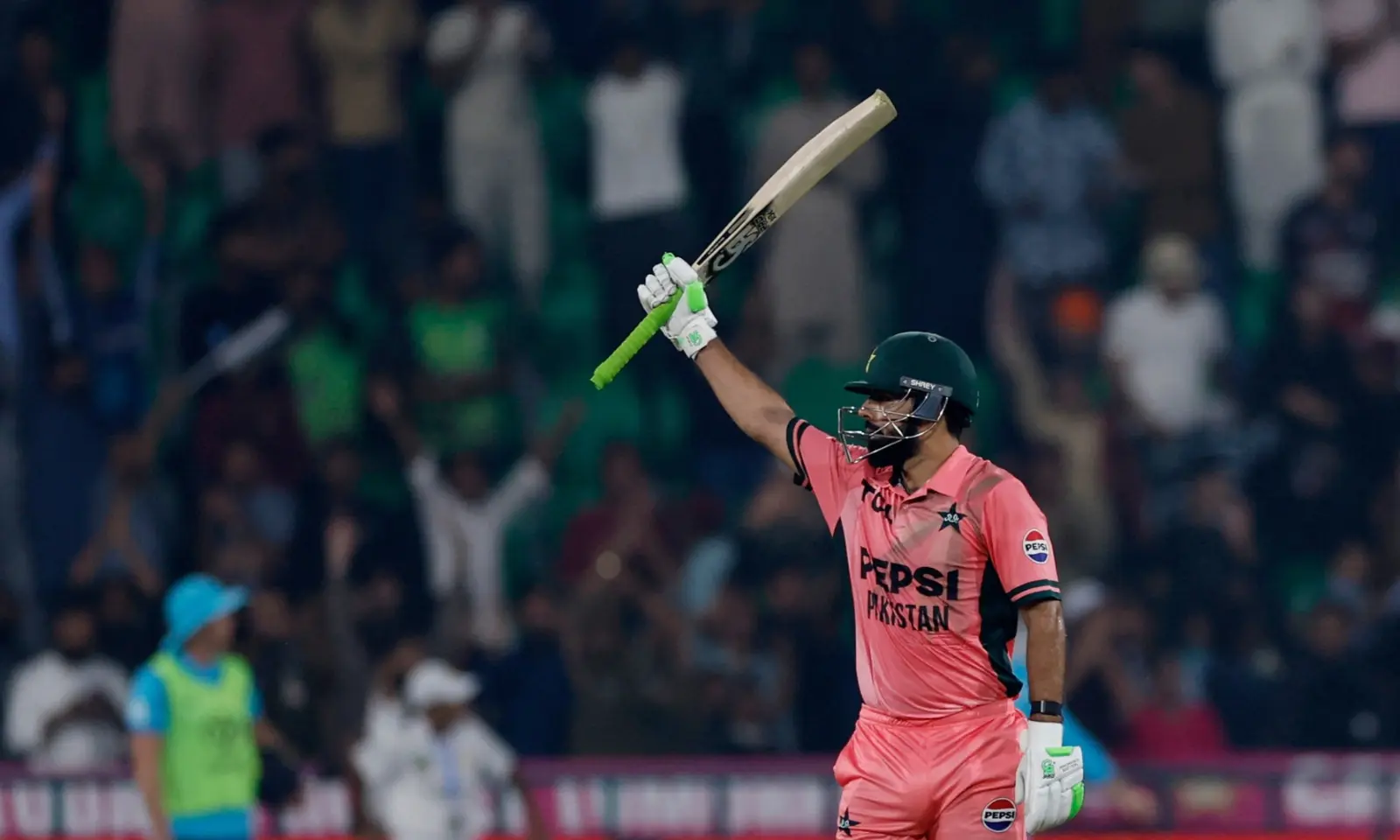
It did not until the 45th over, when Atkinson pinned Shadab lbw and ran off in celebration. Pakistan were 20 runs short of the win, Shadab was three short of a first hundred for Pakistan.
It was done. Shadab rapped his bat on the ground in frustration, with a certain defeatism that made him forget he could review the decision until there were two seconds left on the timer. It was his batting partner in Haris Rauf who urged him to do so.
(“Are you going to take the review home with you?” was what he said to Shadab, as would be revealed later in a video reflection posted by the PCB).
The little sliver of a spike on UltraEdge was exactly the sort of miracle that someone as starved of good returns as Shadab needed. But with the bat, this lack of returns was not for a lack of trying.
Until 2022, Shadab averaged 24.1 with the bat with a strike rate of 71.4. He had proven himself capable of playing second-fiddle to the more established batters in the side and, ultimately, his primary use-case within the XI was with the ball.
Though useful, he was yet to unlock both his potential and power with the bat. This was also reflected in his T20 numbers, where until 2022 his strike-rate was under 130.
However, since the start of 2022, there has been a different trend with the bat. He has a bumped-up strike rate of 144 in T20 cricket since then to show for it, and consequently the uptick is reflected in his ODI numbers as well.
An average of almost 40, a strike-rate of a 100 has not only made him one of the more established batters he would previously been in the shadow of, but it has also made him have the second-highest average in ODIs for those batting at number seven or below, second only to Michael Bracewell.
But putting the numbers aside, all anyone needed to do yesterday to assess Shadab the ODI batter was watch. The range of shots he displayed was alone definitive - paddle and reverse sweeps for four and six, reverse and upper-cuts and flicks off the hip: what stood out was how unhesitatingly and cleanly he was hitting the ball.
“There was belief because of the sort of form I have had in the recent form as a batsman,” Shadab told the broadcaster after the match, when asked if he believed he could pull it off considering the sheer improbability of the situation.
He added that in his recent experience of playing league cricket, he learnt from other hard-hitting batters around the world .
“We used to try hitting the shot as hard as possible,” he said, while saying that those batters “kept things very simple.” A focus on the basics — bat swing, timing, is enough to produce the sort of clean and effective batting he looks to emulate.
A first international hundred for Pakistan, in a run-chase that was all but dead and buried after expertly nursing a tenth-wicket partnership is as good a way as any to prove he can bat as well as he can.
Shadab has been under much scrutiny for some time now, and with the ball in hand it hasn’t exactly been unwarranted, considering the potent spin resources Pakistan now stocks.
He is said to be taking up space that rightfully belongs to young players, accused of nepotism and being the coach’s favourite. There is no telling that yesterday will extinguish any of that.
“I have had lots of ups and downs, and I have received a lot of criticism. Now my mindset has become such that regardless of whether I do well or not, I am going to come off as negative,” he said.
“So I just try my best that whenever I come to the ground, I give my one-hundred percent, and do what I know I can do.”
But what Shadab did yesterday, possibly only Pakistan cricket needed more than him.
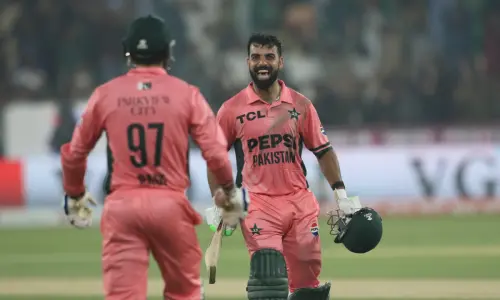
One partnership of stunning defense and exquisite hitting, two men clad in pink (holding their hands up to their heads after a decision review, in disbelief that luck had finally gone their way), and the singular, miraculous win that came off of it is all it took to remind everyone that the beating heart of Pakistan cricket will always be joy when one least expects it.
Shadab was duly supported by Haris. They were just about to post what would be the highest tenth-wicket partnership in a successful ODI run-chase, a record that had been in place since 1975.
So after doubling as a wall for Pakistan’s batting against the last of England’s dying effort with the ball, Haris had only one demand of Shadab.
“I am going to be the one to hit the winning shot,” is what Haris said according to Shadab, after he had asked the number 11 batter to simply go for a single when England squeezed the field around him, just before he hit the winning four.
But going against the grain was not a problem yesterday. Not at all.
The author is a lifelong cricket tragic who is constantly fascinated by the intersection of sports, media and culture. She is currently pursuing a Masters in Journalism as an Alfalah Scholar at the Institute of Business Administration, Karachi.

Saim Ayub released from Pakistan tri-series squad to work on batting form, Sahibzada Farhan named replacement
Shadab Khan's maiden ODI century steers Pakistan into tri-series final after thrilling chase against England