THE LAST DAYS OF BENAZIR BHUTTO
THE LAST CONVERSATION
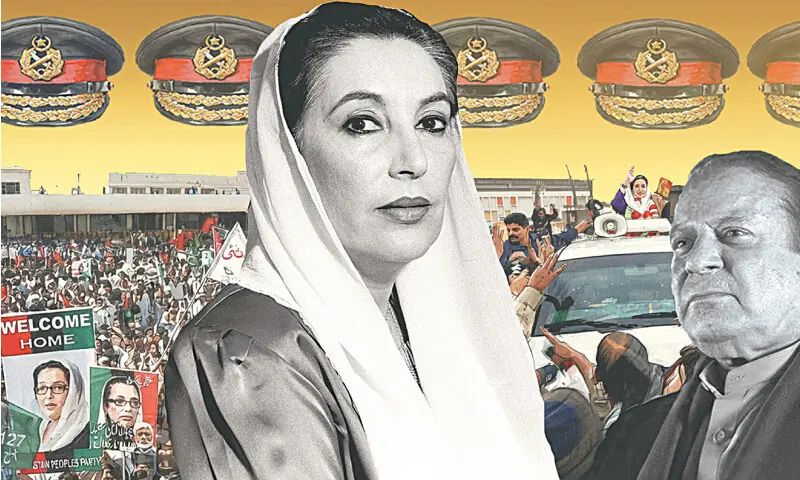
It was December 2007. A chill had begun to descend over Islamabad, and over Pakistan’s democracy. The country was just weeks away from general elections that had been agreed to between Gen Musharraf and Benazir Bhutto, after torturous negotiations laid down in the ‘Memorandum of Understanding.’ Having returned from exile, Benazir Bhutto was navigating a minefield of threats, both political and personal.
But that cold evening, she made time for a quiet dinner with the former prime minister, Mian Nawaz Sharif, at Zardari House in Islamabad. It was in a highly friendly setting. The dinner meeting was consequential, as the Charter of Democracy signed between the two just a year ago had buried the hatchet from the 1990s, when the two parties were at each other’s throats while taking turns forming governments.
It was also consequential as it was their last conversation — the one in which both poured out their hearts as never before. But it was most consequential for the subject matter they discussed that both understood lay at the root of political instability and had to be addressed.
It is hard to forget that evening.
She had invited Mian Nawaz Sharif, her longtime rival, now fellow opposition leader, to Zardari House. With her were also the two vice chairs of the party, Makhdoom Amin Fahim and Yousaf Raza Gilani, who later became the prime minister as well. Nawaz Sharif was accompanied by Raja Zafarul Haq and another close aide.
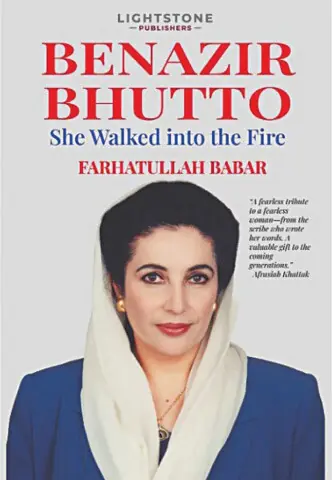
When former Prime Minister Benazir Bhutto returned from an eight-year exile in October 2007, she was hoping not only to resurrect her own political career and clear her name from the mud that had been flung on her from various trials, both in the courts and in the media. It is clear she also had a vision for Pakistan that wanted to take practical measures to end extremism and military adventurism in politics. Eos presents, with permission, excerpts from Benazir Bhutto: She Walked Into the Fire, the third book of memoirs of her close confidante Farhatullah Babar, recently published by Lightstone Publishers…
I was also present, sitting behind Benazir, Makhdoom and Gilani and facing Mian Nawaz Sharif. She was casually dressed. Nawaz Sharif donned a formal black jacket. As the two former prime ministers greeted each other and settled in their seats, I sensed from the gyrations that this was not an ordinary political courtesy — it was something heavier.
Thanking Nawaz Sharif for accepting her invitation for dinner, she began. “Mian sahib, main aap ko takleef dee hoon [Mian sahib, I have bothered you tonight],” she said in Urdu before switching to English, “Because Mian sahib, I thought we should meet to talk about the repeated intervention in politics, derailment of the political process and subversion of the Constitution every few years.”
Nawaz Sharif’s eyes lit up as if he wanted to listen more. He leaned forward, visibly moved and eager for her to speak more. What she had said was music to his ears. I became more attentive. “It cannot go on,” she said, underlining that the country could not afford it for its survival.
“Main exile mein is par sochi hoon [I have been thinking about it in exile],” she acknowledged in Urdu with candour. “We must give it serious thought and, together, do something about it,” she urged Nawaz Sharif, facing her.
“Aap bhi is par sochay hongey Mian sahib [You may have also thought about it, Mian Sahib],” she said in Urdu and again switched to English. “As two-time prime ministers who have witnessed all this, I think it is our responsibility to do something.” I wished she had continued with her analysis.
But before she finished, an excited Nawaz Sharif interjected: “Bibi, aap bilkul theek kehti hain. Main ne bhi is par socha hai. Bas bohat ho gaya hai. Main ne bhi bohat ghaur kiya hai iss par,” he said in Urdu. [Bibi, you are absolutely right. I have also been thinking about it. Enough is enough. I have also given serious thought to it.]
The Mercedes drove forward slowly. I looked back at her vehicle. Its headlights were on, as if the driver was asking for a clear road. It followed the Mercedes at a distance of about 100 metres. Once it turned on the Murree Road to proceed to Islamabad, the Mercedes stopped again to let her vehicle catch up. Another police officer ran up, asking the driver to move on and not block her path. Her vehicle was going to Zardari House, he said.
Attentive to what Nawaz Sharif said, she asked for juice to be served. Nawaz Sharif continued, “Main ne bohat socha hai Bibi is par. Main tayyar hoon [I have thought a lot about it, Bibi. I am ready].” She must have drawn some satisfaction from his observations and hoped that meeting him was not a vain exercise.
He continued, “Bibi, main ne faisla kiya hai ke agar unhon nai phir shabkhoon mara tau kya karna hai [Bibi, I have decided what to do if they ambush again].”
His comment was electrifying. “Really?” she said in amazement, her gaze fixed on Mian Nawaz Sharif.
“Aap kya karain gey, aap kaisay tayyar hain? [What will you do, how are you ready?],” she asked rather impatiently, excited that the former prime minister had also been thinking about it and had even decided on what to do if the Bonapartes struck again.
In a way, it was a historic meeting. Two former prime ministers, each having served twice, witnessed intrigues of the deep state, unconstitutional sackings and endured exiles and witch-hunting, were sitting face to face. They were not talking about the forthcoming elections, seat adjustments and political rallies. They were there to brace themselves for the task of dealing with ambitious putschists and to save the country. Both agreed that the country’s survival was at stake and the adventurers must be reined in. Nawaz Sharif concurred with her for the first time. How did they plan to do it? History was in the making. At that moment, I instinctively reached for my notebook and pen.
I was seated just behind her, slightly off to the side. Makhdoom Amin Fahim and Yousaf Raza Gilani flanked her at the table in the front row. Nawaz Sharif sat across from her, with his team. I quietly opened the notebook, my pen ready and shorthand my asset.
Nawaz Sharif noticed my anxiety. His eyes caught mine: “Babar sahib, ai naee likhna [Babar sahib, this is not to be recorded].” He gestured with his hand — fingers spread open, a wave of disapproval — a typical Sharif gesture.
Benazir turned toward me. “FB, did I ask you to take notes?”
“Sorry, Bibi,” I said, somewhat sheepishly. “It’s just — this is a historic meeting. Two former prime ministers speaking from their hearts about intervention in politics. I thought… I’m sorry,” I said, folding the notebook and slipping the pen back into my pocket.
I stopped taking notes. But the weight of history could not be folded away merely by folding a notebook and inserting the pen back in the pocket. The words uttered were too heavy and too consequential to be erased easily from memory. I committed myself to listening with rapt attention — not just to their words, but to their expressions, gestures and tones. Sometimes gestures speak more clearly than declarations.
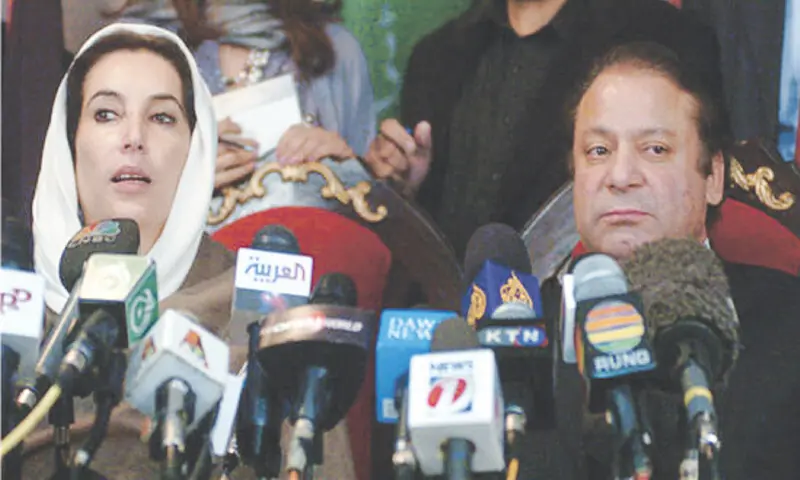
Nawaz Sharif was animated, his voice clear, his expressions genuine and his determination unmistakable. He was shaking off years of embarrassment, exile and powerlessness in the face of putschists. It seemed as if she had touched a raw nerve in Nawaz Sharif. What she had said was melodious music to his ears.
“Hadd ho gayi hai Bibi, bas ab khatam ho jana chahiye [All limits have been crossed, Bibi. It must end now],” he repeated. It must not go on.
Sitting behind her, I could only imagine that she looked directly into his eyes, not to challenge but to agree with him and seek a way forward from him. Nawaz Sharif paused. He then picked up a plate from the dinner table. Cradling it with both hands, as if it were something sacred, he extended it toward her like an offering. There was silence. I watched in amazement.
“Bibi, main un ke paas jaaoonga aur kahoonga, yeh hai aap ka aaeen aur yeh hi hai aap ka mulk aur aap ke loag. Aap karain jo karna chahtay hain. Main ab kuchh nahin kar sakta. Main jaa raha hoon. Aap hi bhugtain [Bibi, I will go to them and say: This is your constitution, this is your country, and these are your people. Do as you please. I’m done. I’m walking away. You face the consequences].”
He did not say what he meant by “they”. It was obvious he meant the putschists. He lowered the plate gently and placed it back on the table. For once, he looked disarmingly candid. My mind swirled at the thought of how a twice-elected prime minister felt pushed to the wall and in utter desperation with the putschists, even ready to abandon the country and politics.
She asked: “But, Mian sahib aap kahaan jaayengey, kya karain gey? [But Mian sahib, where will you go? What will you do?]”
“Main mulk chhor kar chala jaaoonga, wapas nahin aaoonga. Woh karain jo karna chahtay hain, logoan se larrain, kisi se larrain. Yeh is tarha nahin chalay ga. Main ab is ka hissa nahin banoonga [I will leave the country and not return. Let them do what they want — fight the people, fight anyone. It cannot go on this way. I will not now be a part of this any more],” he said.
His words became etched in my mind even though the notebook was folded. It was not the fate the people and the country deserved, I said to myself.
She then reminded Mian sahib that he was the leader of a political party and had twice served as the country’s prime minister, that she too led a political party and has been PM twice. Making out her case, she said that the people and the country must not be abandoned. At times, she too felt very frustrated and wanted to give up politics, but that was no solution to the problem, she said. Together we must find some solution, she declared.
Her prescription in a nutshell was to tell the putschists clearly to change themselves, as it could not go on. The country belonged to all of us, to the people of Pakistan, and it could not be left at the mercy of a few putschists, she said.
Mian Nawaz Sharif listened intently. He agreed with her that something needed to be done, but asked her whether she really believed that the putschists would listen to any sane advice. He said that the Bonapartes refused to heed advice to mend their ways and wanted to do what they liked, only to advance their vested interests.
“Bibi, yeh main ne bhi dekha hai aur aap ne bhi [Bibi, I have seen this, and you too have seen this],” he said, frustrated.
She did not disagree with Nawaz Sharif, but said that we still have to do something about it. She wanted to do something. “Let us sit together some other day, along with our people and work it out,” she said to Mian Nawaz Sharif.
Whether he was convinced that something could be done or not, Nawaz agreed to give it a try.
It was a rare moment, as the two political rivals agreed that something needed to be done and decided to act together. The Charter of Democracy, signed by them a year earlier, had recognised that political parties were also to blame for inviting undemocratic forces to derail an elected government. The Charter promised to end this political culture. Now, at Zardari House, they were exploring it further.
Days later, Bibi was assassinated. The planned meeting was never held.
“Can you believe it, FB?” she said to me after the meeting, “Mian sahib is so angry, but how can we abandon the struggle and run away?” I said that the late Wali Khan had once remarked that the putschists would be held back only if the people of Punjab wanted it. “Mian sahib is the first leader from Punjab to say such things. Punjab may finally be waking up,” I said.
“We will see,” she said.
THE ASSASSINATION
Benazir Bhutto returned to Islamabad from Peshawar late on the night of 26 December, 2007. I had travelled with her to Peshawar and back. In Peshawar, she had addressed a public meeting and visited the house of a party worker near Charsadda who had been martyred in the October 18 attack. She looked exhausted.
Before retiring in Zardari House, she asked to be left alone. There was still one task left: the final chapter of her book Reconciliation. We retreated. After completing it, she sealed the envelope and gave it to Brig Aman, her secretary, for delivery to Mark Siegel, her lobbyist in Washington.
I was still around. She asked me to come to Zardari House the next day to accompany her to the scheduled rally at Liaquat Bagh, Rawalpindi. She gifted [parliamentarian and later prime minister] Raja Pervez Ashraf a copy of Shopping for Bombs, which had just been published and asked Raja to read it. The book centred on the theme that the nuclear proliferation that had taken place from Pakistan and admitted by Musharraf in his memoirs could not have been the work of one lone individual, as claimed at the time.
Author Gordon Corera had claimed in it that protecting A.Q. Khan from international scrutiny was actually meant to protect others involved in the proliferation network. While in New York, she had discussed the issue with the three of us. She wanted to probe the proliferation through a parliamentary committee.
December 27 began like any other day, but destiny had marked it for tragedy.
That morning, she met Afghan President Hamid Karzai at the Serena Hotel in Islamabad — the last foreign dignitary she would meet. Later, Karzai recalled how pleased and impressed he was with meeting her. After meeting Karzai, she returned to Zardari House. I was waiting.
She set off with Naheed Khan, her political secretary, Makhdoom Amin Fahim and her security officer, in her bulletproof Land Cruiser. Rahman Malik, the former interior minister responsible for security; Lt Gen (R) Tauqeer Zia, the chief of the Pakistan Cricket Board who had travelled with her in a political rally a day before; Babar Awan and I followed in the black Mercedes belonging to Zardari House. It led the way. Along the route on Murree Road, a sea of people surged along the route, eager for a glimpse of her.
As I made a mobile call, Rahman Malik turned in surprise. If the mobile networks were working, it meant the jammers weren’t. He knew that jammers had been installed and did not expect the mobile network to function. Concerned, he rang someone to report the jammers’ malfunction. He also remarked that the swelling, uncontrolled crowd could pose a danger. I brushed it off, thinking security personnel often exaggerate danger and overreact.
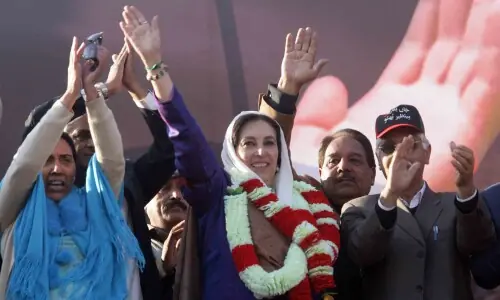
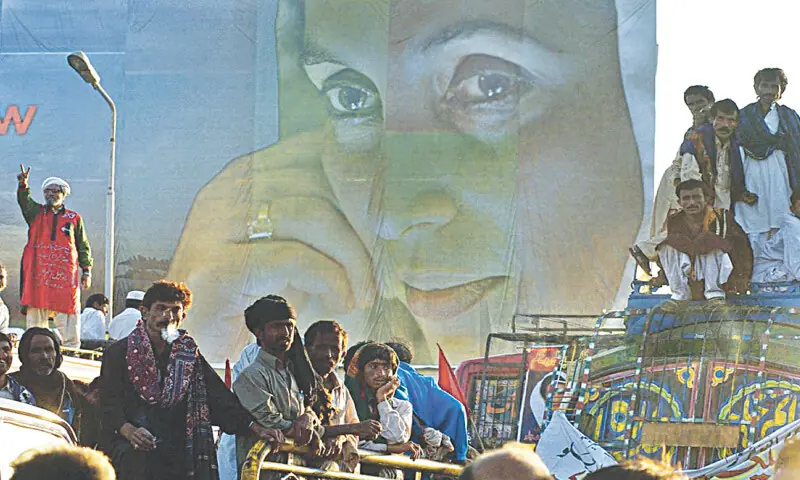
Only [Benazir’s] Land Cruiser and the Mercedes were allowed through the gates of Liaquat Bagh. She ascended the stage with her characteristic grace and energy. She was beaming. What followed was one of the most powerful speeches of her life — a fearless denunciation of extremism.
She pledged to restore the state’s writ in Swat Valley, where militants had removed Pakistan’s flag from official buildings. The symbolism of the lowering of the national flag was not lost on her. She was determined to reinstall the national flag and restore the national honour. She acknowledged the threats to her life but declared her resolve to return and defend Pakistan against extremism and militancy.
“Main Pakistan bachaaoongi, aap bachaaingey, hum sab bachaaingey! [I will save Pakistan, you will save Pakistan, we all will save Pakistan!].” Denouncing that the militant Taliban had lowered the national flag in Swat, she declared: “Main Pakistan ka jhanda dobara Swat per lehraoongi [I will fly Pakistan’s flag in Swat again].”
Her speech ended, she descended the stage, jubilant and radiant, and congratulated the organisers who were lined up at the foot of the staircase. Then she got into the Land Cruiser with Naheed Khan, Makhdoom Amin Fahim, Safdar Abbasi and security officer Maj Imtiaz. The black Mercedes, carrying the rest of us, drove ahead of her vehicle once more.
Coming out of the gate, the convoy turned right on to Murree Road for Islamabad, while the left side, leading to the busy Raja Bazar, had been secured by police. It was said that the road leading to Raja Bazar was the alternate route to be taken in an emergency. On coming out of Liaquat Bagh, the police signalled the Mercedes to turn right. Her vehicle also turned right following the Mercedes.
The crowds on either side were thick and surging, straining against the barricades. Some thought she was in our car and gathered around the Mercedes. But when her Land Cruiser paused — and she emerged from its sunroof to wave — the crowd surged towards her.
In that moment, destiny struck.
There was a loud thud, followed by bellowing smoke, screams and panic. Chaos reigned.
Inside the Mercedes, we could hear almost nothing — our windows were up. Startled, I opened the door to get out of the car. A policeman rushed over and accosted the driver, [telling him] not to block the road — her car, he said, was behind us and needed room.
The Mercedes drove forward slowly. I looked back at her vehicle. Its headlights were on, as if the driver was asking for a clear road. It followed the Mercedes at a distance of about 100 metres. Once it turned on the Murree Road to proceed to Islamabad, the Mercedes stopped again to let her vehicle catch up. Another police officer ran up, asking the driver to move on and not block her path. Her vehicle was going to Zardari House, he said.
The Mercedes moved on. Inside the Mercedes, Rahman Malik tried to reach someone. After talking with someone, he said she was safe and that she was proceeding to Zardari House. The Mercedes was already on its way to Zardari House. It sped up. But when the Mercedes arrived at the gate of Zardari House, her vehicle was no longer behind it. Zardari House was in darkness, with the lights off. A sombre Brig Aman, her secretary, was already at the gate.
He said that her land cruiser had stopped at the Rawalpindi General Hospital and was not coming to Zardari House. She had also been wounded in the attack and taken to the Rawalpindi General Hospital, he said. The hospital was situated on the main Murree Road. The Mercedes had also taken the Murree Road to Islamabad, with her vehicle following. At Zardari House, it [became clear] that her Land Cruiser had halted at the hospital.
I tried to look for Rahman Malik and Babar Awan to rush to the hospital. They had also travelled to Islamabad in the Mercedes with me. In the heat and confusion of the moment, I failed to find them at Zardari House. Where they were, I could not figure out. Lt Gen Tauqeer Zia, too, had travelled both ways in the Mercedes. He was nearby. I told him what Aman had told me, that Benazir Bhutto had been taken to the hospital. I had no car to go to the hospital. Instantly, he offered to drive me there in his car.
Together we rushed to the hospital. At the hospital, crowds blocked the way. Inside, doctors helped and ushered me through the crowd into the operation theatre. There she lay.
Benazir Bhutto, Shaheed, enshrouded in a white sheet of cloth.
Naheed Khan, Safdar Abbasi, Ibne Rizvi and Benazir’s maid were already there, standing like statues. No one touched her. No one got near her. No one tried to look at the wound. No one lifted the white sheet off her face. The room was heavy with grief and reverence. A senior doctor whispered to me that he had never seen such a wound — he believed it was not a bullet wound. The maid had collected blood-stained clothes to return to the family.
From the hospital, her body was taken to the Nur Khan Airbase, not far away. A Pakistan Air Force C-130 was ready to fly her to Sukkur, from where a helicopter would carry her to Naudero — her final abode in her hometown. Her father and two brothers also lie buried there.
Zardari and the children had arrived from Dubai. Friends gathered. I called my wife to inform her. She already knew from television broadcasts. The news had flooded every channel. She also wished to accompany the family. There was space. She joined us at the airbase. And so, with hearts shattered and history changed, we flew with Benazir Bhutto on her final journey.
A leader had fallen, a nation grieved and wept. It was a day when democracy was shot. Her last journey to her final resting place began.
Excerpted with permission from Benazir Bhutto: She Walked Into the Fire by Farhatullah Babar, published by Lightstone Publishers
The author is a journalist and former senator and spokesman for President Asif Zardari.
He was the spokesperson and speechwriter for former Prime Minister Benazir Bhutto during the 1990s
Published in Dawn, EOS, March 19th, 2026