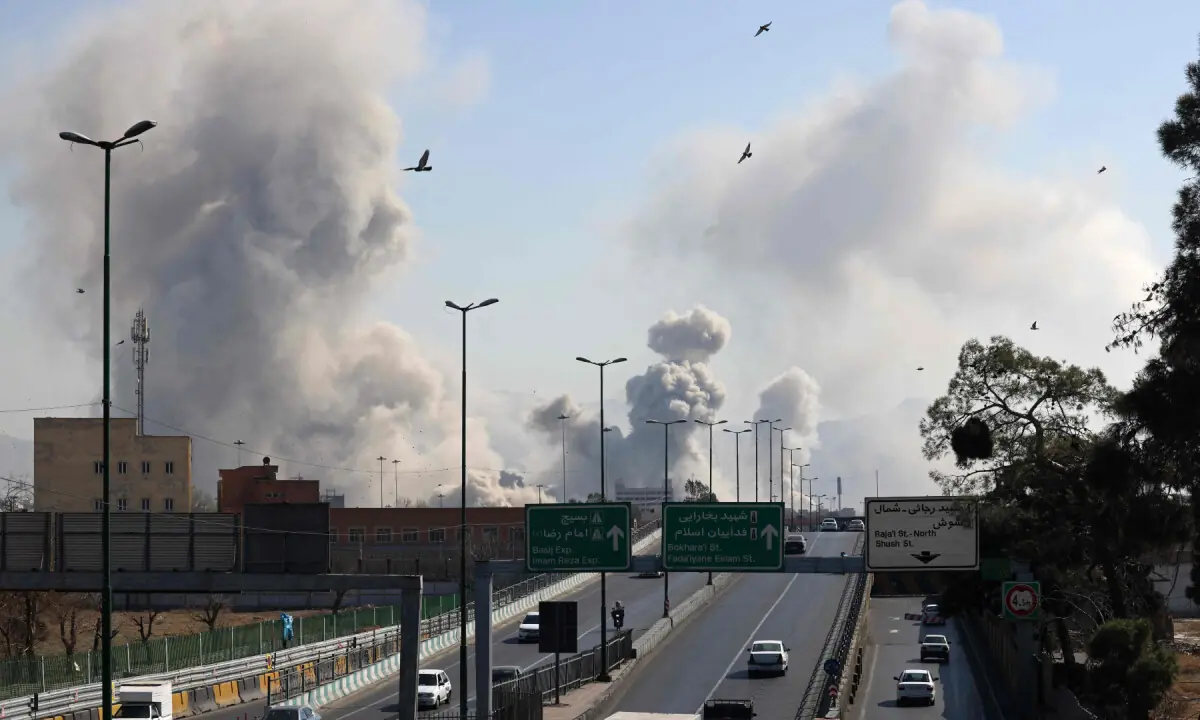
The US and Israel on Feb 28 launched what they described as a “pre-emptive” joint strike against Iranian targets, with Trump announcing start of “major combat operations”
Supreme Leader Ayatollah Ali Khamenei assassinated in US-Israeli strikes, which have so far killed over 1,000 people across Iran
Oman working with other govts, airlines to organise repatriation flights
Iran FM says US will “bitterly regret” sinking warship in int’l waters
Iran says targeted Kurdish groups’ headquarters in Iraqi Kurdistan
Air defence systems in the UAE are currently responding to incoming missile and drone threats from Iran, Al Jazeera reports citing the Emirati Ministry of Defence.
In a brief statement on X, the ministry instructed the public to adhere to safety and security measures.
Israeli Foreign Minister Gideon Saar has posted on X that he spoke with Azerbaijan’s foreign minister, Jeyhun Bayramov, and condemned “Iran’s overt and deliberate aggression against Azerbaijan”.
“This aggression against it (Azerbaijan) and against other countries in the region is completely unacceptable and proves once again that the Iranian regime is mad and unrestrained,” he asserted, adding that Israel was determined to continue the military operation until achieving its objective.
Turmoil in the Middle East has sent investors scrambling for safety once more, reigniting a debate over which assets truly offer protection in times of stress.
The choice is complicated, as traditional refuges behave unpredictably. Gold has swung sharply, and the dollar — which has been out of favour in the past year — has bounced back.
The dollar index, which tracks the US currency against six others, is up 1.5 per cent. The dollar has even gained against the Swiss franc and yen, which both typically outperform at times of market stress.
Government bonds have struggled to attract the kind of safe-haven flows typically seen during geopolitical shocks, with investors trading them primarily on the inflation outlook rather than on their defensive qualities.
Deputy Prime Minister and Foreign Minister Ishaq Dar has had a telephone call with Canadian Foreign Minister Anita Anand, according to the Foreign Office (FO)
According to a post on X, Dar stressed “the importance of dialogue, diplomacy, and adherence to international law to promote de-escalation and stability in the Middle East and the wider region” during the call.
Iranian Foreign Minister Abbas Araghchi has accused Israel of launching a drone attack in Azerbaijan that was blamed on Iran, describing it as an attempt to harm Tehran’s relations with its neighbour, AFP reports.
In a phone call with his Azerbaijani counterpart Jeyhun Bayramov, Araghchi has “denied that Iran fired any projectiles” at Azerbaijan.
He has also condemned “the role of the Israeli regime in such attacks in order to divert public opinion and destroy Iran’s good relations with its neighbours”, according to a statement from Iran’s foreign ministry.
Prime Minister Shehbaz Sharif and his Malaysian counterpart Anwar Ibrahim have expressed “deep concern” over the escalating situation in the Middle East, following the US-Israel’s coordinated attack on Iran.
In a conversation with Ibrahim, PM Shehbaz “emphasised the imperative of respecting the sovereignty and territorial integrity of all states and the urgent need for restraint, de-escalation, and diplomacy”.
He added that the two “agreed to remain in close contact and coordinate our efforts for peace and stability in the region”.
Nato stands by the assertion that a ballistic missile launched from Iran was targeting Turkey before being shot down, an alliance spokesperson told AFP, contradicting a Turkish official’s claim it was headed for a military base in Cyprus.
Asked whether the missile deliberately targeted locations in Turkey, spokesman Martin O’Donnell replied “yes” — and referred to the alliance’s formal response to the incident.
In an initial statement, Nato spokesperson Allison Hart said the alliance condemns “Iran’s targeting of Turkiye,” using the country’s official name.
O’Donnell declined to provide further details on the missile’s target, citing security concerns.
The United Kingdom has said that it was “temporarily” withdrawing some staff and their dependents from its Bahrain embassy as Iran presses on with its retaliation campaign in the Gulf, AFP reports.
“Due to the ongoing security situation, the UK has taken the precautionary step of temporarily withdrawing some embassy staff and their families,” it said in a statement on Instagram.
“Our embassy continues to operate,” it said, adding that “the situation is serious and we do not expect it to end in the coming days”.
The World Health Organization chief has said that it has verified 13 attacks on health infrastructure in Iran amid a US-Israeli campaign, killing four health care workers and injuring 25 others, AFP reports.
“WHO has verified 13 attacks on health care in Iran and one in Lebanon,” World Health Organization Director-General Tedros Adhanom Ghebreyesus told a press conference, without attributing blame.
Dr. Hanan Balkhy added at the same briefing that four ambulances in Iran were also affected and that hospitals and other health sites suffered minor damage due to strikes nearby.
One of these hospitals in the capital Tehran was evacuated as a result, the UN health agency previously said.
The son of Iran’s last shah, toppled in the 1979 Islamic revolution, says that whoever the clerical government chooses to succeed the late Ayatollah Ali Khamenei will be illegitimate, AFP reports.
Reza Pahlavi, who has positioned himself as an alternative leader if the Islamic republic falls, said on social media that “victory is near” after Khamenei was killed last weekend as Mideast war began.
“Any attempt to appoint a successor for him is pre-destined to fail. Whomever is introduced… will lack legitimacy and will be considered an accomplice to the bloody record of this regime and its criminal leaders,” Pahlavi said.
EU and Gulf ministers have called for crisis talks for Iran to immediately end its “indiscriminate” attacks against Gulf countries, warning that the strikes threateninternational security, AFP reports.
“The ministers strongly condemned the unjustifiable Iranian attacks against the GCC (Gulf Cooperation Council) countries, which threaten regional and global security and called on Iran to cease immediately its attacks,” said a joint statement issued after the talks held by videolink.
The UN’s International Maritime Organisation tells AFP that around 20,000 seafarers and 15,000 cruise ship passengers are stuck in the Gulf because of the Middle East war.
The shipping regulator’s secretary general, Arsenio Dominguez, said that the “IMO is ready to work with all stakeholders to help ensure the safety and well-being of the seafarers affected.”
The Middle East war has forced the World Health Organisation (WHO) to suspend operations at its emergency logistics hub in Dubai, AFP reports quoting the agency’s chief.
“Operations at WHO’s logistics hub for global health emergencies in Dubai are currently on hold due to insecurity,” Tedros Adhanom Ghebreyesus told reporters.
Iranian state television says Iran has struck a US oil tanker in the Gulf with a missile, the latest Iranian attack on the energy industry in the region, AFP reports.
The ship “was hit by a missile in the north of the Persian Gulf” and “is currently on fire”, Iran’s Revolutionary Guards said in a statement reported by state television.
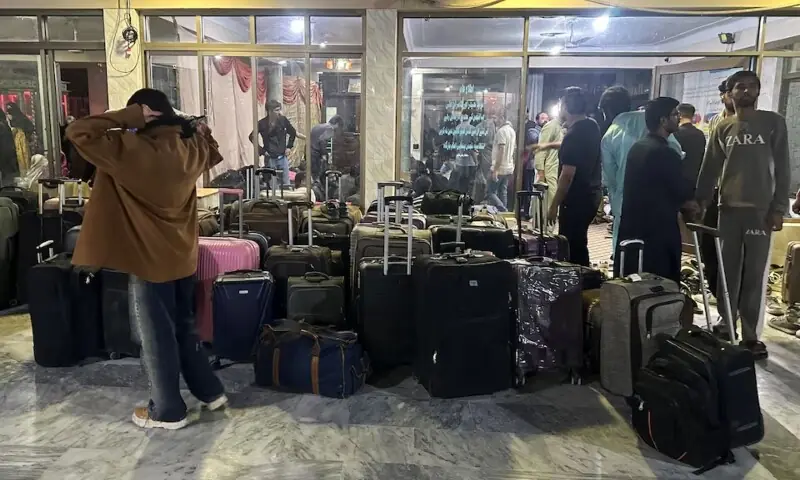
Pakistanis fleeing Iran have described explosions and missile strikes across Tehran shaking the ground under their feet and engulfing buildings in fire and smoke in a city emptied of many of its residents, Reuters reports.
Governments have been scrambling to evacuate stranded citizens, with most of the region’s airspace closed due to the risk of missiles hitting passenger planes.
“I was in the classroom when a powerful explosion rocked our university building,” Hareem Zahra, 23, a student at the Tehran University of Engineering, has told Reuters after crossing Pakistan’s land border with Iran.
“We saw thick smoke coming from many buildings on fire,” she said, adding Tehran was under attack until the moment she left.
Iran’s army says it has launched a drone attack on a US site in the Iraqi Kurdistan city of Erbil, reports AFP.
“The headquarters of the American aggressor forces in Erbil, Iraq, was attacked by the army’s ground forces’ attack drones,” the army said in a statement broadcast by state TV.
Israel’s war in Iran is entering a second phase that will see its fighter jets attacking ballistic missile sites buried deep underground, two sources familiar with Israel’s military campaign have told Reuters.
The second phase will include bunkers storing ballistic missiles and equipment, said the sources, who spoke on condition of anonymity because of the sensitivity of the subject.
One said Israel aimed to neutralise Iran’s ability to launch aerial attacks at Israel by the end of the war, which was also focused on taking out the Islamic Republic’s leadership.
A military spokesperson did not immediately respond to a request for comment on its attack plans.
Residents of Beirut’s southern suburbs have fled en masse after an evacuation warning from the Israeli army covering an area home to hundreds of thousands of people, AFP journalists have reported.
Massive traffic jams formed on the outskirts of the southern suburbs, which has a strong Hezbollah presence, leaving people unable to evacuate quickly.
Nato does not plan to trigger its Article 5 mutual defence clause over the shooting down of a ballistic missile headed for Turkiye, the alliance’s Secretary General Mark Rutte tells Reuters, amid fears the alliance could become embroiled in the Iran-Israel-US war.
“Nobody’s talking about Article 5,” Rutte said in an interview at the alliance’s headquarters in Brussels, even as he described the incident as “serious”.
“The most important thing is that our adversaries have seen yesterday that Nato is so strong and so vigilant,” he said.
Nato member Turkiye said the alliance’s air defences destroyed an Iranian ballistic missile as it headed into Turkish airspace, highlighting the possibility that the conflict could expand to include the entire alliance.
Some Western diplomats in the Saudi capital Riyadh have been told to shelter in place, diplomats tell AFP, as Iran presses on with a retaliatory campaign that has hit US embassies in the Gulf.
A witness said the diplomatic quarter in Riyadh had also been closed off.
The witness and diplomats spoke on condition of anonymity due to the sensitivity of the matter.